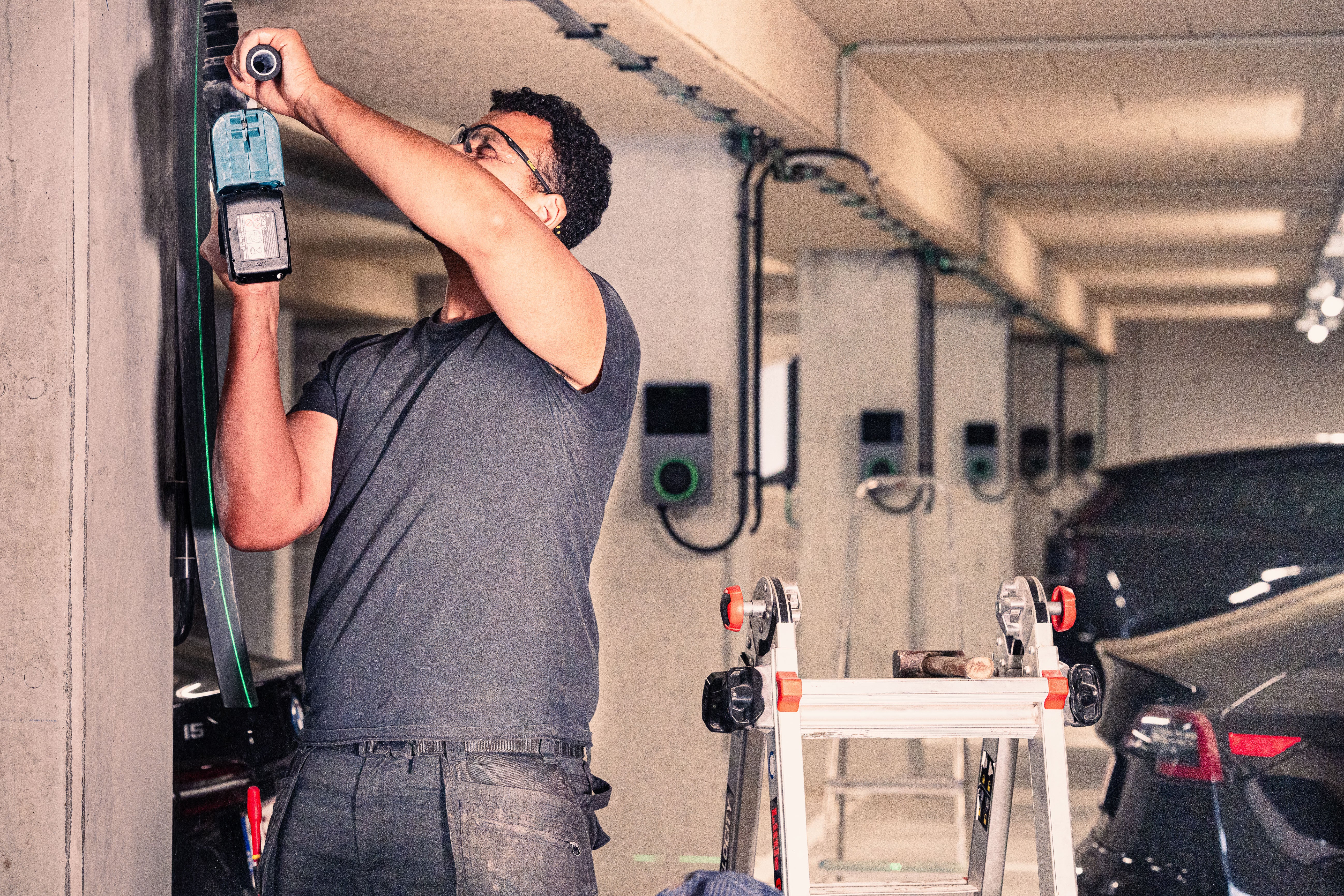


Imagine this: you start every morning with a fully charged car, right at your own doorstep. No more detours, no waiting times at a public charging station. That is exactly what a electric charging station for home you offer. It is much more than a plug; it is a completely new way of 'refueling' that saves you both time and money.
The New Standard for Electric Driving
For most Belgian EV drivers, being able to charge at home is not a luxury, but a pure necessity. It is simply the most convenient and cost-effective way to power your car every day.
The weekly trip to the gas station? That's a thing of the past. Instead, charging becomes a simple habit, just like plugging your smartphone into the charger at night.
The convenience of having your own charging point immediately eliminates one of the biggest worries for novice EV drivers: the fear of running out of battery power. You start every day with maximum range. Ready for your daily commute, but also for an unexpected, longer trip. This not only provides a tremendous sense of freedom but also makes electric driving effortless and perfectly integrated into your daily life.
The Benefits of Your Own Charging Point
Installing your own charging station yields concrete benefits that go far beyond mere convenience.
- Cost savings: Charging at home is significantly cheaper than public charging. You pay the lower residential electricity rate, and if you charge at night using the night rate, your costs drop even further. On an annual basis, this easily saves hundreds of euros.
- Time savings: You now gain back the time you used to lose refueling. You no longer need to plan an extra stop on your way home or to the office. Just plug in and you're good to go.
- Reliability and Peace of Mind: You are no longer dependent on the availability of public charging stations, which may be occupied or defective. Your own electric car home charging station is always available, ensuring a completely carefree driving experience.
For the average Belgian commuter who drives 50 kilometers daily, home charging means the car is always ready for more than three days of driving. This certainty makes the switch to electric driving a logical and comfortable choice. It is the key to a successful and stress-free electric future.
Choosing the Right Charging Speed for Home
Not all charging stations are the same, but the technology behind them shouldn't deter you. Imagine it like filling a water bottle: you can let the tap run gently or use a fire hose. For a electric charging station at home is that smooth-running tap – better known as AC charging (alternating current) – almost always the smartest choice.
AC power is simply the standard electricity that comes out of your wall sockets. An AC charging station converts this power so that your car can be charged. This approach is not only gentler on your car's battery, but also much simpler and cheaper to install in a home than its super-fast counterpart, DC charging (direct current).
What Do Kilowatts Mean for Your Daily Commute?
The speed of a charging station is expressed in kilowatts (kW). Simply put: the higher the number, the faster your car charges. For home installations in Belgium, the most common power ratings are 3.7 kW, 7.4 kW, 11 kW and 22 kW.
But what do those figures really mean in practice?
- 3.7 kW: This is the entry-level model, perfect for plug-in hybrids with a small battery or for those who drive few kilometers.Charging takes a bit longer and usually takes place via a standard single-phase connection.
- 7.4 kW: Also a single-phase charger, but a popular upgrade that already significantly shortens charging time. For most commuters with a fully electric car, this is more than sufficient.
- 11 kW: This charger operates on a three-phase connection and offers the perfect balance between charging speed and the load on your electricity grid. It is the gold standard for most Belgian families with an EV.
- 22 kW: Offers the highest AC charging speed, but requires a heavier three-phase grid connection that not every home has as standard.
To put these speeds in perspective, we have created an overview table.
Home AC Charging Speeds at a Glance
This table compares the most common AC charging capacities and their estimated charging time to add 100 km of range, so that you can choose the right rate for your needs.
| Load capacity | Electrical Phase Type | Average Time for 100km Range | Ideal For |
|---|---|---|---|
| 3.7 kW | Single-phase | 4-5 hours | Plug-in hybrids, city drivers with low mileage, overnight charging of small EVs |
| 7.4 kW | Single-phase | 2-2.5 hours | The majority of fully charged EVs for overnight charging, daily commuters |
| 11 kW | Three-phase | 1.5-2 hours | The standard for most families with an EV, a balance between speed and cost |
| 22 kW | Three-phase | ~1 hour | Homes with a reinforced connection, drivers who want to recharge very quickly |
As you can see, a offers 11 kW-charger an ideal mix of speed and efficiency for home use. Even after a long drive of 250 kilometers, your car will be ready for you again the next morning with a full battery.
The impact of home charging on your daily life is enormous, and it is about more than just a full battery. It is about time, cost, and pure convenience.

Choosing the right asset base is crucial to maximize these benefits. For most Belgian families, a 11 kW The charging station is the best all-round choice, perfectly balancing the investment with daily usability. This way, you never have to worry about your range again.
Navigating the Installation Process in Belgium
Having a charging station installed at home is easier than you might think, especially when an expert partner guides you. The process is designed to ensure that your electric charging station for home is not only efficient, but also fully complies with the strict Belgian safety standards.

Everything starts with a professional on-site inspection. This is not a quick glance; it is a crucial safety assessment. An expert checks your current electrical panel and wiring to ensure it can handle the additional load of an EV charger, thereby avoiding any risk of overloading.
In almost every case, there must be a separate electrical circuit be installed. Think of it as a private, secure highway that directs electricity directly to your charging point, so it doesn't cause traffic jams for other devices in the house.
The Role of a Certified Installer
While a do-it-yourself mentality is admirable, installing a charging station is a job for professionals only. A certified installer is your guarantee that all work complies with the strict AREI regulations (General Regulations on Electrical Installations) in Belgium. They have the expertise to connect the charging point, install the correct circuit breakers, and ensure everything is properly grounded.
Doing the work yourself is not only dangerous, but can also invalidate your fire insurance and the warranty of the charging station. You do not want to take that risk.
After installation, your entire setup must undergo an official inspection by a recognized body. This is mandatory in Belgium and provides you with an official certificate stating that your installation is safe and compliant.
This certificate is non-negotiable for your insurance and, even more importantly, for your peace of mind. Those interested in the broader context can learn a great deal from the principles of a safe smart home electrical installation.
Permits and Local Regulations
The final step is navigating local regulations. The good news is that for most standard home charging station installations in Belgium, you do not need a complex building permit.
You are, however, required to notify your grid operator (such as Fluvius) of your new charging point. This helps them keep the electricity grid stable and balanced for everyone. The experts at Blulinc can easily tell you what is required in your specific region.
For a deeper dive into the technical side of things, you can consult our article on the specific features of a electric car charger.
A professional partner like Blulinc manages this entire process for you. From the initial inspection and the installation of the circuit to the coordination of the final inspection, we ensure a completely seamless and compliant setup. This comprehensive approach takes all regulatory headaches off your hands, so you can enjoy your new home charging station worry-free.
Budgeting: Costs and Tax Benefits in 2026
So, you are ready for the convenience of charging your electric car at home. But what does that really cost? When drawing up a budget for a home charging station in Belgium, you look at more than just the price of the device. To get a clear picture, you must take into account the hardware, the installation, and the attractive tax benefits available.
Let's get straight to the point. For most home installations, you can expect the total investment to be between € 1.500 and € 2.500 lies. This amount typically covers both the charging station and a standard installation by a certified professional.
A Clear Breakdown of the Costs
To help you plan your budget, we break down the costs into three main components:
- Hardware costs: The charging station itself generally costs between € 600 and € 1.200. The final price depends on the brand, the power (such as 11 kW vs. 22 kW) and the smart features you desire.
- Standard installation costs: A professional installation is non-negotiable. This includes the cabling, a separate circuit in your fuse box, and the mandatory inspection.On average, this will cost you between € 750 and € 1.300.
- Possible additional costs: Sometimes your home's electrical installation needs an upgrade to handle the new load, such as increasing your connection capacity. This is not always necessary, and your installer will determine this during the initial site visit.
To give a concrete example: a family in Antwerp chooses an 11 kW smart charging station that € 850 costs. The installation requires 15 meters of cable from the meter cupboard to the driveway, plus the inspection, which amounts to € 1.100 amounts to. Their total initial cost amounts to € 1.950.
Maximize Your Savings with Belgian Tax Benefits
This is where it gets interesting. The Belgian government actively encourages private individuals to install smart charging points by offering a substantial tax reduction. You can benefit from this advantage for expenses incurred in 2026, making the switch to a high-quality home charging station much more affordable.
To qualify, your charging station must meet a few important conditions:
- It has to be smart: The charging point must be able to intelligently control the charging time and power.
- It must be connected: The station must be connected to a management system that can record charging data.
- It must use green energy.: You are required to have a green electricity contract for your home.
This tax benefit applies specifically to the purchase and installation of a new charging station at your primary residence. Thanks to this measure, the payback period of your investment is significantly shortened. By budgeting smartly and making optimal use of the available incentives, a home charging station becomes an incredibly attractive financial decision that saves you a lot of money in the long run.
Save with Smart Charging and Load Balancing
A modern home electric charging station is so much more than a glorified socket. Think of it as an intelligent device that actively helps lower your electricity bill. By utilizing its smart features, your charging point becomes a key player in your home's energy ecosystem, allowing you to save a significant amount year after year.

This is a crucial shift in mindset. The conversation in the sector is no longer just about 'how many charging points do we need?', but has evolved into 'where should they be located, and how do we optimize them?'. Experts now realize that the most efficient charging occurs where vehicles are stationary for extended periods: at home and at work.
Optimize Your Energy Consumption
Smart charging gives you control over when and how your car consumes power. This unlocks powerful, cost-saving strategies that can run automatically, without you having to lift a finger.
- Scheduled Loading: This is the simplest and most effective trick. You can program your charging point to switch on only during off-peak hours — usually deep into the night — when electricity rates are lowest. You wake up with a full battery and have paid the lowest possible price for every kilowatt-hour.
- Integration with Solar Panels: If your home has solar panels, a smart charging point can intelligently direct excess solar energy directly to your car.This means that you literally charge your vehicle for free with clean energy that you have generated yourself, drastically reducing your dependence on the grid.
These functions communicate with your home's digital meter. We have a guide that explains how you the activate the P1 port on your smart meter can activate to get started with this.
Prevent Overloading with Dynamic Load Balancing
One of the most essential smart features is dynamic load balancing. Imagine this: you come home, plug in your EV, and then start cooking while the washing machine is running. Without load balancing, this peak in consumption could easily overload your home's circuit and trip the main switch, leaving you in the dark.
Dynamic load balancing acts as an intelligent traffic controller for the electricity in your home. It constantly monitors your total energy consumption and automatically slows down the charging speed when the system approaches its limit. As soon as other devices are switched off, the charging speed is seamlessly increased again.
This essential safety feature means you never have to worry about power outages. It ensures that your car always charges as quickly as is safe.
Let's look at a concrete scenario. A Flemish family with solar panels and a smart charging station charges their EV at night via scheduled charging. By shifting their main charging session outside peak hours and using their own solar energy during the day, they save an estimated amount. € 400 to € 600 per year on their electricity bill. For them, it is electric car home charging station not just a matter of convenience; it is an active tool to manage their energy costs.
Home Charging Solutions for Employees
If you are a Belgian company with an electric fleet, providing home charging options for your employees is a real game changer. It is a clear win-win: your employees enjoy ultimate charging convenience, while you significantly simplify your fleet management.
The smoothest approach is to a electric car home charging station to offer as part of the compensation package, often via a service model such as Charging-as-a-Service (CaaS). As an employer, we then arrange the installation and maintenance of a smart charging point at the employee's home. This completely eliminates the administrative headaches associated with fuel cards in the past.
Automatic Refund: The Key to Transparency
The crown jewel of this approach is undoubtedly the automatic refund, also known as 'split billing'. This process eliminates the entire hassle of expense reports.
How exactly does that work?
- The smart home charging station measures exactly how much power is consumed to charge the company car.
- This data is securely and certified forwarded to a central management platform.
- Subsequently, as an employer, you can automatically reimburse the employee for the consumed electricity at a pre-agreed rate.
This system is not only 100% transparent, It also guarantees fair and correct compensation. The employee no longer has to pay anything in advance, and the employer no longer has to process stacks of receipts. To ensure a smooth transition as a company, a good understanding of all charging options is crucial, including a detailed guide to European fleet EV chargers.
Imagine an SME in Ghent with a sales team of 15 people.By equipping every sales representative with a home charger, the company ensures that everyone can hit the road with a full battery every morning. This not only increases productivity but also employee satisfaction, as employees now experience maximum charging convenience without administrative burdens.
A Carefree Experience for Everyone
With this model, employees no longer need to constantly search for public charging stations. This not only improves their work-life balance but also ensures that your fleet is always operational and ready to go. Being able to charge at home is a huge boost to satisfaction. Recent figures show a massive increase: from 76% in 2024 towards an expected 95% in 2026 among owners of electric vehicles regarding the availability of their charging point.
For employers, Blulinc’s centralized platform offers a complete overview and control over the charging costs of the entire fleet. You can easily set limits and generate reports, which greatly simplifies budget management. It is a streamlined, fair, and efficient solution that fits perfectly within a modern mobility policy.
Frequently Asked Questions about Home Charging
Are you jumping on the electric bandwagon, but still have a few practical questions? That's understandable. Below, we provide clear, concise answers to the most frequently asked questions about installing and using a charging station for electric cars At home in Belgium. This way, you can make the final decisions with confidence.
Do I Need a Special Electricity Contract?
Although it is not a strict requirement, we strongly recommend a contract with a day and night tariff. It allows you to smartly schedule your charging sessions during off-peak hours, when electricity prices are significantly lower. This maximizes your savings, and a smart charging station can even fully automate this for you.
How Long Does a Standard Installation Take?
A typical installation by a certified professional takes on average three to five hours occupied. The exact duration naturally depends on the complexity of the job, such as the distance between your meter box and the charging location or if minor adjustments to your electrical grid are required.
Can I Install a Charging Station in an Apartment?
Absolutely. This does require some coordination with the Association of Co-Owners (VME). Fortunately, Belgian legislation enshrines a 'right to the plug', which significantly simplifies the process. A professional partner like Blulinc can provide you with perfect assistance in this, from submitting a technical plan to managing a collective installation.
Ready to make the switch to effortless and affordable home charging? The experts at Blulinc are ready to guide you every step of the way.