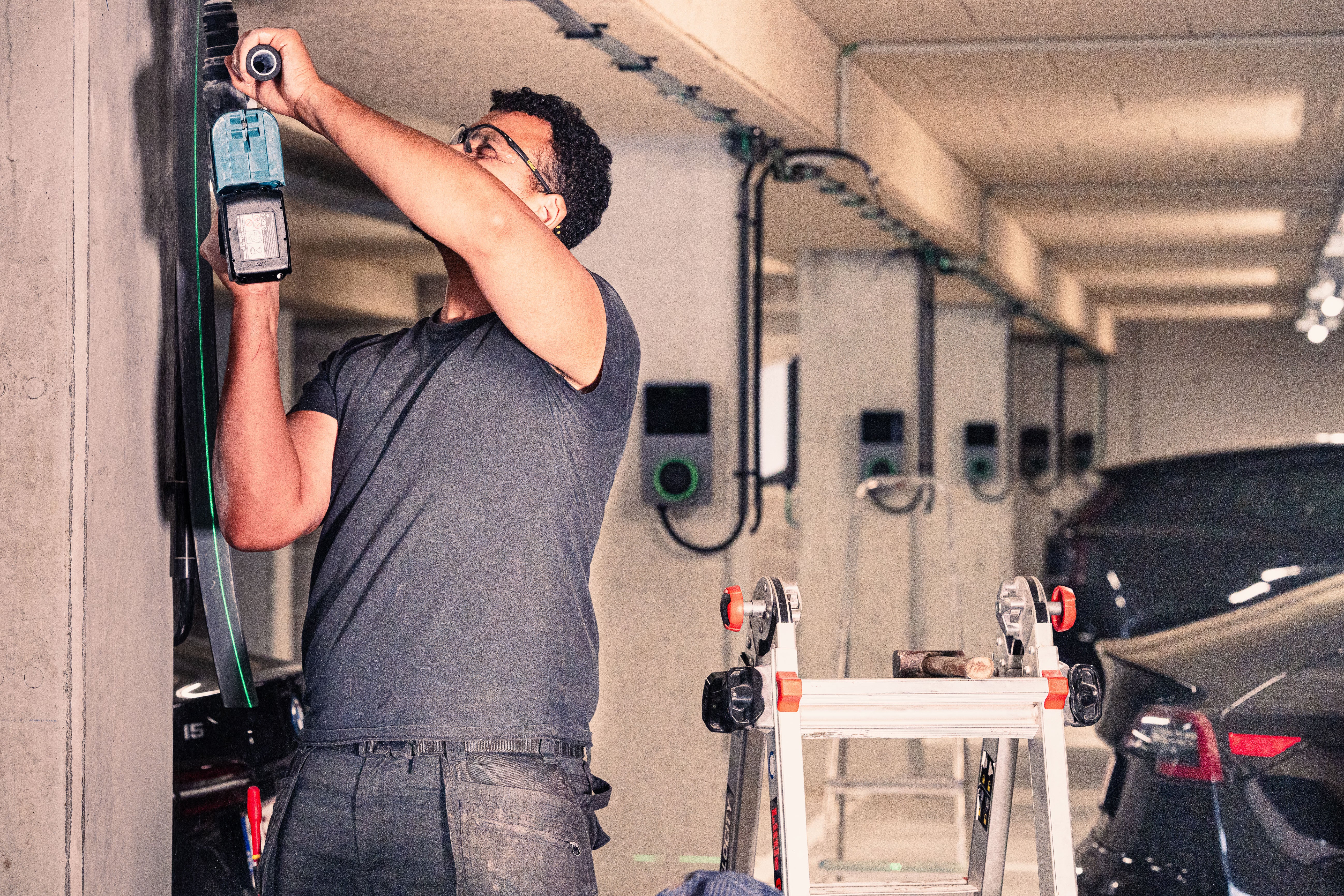


Installing a charging station at your company has become a strategic necessity. This is no longer about offering an extra facility for your employees; it is a smart investment that strengthens your business operations, improves your brand image, and prepares you for the mandatory switch to electric company cars. 2026. So the question is not or you need charging points, but how you can implement them intelligently.

Why smart charging infrastructure is a strategic move
The shift towards electric mobility is fundamentally changing the Belgian business world. Installing a charging station at your company is much more than just placing a socket; it is a decision with far-reaching benefits that directly impact your competitive advantage.
Proactive companies view charging infrastructure as an opportunity to optimize their operational functioning. They reduce the total cost of ownership (TCO) of their fleet, attract top talent, and position themselves as sustainable, future-oriented employers. Companies that wait risk falling behind and missing out on significant tax benefits.
An advantage in the battle for talent
In today's labor market, fringe benefits are more crucial than ever. For a growing number of professionals, the ability to charge their electric car at work is a decisive factor.
Imagine this: two companies offer a comparable salary, but only one offers hassle-free charging during working hours. For an employee who drives an electric car, the choice is easily made. Offering charging facilities is a relatively small investment that makes a huge difference in how potential new employees view your company.
Strengthen your sustainable image
Sustainability is no longer a buzzword; it is a core value that customers and partners expect. By investing in charging infrastructure, you demonstrate a tangible commitment to a greener future. This not only improves your reputation but also opens doors to new business opportunities with other environmentally conscious organizations.
By installing charging points, you send a powerful signal. You demonstrate that your company is not only moving with the times but is actively leading the transition to sustainable mobility.
Optimize your fleet and costs
By installing a charging station on your business premises, you gain full control over your fleet's energy costs. With smart charging solutions, you can:
- Charging during off-peak hours: Benefit from lower energy rates by scheduling charging sessions at night or outside peak hours.
- Monitor consumption: Gain detailed insights into energy consumption per vehicle or per employee.
- Manage cost allocation: Automate reimbursement for home charging or invoice visitors for their charging sessions.
For example, an SME in Antwerp with a fleet of 15 electric vehicles can save thousands of euros per year by strategically planning charging sessions and making optimal use of the available grid connection. This is where a well-thought-out plan for a install charging station company-project makes the difference between a cost and a profitable investment.
Develop your charging plan for the workplace
A successful installation is mapped out long before the hardware arrives on site. Consider this phase as creating the strategic plan for your entire project, evolving from initial ideas to concrete requirements. Good preparation is the key to a cost-effective and future-proof investment.After all, installing charging points for your company is not just a technical job; it is a strategic move to increase your operational efficiency.

Everything begins with a thorough analysis of your specific needs. A company with a sales fleet that needs to leave in the morning with a full battery has completely different requirements than an office where employees park their cars for eight hours. This analysis forms the basis of your charging plan.
Evaluate your location and infrastructure
First, take a critical look at your car park. Where are your parking spaces located in relation to the main building and, crucially, your main connection to the electricity grid? The distance and complexity of the cabling have a direct impact on your installation costs.
You will need to take a few important points into account:
- Layout of the parking lot: Are the parking spaces grouped together? Is there physical space to expand in the future? Wall-mounted chargers are often simpler and cheaper to install than pole-mounted chargers, which require excavation.
- Power source: How far is the electrical panel from the proposed locations for the chargers? Greater distances mean more excavation and more expensive, heavier cables.
- Future growth: Are you planning to expand your building or your fleet? It is much more cost-effective to be prepared for this now by laying empty conduit pipes, than to have to dig everything up again in a few years.
This on-site analysis is essential to avoid unexpected costs and headaches. An expert can help you determine the most logical and cost-effective locations for your charging points.
Determine the number and type of chargers
The right number of chargers is not just about your current fleet; it is about anticipating growth. The Belgian market is evolving rapidly. In Flanders alone, no fewer than 12,000 new public and semi-public charging points installed, bringing the total to early 2025 72,646 brought. With more than a third of new car registrations being fully electric, this explosive growth demonstrates how important it is to plan ahead. Discover more about the growth of Belgian charging infrastructure.
Next, you choose the type of charger. The decision between AC and DC chargers depends on how they will be used on a daily basis.
| Charger type | Ideal use case | Loading speed |
|---|---|---|
| AC chargers | Employees or visitors parked for several hours. Perfect for a full workday or overnight charging. | Slower (3.7 kW to 22 kW) |
| DC chargers | Vehicles that need to get back on the road quickly, such as shared cars or delivery vans from a logistics fleet. | Very fast (50 kW to 350 kW+) |
For most companies, a smart mix of AC chargers for daily use, optionally supplemented with one or two DC fast chargers for urgent charging, offers the most balanced and practical solution.
The role of smart charging and load balancing
This is perhaps the most important concept for any company that installs more than a few chargers: smart charging, also known as load balancing. This is the intelligent technology that dynamically distributes your building's available electrical capacity across all active chargers.
Without load balancing, three cars plugging in simultaneously could draw 66 kW of power. This could easily overload your electrical connection, leading to tripped fuses and expensive peak consumption charges from your energy supplier. With load balancing, the system intelligently manages the power supply to the vehicles.
This technology not only prevents power outages. Crucially, it saves you the significant costs and hassle of upgrading your grid connection.
A concrete example: An SME in Ghent with 10 electric company cars and a standard grid connection. Without smart charging, they would have to pay thousands of euros for grid upgrades. With a smart charging system from Blulinc, all 10 cars can be connected overnight. The system ensures that the vehicles charge sequentially or simultaneously at a lower power level, without ever exceeding the location's maximum capacity. By morning, every car is fully charged, all without expensive electrical works or peak rates.
By carefully considering these elements – your location, the right mix of chargers, and intelligent management – you lay the foundation for a charging infrastructure that not only meets today's needs but is also ready for tomorrow. This enables you to have a productive conversation with an installation partner like Blulinc, armed with the knowledge to build the perfect solution for your business.
Get the most out of Belgian tax benefits and regulations
Investing in charging infrastructure for your company is a solid move. But the real masterstroke? That lies in navigating the Belgian financial and legal landscape to your advantage. Gaining insight into the available tax benefits and local regulations is what will truly reduce your project costs and lower the Total Cost of Ownership (TCO).
For companies that decide to in 2026 To install charging infrastructure, the Belgian government still offers very attractive tax incentives. The most important instrument in this regard is the increased cost deduction, which can drastically shorten the payback period of your investment. This makes acting now a financially sound decision.
Understand the tax deduction
The core of the government incentive is the ability to depreciate a higher percentage of your investment costs. For charging stations that before August 31, 2024 were installed, this deduction amounted to no less than 150%. Although that specific rate has been adjusted, the scheme remains a powerful motivator for companies.
To qualify for these tax benefits, your charging infrastructure must, of course, meet several specific conditions. These criteria have been introduced to ensure the quality and usability of the Belgian charging network as a whole.
The main requirements are:
- Intelligence: The charging station must be "smart". This simply means that it can manage charging times and power, which is essential for load balancing and optimizing your energy consumption.
- Public access: The charger must be accessible to third parties, at least during your business's opening or closing hours. You are not required to offer free charging; you can simply set a rate for visitors.
- Registration: The charging station must be registered with the grid operator (in Flanders, this is Fluvius).
View the requirement of public access not as a burden, but as an opportunity.By opening your chargers to the public, you can create a new revenue stream and strengthen your company's profile as a progressive, sustainable enterprise.
A practical example
Let's make the impact of these tax benefits more concrete. Imagine that you are an SME in Ghent planning to 10 to install charging points for your employees and visitors.
The total investment – including the chargers, installation work, and necessary software – amounts to €40.000. Under the current increased cost deduction scheme, you can depreciate a substantial portion of this investment against your taxable profit. This results in a direct and substantial tax saving. Depending on your corporate tax rate, this net benefit can easily amount to thousands of euros, significantly reducing the effective cost of your project. For a more detailed breakdown, please refer to our article on the tax deductibility of charging stations read.
Navigating permits and administration
In addition to the financial aspect, it is crucial to understand local regulations. Whether you a environmental permit what is needed often depends on the scale of your project and the specific rules in your municipality.
For a small installation of just a few charging points, a simple notification at the local authority suffice. However, for larger projects or if significant earthworks are involved, a permit is almost always necessary.
This is where a professional partner like Blulinc takes the burden off your shoulders. We handle the entire process for you – we analyze local requirements, submit the necessary applications, and ensure that your installation is fully compliant with Belgian law from start to finish. This not only saves you a mountain of time and paperwork but also guarantees that your project runs smoothly and without legal issues. This allows you to focus on what really matters: enjoying the benefits of your new charging infrastructure.
Choose your purchasing model and installation partner
The chargers themselves are only one piece of the puzzle. How you integrate them into your company – and who you collaborate with to do so – is at least as crucial.
This decision determines the success of your install charging station company-project, from initial budgeting to the daily operational flow. It is not just about finding the cheapest option; it is about finding the solution that seamlessly aligns with your business strategy.
The way you finance your charging infrastructure is a strategic choice. Do you feel more comfortable with a one-time capital expenditure (CapEx), or does a predictable operating cost (OpEx) fit your financial planning better? Each path has its own advantages, depending on your company's cash flow, risk profile, and long-term goals.
Compare your financial options
In general, you have three ways to purchase charging infrastructure. Understanding the differences is the first step towards a sound financial decision that aligns with the direction your company is heading.
-
Direct purchase (CapEx): This is the traditional route: you buy the hardware directly. This requires a significant upfront investment, but you are the full owner of the assets. Many companies that want total control and can utilize the depreciation on their balance sheet prefer this model.
-
Leasing (OpEx): Compare it to leasing a company car.You pay a fixed monthly amount for a fixed term, which keeps the initial investment low and makes costs predictable. At the end of the lease period, you often have the choice to purchase the equipment or, more frequently, to upgrade to the latest technology.
-
Charging-as-a-Service (CaaS): This is the all-inclusive, worry-free OpEx model. You pay one recurring amount that covers everything: the hardware, installation, software, ongoing maintenance, and even 24/7 support. It removes the entire burden of ownership and management, allowing you to focus on your actual business.
For many companies, the CaaS model simply offers the most peace of mind. It transforms a complex infrastructure project into a simple, predictable monthly service, just like your internet subscription. It guarantees availability and makes your investment future-proof, as the provider takes care of all updates and maintenance.
Choosing your charging infrastructure purchasing model
To make it even clearer, below is a direct comparison of the financial and operational aspects of each purchasing model.
| Model | Upfront investment | Operational responsibility | Best for |
|---|---|---|---|
| Purchasing (CapEx) | High | You are responsible for all maintenance, repairs, and software updates. | Companies that want full ownership of the assets and have the capital and internal resources to manage the infrastructure. |
| Leasing (OpEx) | Low to none | Maintenance is usually included, but responsibilities may vary by contract. | Companies that want predictable costs and want to safeguard capital, without the full service aspect of CaaS. |
| CaaS (OpEx) | No | The provider takes care of absolutely everything: installation, maintenance, software, and support. | Companies looking for a completely worry-free solution with maximum flexibility and minimal risk. |
Selecting the right installation partner
The choice of your partner is perhaps even more important than the choice of the specific hardware. A great partner does more than just install chargers. They become a long-term advisor who truly understands the Belgian market, provides sound technical advice, and offers solid support long after the installation is completed.
As you evaluate your options, you will quickly realize that an expert partner makes all the difference. For more on this, our guide on selecting a EV charger installer some valuable tips.
Here are some essential questions you should ask every potential supplier:
- Local experience: How many installations have you completed for companies like mine? in Belgium? Can you provide some local references?
- Technical skill: What is your approach to load management and smart charging? Can you show me how your system will prevent overloading of our grid connection?
- Software demo: Can we see a demo of your management platform? How easy is it to set rates, manage different user groups, and request financial reports?
- Support & maintenance: What does your service level agreement (SLA) guarantee? If a charger fails, what are your guaranteed response times?
At Blulinc, we do not see ourselves as merely installers. We are an end-to-end partner. We offer all three purchasing models so that we can find the perfect match for your financial strategy.
Our service covers the entire process – from the initial site audit and arranging permits to the physical installation, software configuration, and ongoing 24/7 support. This comprehensive approach ensures that your install charging station company-project is a seamless success from day one.
The installation and commissioning process from A to Z
As soon as the contract is signed, the real work begins. This is the exciting part where we move from paper plans to a physical, functioning charging hub at your location. It is a carefully managed process that transforms a corner of your parking lot into a smart asset for your business.
Let's look step by step at how a install charging station company-what the project looks like in practice, from the first day of construction to the moment your loaders go live.
Laying the foundation: physical installation
The first thing you will see happening on site is the civil and electrical preparatory work. This forms the basis for a safe, reliable, and professional-looking installation.
- Civil works: We may need to dig trenches for the armored power cables running from your main electrical panel to each parking space. If you have opted for pole-mounted chargers, this is the moment when we pour the concrete pedestals to give them a solid, sturdy foundation.
- Electrical works: Our certified electricians get to work on your main electrical panel, install new circuit breakers and all necessary safety features. Next, they pull the heavy cables through the trenches or conduits to each charging point.
Working with a certified installer is not just a recommendation; it is a requirement. This guarantees that every part of the installation complies with the strict Belgian standards. AREI (General Regulations on Electrical Installations)-standards. This is non-negotiable for the safety of your people, your property, and your investment.
Once the heavy lifting is done, our team assembles the charging stations themselves. We connect everything to the power supply and ensure that every component is perfectly in place for a neat, professional finish. For a deeper dive into the technical side of things, this is engineer's guide on electric car charger installation an excellent source.

Bringing your chargers online: commissioning
The hardware is installed, but it is still just hardware.The next step, the commissioning, is where we bring your chargers to life. This is the technical magic that transforms them into a smart, connected, and manageable system.
During commissioning, we carry out several important tasks:
- Connect to the platform: Each charger is linked to the Blulinc management platform. This gives you one central dashboard to view and manage everything.
- Perform a full diagnosis: We test everything. We check whether every station communicates correctly, delivers the correct power, and whether all safety functions work perfectly.
- Configure smart rules: Here we tailor the system to your needs. We establish load balancing to protect your building's power supply and configure any user groups or charging priority rules you require.
The growth across the country has been incredible. By the end of 2025, the Belgian charging network expanded to 106,677 public and semi-public points – a huge increase in 23% compared to 2024. This is a direct response to the growth of the EV fleet towards 600,000 vehicles.
Practical example: the fleet of a logistics company
Imagine a logistics company in Wallonia with 20 electric vans. They all return to the depot at night and must be 100% charged for the next day's routes. For them, a seamless charging process is not an afterthought, but business-critical.
During their commissioning, we would do the following:
- Set up user access: We assign an RFID card to each delivery van. This ensures that only commercial vehicles can charge and enables the fleet manager to track energy consumption per specific vehicle.
- Define charging rates: The system is set up so that charging is free for their own fleet. But if they want to allow public charging during the day, we can easily configure it so that external users are billed.
- Implementing smart charging: We program the system to automatically start loading after 10:00 PM to benefit from cheaper night rates. The load balancing system is the key here: it ensures that even with all 20 vans connected, the depot's maximum power capacity is never exceeded. No blown fuses, no surprising peak consumption costs.
From day one, this company has had a fully automated, cost-optimized charging system that simply works, allowing them to focus on their business operations without worrying about their fleet.
Some frequently asked questions about installing charging stations for businesses
While you your install charging station company-project plan, you will undoubtedly have questions. It is an important step for any company, and you want to be sure that you are making the right decisions.
We understand that. We speak daily with business leaders across Belgium and hear the same questions time and again. Let's go over them so you can move forward with confidence.
What are the actual costs of installing a business charging station in Belgium?
This is always the first question, and the honest answer is: it really depends on your location.
A simple, wall-mounted AC charger can start in the price range of €2.000 to €3.000. But that is only the starting point.A more complex project involving multiple DC fast chargers, excavation for cables, and an upgrade to your grid connection can easily run into tens of thousands of euros.
The main factors that determine your final costs are:
- Type and number of chargers: Powerful DC fast chargers come with a much higher price tag than their AC counterparts.
- The layout of your site: The further your parking spaces are from your main electrical panel, the more you will spend on cabling and groundwork.
- Your electrical capacity: This is the major factor. If your building's current connection cannot handle the additional load, a grid upgrade is necessary, which entails a significant cost.
Do not look only at the initial price. In Belgium, tax deductions can drastically reduce your net costs. The only way to get an exact figure is with a detailed quotation following a thorough site audit. This is how you calculate the true Total Cost of Ownership (TCO).
Do I really need a permit for charging stations at my company?
Usually yes. Whether you need a full environmental permit depends on the size of your project and the local Belgian regulations.
For just one or two chargers, a simple notification might suffice. However, for larger installations, especially those involving significant earthworks or those that will be publicly accessible, a permit is almost always required.
If you plan to allow the public to use your chargers, there are also additional rules regarding data reporting and registration. The paperwork can feel overwhelming, which is why collaborating with an experienced partner is so valuable. They should handle the entire permitting process for you, ensuring you are fully compliant without the administrative headaches.
What exactly is smart charging and why do I need it?
Smart charging, or load management, is the technology that intelligently distributes power across all your active charging stations. Instead of every car drawing maximum power simultaneously and tripping your main fuse, the system dynamically balances the load.
Think of it as an air traffic controller for your electricity. It prevents a "traffic jam" on your electrical circuit, ensures that every vehicle is charged, and keeps your entire system safely within your building's power limit.
For any company installing more than a few chargers, smart charging is not an extra; it is essential. It is the key to avoiding exorbitant electrical upgrades and protecting your business from high peak consumption costs on your energy bill.
This is particularly crucial in regions such as Flanders, where the grid is already under pressure. The current 68,000 public points with 924 MW capacity to have a boost of by 2030 39% needed. With 29% With all new car sales that are now fully electric, managing your power consumption is no longer optional. You can read more about Flanders' race to expand its EV infrastructure here.
Can I charge people for the use of our company chargers?
Absolutely, and it is surprisingly simple. A modern charge management platform, such as the one we offer at Blulinc, automates the entire process. You get total control to set the rules that work for your business.
For example, you can easily configure your system to:
- to offer free charging to employees as a company benefit.
- To charge a fixed price per kWh to visitors or the public.
- To create different rates for peak and off-peak hours.
- Automate split invoicing and refunds for staff charging company cars at home.
The platform handles everything, from payment processing via charge cards and apps to providing clear financial reports. It is a simple way not only to recoup your electricity costs but also to open a new, hassle-free revenue stream for your business.
Ready to turn these ideas into a concrete plan? At Blulinc We bring the expertise and end-to-end solutions to make your charging project on the shop floor a seamless success. Request a free consultation with one of our Belgian experts and take the first step towards a smarter, more sustainable future today.