

The well-known fear of an empty battery, also known as 'range anxiety', is fortunately rapidly becoming a thing of the past for Belgian EV drivers. The search for a charging point nearby is no longer a stressful undertaking. It is now a simple action on your smartphone.
With the Blulinc app and charging card at hand, you gain access to a gigantic network of more than 900,000 Charging points spread across Europe. This makes charging on the go a breeze.

The Rapid Growth of the Belgian Charging Network
Belgium is fully engaged in an impressive catch-up effort in the field of electric mobility. This rapid evolution is no coincidence; it is the direct result of ambitious targets and growing demand from both private individuals and businesses. The landscape of public and semi-public charging points is expanding at a record pace to support this transition.
And that growth is crucial. For the daily commuter, it means more certainty and convenience on the road. For fleet managers, it opens doors to more efficient logistics and lower operating costs. A larger and more reliable network makes the switch to electric driving not only feasible but also a smart move.
The Numbers Say It All
The progress is crystal clear if you look at the figures. In 2023, Belgium already counted 106,677 public and semi-public charging points, a sharp increase of 23% compared to the previous year.
This growth went hand in hand with record sales of 145,170 electric cars, accounting for a market share of 35%. What is even more striking? The number of ultra-fast DC chargers (more than 150 kW) shot with no less than 57% up. That proves that the focus is not only on quantity, but also on the speed with which you can get back on the road.
Fortunately, it is also becoming increasingly easy to find these new charging points, partly thanks to the developments in intelligent navigation technologies. Where you used to rely on static maps, modern apps now offer real-time information on availability and status.
With the Blulinc app, you not only find the nearest charging point, but you also immediately see if it is available, what type of connection it has, and what the charging costs are. This way, you will never be faced with any surprises.
Essential Tools for Finding a Charging Point
Navigating the growing range of charging points can seem a bit overwhelming at first. Fortunately, there are various tools to help you find the right charging station quickly and efficiently. Here is an overview of the most commonly used methods.
| Tool/Method | Best For | Main Function |
|---|---|---|
| All-in-one Apps (such as Blulinc) | Daily use and travel | Real-time status, filters, and payment in one app |
| Built-in Navigation | Long journeys with planned stops | Automatic route planning including charging stops |
| Specific Network apps | Charging at a favorite network | Specific network promotions and information |
Each tool has its own advantages. It is worth the effort to discover which one best suits your driving habits and needs.
Your Starting Point for Easy Charging
Our Blulinc app and charge card are designed to effortlessly guide you through this growing network.You can easily search and filter based on what you need: a standard AC charger for a few hours at the office or a fast DC charger along the highway.
The app guides you to the chosen location and provides you with all the tools to start and manage the charging session. Curious where all those charging points are located? Check out our extensive map of electric charging points.
Okay, you’ve found a charging point on the map. Perfect. But wait a minute… is it the right charger for your car and for your schedule?
The world of chargers can seem a bit complex at first glance. Fortunately, in practice, it is not that bad. The most important thing you need to know is the difference between AC and DC chargers.
Choosing the Right Charger: AC versus DC and Connector Types
Slow and steady or lightning fast?
AC chargers (alternating current) are the chargers you will encounter most often. Think of the charging stations at the office or at home. They are ideal for situations where your car is parked for a while. They charge more slowly, with a power that is usually between 3.7 kW and 22 kW lies. That is more than enough to get your battery fully charged again in a few hours.
DC chargers (direct current) are also known as fast chargers. And they certainly lived up to that name. These powerhouses are designed for pure speed and you will find them primarily along highways and at strategic locations for longer journeys. A DC charger can bring your battery back to full charge in just 20 to 40 minutes. 80% Charge up. Grab a quick coffee and you can hit the track again.
The Correct Connector for Your Car
In addition to the type of current, the connector is obviously crucial. Otherwise, it simply won't fit. Fortunately, in Belgium and the rest of Europe, there are only two standards you really need to know:
- Type 2 (Mennekes): This is the standard connector for AC charging throughout Europe. Virtually every public AC charger and every modern electric car is equipped with it.
- CCS (Combined Charging System): This is the standard for DC fast charging. It is actually a Type 2 connector with two extra pins for direct current, hence the name "combined".
Fortunately, you don't have to remember all of this yourself. The Blulinc app allows you to easily filter by both charging speed (AC/DC) and connector type. This way, you avoid the frustration of arriving at a charging station that is not suitable for your car.
Just imagine: one of your representatives has to travel from Brussels to the Ardennes for an appointment, but has only 40% battery. Stress? No need.
Using the Blulinc app, he filters by "DC fast chargers" and "CCS connector". The app immediately shows an available fast charger along his route. After a short 25-minute stop, he has enough power to reach his destination and drive back comfortably. This transforms a potentially stressful drive into an efficient, perfectly planned journey.
Paying and Gaining Access at Public Charging Points
You have found a charging station nearby. Perfect. But how do you start the charging session and, just as importantly, how do you arrange payment? A smooth experience at the charging station is crucial. The entire process, from activation to payment, simply has to work.
With the Blulinc charging card and the accompanying app, we have made this process as simple as possible. You hold your card in front of the charging station reader, or start the session with a single tap in the app. That is all there is to it.
Starting, Stopping and Monitoring
As soon as your car is connected, you can activate the charging session. With the Blulinc app, you have full control, directly on your smartphone.
You can monitor the charging speed and battery status in real time, wherever you are. Is the battery full, or do you need to interrupt your charging unexpectedly? With a simple click in the app, you stop the session immediately.
This gives you the freedom to take a walk or attend a meeting without having to constantly wait by your car. You will receive a notification when the charging session is complete, so you can clear the station in time for the next user.
Understanding Price Structures
The costs for public charging can vary widely. The price is often made up of various components, and it is helpful to know what to expect. The most common models are:
- Price per kilowatt-hour (kWh): You only pay for the energy you actually consume. This is the most transparent method.
- Price per minute: You pay for the time your car is connected to the charging station. This model encourages a fast throughput, especially at fast chargers.
- Starting rate: A fixed amount for starting a charging session, often combined with a kWh or minute rate.
Within the Blulinc app, we always display the rates of the charging point. before you start the session. This ensures complete transparency and ensures you are never faced with unpleasant surprises.
Knowing which type of charger you are using is also essential for the charging speed. The difference lies in how the power reaches your battery.

Simply put: with AC charging, the alternating current is converted by the inverter in your car, whereas DC fast chargers skip this step and deliver direct current directly to the battery for maximum speed.
Business Use Simplified
For businesses, it becomes truly interesting. How do you manage your employees' charging costs efficiently? Our solution makes it easy to separate business and private charging sessions thanks to split billing.
Imagine a sales representative driving from Antwerp to Liège. With the Blulinc app, he plans his stops, activates charging sessions, and all costs are automatically recorded for the business. Charging costs from home can also be reimbursed automatically and correctly. This eliminates the need for expense reports and saves your administration valuable time.
For more details on how to keep control of your team's charging costs, read all about our advanced management options for Blulinc charging cards.
Charging at work and at home: your company's secret weapon
While public charging is essential while on the road, the most convenient and cost-effective charging almost always takes place at the office or at your employees' homes. Finding a 'nearby charging point' is one thing, but for the daily top-ups that keep your fleet running, there is nothing better than your own installation.
Don't consider it an extra, but a smart business investment.
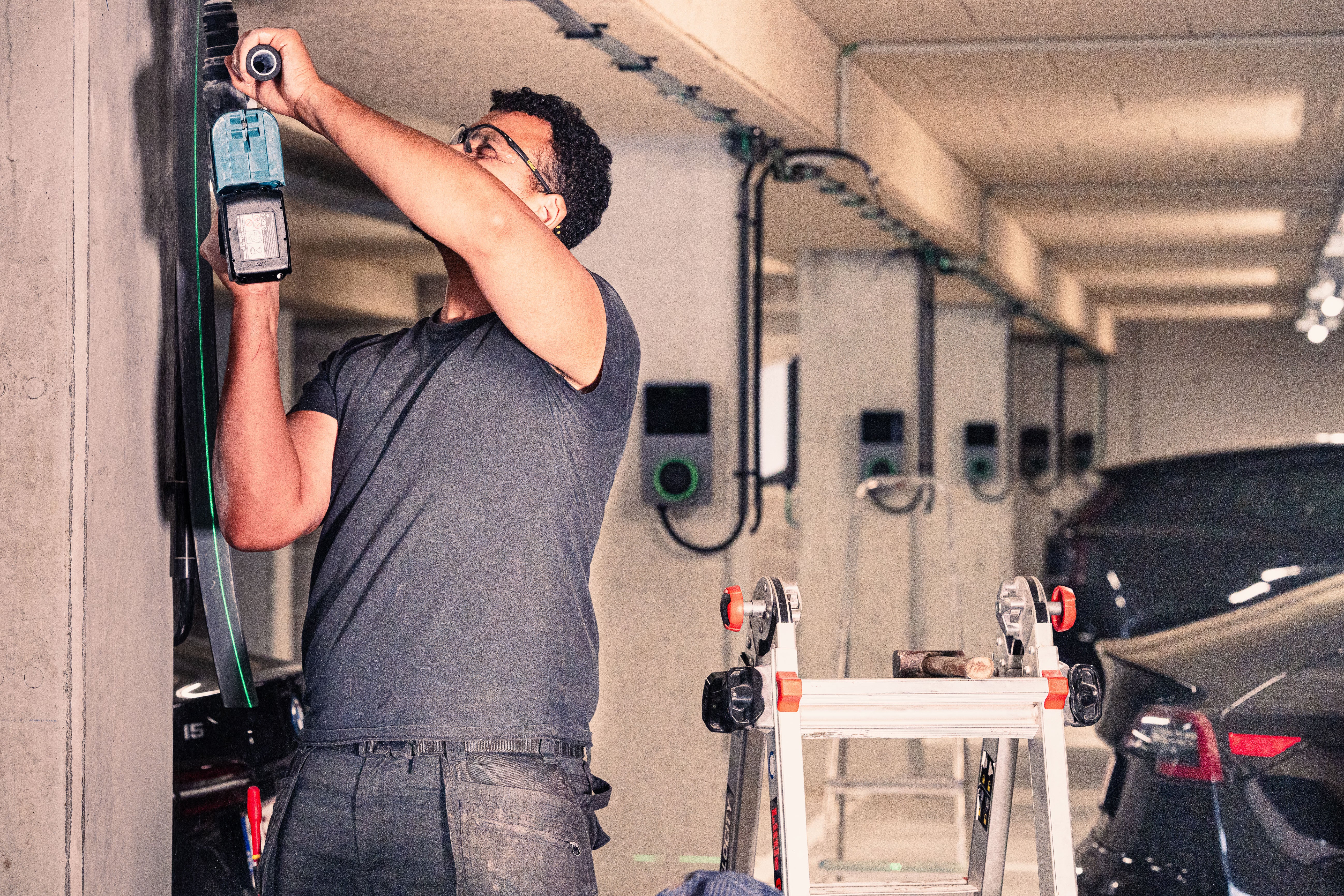
At Blulinc, we don't just sell charging stations. We collaborate with Belgian companies to develop a complete charging strategy. We guide you every step of the way, from the initial site visit and professional installation to the ongoing management of your network. We are here to make your transition to electric mobility smooth and future-proof.

Smart features that work for your fleet
Installing charging stations is about more than just connecting cars; it is about intelligent energy management.One of the most important tools in your arsenal is load balancing.
This smart technology continuously manages the power supply and intelligently distributes the available power across all connected vehicles. This allows you to charge multiple vehicles simultaneously without overloading your building's electrical grid. More importantly, it helps you avoid costly grid upgrades, while still ensuring that every car is ready to go in the morning.
In addition to the hardware, you determine the rules yourself. You can set clear policies for your team, such as who can charge when, and even set different rates for employees, visitors, or the public.
The Golden Duo: Charging at the Office and at Home
The best approach? Combine charging at work with charging at home. Offering a home charging point as part of an employee's salary package is a huge benefit that makes their lives much easier.
We have streamlined this entire process with automatic reimbursement for their home consumption. Our system records the energy used to charge a company car at home and automatically reimburses the employee at a pre-agreed rate. It is a win-win situation that eliminates the administrative burden for both your team and your finance department.
Practical example: An SME in Ghent with 10 Bedrijfswagens came to us for a solution. We installed six charging stations at the office and provided each of the 10 drivers with a home charging point. By using smart charging and automatic reimbursement, the company reduced the total energy costs of its fleet by 15% and saw a huge increase in employee satisfaction.
Growing with the Belgian loading boom
Although setting up your own charging points offers control and convenience, a robust public network remains essential. And the growth here in Belgium is downright explosive.
In 2023 alone, Flanders installed no fewer than 12,000 new public and semi-public charging points, which brought the regional total to 72,646. This network is supported by a combined capacity of more than 1,026,906 kW, with which the 337,127 electric vehicles on Flemish roads are powered. This national effort, about which The Brussels Times reported, makes both public and private charging more accessible than ever.
By combining smart charging points in the workplace, convenient home charging, and easy access to the growing public network, you build a complete and cost-effective ecosystem for your business.
Whether you are just starting out with electric driving or are already a seasoned EV driver, the public charging infrastructure is a shared space. A little courtesy at the charging station contributes to a smooth experience for everyone and keeps the network reliable and efficient.
Fortunately, good charging habits are quick to learn and make a world of difference for your fellow EV drivers.
Basic principles of a load label
Do not view a public charging station as your personal parking spot. It may sound logical, but the most important rule is simple: do not leave your car plugged in unnecessarily.
As soon as your battery is full – or you have enough range for your next ride – it is time to make room for the next one. The Blulinc app It helps you with this by sending a notification when your charging session is complete. This way, you know exactly when it is time to move your car.
Other simple but important habits are:
- Leave the charging spot tidy: Roll up the cable neatly after use and hang it back in the holder. This prevents tripping hazards and protects the cable from damage.
- Park within the lines: Ensure that your car is parked correctly so that other drivers can easily access the charging points.
- Check for reservations: Some charging points can be reserved in advance. Always check your app to see if a charging point is available before connecting the cable.
One of the biggest frustrations among EV drivers is so-called "charging station hogging": a car that occupies a charging point for hours while the battery is already full. By moving your car immediately, you show respect for others who may be urgently looking for a "charging station nearby".
What if Something Goes Wrong?
Even with the most reliable charging stations, things can occasionally go wrong. A charging session that won't start or a charging card that isn't recognized is, of course, frustrating. Fortunately, most of these problems can be resolved quickly.
Reporting a malfunction correctly is, by the way, also a form of good charging etiquette. By reporting a problem immediately via the Blulinc app, you not only help yourself but also enable our technicians to resolve it quickly for the next user.
Below you will find a handy overview of common problems and how to address them.
Common Charging Problems and Quick Solutions
| Problem | Possible Cause | Solution |
|---|---|---|
| Charger does not start | There is a communication error between the car and the charger. | Disconnect the cable at both ends, wait 30 seconds and try again. Check if you are starting the session correctly via the app or with your charging card. |
| Charging card is not recognized | The card reader is dirty or there is a temporary network error at the pole. | Try starting the session with the Blulinc app. If that works, the problem is likely with the card reader. Report this via the app. |
| Loading is unexpectedly slow | The charger distributes the power (load balancing) or the battery is almost full (more than 80%). | Check in the app if there are other cars at the same charging unit. The charging speed also decreases as the battery fills up to protect its lifespan. |
Most glitches can be quickly resolved with a simple reset or a different approach. Still can't figure it out? Then the support team of the charging station operator – whose contact details are usually on the station itself – is ready to assist you.
The Future of Electric Charging in Belgium
The rapid growth in the number of charging points we are seeing today is just the beginning. The search for a "charging station nearby" will transform from a necessary quest into a natural part of our daily routine. The focus is now shifting from simply finding a station to the intelligence, speed, and integration of the entire charging process.
This evolution is driven by ambitious goals and technological leaps forward. Consider the further rollout of ultra-fast charging networks and the standard integration of charging points in new residential areas and construction projects.Innovations such as Vehicle-to-Grid (V2G)-technology, where your car can feed power back into the grid, will play an active role in keeping our energy network stable.
Smarter and Faster Charging
The next generation of charging infrastructure will not only be faster, but also a lot smarter. The EU regulations, such as the Alternative Fuels Infrastructure Regulation (AFIR), will further standardize payment methods and improve cooperation between different networks. In concrete terms, this means that soon you will be able to use a single charging card or app at virtually every public charging station in Europe, without any hassle.
Belgium recently reached an important milestone with the installation of its 100,000th public charging point. This achievement is part of a European sprint towards 1 million charging stations. Almost 100,000 These are ultra-fast chargers that can charge a car in less than 20 minutes. As you can read in an article from the Polis Network, This expansion ensures even better coverage and availability throughout Belgium.
With Belgium's ambition to have up to 2 million electric cars on the road by 2030, the demand for smart and reliable charging solutions is only increasing.
The future of charging is connected, efficient, and fully integrated into our mobility. At Blulinc, we are ready to guide your business through this transition with solutions that are already ready today for the challenges of tomorrow.
Your Questions about Electric Charging Answered
We receive many questions about the daily reality of finding and using charging points in Belgium. Let's cover the most common ones.
How accurate is the availability of charging points in the Blulinc app?
This is an important question. No one wants to arrive at a charging station only to discover that it is already occupied. The good news is that the availability you see in the Blulinc app is updated almost in real time.
Our platform communicates constantly with the charging station operator's network. The moment a charging session starts or ends, that status is typically transmitted to our system within a few seconds. Therefore, what you see on the map is what you will actually find.
Can I use my Blulinc top-up card outside Belgium?
Absolutely. Your Blulinc charging card and app are your key to one of Europe's largest roaming networks, with access to more than 900,000 charging points.
Before you leave on a trip abroad, it is a good habit to use the app to plan your route. You can easily check for compatible charging points and view the specific rates for charging abroad, so there are no surprises.
What does my company need to take into account when installing charging stations?
When considering installing charging infrastructure at your workplace, it comes down to a few core areas. Think about your current and future charging needs, the available electrical capacity of your building, and how you want to manage access and billing for your team.
Ready to ensure your company's transition to electric mobility goes smoothly? Request a free consultation today with Blulinc and we help you find the perfect charging solution for your business. https://blulinc.com