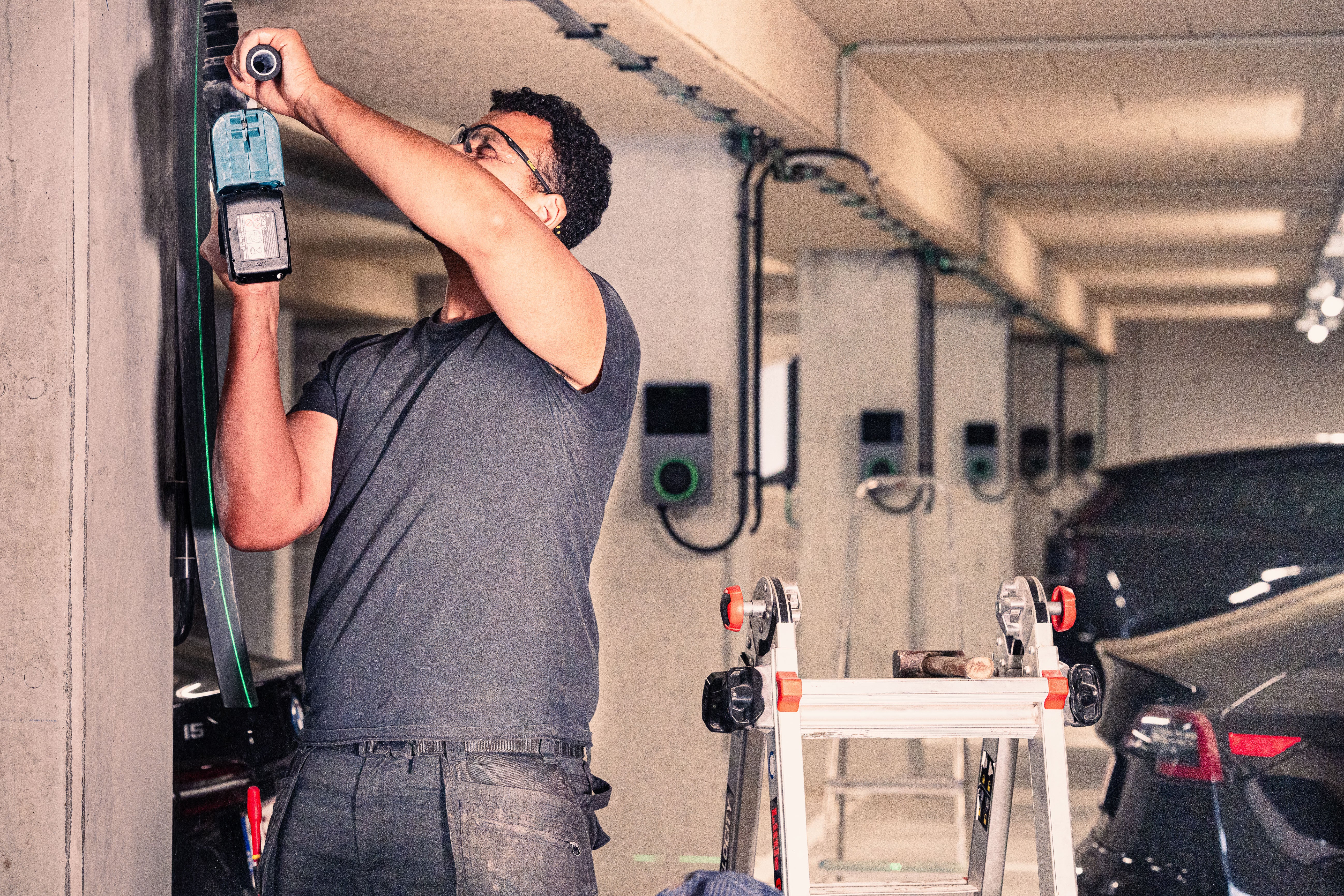


Start every day with a full battery? A Home charging point for your electric car is the simplest way to get that certainty. It is a reliable, cost-effective, and convenient solution that puts an end to the search for public charging stations. This gives you complete peace of mind and control over your charging costs.
Why a home charging point is a gamechanger in Belgium

Now that more and more electric cars are driving on Belgian roads, relying on public charging infrastructure quickly becomes a daily gamble. A private Home charging point for your electric car is no longer a luxury; for the modern EV driver, it is a necessity.
Imagine this: you come home after a long day, plug in your car, and that's it. The next morning, you wake up with a fully charged battery, ready for whatever the day brings. No more searching for an available charging station, no unpredictable rates, and no stress. That reliability is invaluable.
The crucial role in a commercial vehicle market
Belgium has a unique car market that is heavily dominated by company cars. Thanks to tax incentives that encourage companies to electrify their fleets, the transition is taking place at a lightning-fast pace. In 2023 alone, no fewer than 145,170 new electric vehicles sold, good for 35% of the market. What really stands out is that 89% of these battery-electric vehicles (BEVs) were company cars.
With forecasts that predict that against 2026 more than 600,000 EVs as they will be on our roads, the demand for reliable home charging solutions will explode. You can find more details about these Belgian growth figures for EVs on the European Commission website.
For every employee with a company car, a personal charging point is essential. It makes the transition to electric driving seamless and guarantees that the vehicle is always ready to go. For fleet managers, it offers a controlled and efficient way to keep the entire fleet operational.
Having your own charging point at home transforms electric driving from a planning challenge into a simple, daily routine. It is the cornerstone of a carefree and efficient EV experience.
Home charging vs. public charging in practice
The differences between charging at home and charging at a public station are significant, not only in terms of convenience but also in terms of cost. A quick comparison makes the benefits of a private installation crystal clear.
Below you will find an overview highlighting the key differences in convenience, cost, and speed between charging at home and using public infrastructure.
Home charging vs. Public charging at a glance
| Feature | Home Charging Point | Public Charging Station |
|---|---|---|
| Ease | Always available. Plug in at night and leave in the morning with a full battery. | You have to find an available station, often with queues. |
| Cost per kWh | You pay your lower household electricity rate – even cheaper with a night rate or solar panels. | Higher commercial rates, often with additional start-up or parking fees. |
| Reliability | You are assured of a working and available charging point. | Defective stations, occupied slots, or compatibility issues are common frustrations. |
| Loading speed | Perfectly tailored to the needs of your car and the electrical capacity of your home. | Speeds vary widely, from slow AC chargers to expensive DC fast chargers. |
Ultimately, the choice for a Home charging point for your electric car An investment in convenience and predictability. It is the smartest move for every Belgian EV driver who wants to take full control of their mobility.
Choosing the right charging station for your daily commutes
Choosing the right charging station is about more than just technical specifications; it is about perfectly matching the hardware to your lifestyle and driving habits. The ideal Home charging point for your electric car offers maximum convenience without unnecessary costs.
The first thing you need to consider is the charging capacity of your installation. This is measured in kilowatts (kW) and determines how quickly your car charges. The options typically vary from 3.7 kW to 22 kW.
Single-phase vs. three-phase charging
Most homes in Belgium have a standard single-phase electrical connection. With this, you can usually charge up to 7.4 kW. For most drivers, this is more than enough. An overnight charging session is all that is needed to fully recharge an empty battery, perfect for the daily commute.
A three-phase connection, which is sometimes present in new-build homes or available on request, enables higher charging capacities such as 11 kW or 22 kW possible. This becomes interesting if you regularly drive long distances and want your car to be fully charged again quickly. However, an upgrade is not always necessary and entails extra costs.
It is a common misconception that faster is always better. 7.4 kW charging station adds approximately 40-45 km range per hour to go. For a car that charges for 8 hours overnight, that is more than 320 km of extra range – more than enough for the average Belgian driver.
The practical choice: fixed or detachable cable
Another important decision is the type of charging cable. You can choose a station with a permanently attached cable or one with only a socket into which you plug a separate cable.
- Fixed cable: This is the most user-friendly option. You come home, grab the cable hanging at the station, and plug it directly into your car. No hassle with taking cables out of the trunk.
- Loose cable: This offers more flexibility. The station itself looks sleeker on the wall, and you can use different cables – handy if you have trolleys with different connectors (although Type 2 is the European standard).
Two practical examples
Let's make this more concrete with a few examples to help you make the right choice.
Scenario 1: The consultant in Flanders A consultant drives throughout Belgium every day for client meetings. Sometimes, she has to hit the road again unexpectedly in the evening for an urgent appointment. For her, charging speed is crucial. 11 kW three-phase charging station is the ideal choice. With this, she can significantly recharge the battery in just a few hours, giving her the flexibility she needs.
Scenario 2: The family with a fixed rhythm A family uses their electric car primarily for the daily school run and commuting, accounting for about 60 km per day. For them, a single-phase 7.4 kW station with a fixed cable, the perfect solution.The car charges quietly at night at a lower rate, and the fixed cable offers optimal convenience during the morning and evening rush hour. They do not pay for a charging speed they will never really need.
Ultimately, the perfect home charging point for your electric car is the one that seamlessly aligns with your daily reality.
From initial check to final inspection: your installation process
A home charging point for your EV Installation is more than just buying a device and plugging it into the socket. There is a proper process involved, and for good reason: everything revolves around your safety and guaranteeing the best performance from your charger. Although we at Blulinc take all the heavy lifting off your hands, it is good to know what happens behind the scenes.
It all starts with a technical site visit, which we call a 'survey'. During this, a certified installer comes to your home to inspect your electrical installation. He or she focuses on your fuse box and existing wiring to determine whether your home connection can handle the extra load of a charging station.
Before drilling holes, it is crucial to assess your home's electrical system to ensure it can safely support the new charger. Going through a checklist for the electrical inspection of your home is a good way to prepare for this.
From inspection to safe loading
As soon as the site survey gives the green light, we can schedule the actual installation. This is where a professional, turnkey service proves its value. Trying to install a charger yourself is not only a bad idea – it is illegal in Belgium. This type of electrical work must comply with extremely strict safety standards.
A charging station must be installed by a certified electrician and be fully compliant with the AREI (General Regulations on Electrical Installations). This is not a suggestion; it is a legal obligation to protect your home and everyone in it.
After the physical installation is completed, a final, mandatory step follows: a final inspection by a recognized inspection body. Think of it as the official approval label. It confirms that your new charging point is 100% compliant and safe. Only after this inspection is the job officially finished.
This flowchart illustrates the selection process and guides you through the key decisions regarding your home situation, power needs, and cable type.

As you can see, finding the perfect charger is about striking a balance between what your home can offer, what your car needs, and what makes your daily life easiest.
What if I rent or live in an apartment?
Are you not the owner of a detached house? No problem. The process involves a few extra steps, but is perfectly feasible.
- If you rent: You need clear, written permission from your landlord before work can start. By approaching him with a professional plan from your installer, you increase the chance of a 'yes'.
- If you own an apartment: You need the approval of the Association of Co-owners (VME). The good news is that since 2019, Belgian law grants residents a "right to charge." This means that the VME cannot simply refuse your request without a very good reason, although it can set conditions regarding the installation and how the costs are distributed.
In both situations, communicating early and having a professional proposal at hand is the key to success.A turnkey partner like Blulinc can help by providing you with all the technical documents you need to support your request to a landlord or HOA, making it much easier to your own home charging point available.
Save with smart charging and energy management

A modern Home charging point for your electric car is much more than just an advanced socket. Consider it a smart device that actively works to lower your electricity bill by optimizing when and how your car consumes power.
One of the most crucial functions is dynamic load balancing. Imagine this: you come home, plug in your car, and then start the washing machine while the oven preheats. That is a huge, sudden demand for electricity. Without load balancing, you risk a blown fuse and plunging your house into darkness.
Dynamic load balancing prevents this entirely. The system continuously monitors your home's total energy consumption and will automatically reduce your car's charging speed when other major appliances switch on. As soon as they are finished, the power to the car is increased again. It is a seamless process that protects your electrical installation without you ever having to think about it.
Strategic charging for maximum savings
In addition to preventing power outages, this is where the real savings begin. By connecting your charger to the P1 port of your digital meter, you provide it with real-time data on your household's energy consumption. If you need help with this, we have compiled a guide on how to activate the P1 port of your smart meter.
This simple connection offers two enormous advantages:
- Scheduled loading: You can set your charger to operate only during off-peak hours when electricity is cheapest. Your car starts charging late in the evening and is fully charged in the morning, so you always pay the lowest possible price per kWh.
- Optimization for solar energy: Do you have solar panels? A smart charger can be set up to use only the free, green energy that you generate yourself. This means that you literally charge your car for zero euros with 100% green energy.
The growth of the charging infrastructure is undeniable. The number of public and semi-public charging points in Belgium increased by 2025 23% to 106,677, where powerful DC charging stations even with 57% increased. However, this rapid expansion underscores the crucial need for smart home charging to prevent grid overload. Discover more insights about the projected growth of the Belgian EV charging market at CleanTechnica.
Automatic reimbursement for company car drivers
If you have a company car, a smart Home charging point for your electric car One of the biggest administrative pain points: the reimbursement of the electricity you consume at home.
When the charging point is connected to a management platform – such as the one we offer at Blulinc – the process becomes fully automatic. The system accurately measures every kWh going to your company vehicle and keeps this completely separate from your home's regular electricity consumption. This data is then securely sent to your employer for correct reimbursement at an agreed rate.
It is a simple, fair, and tax-compliant solution for all parties involved.
The costs and financial benefits in Belgium deciphered
It is crucial to the total costs for the installation of a Home charging point for your electric car understandable, but the real value lies in the financial benefits available here in Belgium. These incentives can significantly reduce the initial investment.
When budgeting for a home charging station, remember that you are looking at more than just the price of the device itself. The total amount includes the hardware, professional installation, and the mandatory electrical inspection.
For a high-quality, smart charging point, you can generally expect a total cost between €1.500 and €2.500. This range takes into account variables such as the complexity of the installation – for example, how far the charger is from your main fuse box.
The federal tax reduction for individuals
Here is the good news for homeowners. The Belgian federal government is providing a useful tax reduction to facilitate the switch to smart charging. For the purchase and installation of a smart charging station at home in 2024, you qualify for a tax reduction of 15%.
This is not a simple discount on purchase; it is a direct reduction on your personal income tax. The benefit is calculated on an investment of up to €1.750 per charging station, which amounts to a maximum tax saving of €262,50.
To qualify, the charging station must be "smart". This simply means that it has the ability to communicate data regarding its status and charging sessions. This is a standard feature on all modern chargers, including those from Blulinc, and it is what enables essential functions such as load balancing and automatic expense reimbursement for company car drivers.
Here is an example of a cost estimate to give you a clearer picture.
Example cost estimate for a home charging point installation (2026)
This table provides an estimated cost overview for a standard installation of a home charging point in Belgium, including hardware, labor, and potential tax benefits.
| Expense item | Estimated Cost (€) | Comments |
|---|---|---|
| Smart Charging Station (Hardware) | €750 - €1.200 | Costs vary by brand, power (kW), and features. |
| Standard Installation & Labor | €600 - €1.000 | Includes wiring, installation, and connection to the fuse box. |
| Electrical Inspection | €150 - €250 | Mandatory certification of the new electrical circuit. |
| Total Initial Investment | €1.500 - €2.450 | |
| Federal Tax Reduction (15%) | - €262,50 | Limited to 15% on an investment of €1.750. |
| Estimated Final Net Cost | €1.237, 50 - €2.187, 50 | Your final cost after the tax benefit has been applied. |
This immediate financial relief makes the investment in a safe and convenient Home charging point for your electric car a much more attractive proposal.
Increased cost deduction for companies
For companies and self-employed individuals, the tax benefits are even stronger.By installing a charging station that is accessible to the public, you may qualify for an increased cost deduction.
For investments made before the end of 2024, this deduction can amount to 150%. This is a powerful incentive, designed to accelerate the growth of the Belgian public charging network while simultaneously offering a significant return to companies that invest. You can use the specific requirements to your to make charging stations tax deductible read more in our detailed article.
Your most frequently asked questions about home charging answered
Are you considering a electric car with a charging point at home? It is normal to have a few questions. That is perfectly normal. We have collected the most common questions we hear at Blulinc and answered them clearly to help you on your way.
Do I need to upgrade my electrical connection?
Usually not. A standard single-phase connection is generally more than sufficient for a 7.4 kW charger, which is perfect for charging overnight. During the technical site visit, a certified installer analyzes your fuse box to see exactly what your home can handle.
Upgrading to a three-phase connection is generally only necessary if you want to charge faster (from 11 kW) and your home does not have this yet. But honestly, a smart charger with dynamic load management is a brilliant way to get the most out of your current installation without expensive grid modifications.
How does the reimbursement for my company car work?
This is handled fully automatically by a smart charging station connected to a management platform. The charger accurately records the electricity (in kWh) going to your company car and sends this data directly to your employer.
They can then reimburse you at a pre-agreed rate. The entire process is fully compliant with Belgian tax regulations regarding benefits of all kinds, ensuring total transparency for both you and your employer.
In Belgium, installing a charging station for electric vehicles is not a do-it-yourself job. It must comply with strict AREI safety regulations and be officially inspected. Engaging a recognized installer is a legal requirement that guarantees safety, ensures conformity, and is necessary to qualify for tax benefits.
Can I just install it myself?
Although it can be tempting to try to save money, installing a Home charging point for an electric car Prohibited and dangerous in Belgium. The work must comply with the strict AREI regulations and be officially inspected by a recognized body.
Hiring a certified installer is not only a legal obligation to guarantee your safety; it is also a condition for enjoying tax benefits. Moreover, it ensures that advanced features such as load management are correctly configured for optimal performance.
What happens if I move?
Most modern, wall-mounted charging stations can easily be disconnected by an electrician and moved to your new home. The process is relatively simple, but you will require a new installation and inspection at the new location.
Alternatively, some homeowners choose to leave the charging station behind as an extra selling point. home charging point is, after all, an increasingly attractive feature for potential buyers.
Ready to make the switch to effortless home charging? At Blulinc We guide you from A to Z. Our experts are ready to provide you with tailored advice, adapted to your specific situation.