


A charging station for your electric car is no longer a luxury; for every Belgian company, it has become a strategic necessity. Investing in this infrastructure is not just about sustainability – it is about attracting top talent, serving your customers correctly, and future-proofing your operations in a market that is rapidly turning electric.
Why Investing in a Charging Station Is a Smart Move
Just imagine: your most important client or a sought-after employee arrives in their electric car. The first thing that person asks themselves is: "Where can I charge?" This simple scenario illustrates a major shift in the Belgian business world. What was once seen as a sustainable perk is now crucial to keeping your company competitive and operational. Installing a charging station is no longer an option – it is an investment in your future.
The transition to electric mobility is happening faster than many think. As the Belgian government promotes a greener future and more companies electrify their fleets, the demand for accessible and reliable charging points is rising exponentially. For businesses, this is both a challenge and a tremendous opportunity.
Stay Ahead of the Regulations and Expectations
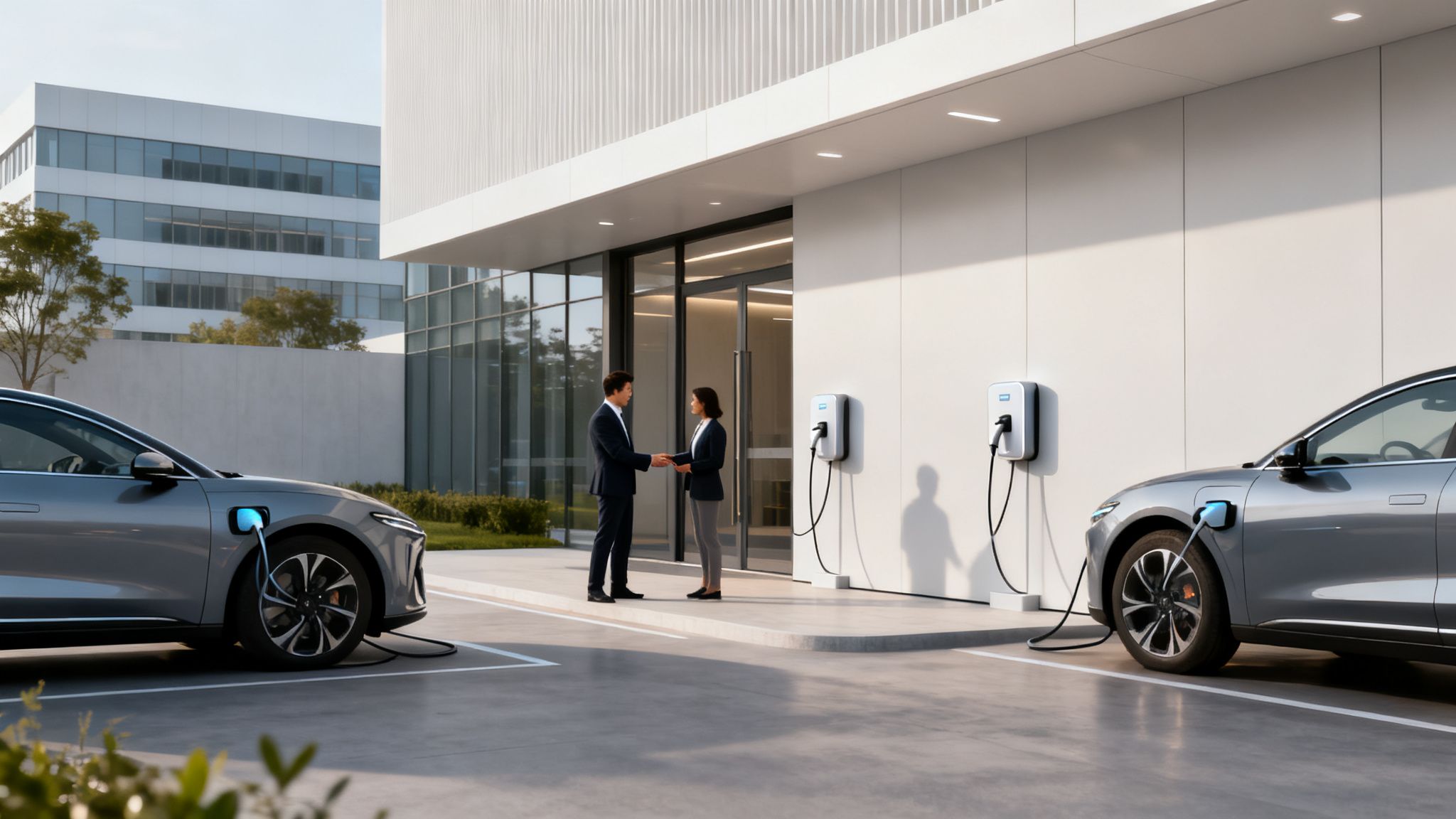
Belgian regulations are clearly steering companies towards electrification, particularly regarding company cars. If you do not offer charging infrastructure, you risk falling behind. But it is not just about compliance; it is about meeting the new expectations of employees and customers who now view a charging station as a standard amenity, just like Wi-Fi or a decent car park.
Investing in charging infrastructure is not merely an operational cost. It is a strategic move that strengthens your brand image, demonstrates your commitment to sustainability, and prepares your property for the demands of tomorrow.
A proactive approach makes you a more competitive employer and a forward-thinking business partner. A consultancy firm in Brussels that installs charging stations for its team not only helps its employees switch to electric cars but also sends a powerful signal to clients about its commitment to modern, sustainable practices.
Growing Confidence in the Belgian Charging Network
The perception regarding the availability of charging points is also changing. Public trust has improved drastically: 50% of Belgians now believes that there are sufficient charging points. A huge leap, considering that previously only 25% felt the infrastructure was adequate. Among EV drivers themselves, satisfaction with the availability of chargers has risen to no less than 95%, which proves the reliability of the growing network. You can find more insights on the electrification of vehicle fleets in Belgium at nextmobility.be.
This growing confidence accelerates the adoption of electric cars, which means that more of your employees, customers, and partners expect to be able to charge at your location.
By installing a charging station, you are not just adding a piece of hardware. You are building essential infrastructure that supports the following:
- Attracting and Retaining Employees: Top talent increasingly wants to work for employers who support their sustainable lifestyle.
- Improved Customer Experience: Offering a charging point to visitors is a demonstration of modern professionalism and hospitality.
- Future-proofing your Real Estate: Commercial real estate with charging facilities is simply more attractive to tenants and buyers, which increases long-term value.
Ultimately, the decision to install charging stations is about ensuring your company's relevance and operational readiness for a fully electric future. It is a practical step that yields immediate benefits and strategic long-term advantages.
The Different Types of Charging Stations and Power Levels
Choosing the right charging station for your electric car can seem daunting, but it comes down to one simple principle: matching the charging speed to what your business really needs.
Think of it this way: an AC charger is your trusty garden hose – stable, reliable, and perfect for cars parked for extended periods, such as your employees' vehicles during the workday. A DC charger, on the other hand, is a high-pressure fire hose. It is built for speed and designed for quick charges when time is money.
Understanding this fundamental difference is the first step. The goal is not to choose the fastest charger, but to find the charger that efficiently delivers the right amount of power, without paying too much for speed you will never use. For most Belgian companies, it is about the perfect balance between performance, cost, and the available electrical capacity of your building.
The vast majority of charging sessions occur with AC chargers (alternating current). This is the standard electricity that comes from the grid and powers our buildings. The battery of an electric car, however, can only DC (direct current) store. So when you use an AC charger, the inverter in the car itself must convert the current from AC to DC. That is why AC charging is usually slower; the car sets the pace.
Understanding AC Power Levels: The Workplace Standard
For charging at work or charging fleet vehicles overnight, AC is almost always the best choice. These chargers are available in various power levels, measured in kilowatts (kW), which directly indicates how fast a car charges.
Let's look at the most common options:
- 7.4 kW Chargers: This is a solid entry-level model, often used for home installations. They add approximately 40-50 km range per hour plus, which makes them suitable for employees with shorter commutes or for plug-in hybrids.
- 11 kW Chargers: This is the ideal choice for many Belgian workplaces. 11 kW charger adds about 60-70 km range per hour ...which is more than enough to fully charge most electric cars during a standard 8-hour workday.
- 22 kW Chargers: This is the fastest AC option, which up to 120 km range per hour adds. However, this requires a more powerful three-phase electrical connection, which not all commercial buildings have. If your grid connection can handle this and you need faster charging times for shared company cars, this is an excellent choice.
For a typical office, a 11 kW installation the ideal mix of charging speed and cost efficiency. It ensures that your team leaves with a full battery, without you having to make an expensive upgrade to your grid connection.
When DC Fast Chargers Make Sense
DC chargers are a completely different story. They bypass the small inverter in the car and pump direct current directly into the battery. To understand how this works, insight into the conversion of AC to DC voltage essential, since this is the core principle behind the incredible speeds – often of 50 kW to more than 350 kW.
A DC charger is not intended for employee daily parking.It is a specialized tool for companies where vehicle availability is directly linked to revenue.
Take, for example, a logistics company with a fleet of 20 electric vans. They cannot afford to have those vehicles standing idle for hours. 50 kW or 150 kW A DC fast charger can charge a van's battery in less than an hour to 80% Charging while the driver is on their lunch break. This way, the van is back on the road quickly to generate revenue. This makes DC charging essential for fleets that cover high mileage, taxi services, or any other activity where vehicles are constantly on the move.
Choosing the Right Charger for Your Business
To help you decide, this table compares the two main types based on the factors that are most important to a company.
| Charger Type | Customary Caps | Ideal For | Example Loading Time (20-80%) |
|---|---|---|---|
| AC Charger | 7.4 kW, 11 kW, 22 kW | Workplace, nighttime fleet charging, employee parking | 3-8 hours |
| DC Charger | 50 kW, 150 kW, 350 kW+ | High-turnover rafts, public loading stations, logistics | 20-60 minutes |
Ultimately, choosing the right charger means being honest about your daily operational needs. By understanding these core types and power levels, you can make an informed decision that truly supports your business objectives.
Evaluate Your Location for a Smooth Installation
Before you even consider ordering hardware, a successful installation of a charging station begins with a thorough analysis of your location. It is comparable to laying the foundation of a house: if you do this right, everything that follows will proceed more smoothly, efficiently, and much more cost-effectively. A thorough preliminary check prevents unpleasant surprises regarding costs and operational headaches later on.
The first step is a practical evaluation of your physical space and, crucially, your electrical installation. The detailed installation requirements for EV chargers Understanding is essential. This means looking beyond the parking spaces themselves and digging deep into the core of your building's infrastructure.
Your Electrical Fuse Box: The Heart of the Operation
Your building's main fuse box is the central hub for all your power. Think of it as the heart that pumps electricity to every corner of your facility. Before adding the significant demand of one or more charging stations, you must be absolutely certain that there is sufficient reserve capacity to safely handle the additional load.
An experienced electrician can perform a load calculation to determine exactly how much power you are currently consuming and how much is still available. Overloading your fuse box is not just inconvenient; it is a serious safety risk that can lead to costly breakdowns. If your box is already running close to its limit, an upgrade may be necessary—a crucial factor to include in your budget from the start.
This flowchart shows the basic difference between the two main charging technologies that will draw power from your system.
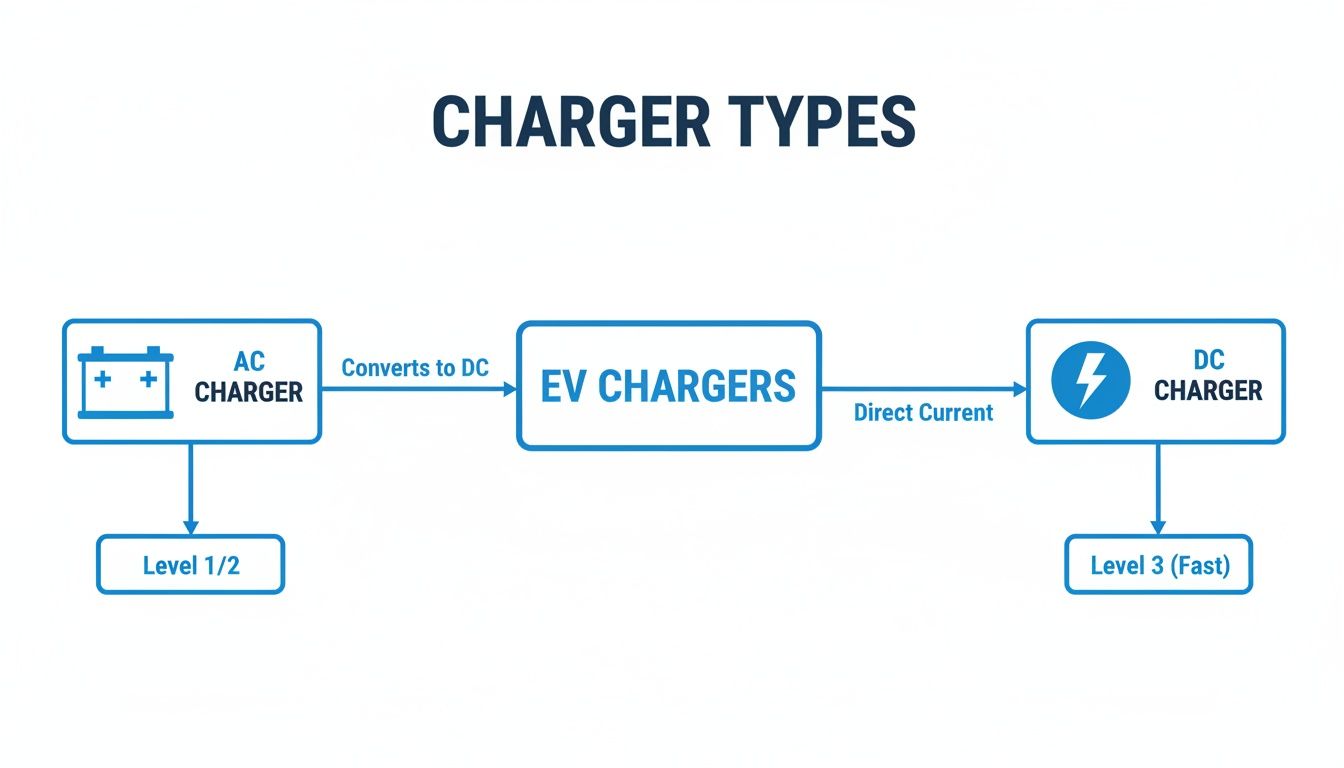
As you can see, there is a clear distinction between the slower, stable AC charging, perfect for all-day parking, and the fast, powerful DC charging, designed for quick charges.
Analyze Physical Location and Earthworks
Next, we need to consider the physical path the flow must travel.The distance from your electrical fuse box to the selected parking spaces is a huge factor in the final cost. Longer distances mean more cabling and potentially more complex and disruptive work, such as excavation.
Here are the key physical points we look at during a site visit:
- Distance to the Parking: How far do the cables need to run from the fuse box to the chargers? Shorter is always cheaper.
- Substrate Type: Do we need to break through concrete and asphalt, or can we lay cables through existing pipes or soft ground such as grass?
- Mounting options: Do you have walls available to mount the chargers to, or do you need pole mounting for parking spaces in an open car park?
A concrete example: a company with a parking lot 50 meters Installation from the main building will have significantly higher installation costs. This is due to the need for extensive excavation and heavy, armored cabling. Compare that to a company installing chargers on a wall directly next to the technical room, and the difference is enormous. Planning the most efficient route is essential to keep your budget under control.
Smart Load Management: Your Electric Air Traffic Controller
Let's now discuss an essential concept for any company that wants to install multiple chargers: smart load management. Imagine your building's power supply as an airport runway. If too many aircraft (or in this case, electric cars) try to take off at the same time, chaos ensues. Smart load management is your air traffic controller.
Instead of forcing you to undertake a massive and expensive upgrade to your grid connection, smart load management intelligently distributes the available power across all active chargers. It ensures that the total demand never exceeds your building's maximum capacity.
This technology is a real game changer. When many cars are connected, the system can slightly reduce the power to each car so that everyone charges without tripping a fuse. As soon as a car has finished charging, that power automatically becomes available to the remaining vehicles. Crucially, this avoids expensive "peak consumption" charges from your energy supplier—fines for drawing too much power at the same time. It transforms a potential electrical bottleneck into a managed, efficient, and cost-effective system.
Finding the Right Financial Model for Your Business
Choosing the right chargers is only half the battle. How you pay for them is just as crucial. The model you choose can have a major impact on your budget, cash flow, and long-term operating costs. It is about finding a solution that fits your company's financial strategy – whether that means fully owning the assets or preferring predictable monthly expenses.
For every company in Belgium, this decision is taking place in a rapidly growing market. Demand for charging equipment is exploding, driven by government targets and an increasing number of companies electrifying their fleets. Forecasts show growth of an estimated 55,670 units in 2025 to a predicted 180,470 units by 2030. This growth underscores the urgency to implement a charging solution.
To assist you with this, we discuss the three main financial models. We help you determine which model is most suitable for your organization.
Traditional Purchase: A Capital Investment
The most direct way is simply purchasing the charging stations.This is a capital investment (CapEx), which means that the hardware is your property from day one. This approach is usually suitable for companies that prefer to own their assets and have the capital available for the initial investment.
The main benefits of the purchase are:
- Full Ownership: The equipment is yours, giving you full control over its use and management.
- Potential for Higher Return: In the long term, owning the assets can yield a better return, especially if you plan to generate income from public charging.
- Access to Tax Benefits: As a capital investment, you can often apply depreciation and make use of specific Belgian tax deductions for green infrastructure.
Naturally, the high initial cost for hardware and installation can be a significant hurdle, especially for many small and medium-sized enterprises (SMEs). You are also responsible for all ongoing maintenance, repairs, and software updates, which can entail unpredictable costs.
Leasing: A Balanced Approach
Leasing offers a middle ground, allowing you to spread the costs of the hardware over a fixed period. This model lowers the financial barrier, making it much easier for companies to start with charging infrastructure without a huge upfront outlay. At the end of the lease period, you usually have the choice to purchase the equipment, enter into a new lease agreement, or upgrade to the latest technology.
This is a very attractive option if you want to keep your capital free for other business priorities but need charging infrastructure today. It provides you with a clear, fixed monthly payment that makes budgeting much easier.
Charging-as-a-Service (CaaS): The OpEx Gamechanger For companies that want maximum flexibility with zero operational worries, Charging-as-a-Service (CaaS) is the perfect solution. This is a purely operational expenditure (OpEx) model. Instead of purchasing hardware, you pay a simple, predictable monthly fee. In return, we take care of absolutely everything: the chargers, professional installation, smart management software, ongoing maintenance, and 24/7 support.
Suppose you are a property manager furnishing a new office building with 10 Charging stations. Purchasing these can entail an initial investment of tens of thousands of euros. With our CaaS model, you completely bypass this initial cost and instead pay a manageable monthly subscription. This frees up capital, simplifies your accounting, and guarantees that your charging infrastructure is always expertly managed and maintained by us. It is the most worry-free way to offer a professional charging solution.
Calculate Your ROI and Utilize Belgian Subsidies
Investing in charging infrastructure for electric vehicles is not just about supplying power; it is a financial decision that requires a clear view of costs and returns. To get the full picture, you must look beyond the initial price for hardware and installation and focus on the Total Cost of Ownership (TCO) and your Return on Investment (ROI). It is all about calculating long-term savings and discovering new ways to generate income.
When you weigh the initial investment against the enormous operational savings and the powerful government incentives available here in Belgium, the true financial picture becomes clear.For many companies, the numbers are not just good, they are revolutionary. A smart charging strategy can pay for itself surprisingly quickly and start generating a healthy return.
Mapping out Costs and Benefits
The initial cost of a charging station is merely the starting point. A correct ROI calculation must take into account ongoing costs such as operational expenses, maintenance, and any software subscriptions. But even more importantly, it must weigh these against the significant financial benefits that accumulate over time.
These benefits often include:
- Lower Fuel Costs: This is the most obvious gain. You replace expensive petrol and diesel with much more affordable electricity.
- Lower Maintenance Costs: Electric cars have far fewer moving parts than cars with an internal combustion engine. This means significantly lower maintenance and repair costs over the lifespan of the vehicle.
- New Revenue Sources: By making your chargers public, you can generate direct revenue. You turn what could be an expense into a profit center.
Let's take a concrete example. A Belgian SME with a fleet of 15 vehicles, each approximately 30,000 km drive per year, could see a huge difference. If their petrol cars average 8L/100km consume €1,80/L, they give annually €64.800 out on fuel. An equivalent electric fleet, charging at night at a business rate of €0,30/kWh, would only €16.200 on electricity costs. That is an annual saving of €48.600.
Leveraging Essential Belgian Fiscal Incentives
The Belgian government actively encourages companies to install charging infrastructure by offering very attractive tax deductions. These incentives are designed to reduce your net investment and accelerate your ROI, making the switch to electric an even easier decision.
For companies in Belgium, current regulations offer an increased cost deduction for the installation of intelligent, publicly accessible charging stations. Think of it as a direct financial reward for investing in infrastructure that benefits the entire community.
To qualify, your charger must be "intelligent," which simply means it can communicate its status and usage data—something all Blulinc solutions do by default. It must also be accessible to third parties, even if only outside your normal business hours. By meeting these conditions, you can claim a significant tax deduction, which lowers the real cost of your investment. You can learn more about the specific details of the CREG tariff for your charging station to ensure that you are fully compliant and achieve maximum financial benefit.
Calculate Your Long-Term Return
A true ROI calculation also takes into account the less tangible, but equally important benefits. Strengthening your company's image as a sustainable leader can attract new customers and top talent. At the same time, you make your property future-proof and increase its long-term value in a market that is rapidly leaving fossil fuels behind.
When you add it all up – the operational savings on fuel and maintenance, the strong Belgian tax deductions, and the potential for new revenue – the financial arguments for installing a charging station are undeniable.It is a strategic move that yields returns on multiple fronts, from your operating results to your brand reputation.
We can help you prepare a detailed financial projection for your specific situation. Request a free consultation today to calculate your potential savings and build a solid business case for your charging project.
Why Smart Management Software Is the Real Gamechanger
An electric car charging station is merely the hardware; it is the software running behind the scenes that truly unlocks the potential for your business. Think of it this way: the charger is a powerful tool, but the management platform is the intelligent operator that dictates exactly what needs to be done, when, and for whom.
For any serious business application, a central management platform is not just a nice-to-have; it is absolutely essential. It transforms your chargers from simple sockets into smart, data-rich assets that increase efficiency and provide you with critical insights into your business operations. Without this platform, you are flying blind.
From One Dashboard to Total Control
Imagine you run a company with offices in Antwerp, Ghent, and Brussels, each with its own set of chargers. A smart management platform brings this entire network together under one digital roof.
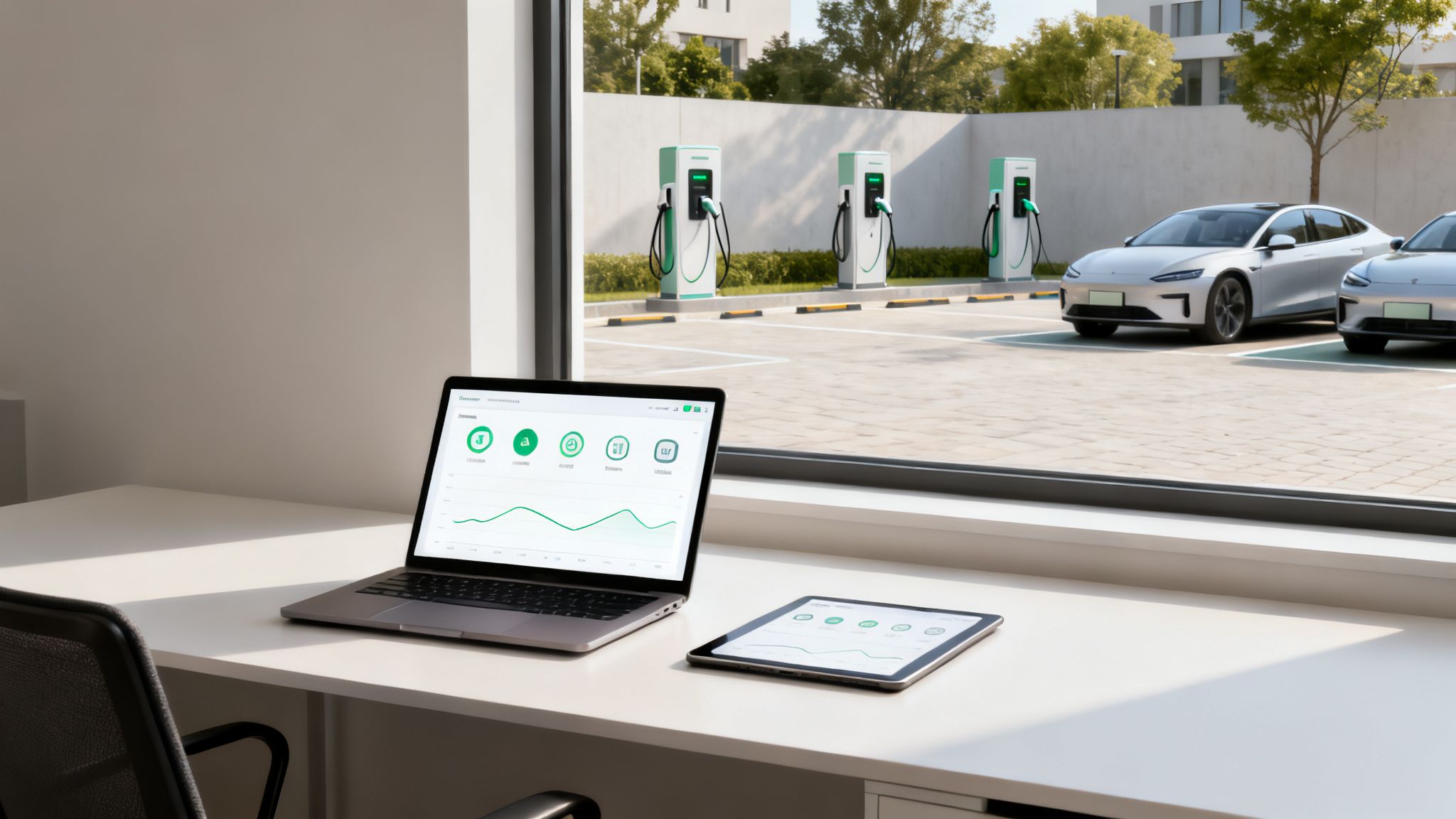
From a single screen, you can oversee every part of your charging ecosystem:
- Real-time Monitoring: See immediately whether a charger is occupied, free, or requires maintenance. This proactive approach ensures that your network runs smoothly, with maximum availability for every driver.
- Dynamic Pricing: Set different charging rates for different groups. You can offer free charging for employees, a reduced rate for registered visitors, and a competitive public rate for everyone else – all managed automatically.
- Usage insights: Monitor energy consumption, charging time, and peak hours. This data is invaluable for optimizing your energy costs and planning for future growth.
This level of control means you can efficiently manage your assets, wherever they are located. You can learn more about how this connects to your building's infrastructure in our guide on the activating the P1 port on your smart meter.
Automating Complex Processes, Such as the Reimbursement for Home Charging
One of the biggest operational benefits is automating the reimbursement of charging costs for employees at home. When you equip an employee with a smart charger for their company car at home, our platform takes care of the rest. It accurately tracks the electricity used for business charging and automates the entire reimbursement process based on the rate set by your company.
This simple change puts an end to manual expense reports, saves your administrative team countless hours, and gives your staff a fair, transparent system they can trust.
Smart software is the bridge between your physical chargers and your business objectives. It takes complex tasks such as monitoring, invoicing, and reporting off your hands, allowing you to focus on your core activities.
The Belgian charging infrastructure is growing at an incredible pace and is expected to reach a milestone of by the end of 2025. 106,677 public and semi-public charging points reach. This dense network supports scalable solutions for companies like yours, enabling multi-location management and giving your employees seamless access to more than 900.000 charging points throughout Europe.
Our platform integrates with this extensive network, making the transition to electric mobility simple and efficient for your entire fleet.
Ultimately, investing in smart management software is what elevates your charging infrastructure from a simple facility to a powerful, integrated part of your business strategy.
Your Questions About Charging at Work, Answered
As you explore what an electric vehicle charging strategy looks like for your company, you will undoubtedly have practical questions. We understand that. Clear, simple answers are essential for planning with confidence. That is why we have collected some of the most frequently asked questions we hear from companies like yours.
How Long Does a Typical Installation Take?
This depends heavily on what we find at your location. For a simple job – where your electrical fuse box has sufficient reserve capacity and the chargers are placed nearby – we can often complete everything in one day.
However, more complex projects can take several days, especially if we need to dig trenches for new cabling or carry out significant electrical upgrades. Therefore, we always start with a detailed site survey. This allows us to provide you with a precise, realistic schedule and ensure that we keep disruption to your daily operations to an absolute minimum.
Can I Offer Public Charging and Generate Revenue?
Absolutely. This is one of the biggest advantages of a smart charging system. Our management software gives you full control, allowing you to set different rates for different groups of users.
A popular approach we often see is offering free charging for employees during the workday, and then opening the charging stations to the public at a competitive rate in the evenings and on weekends. This not only provides a fantastic service to your local community but also creates a new revenue stream that helps you recoup your investment faster.
Think about this: A retail park can offer charging as an extra to attract shoppers during the day, and sell that same electricity to local residents at night. It turns a business asset into a real source of income.
What Happens If a Charger Has a Problem?
Keeping your chargers operational is our top priority. Our smart chargers are constantly connected to our central platform, which means we can monitor their status in real time. We can often detect and even resolve problems remotely before you or your drivers notice anything is wrong.
If a problem does require an on-site intervention, our maintenance plan ensures that a qualified technician is dispatched quickly to get the station back online. It is all about a proactive approach to provide a reliable and seamless charging experience for every user.
How Does Home Charging Reimbursement Work for Employees?
We have made this process fully automatic and hassle-free. When we install one of our smart chargers at an employee's home, it accurately records every kilowatt-hour used to charge the company car.
Our platform then automatically calculates the correct reimbursement based on your pre-agreed rate and generates a simple report for your payroll administration. This puts an end to manual expense reports, saves your administrative team a tremendous amount of time, and guarantees a fair and transparent system for everyone.
Ready to take the next step with a clear and effective charging strategy for your business? The experts at Blulinc are ready to provide you with the answers and support you need.