


You are investing in electric vehicles for your Belgian company and come across the term 'CREG tariff for charging stations'. It might feel like solving a complex puzzle. Let's be clear: there is no fixed, simple tariff for charging your electric cars. What you pay is a mix of the energy price, net costs, levies and the new, crucial capacity rate.
What does the CREG tariff mean for your charging stations?
Many companies struggle with the question of what it really costs to charge their fleet, their employees' cars, or their customers' cars. This guide is intended to clear up that confusion and give you back control. The CREG, the Belgian energy regulator, sets the rules for your electricity bill, but understanding how this affects your charging costs requires a smart approach.
Gaining insight into the various components of your invoice is the first step towards managing your operational costs. We will break everything down for you, piece by piece, so you don't need to be an energy expert. This allows you to make informed, strategic choices as your company makes the switch to e-mobility.
The building blocks of your charging costs
The final price you pay per kilowatt-hour (kWh) is made up of various components that together form the "CREG tariff". These are the key elements you need to know:
- The Energy Price: This is the base cost of the electricity itself, which fluctuates with supply and demand on the energy market.
- Net costs: These costs cover the transport of electricity from the power plant to your business location, via the high- and low-voltage grid.
- Levies and VAT: These are the various taxes and surcharges that the government levies on top of your energy consumption.
- The Capacity Rate: This is perhaps the biggest change. This part of your bill is calculated based on your highest consumption peak during the month.
A common mistake is thinking that the CREG publishes a specific "charging station tariff". That is not the case. The CREG determines the method grid operators use to calculate their tariffs – including the capacity tariff – which subsequently has a direct impact on your charging costs.
A practical example
Imagine: your fleet of 20 vehicles It is plugged in to charge precisely at 9 a.m. That single moment creates a huge peak in your electricity demand. Even if the total amount of energy consumed that day is quite low, that one peak will drive up your capacity rate for the entire month, resulting in an unpleasant surprise on your bill.
This is exactly where a smart charge management system proves its value. By simply spreading out the start times of each charging session, you smooth out that peak, keep your capacity rate low, and get your costs under control. In the following sections, we will delve deeper into how you can analyze and optimize these costs.
Decipher your electricity bill for electric charging
To truly understand your charging costs, you must first know what you are paying for. Do not view your electricity bill as a single amount, but as a detailed overview. Each item contributes to the final cost of the Creg charging station tariff.
Analyzing this invoice reveals four main components. Knowledge of each component is the secret to discovering real savings opportunities and ensuring that your switch to electric mobility becomes a financial success.
The four pillars of your charging costs
Your total electricity bill is a mix of various costs, which are determined or influenced by the CREG. Each component has a specific function, and together they determine the final price you pay per kilowatt-hour (kWh) at your charging stations.
These are not abstract figures on paper; they have a direct impact on the cost of powering your fleet daily. Let's break them down.
-
Energy cost: This is the pure price of electricity as a product. It fluctuates with supply and demand on the wholesale market, similar to petrol prices. The exact rate is stipulated in the contract with your energy supplier.
-
Network costs: This part of the invoice covers the transport of electricity from the power plant to your company. It includes the maintenance, operation, and expansion of the physical infrastructure – the electricity cables, transformers, and everything in between.
-
Levies and VAT: These are government-imposed charges, such as VAT and other federal or regional energy levies. They are applied to your total consumption and fund public services and green energy initiatives.
-
Capacity rate: This is the most important and often most misunderstood component for companies with charging stations. It is a fee based on your highest average electricity consumption during a quarter of an hour within a specific month. It is designed to encourage everyone to spread their energy consumption and avoid overloading the grid.
This diagram shows how the base energy price, grid costs, and taxes together make up your final charging costs.
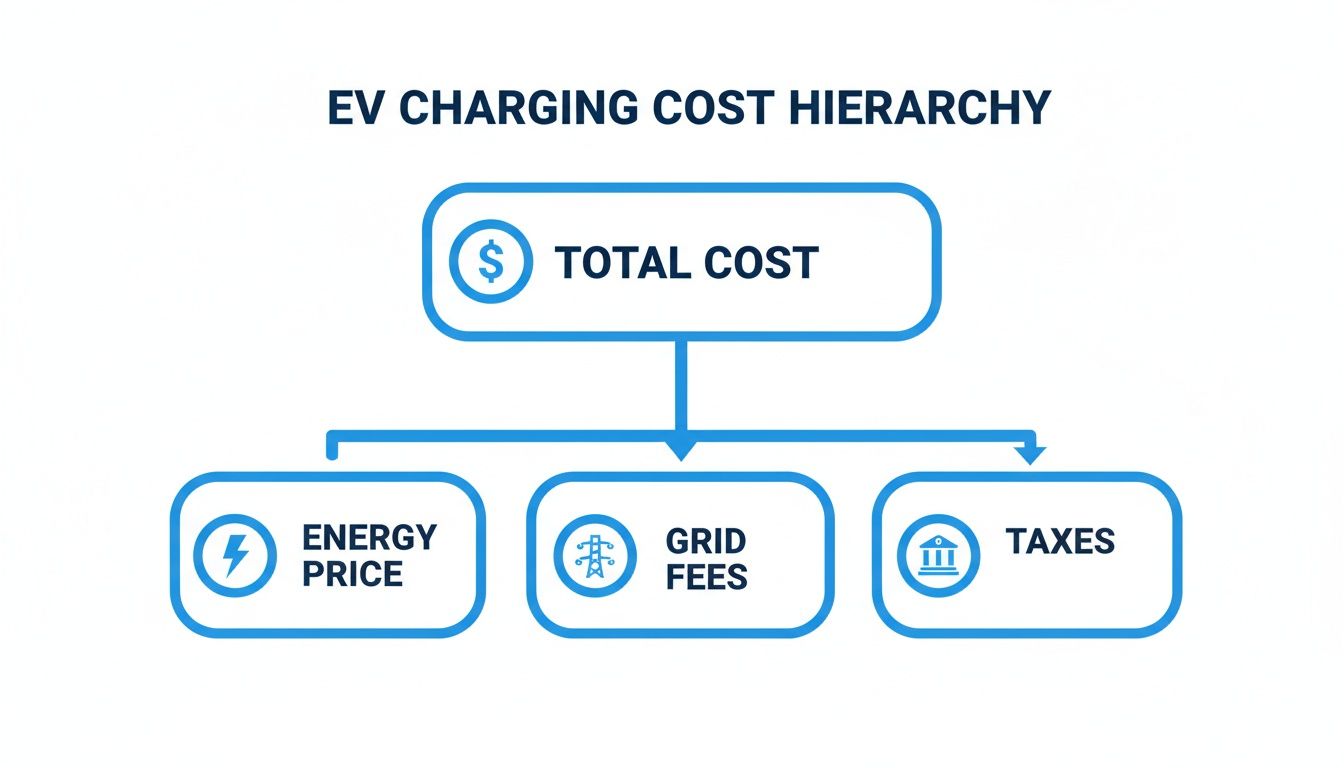
As you can see, the final price depends on much more than just the electricity itself. It also involves the distribution network and the associated government levies.
Anatomy of the CREG tariff for electric charging
To truly understand how these components work together, it helps to view them side by side. Consider it the recipe for your final electricity price.
| Rate component | Analogy | Who determines the rate? | Impact on electric charging |
|---|---|---|---|
| Energy cost | The fuel for your car. | Your energy supplier | The basic cost of the electricity used to charge your vehicles. |
| Net costs | Toll for the use of the motorway. | Grid operators (e.g. Fluvius, Elia) | Covers the costs of supplying electricity to your charging stations. |
| Levies & VAT | Road tax and VAT on fuel. | Federal & regional authorities | A mandatory percentage that is added to your total energy bill. |
| Capacity rate | A fine for causing a traffic jam. | Grid operators, regulated by the CREG | Penalizes high, concurrent power demand, such as the simultaneous charging of many EVs. |
Understanding this breakdown is the first step towards strategically managing your charging sessions to keep that final price per kWh as low as possible.
How the capacity rate really affects your business
The capacity tariff is a game changer for every company that operates charging stations.Unlike your regular energy consumption, which is measured in kWh over the entire month, the capacity rate is determined by your highest power peak (measured in kW).
Here is an analogy: suppose the electricity grid is a highway. The energy cost is like paying for the fuel you consume during your drive. It capacity rate On the other hand, it is like paying for the width of the road itself. If you suddenly send a huge convoy of trucks (a high power peak) onto the road at the same time during rush hour, you need a much wider and more expensive highway to handle that sudden increase.
The capacity tariff effectively penalizes simultaneous high power consumption. For a business, this means that connecting multiple EVs at the same time as other heavy machinery is running can create a costly power spike that blows up your grid costs for the entire month.
If, for example, you have a fleet of 20 has vehicles that are all connected at 9 a.m., your power demand can peak from 50 kW to more than 200 kW. Even if they only charge for a few hours, that single peak determines a high capacity rate for your entire billing cycle. This is exactly why managing when charging is just as important as managing how many you charge.
The role of the CREG in the reimbursement of home charging sessions
The influence of the CREG does not stop at your office. It also plays a crucial role in establishing the rules for reimbursement to employees who charge their company cars at home. To keep things simple, the Tax and Customs Administration accept a flat-rate reimbursement per kWh, provided it does not exceed the official CREG rate published quarterly for Flanders, Brussels, and Wallonia.
For Q2 2025 are the provisional maximum rates:
- Flanders: 31.94 cents/kWh
- Brussels-Capital Region: 35.84 cents/kWh
- Wallonia: 36.17 cents/kWh
To qualify for this tax-friendly reimbursement, your company needs a solid system to accurately record the electricity used for the company car. You can read more about this in our guide on split billing and VAT for refunds to employees. Such a system ensures fair and compliant handling and prevents the reimbursement from being taxed as an additional benefit in kind. Without this system, you are navigating blindly.
Who pays the CREG rates at various charging points?
Understanding the CREG tariff structure is one thing, but knowing who ultimately pays the bill is truly crucial for controlling your costs. The responsibility for the Creg charging station tariff After all, it depends entirely on where the charging station is located.
Depending on the charging situation, that responsibility shifts, and this has a direct impact on how you manage your charging infrastructure, pass on costs, and comply with all regulations. Let's take a closer look at the three most common scenarios for Belgian companies.
Charging at work
When you install charging stations on your own company premises, the situation is the most straightforward. Your company has the energy contract and therefore the connection to the grid. This means that you directly responsible are responsible for all components of the energy bill.
- Direct liability: You pay the energy costs, network costs, levies, and the capacity tariff directly to your energy supplier and grid operator.
- Full control: This puts you in complete control. You can optimize charging costs with smart charging and load balancing to avoid expensive consumption peaks.
With this model, you can easily offer charging sessions as a perk for your employees or as a paid service for visitors. However, it does require a robust management platform to accurately track usage and correctly allocate costs.
Home charging by employees
For employees with a company car who charge at home, the situation is completely different. It is the employee who holds the residential energy contract in their name and therefore receives the invoice from the energy supplier. In this case, your company is not the direct payer of the CREG tariffs.
Your responsibility lies in the refund of those costs. To do this in a fiscally correct and efficient manner, you need a watertight system that can separately record the exact energy consumption of the company car. Otherwise, correct reimbursement is simply impossible.
A smart home charging station that communicates with a central platform is not a luxury here, but an absolute necessity. It guarantees that you only reimburse business charging costs and meet the requirements of the tax authorities, so that this is not considered an ancillary benefit in kind.
You can read more about the specific requirements in our article about new obligations for charging points.
Public loading
At public charging points – think of those in shopping centres, public car parks, or along the motorway – the Charge Point Operator (CPO) the party that pays the CREG tariffs. The CPO is the owner of the charging infrastructure and holds the contract with the grid operator.
The price you pay as a driver at the charging station is an all-in rate set by the CPO. This rate covers:
- The underlying energy and network costs (including the capacity tariff).
- The operational costs for maintenance and management.
- A profit margin for the CPO.
The growth of public charging infrastructure is essential for the transition to e-mobility. By 2025, Belgium crossed the milestone of more than 100,000 public charging points, which firmly puts our country on the map as a mature EV market. This growth, largely driven by leasing companies, included an increase of 22% in AC charging points and paves the way for even broader adoption of electric vehicles.
For businesses, this means that publicly accessible charging points can become an interesting new revenue stream. As a CPO, you can determine the rates yourself, but it is crucial to correctly factor in the underlying CREG costs. The Blulinc platform simplifies this process and provides you with the tools to measure consumption, set rates, and fully automate billing for each of these scenarios.
The CREG tariffs in practice: realistic business scenarios
Theory is one thing, but seeing how it Creg charging station tariff How it plays out in practice is where it becomes truly clear. Let’s leave the abstract concepts of grid costs and capacity tariffs behind and see how they affect businesses on a daily basis.
We will go through a few common scenarios. You will quickly see how a little smart planning can make a huge difference to your bottom line.This is not just about advanced technology; it is about making smart financial decisions.
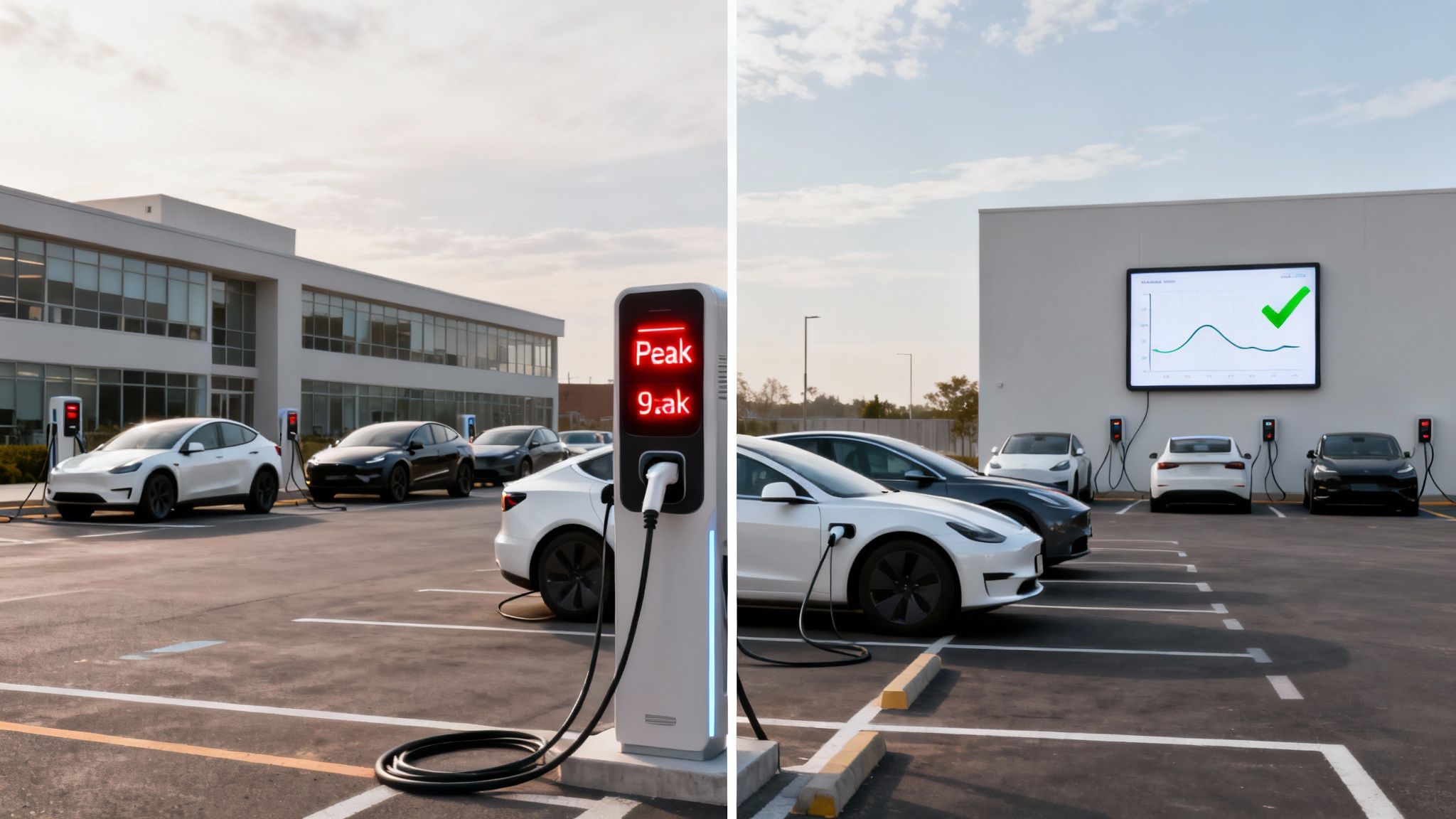
Scenario one: The SME with unattended charging at work
Imagine a medium-sized company with a fleet of 10 electric vehicles. The workday begins, and employees arrive between 8:30 and 9:00. What is the first thing they do? Plug in their cars.
Without a smart charging system, this leads to a predictable – and expensive – result.
Every car starts drawing power at exactly the same moment. This creates a huge, sudden peak in the company's energy demand, all packed into a very short timeframe. This is precisely the kind of activity that the capacity tariff is intended to discourage.
- The problem: You have 10 EVs, each 11 kW consume. That is a combined, immediate demand of 110 kW. This peak occurs just as the office comes to life – lights on, computers started up, coffee machines in operation. This power surge establishes a new, very high monthly peak.
- The financial impact: The capacity tariff portion of their electricity bill is skyrocketing. Even if the cars only charge for a few hours, that one determines 15-minute peak a large part of their network costs for the full month. The company is effectively paying a hefty fine for an inefficient morning routine.
This is a classic pitfall for companies just starting with electric charging. It is easy to focus solely on the total energy consumed (kWh) and completely overlook the impact of peak load (kW). That inattention leads to unpleasant surprises on the monthly bill.
Scenario two: The same SME, but with smart charging
Now let's rewind and play that same morning again. This time, a smart loading platform manages like Blulinc the charging sessions. The hardware is the same – 10 chargers for 10 cars – but the approach is completely different.
The system uses dynamic load management to coordinate the charging sessions. Instead of a chaotic start, the platform is deployed smartly.
It continuously monitors the total energy consumption of the building and intelligently distributes the available power. For example:
- It can start by charging five cars at a reduced power of 7 kW each.
- As those cars fill up or the building's total energy consumption decreases (for example, after the morning rush hour), it increases the power supply to the other vehicles.
- The system ensures that every car is fully charged by the end of the workday, but does so without creating that disastrous energy peak.
The result? A much flatter, more stable energy demand curve. The peak load on the chargers is drastically lower, which means a much more favorable capacity rate. By simply spreading the charging, the company would reduce the capacity rate portion of its bill by more than 50% can lower. Smart charging is not about using less energy; it is about using it more intelligently.
Scenario three: The retail park as charging station operator (CPO)
Let's look at another model. Imagine a retail park that wants to offer public charging as a service for customers and as a new source of revenue. In this case, it becomes a charging station operator (CPO). The goal is not only cost control but also generating profit.
The establishment of a public Creg charging station tariff requires a delicate balancing act.The CPO must juggle various factors to determine a price that is both attractive to directors and profitable.
- Net costs: This includes the basic CREG rates, with special attention to the capacity rate, which is influenced by the number of shoppers charging simultaneously.
- Energy prices: The wholesale price of electricity changes constantly. A fixed charging price is a recipe for loss.
- Operational costs: You must take into account maintenance, software costs, customer support, and payment processing fees.
- Profit margin: Naturally, a margin must be added to make the whole thing profitable.
A CPO using a robust platform like Blulinc can implement dynamic pricing. This allows the retail park to offer lower rates during off-peak periods to attract more drivers, while prices during peak hours remain high enough to cover increased costs. This strategic approach transforms their charging points from a simple cost center into a valuable, revenue-generating business asset.
Get a grip on your charging costs
The ins and outs of the Creg charging station tariff Knowing them is one thing; actually managing those costs is where you start to see real savings. With a few smart moves, you can transform your charging infrastructure from an unpredictable expense into an efficient and well-managed asset.
It is not just about consuming less electricity. It is about using it smarter. Let’s walk through three powerful ways to lower your costs and take full control of your charging operations.
Use Dynamic Load Management
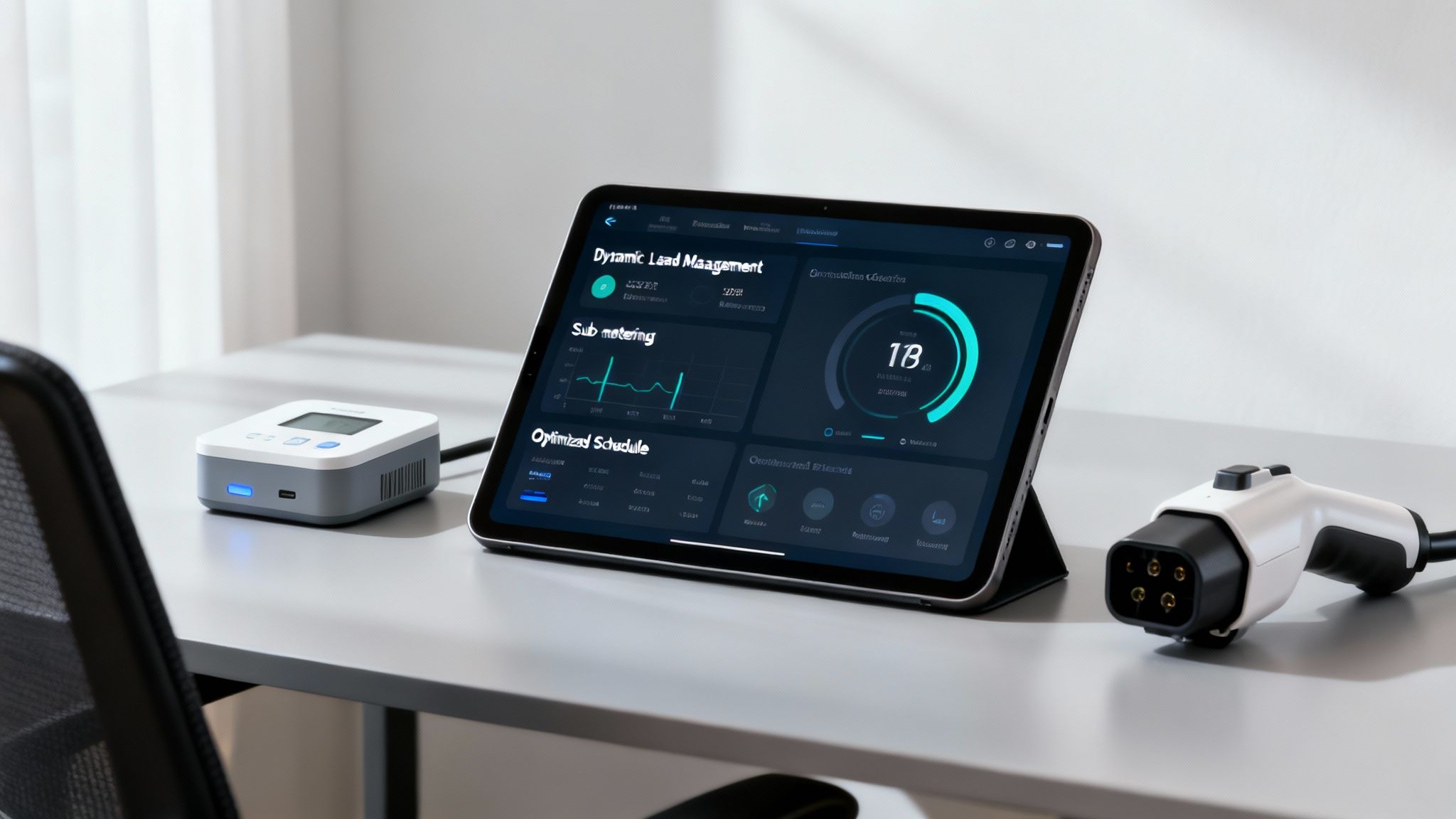
Consider Dynamic Load Management (DLM) as an intelligent traffic controller for the electricity in your building. It constantly monitors the total power consumption of your location and adjusts the power supply to each charging vehicle in real time.
DLM's primary task is to avoid those expensive consumption peaks that drive up your capacity rate. Instead of having every connected car immediately draw maximum power, DLM intelligently distributes the available power across all vehicles.
By setting a power cap for your entire location, a DLM system ensures that your chargers never push you over a new, more expensive consumption peak. It is easily the most effective tool you have to tame the capacity rate.
Suppose a fleet of 20 vehicles starts charging simultaneously. That can easily cause a power peak of more than 200 kW cause. With DLM, that demand is spread across day and night, keeping your peak low while ensuring every vehicle is fully charged and ready for use. This single change can often halve the capacity tariff portion of your bill.
Use smart meters and submeters
You cannot manage what you do not measure. That is where smart metering comes in, giving you a crystal-clear, live overview of your energy consumption, down to the level of the individual charging station.
This kind of detailed data is worth its weight in gold for various reasons:
- Accurate invoicing: This allows you to invoice various user groups – such as employees, visitors, or the public – with complete accuracy.
- Detecting waste: You can easily see where energy is being wasted, such as chargers running during peak hours or having standby consumption when not in use.
- Fair refund: For employees who charge at home, a certified meter is a must for tax-compliant reimbursement. It guarantees that you only pay for energy used for business purposes.
By adding submeters, you can completely separate the electricity used by your chargers from the rest of your building. This gives you the granular data you need to make smart decisions and optimize your entire charging network.
Determine your charging schedules
Timing your charging sessions to times when electricity is cheapest is another fantastic strategy. Electricity prices fluctuate, and you will almost always find lower rates at night or during other off-peak hours.
A smart charging platform allows you to set up schedules that automatically start charging sessions when energy costs are lowest. This is especially powerful if you have solar panels at your location. You can program your chargers to use all that self-generated, virtually free solar energy before tapping into the grid.
These tactics receive an extra boost from government subsidies. The Belgian incentive measures for electric charging, for example, have been a key factor in the growth of the sector. Companies can benefit from a tax reduction of up to 31 August 2024 200% receive for smart, publicly accessible charging points. In Brussels, companies can even receive tax savings of up to €75 receive per office parking space with charging points.
In addition to electric charging, investigating broader strategies for energy saving to provide a broader picture of savings. Ultimately, it is the partnership with a provider whose platform combines all these features that truly turns your charging infrastructure into a financial advantage.
Let Blulinc simplify your CREG tariff management.
Understanding the Belgian CREG tariff landscape does not have to be a solo mission. The entire system, from the capacity tariff to the rules for reimbursement of your Creg charging station tariff, can feel overwhelmingly complex. This calls for a smart, robust solution. That is exactly what we built the Blulinc platform for – it is designed to turn a potential headache and cost into a smoothly managed asset.
Our centralized dashboard gives you a live, real-time overview of your energy consumption, giving you full control over your entire charging setup. In the background, our smart load balancing technology works around the clock to keep your capacity costs low by preventing costly energy peaks.
We also automate the entire invoicing and reimbursement process, whether it involves charging at work, in public, or at an employee's home. This ensures that everything is fair, accurate, and perfectly in line with Belgian regulations. You can learn more about our all-in-one solution. charging station management platform and discover everything it can do.
Your experienced e-mobility partner
With a combined experience of a decade and a half helping hundreds of Belgian SMEs, we see ourselves as more than just a technology supplier. Consider us your expert partner who guides you and translates complex regulations into charging solutions that are both efficient and cost-effective. In a market that is growing so fast, that kind of experience is essential.
Just look at the figures. The Belgian public charging network exploded in 2023, with a huge leap of 82% from 24,100 points in 2022 to approximately 44,000. This massive move towards electrification makes smart management more crucial than ever.You can read more about this trends on the Belgian EV market on Mordor Intelligence.
At Blulinc, our goal is simple: to offer you complete control and peace of mind. We take care of the technical complexity, so you can focus on what you do best: running your business, knowing that your charging infrastructure is optimized for performance and cost.
Ready to get a grip on your charging costs and prepare your business for the future? Contact us for a free consultation and let's explore together how we can help you.
Do you have questions? We have answers.
We get it – navigating the CREG tariff can feel like a maze. Let’s clarify some of the most common questions we hear from companies like yours.
What is the real difference between a CPO and an e-MSP when it comes to rates?
Think of it this way: the Charge Point Operator (CPO) is the owner of the hardware. They manage the physical charging stations, arrange the grid connection, and are the ones who actually pay the CREG tariffs to the energy supplier. They determine the 'wholesale price' for a charging session.
The e-Mobility Service Provider (e-MSP), on the other hand, is the company that provides drivers with a single card or app to access charging stations from many different CPOs. The price you see from an e-MSP is the CPO's rate with a service fee on top. When you partner with Blulinc, we can act as your CPO, giving you control over your infrastructure and costs.
We only have a few charging stations. Does the capacity tariff really matter?
Absolutely, and it might surprise you. The capacity rate is not about how much energy you consume in total; it is based on your highest 15 minutes power peak of the entire month.
Imagine two employees plugging in their cars at the same moment your office air conditioning kicks in. Boom. You have just created a new monthly peak, and your grid costs for the entire month have risen. Smart charging is the answer here. By simply spreading out the start times of those charging sessions—even by a few minutes—you can smooth out that peak and keep your energy bills predictable.
Can we offer different charging rates for our staff and visitors?
Yes, and this is exactly where a professional management platform excels. The software from Blulinc is designed to allow you to create different user groups – such as Employees, Management, Visitors, or the Public – and set a unique rate for each.
You can offer free charging as a benefit for your team, set a simple fixed rate for visitors, and charge the public a market-based price. All of this happens from a single central dashboard, giving you the flexibility to create a fair usage policy or even open a new revenue stream.
Is it better to reimburse employees for charging at home or to let them charge at the office?
Frankly, the best approach really depends on how your company operates. Reimbursing home charging is incredibly convenient for your employees. With a smart charging station, you can easily separate their private energy consumption from their business charging sessions for simple, accurate reimbursement.
On the other hand, charging at the workplace gives you much more control over your energy costs, especially if you have invested in solar panels. Many companies we work with ultimately use a hybrid model.Blulinc's platform handles both scenarios seamlessly, automating all tracking and split-billing to simplify your payroll administration and keep everything compliant.
Ready to stop guessing and start managing your Creg charging station tariff? Leave Blulinc bring the clarity and control you need. Request a free consultation today and discover how our smart solutions can optimize your charging costs.