

The Mercedes EQC 400 is a fully electric, premium SUV that combines luxury, performance, and sustainability. It is therefore no surprise that this model is a popular choice for Belgian corporate fleets. Especially for executive cars, the EQC 400 is a serious contender and a clear step towards a greener fleet. But is it really the right choice for your company?

The EQC 400 as a strategic choice for your fleet
The decision to electrify your fleet is a major step, and choosing the right vehicle is crucial. The Mercedes EQC 400 is much more than just an electric car; it is a statement that reflects your company's values: progressive, quality-conscious, and focused on sustainability. But beyond image, a company car must, of course, above all be practical and economically sound.
For Belgian companies, from SMEs to large enterprises, the EQC 400 offers a very attractive overall package. The mix of a refined driving experience, a comfortable interior, and a solid range makes it ideal for daily commutes, client visits, and even longer journeys on our motorways.
Why the EQC 400 aligns with the Belgian market
The popularity of electric vehicles in Belgium continues to grow. Since its launch, the Mercedes EQC 400 has secured a strong position within this segment. For Belgian fleet managers and SMEs, this growth underscores the vehicle's appeal. The luxurious finish, smooth performance, and a range perfect for most business trips make it a logical choice. The growth of Mercedes EVs demonstrates the resilience of the market, even facing challenges such as phasing out tax benefits. Would you like to know more about Belgian car sales figures and the position of EVs? You can read more about it here..
With the accelerated transition to electric mobility, driven by fiscal incentives such as the 100% deductibility and the low Benefit in Kind (BIK), the EQC 400 becomes an even more interesting option. It is a car that not only meets the driver's requirements but also the financial and operational goals of your company.
The right charging infrastructure is the key to a successful transition. Without a reliable and efficient charging solution, both at the office and at the employee's home, even the best electric car cannot realize its potential.
At Blulinc, we understand that a vehicle is only one part of the larger mobility ecosystem. That is why we offer a complete charging solution that perfectly aligns with the needs of the EQC 400 and your company. From smart charging points in the workplace that optimize energy costs to seamless reimbursement for your employees' home charging sessions, we ensure that your transition to electric driving runs smoothly.
On the track in Belgium: how far does the EQC 400 really get?
The official WLTP figures are one thing, but the daily reality on Belgian roads is often another story. What does that theory mean when you are stuck in traffic on the Antwerp or Brussels ring road, trying to maintain a constant speed on the E40, or setting off on a freezing cold morning in the Ardennes?

As a fleet manager, you need to know what you can really expect from a vehicle. Where the EQC 400 has a range of around on paper 414 kilometers (WLTP) achieves, in practice you can count on 320 to 380 kilometers. That is a realistic range that depends heavily on driving style, outside temperature, and the type of route.
Driving experience and comfort: more than just a commercial vehicle
One of the absolute strengths of the Mercedes EQC 400 is its exceptional comfort. The car is whisper-quiet, ensuring a remarkably relaxing driving experience. For employees who spend hours on the road every day, that makes a world of difference. The absence of engine noise and vibrations significantly reduces fatigue, especially on longer journeys.
And then there is that instant acceleration characteristic of electric cars. Overtaking on the motorway or smoothly merging into busy city traffic? Child's play. This makes the EQC 400 not only an environmentally responsible choice, but also a dynamic and extremely pleasant car for daily professional use.
The true value of an electric company car lies not only in the figures on paper, but in the reliability and comfort it offers every day. It is a mobile office where your employees can be productive and relaxed.
The combination of luxury, silence, and performance reflects positively not only on the well-being of your employees but also on the image of your company.
Practical example: a business trip from Antwerp to Luxembourg
Suppose your account manager has a crucial meeting in Luxembourg. A drive of about 220 kilometers from Antwerp. This is the perfect scenario to see what the EQC 400 is capable of.
- Departure: With a full battery (100%), the outward journey is a piece of cake. Even on a winter day, when the range drops to roughly 320 km, Your employee gets there without charging stress or stops.
- Arrival: Upon arrival in Luxembourg, there is still more than enough battery capacity remaining. The car can be plugged into a public charging point in the city or – ideally – at the customer's own location.
- Return journey: While the meeting of a few hours is underway, the car charges. Even a short session at a fast charger (DC) fills the battery. 30-40 minutes back on until 80%. More than enough for a worry-free return trip.
This example perfectly demonstrates that the range of the EQC 400 is more than sufficient for most business trips in and around Belgium. With a little planning and a Blulinc charging card in your pocket, range anxiety past tense. This way, the EQC 400 gives your employees the freedom and flexibility they need.
A practical guide to charging your EQC 400
The key to maximizing your electric fleet is understanding the charging options. It is simpler than it sounds and comes down to two options: daily charging via alternating current (AC) and fast charging via direct current (DC) when you need to get back on the road quickly.
Each method has its own role. Understanding the difference is crucial to keeping your vehicles on the road and keeping your costs under control.

The good news is that the EQC 400 can handle both methods, making it an extremely flexible choice for just about any business need.
AC charging: the daily standard
AC charging is the most common and cost-effective way to charge. This typically takes place at the office or at an employee's home. The EQC 400 is equipped with a solid 11 kW on-board charger, which determines how quickly the car can absorb alternating current.
In practice, charging at night is the best strategy. An employee plugs in the car after work, and by morning the battery is 100% full. This simple model of "charging while you work" or "charging while you sleep" forms the basis of a worry-free electric fleet.
DC fast charging: for quick charges on the go
When time is critical during a long drive, DC fast charging (direct current) is your best friend. These powerful charging stations, which you usually find along highways, are built for speed. They bypass the car's onboard charger and pump the electricity directly into the battery.
The Mercedes EQC 400 can achieve a DC charging speed of up to 110 kW on. What does that mean in practice?
- By 10% to 80% charge in about 40 minutes.
- 100 km add range in about 10 minutes.
This speed means that a short coffee break is sufficient to add significant range, which takes the stress out of longer journeys.
The Combined Charging System (CCS) connector is the standard plug for DC fast charging throughout Europe. The EQC 400 uses this universal connector, giving you access to a huge and growing network of charging stations in Belgium and beyond.
To give you a clearer picture, here is an overview of the different charging methods and times for the EQC 400.
Charging times and methods for the Mercedes EQC 400
| Charging method | Assets | Estimated Time (10-80%) |
|---|---|---|
| Standard socket | 2.3 kW | ~26 hours |
| AC charging station/public charger | 11 kW | ~5.5 hours |
| DC fast charger | 50 kW | ~1.5 hours |
| DC ultra-fast charger | 110 kW (Max) | ~40 minutes |
As you can see, the right charger for the right situation makes all the difference in keeping your fleet running efficiently.
One charging card for everything
While the CCS standard is a major plus, juggling various charging providers, apps, and payment methods can quickly become a major headache for a fleet manager. This is where a central, uniform solution makes all the difference.
The EQC 400 was Mercedes-Benz's first major step into the EV world. Its premium feel and solid performance have made it a popular choice for Belgian companies. Its success reflects the growth of electric vehicles across the continent, which you can read more about in this analysis of the European car market.
Blulinc removes all that complexity. Our charging card gives your drivers access to one of Europe's largest public networks with a single tap, with more than 900,000 charging points. No more hassle with different apps or subscriptions. Just one pass, one app, and one simple way to manage everything.
Deploying the EQC 400 in your company fleet
Adding the Mercedes EQC 400 to your fleet involves more than just handing over the keys. You need a solid plan for charging, especially when multiple vehicles return to the office at the end of the day. The big question is: how do you get each vehicle fully charged for the next day without tripping the main fuse?
Here, a smart charging infrastructure becomes one of your most valuable business assets. The goal is not just to supply power, but to do so smartly, affordably, and reliably. This makes the transition to an electric fleet not only manageable but also truly profitable.
The challenge of charging at the company site
Imagine a typical Belgian SME.You have a fleet of 15 Mercedes EQC 400s, all returning to the parking lot between 5 and 6 p.m. If every driver plugs in their car and starts charging immediately, the enormous power demand can easily overload your building's grid connection.
This leads to a number of major problems:
- Grid overload: That sudden power surge can cause your main fuse to blow, leaving all chargers – and perhaps even the rest of your office – without power.
- Sky-high costs: Consuming all that power during peak hours, when electricity rates are highest, will drive your operating costs up.
Without a managed system, expanding your electric fleet quickly becomes an expensive and frustrating exercise.
What are Smart Charging and Load Balancing?
This is precisely the problem for which smart charging technology is designed. Instead of letting each charger go its own way, a smart system connects them into a network and manages them as a single intelligent unit. This relies on two key concepts:
Smart Charging: This is all about control. You can schedule when your vehicles charge, so you can take full advantage of cheaper off-peak electricity rates. You can program the entire fleet to start charging after 10 pm when the price per kilowatt-hour drops, lowering your energy bill without anyone having to lift a finger.
Load Balancing: This is the secret sauce for charging at your corporate site. Load balancing acts as a traffic controller for your electricity, intelligently distributing the available power across all connected vehicles. The system continuously monitors your building's total power consumption and automatically adjusts the charging speed for each EQC 400. This guarantees that total demand never exceeds your grid connection limit.
By actively managing how power is distributed, load balancing guarantees that every vehicle is ready for departure in the morning, while utilizing your building's electrical capacity as efficiently as possible. It transforms a potential power crisis into a smooth, automated, and cost-effective operation.
A concrete example
Let's return to our Belgian SMEs with a fleet of 15 Mercedes EQC 400s.
Without smart technology, the 15 cars have a power of when plugging in 165 kW (15 x 11 kW) demand. That is much more than a standard commercial building can handle. The system would shut down immediately.
Now let's look at how Blulinc's smart platform makes a difference:
- Drivers plug in: Upon arrival, the drivers plug in their cars. The system registers each vehicle but does not immediately start charging at full power.
- Smart planning: The platform waits until the cheaper off-peak rate takes effect. It then checks the battery level of every EQC 400 and prioritizes the vehicles that require the most charge.
- Distribution of wealth: The system carefully distributes the building's available power. Perhaps it starts loading five cars at full speed while the others wait, and rotates as each car reaches its destination. The system continuously makes micro-adjustments to remain within the building's safe power limit.
The result? All 15 Vehicles are fully charged and ready for use the next day. Your grid connection remains stable, and you have paid the lowest possible price for the energy consumed.This type of strategic management is essential for the successful operation of an EV fleet. To get the most out of your EQC 400 fleet, it is crucial to implement the right strategies, including the top fleet management best practices to ensure everything runs smoothly.
Calculating the Total Cost of Ownership (TCO) in Belgium
When considering a premium vehicle such as the Mercedes EQC 400, the purchase price is only the beginning of the story. To get the full picture for your business, you need to think in terms of Total Cost of Ownership (TCO). This means adding up all costs over the entire lifespan of the vehicle – from energy and maintenance to the powerful tax benefits available here in Belgium.
Compare the EQC 400 with a similar diesel SUV, such as a Mercedes GLC, and the long-term financial arguments for electric driving become undeniable. It is a complete shift in mindset: you move away from high operating costs such as fuel and maintenance to a model with drastically lower daily expenses and significant tax benefits.
The power of Belgian tax benefits
For companies in Belgium, the government has rolled out the red carpet for electric vehicles. These incentives are designed to make the switch not only an ecological statement, but also a truly smart financial decision. In fact, these tax benefits are the main reason why the TCO of the EQC 400 is so compelling.
These are the main benefits you will enjoy:
- 100% tax deductibility: The full purchase price of the Mercedes EQC 400 is 100% deductible of your corporate tax. This is a huge benefit that no longer exists for new petrol or diesel cars.
- Deductibility of infrastructure: It is not just about the vehicle. The costs you incur for the installation of charging points on your business premises are also fully deductible, which further reduces the net investment.
- Lower Benefit in Kind (BIK): For your employees, the Benefit in Kind – the tax they pay for the private use of a company car – is much lower for an EV like the EQC 400 compared to its fossil fuel counterpart. This makes it a very attractive part of their compensation package.
When you combine these factors, they significantly reduce the real costs of owning and using the vehicle over its lifespan.
A practical TCO scenario: EQC 400 vs. GLC Diesel
Let's make this concrete with an example. A consultancy firm in Ghent provides its senior consultants with a company car for client visits throughout Flanders. They drive approximately 30,000 km per year. We compare the TCO over four years for a Mercedes EQC 400 with that of a comparable Mercedes GLC 220d.
The initial purchase price of the EQC 400 may be higher, but the lower operating costs and tax benefits begin to close that gap almost immediately. Over a typical 4-year lease period, the electric model very often emerges as the cheaper option.
Smart charging is an essential part of keeping EV fleet costs low. This infographic shows just a few of the benefits it can bring to your business.

As you can see, implementing a smart charging strategy has a direct impact on your business results and makes your operations more reliable.
An analysis of the costs
Fuel vs.Electricity: A GLC 220d with a consumption of 6.5 l/100 km at € 1,80/l costs you € 3.510 per year on fuel. An EQC 400 with a consumption of 22 kWh/100 km, mainly charged at the office on € 0,25/kWh, on the other hand, costs only € 1.650 per year of electricity. That is an immediate annual saving of € 1.860 on energy alone. You can delve deeper into how electricity costs are calculated in our article on the CREG tariff: https://www.blulinc.com/blogs/news/creg-tarief-laadpaal.
Maintenance: Electric vehicles have significantly fewer moving parts. There are no oil changes, no exhaust systems, and no complex engines that require maintenance. The maintenance costs for an EQC 400 can reach 40% lower are then for a diesel car, which saves you hundreds of euros annually. For total fleet management, considering solutions that are advanced can vehicle health monitoring offer, make a real difference to your efficiency and costs in the long term.
As soon as you the 100% tax deductibility and combining the lower VAA with these operational savings, the financial argument for the Mercedes EQC 400 becomes crystal clear. It is a strategic move that pays off in lower costs, satisfied employees, and a stronger corporate image.
Your complete charging solution for the EQC 400
Including the Mercedes EQC 400 in your fleet is a brilliant move. But let's be honest: its success depends on one thing: a charging experience that simply works, every time. You are probably struggling with some key questions. How do you arrange charging at the office? How do you manage the costs? And how do you ensure your team never gets stranded on the road? The answer isn't just installing chargers; it's about creating a connected ecosystem where all these pieces fit together perfectly.
That is where Blulinc comes in. We take all that complexity off your hands. Think of us less as a supplier and more as your strategic partner in e-mobility. Our goal is to make managing your electric fleet so simple and efficient that you can focus again on what really matters: running your business.
For a successful transition to electric driving, you need more than just charging stations. You need a partner who can manage the entire charging process – from installation to billing – and optimize the experience for both the fleet manager and the driver.
A fully integrated service
We have built an all-in-one solution specifically designed for the needs of Belgian companies with vehicles such as the Mercedes EQC 400. Our service covers every step of the charging process:
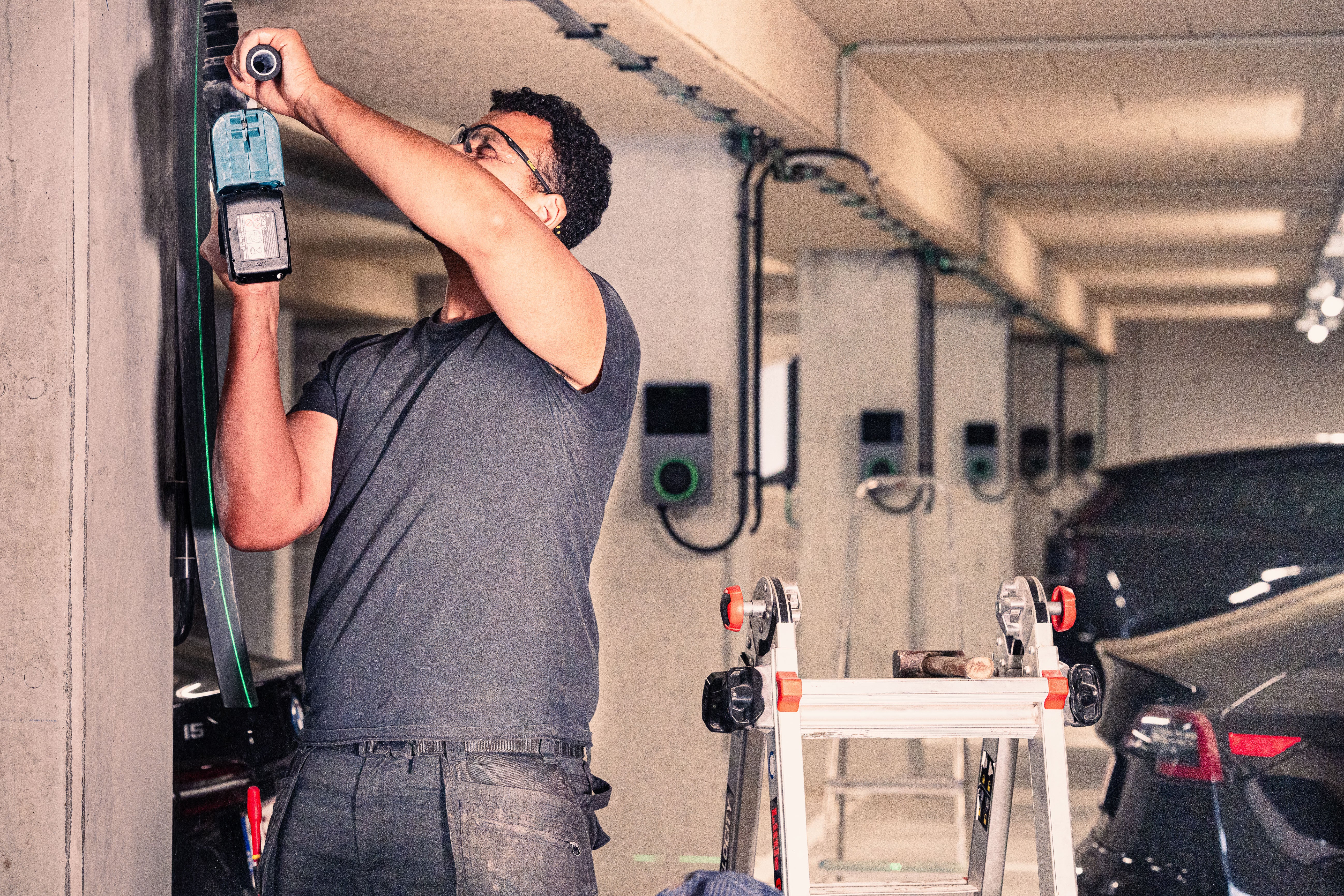
- Installation at the office and at home: We install smart charging stations at your business locations and at your employees' homes. These are not just any installations; they are high-quality, strategically placed, and configured for maximum efficiency and safety. You can learn more about what is involved in our detailed article on the charging station installation process.
- An intelligent management platform: Our intuitive software platform is the nerve center of your charging infrastructure. It provides you with a real-time overview to monitor consumption, allocate costs, and manage charging sessions. Automatic reimbursement for home charging saves your administrative team countless hours and eliminates human error.
- Seamless public loading: With one Blulinc charging card and app, your drivers get access to a network of more than 900.000 public charging points Throughout Europe. No more hassle with different apps or payment methods. Just plug in, charge, and hit the road again.
Practical example: a Brussels consultancy firm
Imagine this: you manage a fleet of 10 EQC 400s for your consultants in Brussels. With Blulinc, charging management becomes a breeze. We install chargers at the office, complete with load balancing to protect your power grid, and place smart chargers at every employee's home.
Every month, our platform automatically calculates the electricity costs for every employee charging their company car and processes the correct reimbursement. When on the road, your consultants use their Blulinc card to charge effortlessly throughout Belgium and beyond. At the end of the day, you receive one clear, consolidated invoice for all charging sessions. This makes the switch to electric driving simple, predictable, and cost-efficient.
Ready to leave the complexity of electrifying your fleet behind? Let us show you how we can build a tailored solution for your Mercedes EQC 400 fleet. Request your free consultation today.
Frequently asked questions about the Mercedes EQC 400
If you are considering adding the Mercedes EQC 400 to your fleet, you probably have a few practical questions. We have compiled a list of the most common questions from Belgian fleet managers for you, with clear, no-nonsense answers.
What is the lifespan of the EQC 400 battery in practice?
Mercedes-Benz gives you a solid guarantee: the high-voltage battery certificate covers the performance for 8 years or 160,000 kilometers. However, in practice, we see that modern EV batteries are designed to last the entire lifespan of the car, with minimal degradation.
You can give the battery's health a helping hand yourself. Try not to charge the car to 100% every day and save those fast DC charging sessions for when it is really necessary. This way, the battery remains in top condition.
How do home charging and reimbursement work for employees in Belgium?
This is a question we receive daily, and fortunately, the answer is simple. It is standard practice in Belgium that we can fully automate for you. Blulinc installs a smart charging point at your employee's home, which perfectly tracks how much power flows to the company car.
Our platform processes this data automatically. This ensures a seamless and correct reimbursement from the company to the employee, fully compliant with Belgian tax regulations. This eliminates all administrative hassle and makes home charging the most convenient and cost-effective choice for everyone.
Correct reimbursement for home charging sessions is more than just administrative simplicity. It is an essential part of a modern and attractive compensation package for your employees.
Is the EQC 400 practical for long drives from Belgium?
Absolutely. The EQC 400 feels perfectly at home on European motorways, thanks to its fast-charging capabilities. With a Blulinc charging card in hand, your drivers have access to a vast charging network across the entire continent.
A typical trip to France or Germany simply means a few planned stops of 25-35 minutes every two to three hours at a powerful charging station. The EQC 400's navigation system even helps plan those stops, for a completely worry-free drive. This makes the EQC 400 a reliable partner for international business.
Do you want a charging solution that is just as advanced and reliable as the Mercedes EQC 400 yourself? Blulinc offers a complete service for your fleet.