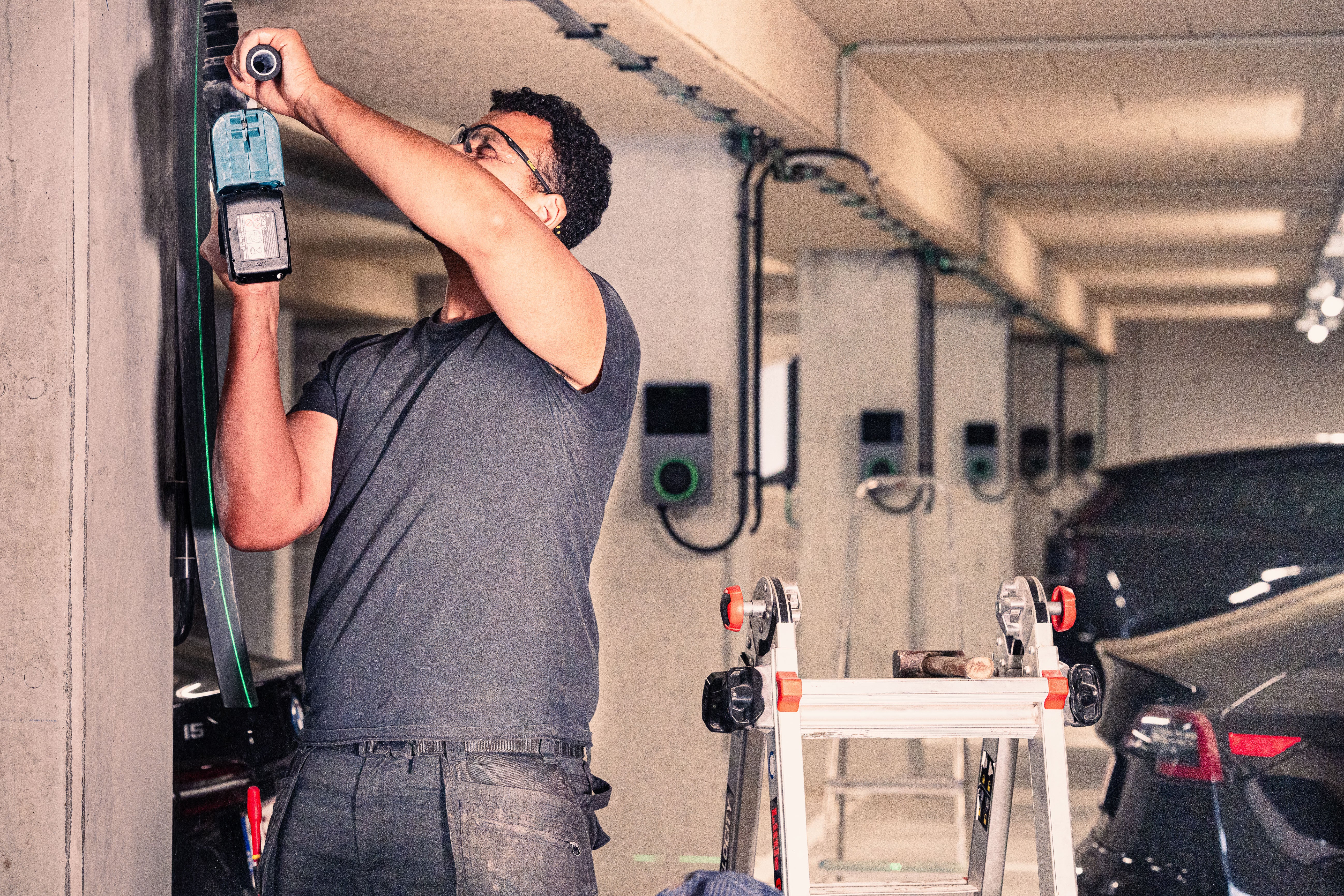


The choice for a installer of charging stations is one of the most important decisions for your charging infrastructure. It is much more than screwing a charging station to the wall; you choose a partner who guides you through complex regulations, challenging electrical installations, and the future of your site.
If you make the right choice, you are assured of a safe, cost-effective, and scalable solution. If you make a mistake, the headaches have only just begun.
Why the Choice of Your Installer Is So Crucial
The transition to electric mobility in Belgium is no longer a vision of the future, but the reality of today. For companies, installing charging points has evolved from a 'nice extra' to a strategic necessity. However, the success of that investment depends entirely on the partner you bring on board. This is absolutely not a job for a general electrician; it requires specialized expertise.
A professional installer of charging stations is more than just a technician. View him as your guide through the entire process, starting with a thorough analysis of your location and the capacity of your grid connection. Do you have sufficient capacity, or is an upgrade necessary? An expert identifies this early on, helping you avoid costly surprises and delays.

The Role of a True Partner
The difference between a simple contractor and a strategic partner lies in the depth of service. A true partner thinks ahead and plans for your future, not just for the immediate project.
- Future-proofing: Your fleet will grow. A good installer designs a system that can scale with you, without the need for a complete and costly overhaul later on. This means planning cable routes and physical space for charging stations that you haven't even purchased yet.
- Regulations and Administration: Every installation must comply with the strict Belgian AREI standards and pass an official inspection. An experienced partner takes on this entire administrative burden and ensures that your installation is ready from day one. 100% compliant is.
- Cost optimization: A true expert advises you on smart charging solutions such as load balancing to avoid costly upgrades to your grid connection. He also assists you with applying for Belgian tax benefits, which can significantly reduce your net investment.
We saw it ourselves: an SME in Ghent with a fleet of 20 vehicles that charges at night using a smart charging strategy can save thousands of euros per year in energy costs, simply by avoiding peak rates. This is only possible with a system that is correctly configured by an expert installer.
Choosing the right installer is an investment in the long-term reliability and efficiency of your charging network. It is your guarantee of maximum availability, complete safety, and an infrastructure ready for the inevitable growth of electric vehicles on Belgian roads. Below, we delve deeper into what distinguishes an installer from a partner.
Determine your Business Charging Needs

Before you even consider calling an installer, it is crucial to have a clear picture of what your organization truly needs. This is the foundation. By getting this right now, you avoid spending too much on charging capacity you will never use or, worse, underinvesting in a system that will outgrow your company within a year.
Look at it this way: a medium-sized consultancy firm in Antwerp has very different needs, depending on who comes to charge. Are the charging stations for the company cars of employees who all arrive around 9:00 AM and stay all day? Or are they for clients dropping by for a one-hour meeting? The right solution for each scenario is completely different.
You also need to look beyond today. How many cars do you need to be able to charge simultaneously in 2026 versus 2029? Planning for that future growth from day one is always more cost-effective than trying to add extra capacity later.
Create your User Profiles
First and foremost: who will use the charging stations and how? Different people have completely different charging habits, and that directly determines the type of hardware you need.
- Employees with Company Cars: These drivers are your long-term parkers, usually 8+ hours present. Slower, more affordable AC chargers are usually a perfect match, since their cars have the entire workday to charge.
- Visiting Customers: They are in more of a hurry. A visitor wants a meaningful charge during a short meeting, so a faster AC charger or even a DC fast charger may be necessary to offer a truly useful service.
- Fleet vehicles (e.g. vans): For these workhorses, time is money. They often need a quick charge between shifts to get back on the road, making powerful DC fast chargers the only realistic option.
Analyze your current team and their vehicles, but also project what your fleet might look like in a few years. By accurately estimating these profiles, you can determine the right mix of charging station types and numbers.
Understand Smart Charging and Load Balancing
These are not buzzwords; it is your key to managing electricity costs and avoiding exorbitant grid connections. Every good installer of charging stations will mention this in your first meeting.
Smart Charging gives you control over when and how fast charging vehicles. For example, you can set all charging sessions to take place during off-peak hours, when electricity is cheapest. This simple adjustment can make a huge difference to your operating costs.
Load Balancing is another indispensable function. It automatically distributes the available power across all charging stations currently in use. If your building's electrical installation has a limit, load balancing prevents the main switch from tripping by intelligently managing the energy flow.
This means that you can often install more charging points than you thought possible, without an expensive upgrade to your grid connection – a huge gain for any budget-conscious Belgian company. Armed with this knowledge, your first meeting with a potential installer will be much more productive.
Selecting the Right Partner: More Than Just the Price
Right, you have done your homework and have a solid list of requirements. Now comes the most critical part: finding the right partner to bring your charging project to life.
It is tempting to look only at the final price on a quotation, but that is a mistake. A thorough evaluation of a potential installer of charging stations It is about protecting your long-term investment. You are looking for a reliable partner, not just a contractor who disappears the day after the installation is completed.
Check the core qualifications first.Any installer you consider must be a recognized electrical contractor in Belgium with proven experience in installing charging infrastructure. Ask for references, but more importantly, ask for case studies of projects similar to yours. A glowing review of a small office with two charging stations will be of little help if you plan to electrify an entire logistics fleet.
Technical Expertise and Brand Independence
A truly skilled installer brings deep technical insight, going far beyond simply mounting hardware to a wall. He must be able to analyze the nuances of your site's electrical installation and proactively advise on necessary adjustments.
Pay close attention to the approach to hardware. Does the installer offer independent advice, or is he trying to push you towards one specific manufacturer? A true partner listens to your needs and recommends the best hardware for your situation, not just the equipment that yields him the highest profit margin.
Essential Questions for Every Potential Installer
To compare quotes correctly, you must ask the right questions. Detailed answers to the following points will give you a crystal-clear picture of their capabilities and reliability:
- Project management: What does your project process look like, from the initial site survey to final delivery? Who is our dedicated point of contact throughout the entire project?
- Hardware and Warranty: What guarantees do you offer on the proposed charging stations and on the installation work itself?
- Software options: Which management platform do you use? Can we use it to monitor usage, automate employee reimbursements, and set access rights?
- Service and Maintenance: What is included in your service level agreement (SLA)? What are your guaranteed response times if a charging station fails?
Effectively screening candidates also includes a good understanding of contractors risk management, which helps you identify and limit potential problems before they occur.
A practical example: An SME in Antwerp with 15 company cars received two quotes. One was € 2.000 cheaper, but came with a basic software platform that could not automate reimbursement to drivers. The second, more expensive quote included an advanced software package that would reduce the HR department's administrative workload by several hours each month, quickly recouping the initial price difference.
Always look beyond the initial cost. A slightly higher investment in a partner offering superior software, robust warranties, and proactive service always pays for itself in the long run. It is the smartest way to guarantee the performance and return on your charging infrastructure.
The Belgian Labyrinth: Regulations and Grid Connections
Installing business charging stations in Belgium is not just about the physical work. It is a journey through an administrative maze that requires careful planning with multiple authorities. See a professional installer of charging stations as your indispensable guide through this labyrinth, ensuring your project is compliant and avoiding costly delays.
Two things are absolutely crucial: compliance with regulations and the management of your grid connection.In Belgium, every new electrical installation must comply with the AREI (General Regulations on Electrical Installations). This is not a recommendation, but legislation designed to guarantee the safety and reliability of your entire system. Once the charging stations are installed, an accredited body must carry out a mandatory inspection to certify that everything complies with the AREI standards. A good installer will handle all of this for you, from the initial design to the final approval.
In Conversation with Your Network Operator
Equally important is contact with your regional distribution network operator (DNO), whether that is Fluvius in Flanders, Sibelga in Brussels or ORES is in Wallonia. Your building has a fixed electrical capacity, and it is surprisingly easy to exceed it when you add multiple charging stations.
If your plans extend beyond one or two charging stations, your installer will almost certainly need to request a grid study from the DNB. This study checks whether the local electricity grid can handle the additional demand from your new charging stations. It is a step that many companies do not see coming.
We have seen it happen. A logistics company in Wallonia wanted to install six 22 kW AC chargers for their delivery vans. Such a load immediately led to a mandatory grid study by ORES. The study alone can take several months. When it turned out that the local grid had insufficient capacity, grid reinforcement was necessary, which added even more time and costs to their project.
This is where a proactive installer proves his worth. He anticipates these obstacles and contacts the DNB early in the process. He has all the technical documents ready and can give you a realistic estimate of the timing. This kind of foresight makes the difference between a smooth installation and one that stalls for months.
What to Expect Regarding Timing and Costs
Frankly, administration and approvals often take up much more time than the actual installation work. It is crucial to factor this administrative time into your project planning.
Here is a realistic breakdown of what you can expect:
- Application & Net Study Assessment: This can easily be done. 2 to 6 months take. Everything depends on the complexity of your project and the workload at the DNB.
- Grid reinforcement (if necessary): If the grid needs an upgrade to support your charging stations, you can count on an extra 3 to 9 months.
- Inspection (Final inspection): This part is quick. It is usually carried out within a week of the completion of the installation.
Trying to cut corners or manage this process without an expert is a recipe for serious frustration. When you work with an experienced charge station installer, you are not just buying equipment; you are investing in peace of mind, knowing that every checkbox is ticked, every form is submitted correctly, and your project keeps moving forward.
From Groundbreaking to Go-Live: The Installation Process
As soon as you your installer of charging stations Once you have made your choice and the paperwork is complete, the real work begins. This is the exciting part where your plans become physical reality, from blueprints and permits to the moment the first EV driver plugs in their car.
The first step is the "civil" works. This is usually the most disruptive phase, but a good installer makes it as painless as possible.It includes things like digging trenches for the armored cables that run from your main panel to the charging station locations. In a finished parking garage, this means carefully breaking up and then repairing the asphalt or paving to leave a neat, professional finish. The end goal is a safe and discreet path for all high-voltage cables.
The Installation and Commissioning Phase
Once the groundwork is completed, the charging stations themselves are installed. Your installer mounts the devices – either on the wall or on specially designed poles – and connects everything to the new electrical infrastructure. This is precision work and must strictly adhere to all safety standards.
Next comes the most critical part: the commissioning. This is much more than just flipping a switch. Your installer will meticulously:
- Test all hardware components to confirm that they work perfectly.
- Configuring the management software, where each charging station is connected to its cloud platform.
- User profiles, payment systems and any refund rules set up for your employees.
- Verify the network communication to ensure that every charging station is online and transmits data correctly.
This is where a professional team truly proves its worth. We ensure that every piece of the puzzle communicates with every other piece – from the charger to the software – and that smart features such as load balancing are correctly configured to protect your grid connection and keep costs low.
The infographic below shows the key legal steps your installer in Belgium goes through to get you across the finish line.

This process, from ensuring AREI compliance and completing the grid study to the final 'inspection', is all managed by your installation partner.
Delivery, Training and Ongoing Support
The final step before you can declare your new charging network open is the handover. This should never be a rushed affair. A high-quality installer of charging stations will provide you and your team with thorough training. You will learn to operate the system, use the management platform to monitor consumption and process refunds, and resolve common issues.
For a deeper insight into what you can expect from start to finish, this guide on the EV charger installation process an excellent resource that covers everything from site analysis to final delivery.
Finally, you want a clear Service Level Agreement (SLA) have. This is your contract for continuous support and maintenance, in which everything is recorded, from repair response times to preventive maintenance schedules. An SLA gives you peace of mind and guarantees that your charging network remains a reliable and high-performing asset for your organization for years to come. And if you would like more details on managing capacity at your site, you can learn more about how load balancing works in our dedicated article.
Your Questions, Answered: What Belgian Companies Ask Us Most Often
Now that companies across Belgium are exploring the possibilities of charging stations, we see the same practical questions recurring. It is a big decision, and you need clear answers from people with experience in the field. We understand that.
Here is an overview of the most common questions we receive daily.
What are the realistic costs of installing business charging stations in Belgium?
This is the big question, but the honest answer is: it depends entirely on your location. For a simple, wall-mounted AC charger where your electrical cabinet has sufficient remaining capacity, you can expect a cost between € 2.000 and € 3.500 per charging point, all inclusive.
However, the price changes as soon as more work is required. Projects requiring excavation for new cables, a long cable run from your main distribution board, or an upgrade to your grid connection will naturally cost more. And if you are considering DC fast chargers, that is a completely different category – those installations often start from € 30.000 and can amount to more than € 100.000 per unit.
A professional installer will never give you a vague estimate. We offer a detailed, itemized quote that breaks down every cost: hardware, labor, any civil works, and administrative costs for permits. Crucially, we also include available Belgian tax deductions, so you see your actual net investment from day one.
How Long Does an Installation Project Really Take?
Although our technicians can physically assemble a few AC chargers in a few days, that is only a small part of the total lead time. The determining factor is almost always the administrative side.
Having the mandatory grid impact study carried out and waiting for any necessary reinforcement works by your grid operator (Fluvius, ORES or Sibelga) is the biggest delaying factor. This process alone can three to nine months to last.
Add a few weeks for permit applications, and you are looking at a realistic total project duration of four to seven months, from contract signing to operational charging stations. An experienced partner will be open about these timelines and include them in the project plan from the start.
Are Smart Chargers with Load Balancing Really Necessary?
For every company that installs two or more charging stations, our answer is an unconditional yes. "Smart" simply means that the chargers are connected to a central management platform, which unlocks all the features you need as a company:
- Remote Monitoring: Check the status of your chargers without having to walk outside.
- Access control: Determine exactly who is allowed to charge – employees, visitors, or the public.
- Automated Invoicing: Effortlessly process public payments or employee refunds.
Of all smart features, load balancing the most critical. It intelligently manages your building's available power and distributes it among all vehicles currently charging. Imagine you have reserved 50 kW of power for ten 11 kW chargers. Load balancing is the brain that ensures the total demand never exceeds that 50 kW threshold. This single function prevents tripped fuses and, more importantly, helps you avoid costly upgrades to your grid connection.
Ready to take the next step in the electrification of your business? Blulinc offers expert guidance and end-to-end installation services, tailored to the Belgian market.