


Just imagine this: your entire business operation grinds to a halt. The lights flicker and go out, production lines stop, and every computer screen goes black. The cause? Several employees plugged in their electric cars at the same time.
This is not a far-fetched doomsday scenario; it is a real operational risk for companies in Belgium. Without a smart solution such as load balancing for your charging stations, the switch to e-mobility can quickly become an expensive and unpredictable gamble.
Why Unattended Charging Is a Business Risk
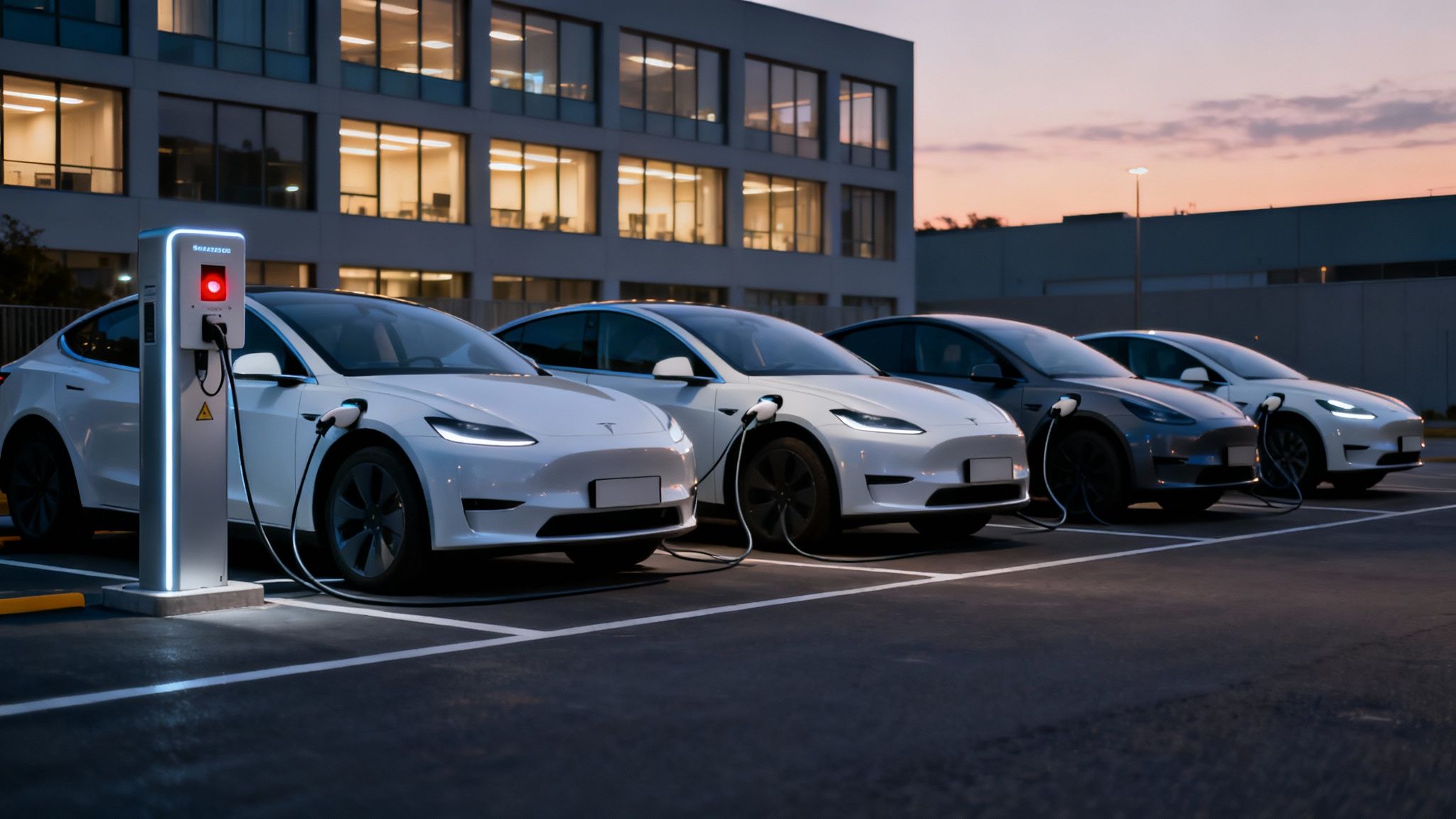
As corporate car parks and commercial fleets switch to electric, the pressure on a building's existing electrical infrastructure increases enormously. When multiple electric vehicles (EVs) start charging simultaneously, they create a massive power surge that can easily overload your local grid connection.
This is not just an inconvenience; it has serious financial and operational consequences. Without a way to manage that demand, your power supply simply cannot handle it.
The sudden, high energy demand from multiple EVs charging simultaneously can cause your building's main fuse to blow. This means an immediate shutdown for your entire operation, leading to productivity loss and escalating costs.
The Rising Demand for Charging Points
The need for smarter charging becomes crystal clear when you look at the growth figures. In 2023, public charging infrastructure in the UK experienced explosive growth, with the number of charging points increasing by no less than... increased by 45% to more than 53,000 devices. This rapid expansion, driven by government targets and commercial investments, highlights how crucial load balancing is to prevent grid overload now that more and more EVs are on the road. You can find more insights into the UK's charging infrastructure growth on Zapmap.
This trend is not limited to public roads; the demand for charging points at work is also rising exponentially. Simply installing charging stations without an energy management strategy is like building a highway without traffic control. Chaos is inevitable.
The Prohibitive Costs of NetUpgrades
What happens if your current grid connection cannot handle the load? The traditional answer is a grid upgrade – asking the distribution grid operator (DNO) to increase the capacity of your connection. However, this is an extremely expensive and time-consuming process.
Here is a concrete example. A medium-sized logistics company wanted its fleet of 20 electric vans Charging at night. An initial analysis showed that their existing grid connection was nowhere near capable of handling the demand. The quotation for a grid upgrade, including a new transformer substation, amounted to more than €50.000, with a delivery time of several months.
This type of hidden cost can completely undermine the business case for electrification. This is exactly where EV load balancing makes the difference. By intelligently managing and distributing the power you already have, you can often completely avoid these expensive upgrades, thereby protecting both your operational stability and your bottom line.
How Does Load Balancing Work for Charging Stations?
Let's break down the technology behind what is often called a 'load balancing station'. At its core, the concept is quite simple. Imagine the total electrical capacity of your building as one large water pipe. Every device you switch on, from a kettle to the air conditioning, opens a small tap on that pipe.
Connecting multiple electric vehicles is like turning on a few fire hydrants at the same time.If you open too many, the pressure drops for everyone. Worse still, the main line can become overloaded and the entire system can fail. This is exactly what happens when a line of unattended EVs causes the main fuse to blow.
Load balancing acts as a smart, automated traffic controller for your charging network. It constantly monitors the total power demanded from your main connection and intelligently adjusts the flow to each charging station in real time. This guarantees that the total demand never exceeds your building's limit.
Static vs. Dynamic Load Balancing
There are two ways to manage this electrical demand: static and dynamic load balancing. Understanding the difference is crucial to choosing the right solution for your needs.
Static Load Balancing is the most basic approach. It works by setting a fixed, maximum power limit for a group of chargers. The system then distributes this available power evenly among all vehicles that are actively charging.
- How it works: Suppose you have four charging points with a static limit of 22 kW for the entire group. If one car joins, it gets the full 22 kW. But if four cars are connected simultaneously, the system distributes the power, and each car receives only 5.5 kW.
This method is a reliable way to prevent overloading, but it is not particularly efficient. It cannot redirect unused power from a nearly full car to a car that needs to recharge quickly. The result? Longer charging times for everyone when multiple vehicles are connected.
Dynamic Load Balancing Explained
Dynamic Load Balancing is a much more advanced and intelligent approach. Instead of a fixed limit for the chargers, it monitors the real-time energy consumption of the entire building. It knows when the elevators are running, when the air conditioning turns on, and how much power the office equipment consumes at any given moment.
The system uses this live data to dynamically allocate the remaining power to the charging stations. You can learn more about how this system connects to your infrastructure by activating the P1 port on your digital meter in our detailed guide on taking control with smart charging.
With dynamic load balancing, EV charging automatically accelerates when the building's energy consumption is low (such as at night) and slows down slightly during peak hours. This allows you to squeeze every drop of charging efficiency out of your existing connection, without ever risking an overload.
This smart allocation makes the difference. It ensures that your vehicles are charged as quickly as possible within your location's capacity, offering drivers a reliable and seamless experience while protecting your entire electrical system. This is the cornerstone of a truly future-proof charging network.
How Do You Choose the Right Load Balancing Strategy?
Okay, you now know what a load balancing charging station that is essentially what it does. But how do you translate that into the right choice for your company? There are actually two options: a local system with a 'smart' controller, or a central, cloud-based platform, like the one we have developed at Blulinc.
The best approach depends entirely on your situation. An SME with five charging stations for employees has very different needs than a logistics company that needs to fully charge a fleet of twenty delivery vans overnight. It is therefore crucial to understand the differences in order to make an investment that makes sense tomorrow.
Local Smart Controllers: The Master/Slave Setup
The first, more traditional option is a local system, often a master/slave-configuration referred to. The idea is quite simple: one charging station becomes the 'master'. This main charger measures the total current available at the site and distributes it neatly among the other, subordinate 'slave' chargers in the group.
The major advantage? This approach is relatively simple and works completely independently of an internet connection. That makes it a robust choice for locations where connectivity occasionally falters. The intelligence resides locally, so basic functionality is always guaranteed.
However, that simplicity also has a downside. A master/slave setup typically offers only very limited remote control and insight. You cannot monitor charging sessions live, prioritize specific vehicles, or generate detailed reports on consumption. Scaling up can also be a stumbling block; if you want to add more chargers than the master can handle, a substantial hardware upgrade is often required.
Centralized, Cloud-based Platforms
The second and much more modern approach is a centralized management platform in the cloud. In this setup, each charging station is connected to a central online system that handles the entire load balancing process. This system continuously retrieves data from each charging station as well as from your building's main connection.
This constant stream of data enables the platform to regulate energy distribution with extreme precision and dynamics. It can take into account the charging status of each car, set departure times, and even fluctuating electricity prices throughout the day. The real added value lies in this in-depth control. You can check charging statuses remotely, assign charging priorities, and automatically charge costs to the appropriate employee or department.
This infographic perfectly illustrates which core decision load balancing addresses: what do we do if a power surplus is imminent?
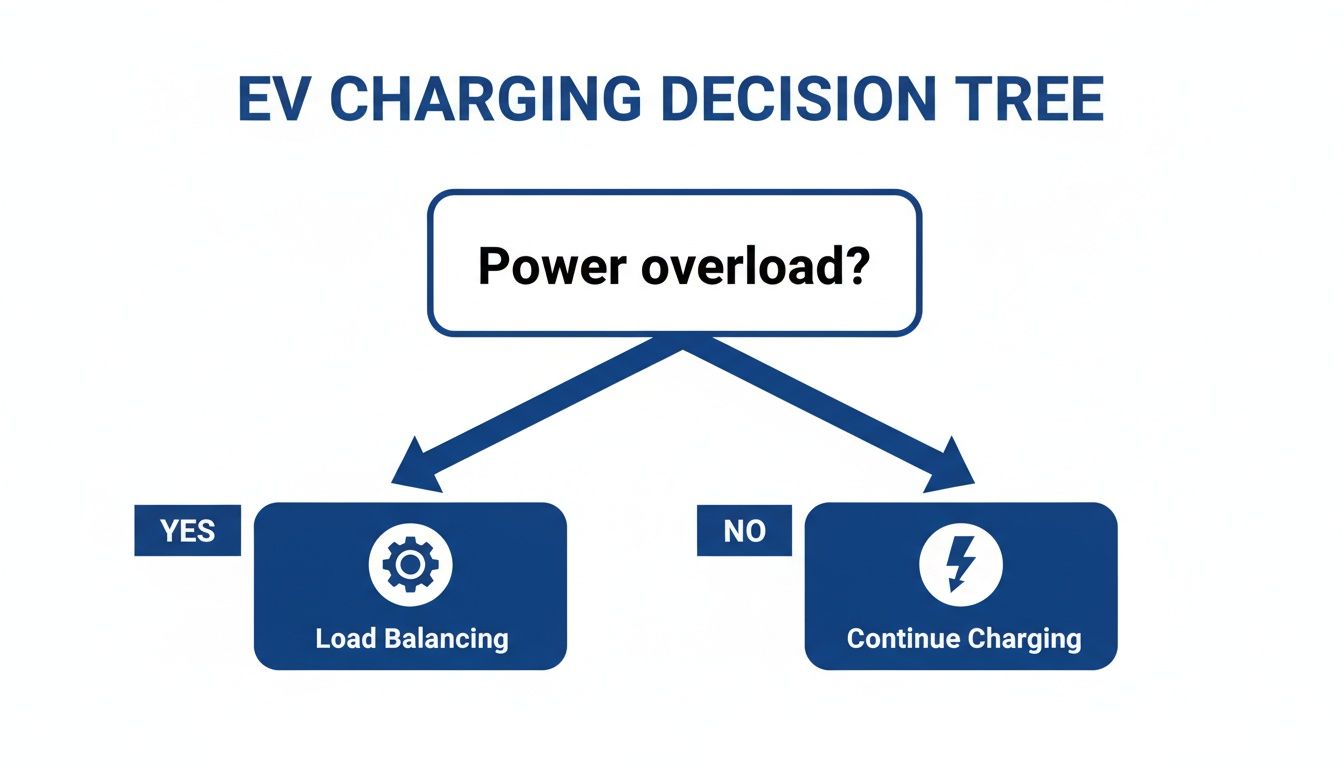
As you can see, a smart system offers an active solution to overload, rather than simply hoping that things will work out.
A Practical Comparison
Let's make it concrete with an example to make the choice easier. Imagine this: an SME electrifies its fleet of 10 vehicles.
-
Scenario 1: Master/Slave: The company installs 10 charging stations in a master/slave setup. The system does its job and ensures that the main connection does not become overloaded. However, the fleet manager has no idea which vehicle is already fully charged and which car absolutely must be given priority for an early trip the next morning. Consequently, all cars charge equally slowly.
-
Scenario 2: Cloud Platform: With a platform like Blulinc's, the fleet manager logs into a dashboard. He immediately sees that 3 of the 10 vans already before 90% be full. He can set charging priority for two other vehicles that need to hit the road early in the morning, ensuring they receive their charge. At the same time, all charging costs are automatically recorded for accounting purposes.
In short, a local controller effectively prevents overloading, but a central platform gives you the control, insight, and scalability that are indispensable for the efficient management of a professional fleet. For more details on how to efficiently manage your charging infrastructure, you can view our solutions for charging station management to look at.
Local vs.Cloud-based: A Comparison for Businesses
To help you make a decision, we have listed the key differences below. This table compares the two main approaches to load balancing, so you can determine which strategy best fits your organization's current and future goals.
| Feature | Local Smart Controllers (Master/Slave) | Centralized Platform (Cloud-Based) | Best Choice For |
|---|---|---|---|
| Control & Insight | Limited; no real-time monitoring or priority settings. | Full; live status, set priorities, detailed reports. | Companies that want to use data to optimize their fleet. |
| Scalability | Limited; expansion often requires new hardware (master unit). | Virtually unlimited; easily add new chargers via software. | Organizations with growth plans for their EV fleet. |
| Internet dependency | None; works completely offline. | Requires a stable internet connection for full functionality. | Locations with reliable internet access. |
| Cost management | Basic; no automatic settlement or cost allocation. | Advanced; automatic invoicing, cost allocation per user/department. | Companies that need to settle or monitor charging costs. |
| Installation complexity | Relatively simple; less configuration required. | Requires network configuration and platform setup. | Anyone, provided the installer has experience with network equipment. |
| Smart features | Very limited; focuses solely on avoiding overload. | Comprehensive; dynamic charging based on electricity prices, departure times, etc. | Fleet managers striving for maximum efficiency and cost savings. |
Hopefully, this comparison gives you a clear picture. While the master/slave solution offers a solid foundation, a cloud platform truly unlocks the full potential of a smart charging infrastructure.
The Business Case for Smart Charging
We have discussed the technology. But what does a load balancing charging station Is this system now truly for your business in euros? It is simple: this is not just a technical upgrade; it is a smart financial move with a clear and measurable return.
When you handle charging correctly, you see three major benefits. You save on enormous initial costs, reduce your operating expenses, and ensure that your chargers are always ready for use. Let's look at how that plays out in practice.

Avoid Expensive Net Upgrades
Here is the biggest and most direct saving: avoiding a phone call to your grid operator for an expensive grid upgrade. If you simply install a series of charging stations, you will almost certainly exceed the capacity of your existing electrical connection. The traditional solution is a grid upgrade, a project that you easily tens of thousands of euros can be costly and can drag on for months with planning and excavation work.
A load balancing system, on the other hand, allows you to install more chargers using the power you already have. It distributes the power intelligently so that you never overload the main fuse.
For most companies, the one-time cost of a smart charging platform is a fraction of what you would pay for a physical grid reinforcement. It turns a huge capital obstacle into a much more manageable operational cost.
Reduce Costs by Limiting Peak Consumption
Your company's energy bill is not only about how much electricity you consume, but also about when you consume. Consuming a huge amount of electricity during peak hours leads to high capacity rates, better known in Belgium as your 'quarter-hour peak'. Unattended charging, especially when everyone plugs in at the same time in the morning, creates exactly such a huge power peak, which can cause your bills to skyrocket.
Dynamic load balancing puts an end to this. The system monitors your building's total energy consumption. When it detects a peak – for example, when the air conditioning and machines all switch on – it automatically reduces the charging speed for the EVs. It shifts that charging load to the cheaper off-peak hours. This simple, automated adjustment can lead to significant savings on your monthly energy costs.
This is becoming increasingly important. With forecasts that 2 million EVs To predict the demand on Belgian roads by 2030, managing energy demand is not just a good idea; it is essential. Smart load balancing will keep the grid stable and keep electricity costs for businesses under control.
Maximize Availability and Reliability
Finally, smart charging makes your entire installation more reliable. Nothing is more frustrating for a driver than arriving at a charging station and discovering that it is out of service because a fuse has blown. That is bad for morale and disastrous for business operations.
By preventing system overload before it happens, load balancing ensures that your chargers are always working and available. This is absolutely indispensable for commercial fleets that rely on their vehicles being fully charged and ready for departure every morning.
Example: A Fleet of 20 Vehicles
Imagine a logistics company that needs to charge 20 electric delivery vans for the next day.
- Without load balancing: Plugging everyone in at the same time would require a major grid upgrade, which probably €50.000+ cost. Moreover, the daily power peak would drive up their energy bill due to high capacity rates.
- With load balancing: A platform like Blulinc's automatically spreads out charging. It creates a smart schedule to ensure that every van is 100% charged by morning, without ever exceeding the site's existing power limit. The capital savings are immediate and operating costs remain low.
For every commercial player, it is crucial to understand these types of operational benefits. As many discover, the show top fleet management system benefits that smart charging is not an extra; it is an essential component for running an efficient, modern fleet. It leads directly to improved reliability and a much healthier return on your EV investment.
Load Balancing in Practice
Theory is one thing, but seeing how smart charging solves real business problems is what it's really all about. A successful load balancing charging station Installation is not just about connecting chargers; it is about strategically managing your entire energy ecosystem.
Before we dive into specific examples, let's go over a practical checklist for any company considering implementing smart charging. By asking these questions in advance, you will save yourself a lot of trouble later.
Your Implementation Checklist
-
Know Your Electric Limit: What is the maximum power your building can draw from the grid? An energy audit is the first step. It tells you exactly what you can work with and identifies potential bottlenecks.
-
Define Your Charging Needs (Now and Later): How many vehicles do you need to charge today? And what will that look like in two, or even five years? Consider the mix of vehicles – employee cars, vans – and how long they are typically parked.
-
Map Charging Patterns: When will most vehicles charge? A fleet connected at night creates a very different energy profile than employees and visitors who charge during the day.
-
Growth Plan: Your charging needs will only increase. Ensure that the system you choose is scalable. Good software should enable you to add more charging points later without having to replace everything.
This type of strategic planning is becoming indispensable in many regions. Some countries, for example, have seen explosive growth in public charging infrastructure, often concentrated in specific areas. This density places enormous pressure on local grids, making smart energy management and dynamic load balancing an absolute priority for companies looking to install chargers.
Scenario 1: The Property Manager
Imagine a property manager who needs to install charging stations in a shared underground parking garage of a multi-tenant office building. The challenge? The capacity of the main panel is strictly limited, and an expensive grid upgrade is not an option.
- The Challenge: Offer reliable charging for dozens of tenants without overloading the building's main fuse. The system must also bill everyone fairly for their usage.
- The Solution: A cloud-based dynamic load balancing system is the perfect solution. Tenants use an RFID card or a mobile app to start a charging session, which immediately links the consumed power to their account. The platform continuously monitors the building's total power consumption and intelligently distributes the remaining capacity across all active chargers. During peak office hours, charging speeds may be slightly reduced, but they automatically increase after 5:00 PM, when the building's total energy consumption drops.
Scenario 2: The Logistics Company
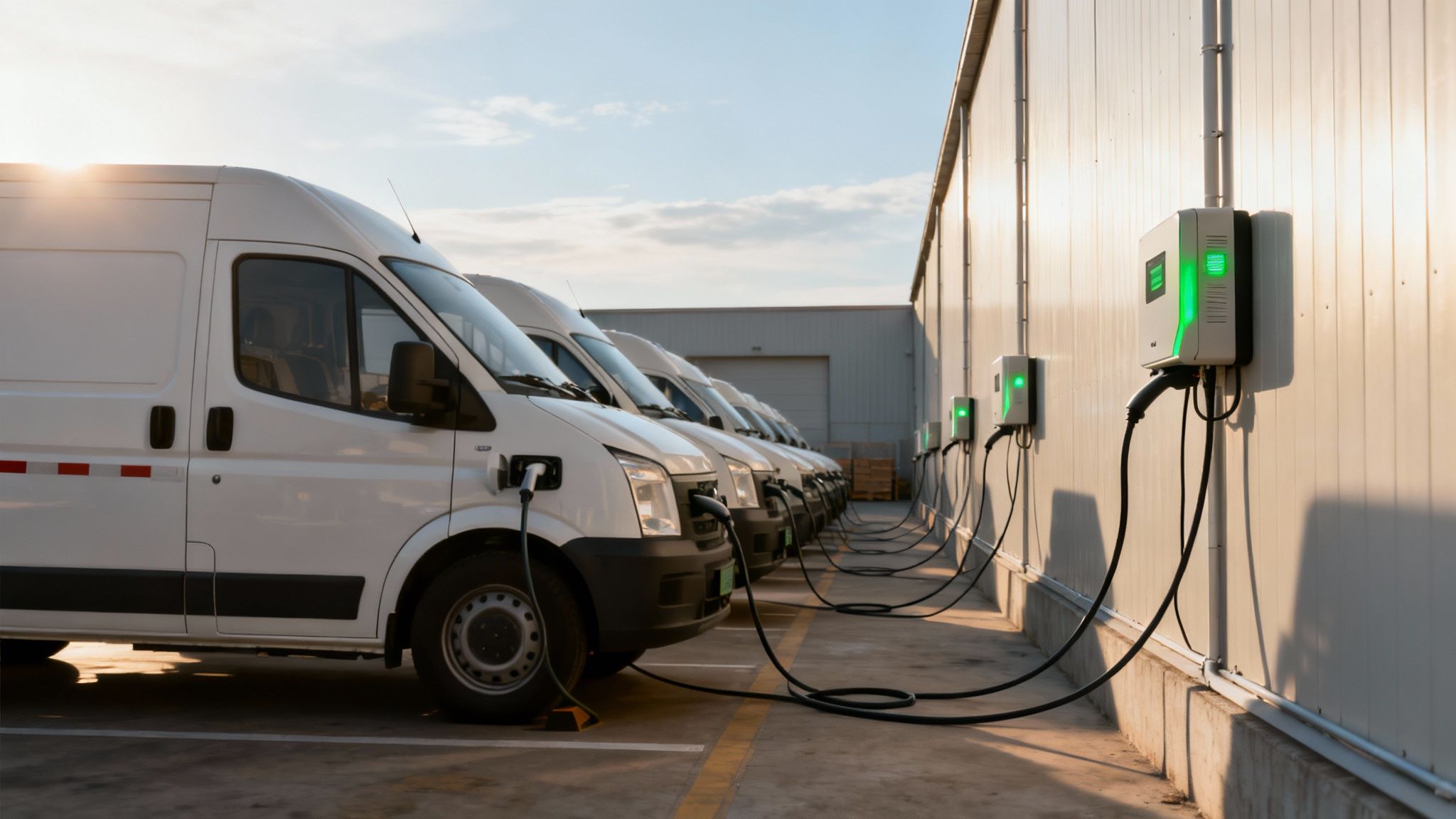
A logistics company relies on its fleet of 20 electric vans fully charged and ready for departure every morning at 6 am. The problem is that all vans return to the depot around the same time in the evening. If they were all to start charging at maximum power simultaneously, this would cause a massive, grid-loading power surge.
- The Challenge: Guarantee that every vehicle 100% charged is against a fixed deadline, but without the costs of an exorbitantly expensive grid reinforcement.
- The Solution: They are implementing a centralized management platform that combines load balancing with smart planning. The fleet manager simply enters the departure time and the required battery level for each van.The system then creates an optimized charging schedule that spreads out start times and dynamically adjusts power to each vehicle overnight. It is smart enough to prioritize the vans with the lowest battery status, ensuring every vehicle is ready for the morning shift.
Scenario 3: The SME office
An SME with 50 employees decides 10 chargers to be installed for a mix of staff and visitors. The goal is twofold: to offer charging as a great staff benefit and to give visitors the opportunity to top up their cars.
- The Challenge: Juggling regular and occasional users, giving employees priority and, crucially, not letting the main fuse blow when the office's heavy machinery and air conditioning are running at full speed.
- The Solution: Dynamic load balancing is deployed, directly connected to the building's main meter. The system is configured to prioritize registered employee vehicles. When a visitor connects, they receive power from the capacity remaining after employees and the building's core operations have done their part. This approach provides a valuable service without jeopardizing daily operations.
In any case, a changes load balancing charging station system a potential electrical nightmare in a controlled, efficient, and future-proof operation.
Your Next Steps to Intelligent Charging
Where are you going now? We have discussed how a load balancing charging station the system is the key to managing your energy, saving you serious money and ensuring that your charging setup is ready for the future.
Theory is one thing, but putting it into practice is what counts. Every company is different – you have your own electrical capacity, your own daily schedule, and your own growth plans. The next step is to translate this knowledge into a concrete plan that works for you.
Working Together for a Smooth Transition
At Blulinc, we are more than just a technology supplier; we are a partner in your transition to electric. We understand the nuances of Belgian regulations, the headaches of fleet management, and the financial realities companies face. Our task is to turn the promise of smart charging into real benefits for your business.
Choosing the right charging infrastructure is one of the most critical decisions you will make in your electrification journey. A well-designed system pays for itself over the years, while a poorly planned system causes constant operational problems.
We have made it our mission to keep this process simple and effective. We have already more than 200 SMEs helped find their footing, by designing charging solutions that are powerful, but above all practical.
Request a Personalized Analysis
Would you like to know what smart charging can mean for your budget? Discover it quickly with our simple online tool. Learn more and Calculate your savings to get a clear starting point.
Based on that initial calculation, we can help you draw up a complete business case. Request a free consultation and let's work together on a charging strategy that truly moves your business forward.
Your Questions about Load Balancing, Answered
The move into the world of smart charging naturally raises questions. We understand that. It is new territory for many companies.To provide clarity, we have listed the answers to the most common questions we hear from organizations considering the switch.
What happens if our internet connection goes down?
That is an excellent question, and probably the first one asked about a cloud-managed system. You can rest assured: our charging stations are designed with a built-in safety net. They won't simply block if the internet drops.
Each charger has its own local intelligence. It will simply continue charging based on the last received instructions and its pre-configured safety limits. When the connection is restored, everything automatically synchronizes with the central platform – no lost data, no manual restarts, and no hassle for you.
How many chargers can we manage with one system?
Our centralized platform is designed to scale from the ground up. Whether you are starting with a few chargers for your small business or planning a network of hundreds of chargers across multiple locations, the system can handle it without any problems.
The beauty of it is how it grows with you. As your EV fleet expands, you can seamlessly add new charging points via the software. You don't need to replace any hardware; the platform simply expands to meet your needs.
Can this system communicate with our existing building management system?
Yes, and this is where it gets really smart. For true energy optimization, your charging infrastructure must not be an isolated island. Our platform is designed to integrate seamlessly with Building Management Systems (BMS) via open, standardized protocols.
Imagine this: instead of just distributing the load among the chargers, the system can see the building's total energy consumption in real time. It knows what the air conditioning, lighting, and other systems are consuming and allocates the remaining power to the EVs in the most efficient way.
This integration means that your charging infrastructure becomes a harmonious part of the overall operation of your facility. You do not just manage cars; you manage your total energy footprint, which is a smarter and more cost-effective approach to e-mobility.
Ready to build a charging solution that is as smart as it is scalable? The team at Blulinc is ready to assist you with a personalized analysis of your site's needs. Request a free consultation and discover how intelligent charging can make your business future-proof.