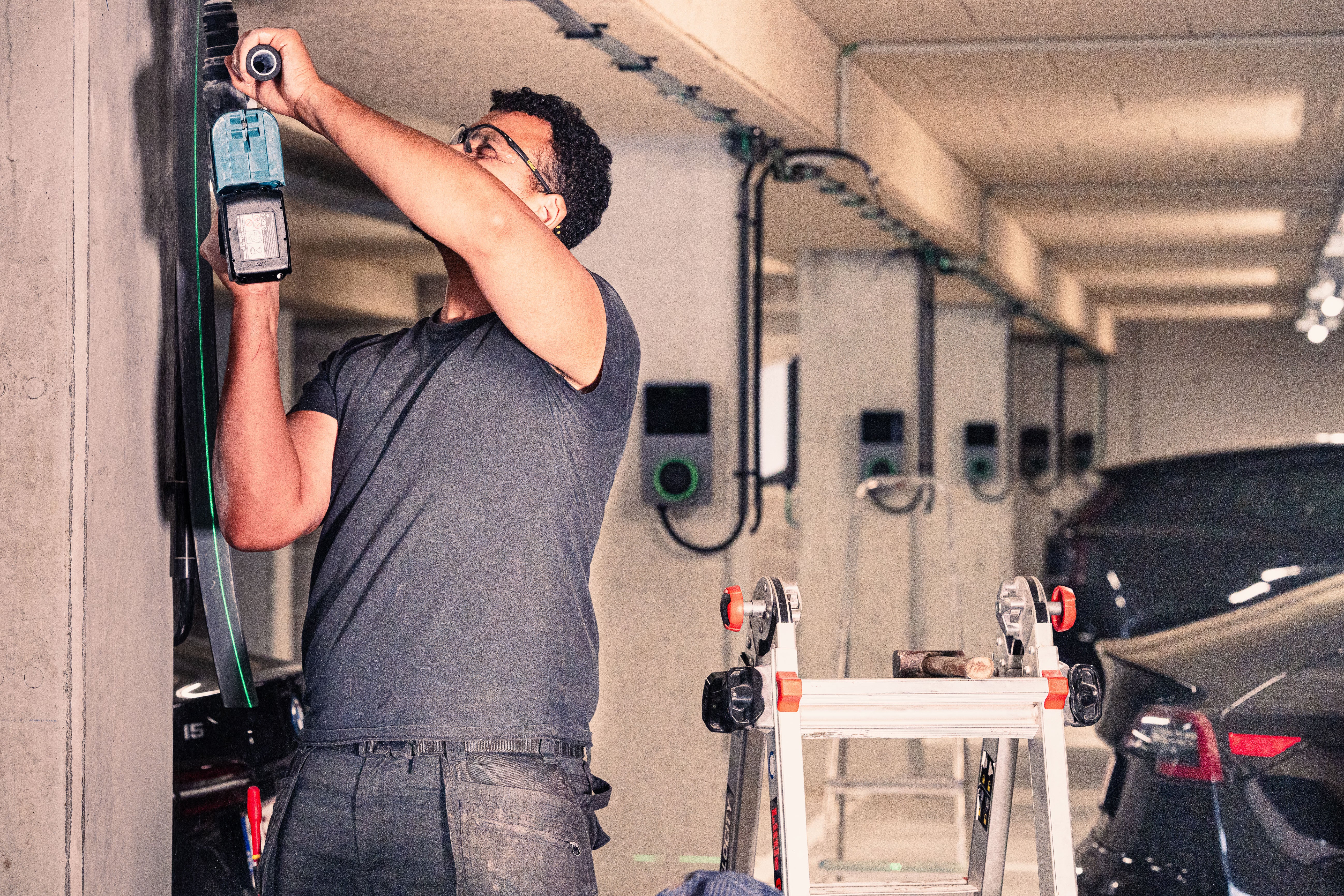


"Charging station nearby." That search query almost always starts with a slight panic in the fingers. Fortunately, the answer is simpler than you think: a good mobile app and a universal charging card. With those two tools in your pocket, you can see not only where the charging stations are located, but also whether they are available, how fast they charge, and what it costs. This is how you create immediately the right choice.
The Need for Reliable Charging Solutions Is Growing
Fortunately, the days when you simply had to hope for a free and working charging point are over. The transition to electric driving in Belgium has gained momentum, and the infrastructure is growing rapidly to keep pace. This is no coincidence, but a crucial development to accommodate the wave of new electric cars.
A Full Growth Network
The Belgian charging infrastructure has literally exploded in recent years. By early 2026, our country will have more than 100,000 counting public charging points. That is a doubling compared to the 50,000 points that were in place in April 2024.
This impressive sprint places Belgium in the European top three, just behind the Netherlands and Denmark. And that is just as well, because that expansion is desperately needed to meet the expected two million electric vehicles to support on Belgian roads by 2030 – a giant leap compared to the 190,000 in 2023. You can find more details about this growth at Go-Electra.com.
So the numbers don't lie: finding a charging station is becoming technically easier and easier. The real challenge now is to navigate that enormous selection smartly and efficiently.
Know the Different Types of Charging Points
When searching for a charging station, you will encounter various types. It is helpful to know the differences to save time:
- Public charging stations: You can find these along highways, in city centers, and in public parking lots. They are accessible to everyone, usually via a charging card or app.
- Semi-public charging stations: Think of the charging stations at companies, supermarkets, or hotels. They are often available during opening hours and are sometimes intended as an extra service for customers.
- Private charging stations: These are the charging points at people's homes or on enclosed business premises. Logically, these are for private use only.
A good app, such as the one from Blulinc, filters these options for you. You get access not only to our own extensive network but also to that of our roaming partners. This transforms the search for a "charging station nearby" from a stressful task into an effortless act.
Navigate Smartly through the Charging Network with an App and Charging Card
Finding a charging station on the map is one thing. But what if you arrive? Is it the right type? Does the station work? And how do you pay? Navigating the Belgian public charging network can seem overwhelming, but with the right tools, it is child's play.
Consider a good mobile app as your command center on the go. It is the tool that saves you from driving around aimlessly looking for a working charging point. A solid app allows you to filter your search and find exactly what you need, when you need it.
You can immediately refine your options based on:
- Connector type: Quickly find charging stations with the right plug for your car, whether that is a Type 2 is for AC charging or a CCS-plug for a fast DC charge.
- Loading speed: Do you need a quick boost during a long drive? Then filter by fast chargers (DC) or ultra-fast chargers. For longer stops, a standard (AC) charging station is sufficient.
- Network operator: If you have a preference for a specific network, you can select it. Better yet: use an app with broad roaming access so you don't have to worry about that.
- Real-time availability: This is an absolute lifesaver. See which charging points are occupied, free, or out of service before you leave.
Make Loading and Paying Painless
Once you arrive, the last thing you want is the hassle of payments. Juggling half a dozen different apps, each with its own account and payment details, is a real headache.
This is where a universal charging card makes the difference. A single card, such as the Blulinc Charging Card, gives you seamless access to a gigantic network of charging stations from all kinds of different operators. No more hassle with different apps.
The whole process becomes incredibly simple.
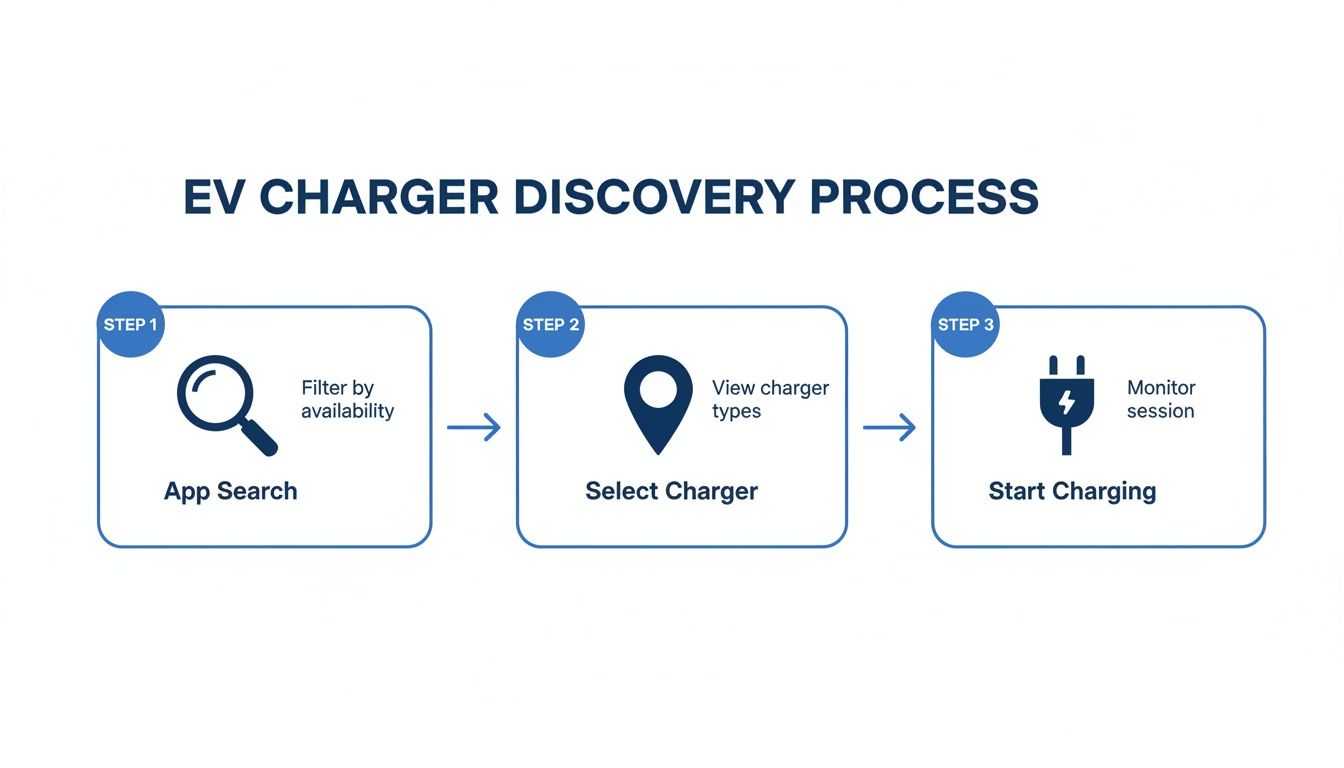
As the image shows, a unified system makes the process from finding to activating extremely efficient.
This simple approach is essential in a rapidly growing market. In 2023 Belgium counted 190,000 new registrations of battery-electric vehicles – a staggering rise of 111% compared to the previous year. By almost two million electric cars expected on our roads against 2030, the need for user-friendly charging solutions is greater than ever.
The market for charging infrastructure is expected to grow from 55,670 units in 2025 to more than 180,470 in 2030. This underscores the urgency for simple, effective navigation tools. You can find more details about this growth in the Belgian EV charging equipment market report from Mordor Intelligence.
Imagine this: a sales representative is driving from Ghent to Liège. Instead of stressing about which network to use, he opens the Blulinc app, finds an available ultra-fast charger along his route, and pays with his single company card. The entire stop is managed in one place, and all costs appear on a single, clear invoice.
This kind of convenience transforms public charging from a potential burden into a reliable part of the journey. For individual drivers and companies with a fleet, a unified solution is no longer a luxury, but a must-have for efficient electric mobility. You can discover the ultimate solution for EV users with the Blulinc charge card in our guide.
Choose the Right Charger for Your Needs
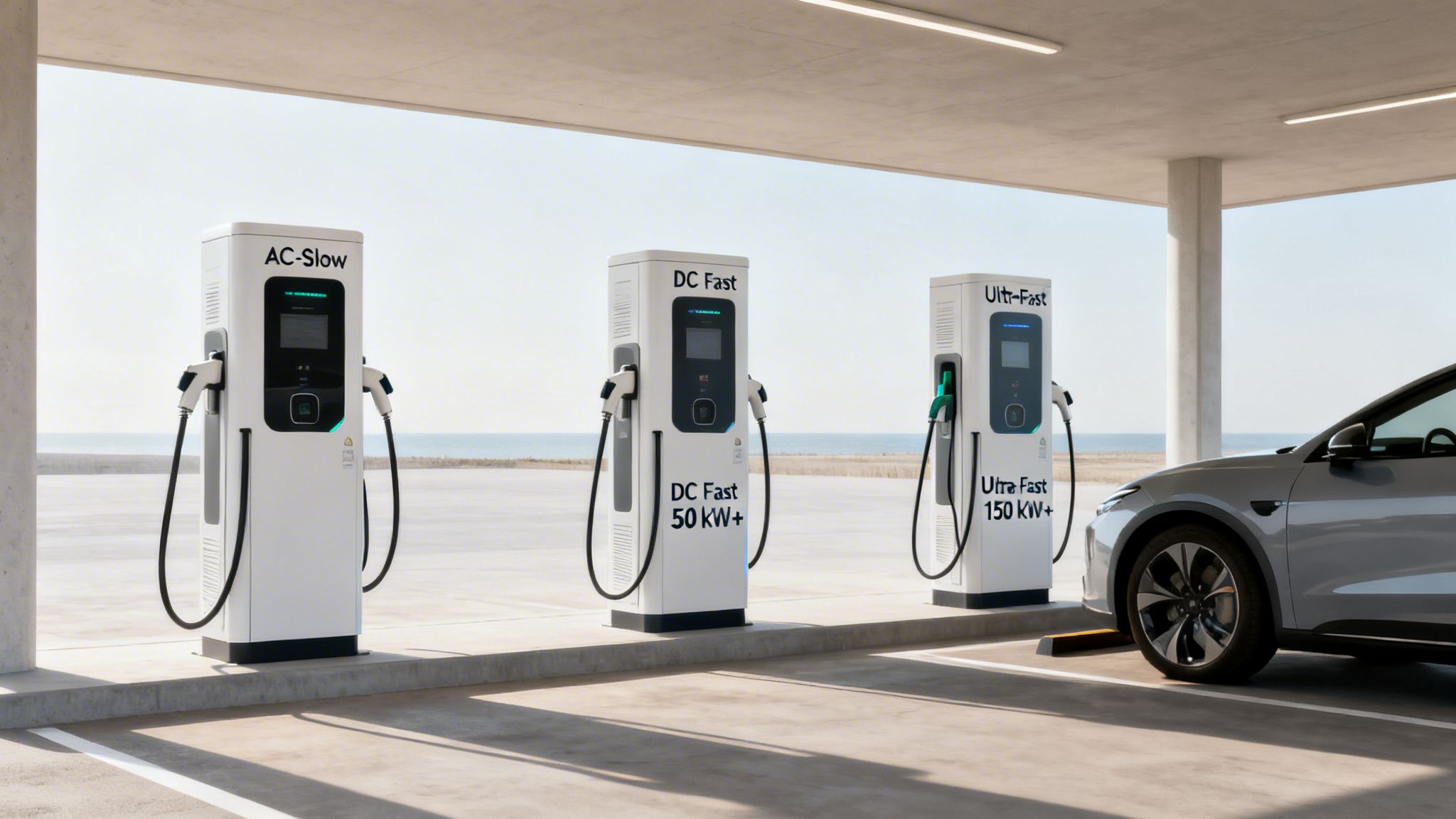
When you open a map of charging points, you see a mix of different speeds and power levels. It is easy to get lost in the jargon, but making the right choice is the difference between a quick charge and a frustratingly long wait.
Look at it this way: you don't use a small screwdriver to break down a wall. The same logic applies here. Your needs change depending on the situation, and there is a specific tool for every task.
Let's divide them into three simple categories.
AC (Slow) Charging
Alternating current (AC) chargers are the chargers you find most often at work, at hotels, and in public car parks. They are designed for situations where your car is parked for a few hours.
- Ideal for: Charge at home overnight or top up for a full day at the office.
- Speed: They usually deliver 30 to 100 kilometers driving range per hour.
- Scenario: An employee plugs in his company car at the office in the morning. At the end of the day, he leaves with a full battery, ready for the next workday.This is not only convenient; this slower, steady charging method is also better for your car's battery in the long run.
DC Fast and Ultra-Fast Charging
Direct current (DC) chargers are the real gamechangers for anyone who travels long distances or needs a quick boost during the day. These are the powerhouses you see along highways and at major shopping centers.
DC fast chargers usually start around the 50 kW, but the ultra-fast chargers deliver 150 kW and more. The difference in speed is enormous. A standard DC charger might give you 100 km of range in 20-30 minutes, but an ultra-fast charger can do that in less than 10 minutes.
This is where the Belgian charging landscape is truly transforming. Finding a fast "charging station nearby" is becoming easier every day. By the third quarter of 2024, Belgium counted 77,443 public charging points. The most impressive part? The number of fast chargers (100 kW+) shot up by in just one year 119% into the air until 3,162 pieces. We are seeing new hubs such as Allego's in Mechelen, with 24 ultra-fast charging points, proving that high-capacity fast charging is the future. You can read more about the evolution of ultra-fast charging in Belgium.
For a fleet manager, this speed is absolutely crucial. Imagine a delivery van that needs to recharge quickly between two deliveries. An ultra-fast charger gets that vehicle back on the road in the time it takes the driver for a cup of coffee. That means minimal downtime and a smoothly running operation.
Ultimately, knowing whether you need a slow AC charge or a fast DC boost empowers you to make smarter, more efficient decisions every time you plug in.
Understanding the Costs of Public Loading
The cost of public charging can sometimes seem like a mystery. Why does one charging station charge per kilowatt-hour (kWh), while another bills you per minute? This can be a real headache, especially for a fleet manager who wants to keep costs predictable. Let’s break down the most common price components in Belgium.
Knowledge of these various elements is the key to avoiding surprises. The final price on your invoice is rarely a single number; it is almost always a combination of different rates.
The Key Price Components
When you charge at a public charging station, the total cost is usually made up of several of these components:
- Starting rate: This is a small, one-time cost to start a charging session. Think of it as a connection fee, usually between € 0,25 and € 0,75.
- Price per kWh: This is the simplest part – you pay for the exact amount of energy your car consumes. It is the fairest payment method because it is directly linked to the 'fuel' you actually receive.
- Time-related costs: Some operators, especially at fast DC chargers, charge per minute or per hour. This makes sense in locations where a fast flow of vehicles is the priority.
- Occupancy or blocking costs: To prevent drivers from occupying a charging spot after their car is fully charged, some stations charge a fine if you stay too long. It is a way to keep the charger free for the next user.
The tricky part is that operators can combine these components, meaning the final cost for the same amount of energy can vary significantly from station to station.
A Practical Cost Comparison
Suppose you need 40 kWh recharging.Here you can see how the price can differ at two Belgian charging stations.
Scenario A: The Charger at the Supermarket This station uses a simple, clear model, typical of AC chargers where cars are parked for longer periods.
- Starting rate: € 0,50
- Price per kWh: € 0,55
- Time cost: None
- Total cost: (€ 0,55/kWh * 40 kWh) + € 0,50 = € 22,50
Scenario B: The fast charger along the highway This is a DC fast charger that bills based on time to encourage a fast throughput.
- Starting rate: € 0,75
- Price per minute: € 0,40
- Charging time (for 40 kWh): 30 minutes
- Total cost: (€ 0,40/min * 30 min) + € 0,75 = € 12,75
As you can see, the fast charger is much cheaper for a quick charge. However, if your car were to charge more slowly or if you were to remain plugged in longer, that time-related cost would quickly add up.
The Hidden Costs of Roaming
In addition to these direct costs, there is another factor: roaming. When you use a charging card from one provider at a charging station from another, your card provider often charges a small surcharge for processing the transaction. Convenient, certainly, but those small roaming costs can quickly add up and throw your budget into disarray.
A unified solution like the Blulinc charging card is designed to solve this problem. We offer clear, transparent pricing and bundle all charging sessions—regardless of the network—onto one predictable monthly invoice. This gives fleet managers the control they need to effectively forecast and manage expenses, and transforms a complex web of costs into one simple figure.
By understanding these different pricing models, you can make smarter choices when looking for a "charging station nearby". For a more in-depth look at how these rates are structured in Belgium, you can learn more about the CREG tariff for charging stations in our detailed article.
Do you have charging stations? Here's how to ensure they are found.
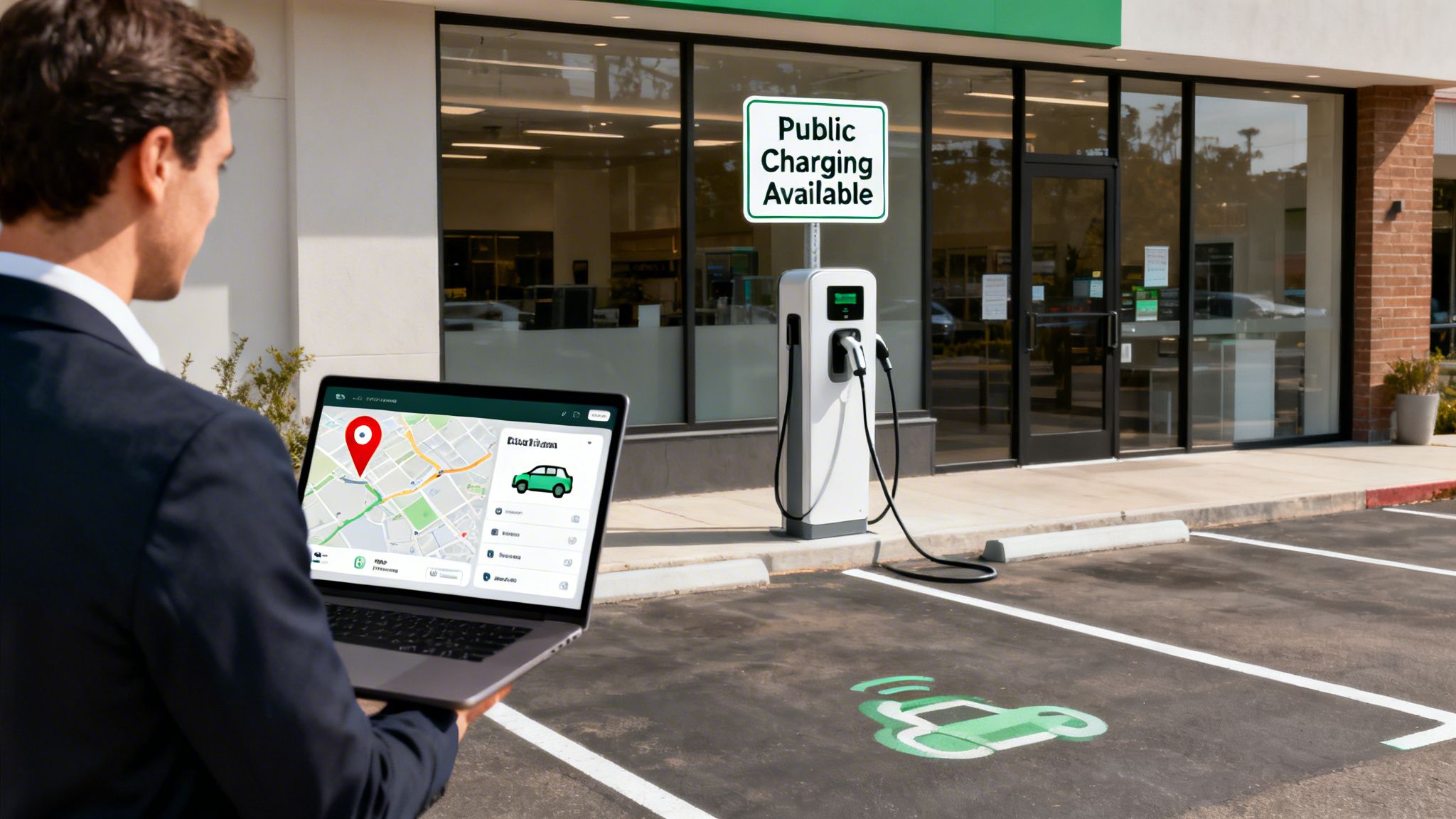
Investing in charging infrastructure is a fantastic move for any forward-thinking Belgian company. But installing charging stations is not enough. If drivers cannot find them, you are missing a huge opportunity – whether it concerns revenue from public charging, a key benefit for your team, or attracting new customers.
The real goal is to make your charging stations both visible and reliable. This means they must be included in the charging cards and apps that every EV driver has on their phone. Without that visibility, your investment is practically invisible and serves only those who happen to stumble upon it.
Put your charging stations on the map
So how do you ensure that your charging stations appear when someone searches for a "charging station nearby"? The answer is to connect them to a wider network via e-roaming platforms. Consider these platforms as the bridge between your physical hardware and the apps in drivers' pockets.
It is comparable to listing a holiday home on a major booking site; suddenly, you are seen by a massive audience. E-roaming does exactly that for your charging stations, making them visible to thousands of EV drivers across various networks. It is the essential first step to turning a private investment into a publicly accessible facility.
The Absolute Must-Haves for Public Access
Once your chargers are on the map, the user experience must be seamless. Drivers crave clarity and reliability. Get these three things right, and you will see people come back.
- Show Real-time Status: Your station must communicate whether it is available, occupied, or out of service. There is nothing more frustrating for a driver than arriving at a charging station and discovering that it is already in use or, worse, out of order.
- Be Clear About Prices: No one likes surprises when it comes to costs. Your rates—whether per kWh, per minute, or a fixed amount—must be clearly displayed in the app. before a driver plugs in.
- Guarantee Reliability: A charger that is constantly offline is worse than no charger at all. It damages trust. Regular maintenance and active monitoring are crucial to building a reputation for reliability.
For business owners who want to attract more local drivers, integrating your EV chargers into a smart local marketing strategy make a world of difference.
Think of an SME in Antwerp with 10 semi-public charging stations. By opening them to the public after office hours and setting a competitive off-peak rate, they not only recoup their investment faster, but also provide a valuable service to the neighborhood and attract potential new customers directly to their doorstep.
The Smart Way to Turn Your Investment into an Opportunity
Managing all of this—uptime, pricing, public visibility—requires a powerful system behind the scenes. This is where a platform like Blulinc becomes the command center for your entire charging operation. It allows you to see everything in one place: monitor when chargers are online, track their usage, and manage your public tariffs.
Without such a system, you are flying blind. You do not know that a charger is defective until a dissatisfied customer calls, and you lack the data to determine the correct prices. A solid management platform transforms a piece of hardware into a dynamic, profitable asset or a highly valued employee benefit.
To make this crystal clear, here is a short checklist to get your charging station ready for the general public.
Checklist for a Findable and Reliable Charging Station
| Action point | Why it is important | How Blulinc Helps |
|---|---|---|
| Sign up for Roaming Networks | Makes your charger visible in dozens of popular EV apps that drivers use daily. | We connect your chargers to the major e-roaming platforms, immediately increasing your range in Belgium and Europe. |
| Show Live Status | Prevents driver frustration by displaying real-time availability (free, occupied, defective). | Our platform continuously synchronizes the status of your charger with all connected apps, so that the data is always accurate. |
| Set Transparent Pricing | Builds trust and helps drivers make an informed choice before plugging in. | You get full control to set and adjust public charging rates directly from your Blulinc dashboard. |
| Uptime & Status Monitors | Ensures that your chargers always work, which protects your reputation and revenue. | We offer real-time notifications and diagnostics, so you know immediately if a charger needs attention, often even before a driver notices. |
Following these steps is the final, crucial piece of the puzzle. It is how you ensure that your EV infrastructure is not only installed, but is also truly successful, findable, and appreciated by everyone who uses it.
Frequently Asked Questions about Electric Charging in Belgium
The switch to electric vehicles is exciting, but naturally raises questions. Whether you are a driver looking for a "charging station nearby" or a company managing a fleet, clear answers are essential. Let's address some of the most common questions we hear daily.
What should I do if a charging station is not working?
It is one of the biggest frustrations for every EV driver: you arrive at a charging station and it is out of service. Before you give up and drive away, take a quick look at the charging station screen. Any error messages can give a hint as to what is wrong.
Often, the solution is surprisingly simple. Just try restarting the charging session from your mobile app. If that doesn't work, look for a support number printed on the charger itself. A quick call to the operator can provide you with immediate assistance.
Of course, the best approach is to avoid this scenario entirely. A reliable app like the one from Blulinc It shows you the real-time operational status of charging stations, so you know that a station is working before you leave. For businesses, our platform sends immediate notifications in the event of malfunctions, allowing you to stay one step ahead of the problem.
Can I use any charging card at every station?
Not always. Although roaming agreements have made things much simpler, you will still find charging stations exclusive to a specific provider. This patchwork of networks can be confusing and often means you have to juggle multiple passes just in case.
Your best choice is a service with extensive roaming coverage. The Blulinc Charging Card, for example, gives you access to more than 900,000 charging points throughout Europe, including the vast majority of charging stations here in Belgium. This takes the guesswork out of it and simplifies your life with one predictable monthly invoice.
How can a company set spending limits for employee charge cards?
For every company with an electric fleet, strict control over charging costs is essential. Trying to track expenses manually is a recipe for headaches and errors. A smart charging management platform is the only right way.
With Blulinc, fleet managers can easily set individual spending limits for each employee's charging card. You can define a monthly budget in euros (€) or limit the total number of kilowatt-hours (kWh) they are allowed to consume. You can even set smarter rules, such as restricting access to expensive ultra-fast chargers or defining specific charging times. It is all about automatically enforcing your company policy, which provides you with clean data for expense reports and takes the administrative burden off your shoulders.
Is public charging more expensive than home charging?
Yes, as a general rule. Prices for public charging must cover not only the electricity but also the hardware, ongoing maintenance, and operator service costs. For most drivers, the smartest and most cost-effective strategy is to charge daily at home or at the office, where electricity rates are much lower.
Consider the public grid as your solution for longer journeys or when you need a quick charge on the go. An integrated solution is perfect for managing this hybrid approach. The Blulinc platform, for example, seamlessly processes both charging sessions at the workplace and public charging stops, giving you one complete, unified overview of all your costs and usage.
Ready to simplify your company's charging strategy and gain full control over your fleet costs? Request a free consultation today. The experts at Blulinc are ready to help you build a future-proof charging solution. https://blulinc.com