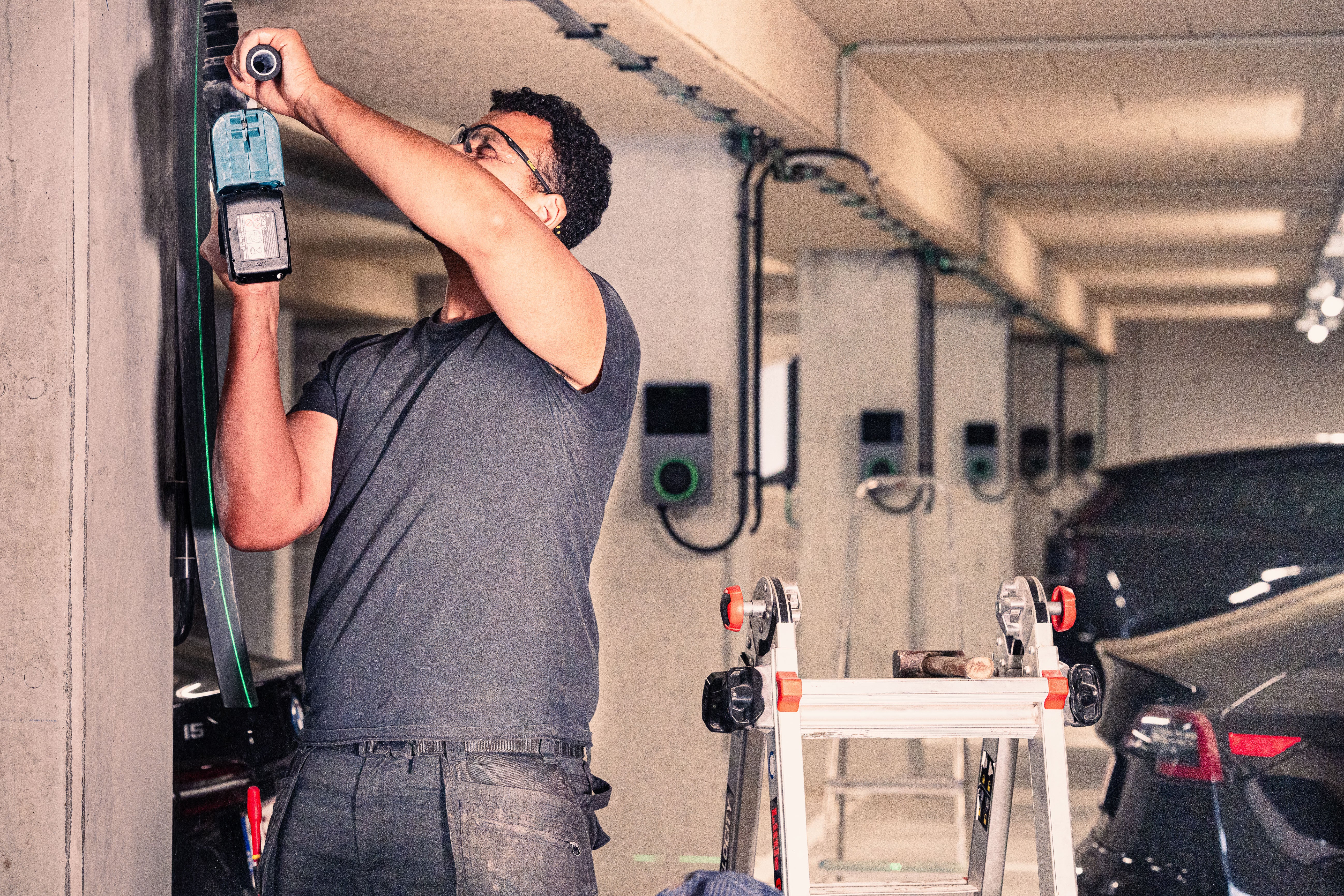


Everyone knows that slight feeling of panic when the battery light on your electric car suddenly starts flashing. That uncomfortable feeling is relatable, but fortunately, finding a reliable charging station in your neighborhood In Belgium, it is much simpler than you think. With the right approach, that charging stress will be a thing of the past for good.
The key to success is knowing which tools to use. Whether you manage an SME fleet or simply drive for yourself, the fast-growing Belgian charging network is always within reach. We show you the best ways to find your next charging point stress-free.

Start with your car's built-in navigation
Often, the most direct method is already within reach. Most modern electric vehicles are equipped with a navigation system that automatically shows nearby charging stations when your battery level drops.
The major advantage of this is that many of these systems real-time availability show, which saves you the frustration of arriving at an occupied or defective charging point. It is your first and best line of defense against charging stress.
Gain more control with specialized charging apps
For more details and control, a specialized app like the Blulinc app is indispensable. These tools do much more than just show a location on the map. They enable you to filter your search based on what is truly important for your specific trip.
With a powerful app, you can easily check for:
- Plug type: See immediately if a charging station has the right plug for your car, such as a Type 2- or CCS-connector.
- Loading speed: Choose between a standard AC charger for a longer stop or a fast DC charger to get you back on the road quickly.
- Network access: Use one app and charging card to access a wide range of charging networks without needing multiple accounts.
These apps offer an all-in-one solution and streamline everything, from finding the charging point to handling the payment. You can find more tips in our in-depth guide to locating electric car charging near you.
To make it even clearer, here is a brief overview of the most commonly used tools.
Quick guide to finding your next charge
| Tool | Ideal for | Main function | Coverage |
|---|---|---|---|
| Built-in navigation | Quick searches on the go | Real-time availability integrated into your route | Varies by car brand, often gives preference to certain networks |
| Specialized apps (e.g. Blulinc) | Detailed planning & filter | Extensive filters (speed, connector, cost) | Extensive access to multiple networks in Belgium & Europe |
| General map services (e.g. Google Maps) | A quick, initial exploration | Familiar interface and broad map coverage | Limited; often lacks real-time data and detailed specifications |
Ultimately, the combination of your car's navigation for quick checks and a specialized app for detailed planning gives you the most robust and stress-free charging experience.
What about general card services?
Although apps like Google Maps and Waze are excellent for general navigation, they have their limitations when it comes to charging stations.They do show you where the charging stations are located, but critical information regarding availability, charging speed, or specific connector types may be incomplete or outdated.
Consider them a solid starting point. But for a truly seamless experience, we always recommend verifying the details with a specialized charging app before taking a detour.
The Belgian charging infrastructure is experiencing explosive growth. According to forecasts, our country will by the end 2025 106,677 public and semi-public charging points count—a sharp increase of 23% compared to 2024. This expansion keeps pace with the booming EV market, which in 2025 alone accounted for 145,170 electric cars sold, which amounts to a market share of 35%. For SMEs and fleet managers, this means that reliable charging options are becoming more numerous every day.
The different charging types and speeds deciphered
You have found a cluster of charging stations nearby. That is the easy part. The real art is knowing which charging point is suitable for your car and your schedule. The technical jargon can seem a bit overwhelming at first, but once you know the basics, you will charge like a pro.
Let's outline the essential difference between charging types and speeds. Understanding this is crucial for managing your time efficiently, whether you are charging a single company vehicle or an entire fleet. The most important distinction you will encounter is between AC (alternating current) and DC (direct current) chargers.
Think of it this way: AC charging is your steady, reliable marathon runner, while DC charging is the sprinter.
AC vs. DC charging: a simple explanation
AC chargers They are the workhorses of the EV world and by far the most common type you will find. They are the perfect solution for situations where your vehicle is parked for a few hours—think of charging at the office during the workday or at home overnight.
- Connector: Throughout Belgium and the rest of Europe, the Type 2-connector the universal standard for AC charging.
- Speed: They deliver power of 3.7 kW to 22 kW. In practice, that adds approximately 20 to 120 kilometers of range for every hour you are connected.
DC chargers, often called fast chargers or ultra-fast chargers, are a different caliber. They convert the power. before this reaches your vehicle's battery, enabling dramatically higher charging speeds. This makes them ideal for a quick charge during a long journey or for commercial vehicles that cannot afford long periods of downtime.
- Connectors: The most common DC connector is the CCS (Combined Charging System), the standard here in Europe. You can also occasionally a CHAdeMOencounter -plug, primarily used by some Asian car manufacturers.
- Speed: DC charging starts with a smooth 50 kW and with the latest ultra-fast chargers can rise to well above 300 kW. At that speed, you can add hundreds of kilometers of range in less than 30 minutes.
Imagine a fleet manager whose delivery van has a tight schedule. He will always prioritize a fast DC charger to minimize downtime. An employee who parks at the office all day, on the other hand, can easily use a more cost-effective AC charger. Matching the charger to the mission is the key to operational efficiency.
Why speed and plug type are crucial
Choosing the right charger isn't just about getting back on the road faster; it's about optimizing your time and taking care of your vehicle's battery. While fast charging is an incredibly handy tool, fast charging too often can affect the long-term lifespan of some batteries. A balanced charging habit is always the best approach.
Fortunately, the Belgian charging infrastructure is expanding at an incredible pace to meet these diverse needs. Our guide on how to find fast charging stations near you offers more specific tips on this.
The density of charging points here is truly impressive. In the third quarter of 2024, the country counted 77,443 publicly accessible charging points, what an astonishing rise of 72% is on an annual basis.
Although the use of DC fast chargers currently around the 7-8% lies, its availability is steadily increasing. This growth ensures that, whether you need a slow and steady AC charge or a fast DC boost, the right option is almost always around the corner. You can even view more data on how ultra-fast charging has evolved in Belgium.
Mastering your public charging session
The first few times you charge in a public station, it might feel a bit awkward, but you will find that it quickly becomes just as routine as refueling. Let's go through, step by step, how to confidently start and stop a charging session, from parking at the charger to paying.
Once you have found an available spot, park your car so that the charging cable can easily reach your vehicle's charging port. Open the charging port and connect the cable. Depending on the station, the cable is either attached to the unit (often with DC fast chargers) or you need to use your own cable (typical for AC chargers).
Start the session and pay
With the cable connected, it is time to authorize the session. The most common methods in Belgium are:
- RFID card: Simply hold your charging card, like the Blulinc Charge Card, against the indicated reader at the station. This is often the simplest and most reliable method, especially for business users.
- Mobile app: Open the station operator's app or an umbrella app such as Blulinc. Locate your charging point on the map and tap "Start Charging".
- QR code: Scan the QR code on the charger with your smartphone. This usually takes you to a webpage for a one-time payment with a credit card, without having to install an app.
With the Blulinc app, you can do more than just find a station. It allows you to start the session, track progress in real time, and handle payment transparently afterwards. All your costs are neatly organized in your session history.
An excellent example is a sales representative who travels throughout Europe. He uses his single Blulinc charging card at various charging networks. All costs, regardless of the operator, are automatically consolidated on one invoice. This makes the expense report incredibly simple for his employer.
Choosing the right charger often depends on how much time you have. The image below shows the different available charging speeds, from slower AC charging to ultra-fast DC options.

As you can see, the right choice really depends on your schedule and how quickly you need to be back on the road.
Choosing the payment method at a public charging station depends on convenience and how often you charge away from home. Here is a brief overview of the usual options.
Payment options at public charging stations
| Payment method | How it works | Ideal for | Example |
|---|---|---|---|
| Payment via app | Start and stop sessions via a provider's or aggregator's app. Payment is linked to your account. | Frequent EV drivers who want to keep track of history and have access to multiple networks. | Use the Blulinc app to manage sessions with different providers. |
| RFID charging card | Tap the charger reader with a physical card to authorize and pay. | Business users and managers who value simplicity and reliability. | A fleet driver who uses his Blulinc Charge Card for simple invoicing. |
| Contactless/QR code | Tap your bank card or scan a QR code for a one-time web payment. | Occasional users or drivers without the app/card from a specific provider. | A tourist paying directly with his credit card at a gas station along the highway. |
With a charging card or a versatile app like the one from Blulinc, you have the most flexibility, so you are never faced with surprises, no matter where you need to charge.
End your session
To stop charging, simply repeat the process you used to start. Hold your charging card against the reader again or end the session in the app. Wait a moment for the station to release the cable, then disconnect it from your car and store it neatly.
By moving your car as soon as you are finished, you free up the spot for the next driver and avoid potential occupancy fees that some operators charge for overparking.
The growth of the Belgian charging infrastructure is impressive. By 2026 the market is estimated at 55,670 units, with a forecast of 180,470 charging points against 2030. This corresponds with the prediction of EV Belgium, which states that 2 million electric vehicles annually 20,000 to 30,000 will need new charging points.
For fleet managers, Blulinc's end-to-end solution offers—from load management to the app for finding, starting, and paying at more than 900,000 charging points—the scalability needed to handle this growth. You can read more about these Belgian market forecasts on Mordor Intelligence.
Building your personal charging strategy
Getting the most out of your electric car goes beyond just public transport. charging stations in your neighborhood find. True freedom comes from building a charging routine that fits seamlessly into your life, whether you are at home, at the office, or on a long drive.
For most drivers, the best and cheapest charging happens when the car is already parked. This simple change in mindset transforms charging from an active quest into a background task that takes place during your daily standstill.

Charging at work: more than just a perk
For companies and fleet managers, the installation of charging stations at the workplace is a game changer.It is not just a pleasant perk for employees; it is a direct investment in efficiency and your company's green reputation. By offering reliable charging during the workday, you support your team's transition to electric driving and keep your company fleet charged and ready for use.
At Blulinc, we help companies implement these solutions with smart features that make a difference:
- Smart charging management (Smart Load Management): This smart technology automatically distributes power across all chargers in use. It prevents you from overloading your building's electrical system, which is crucial when multiple cars are plugged in simultaneously. This helps you avoid expensive grid upgrades and punitive peak consumption rates from your energy supplier.
- Attracting and retaining talent: Offering charging facilities at work is increasingly becoming a key benefit that top talent seeks. It sends a clear signal that your company is modern, forward-thinking, and committed to sustainability.
The power of home charging and split billing
The smartest charging plans almost always start at home. For employees with a company car, charging overnight is incredibly convenient. But this naturally raises questions about reimbursement. How do you properly separate the electricity used for the car from the rest of the household's energy consumption?
This is exactly what it is for. split billing is designed. A smart home charging station from Blulinc can measure the precise amount of energy used for the company car. That data is forwarded for automatic processing, and the costs are reimbursed directly to the employee or settled with the employer. No more manual expense reports or guesswork.
Just imagine this: An SME in Ghent provides 10 of its sales representatives with a new electric company car. By installing smart home charging stations with split billing, the entire reimbursement process is automated. This eliminates a huge administrative burden and guarantees that every employee is reimbursed fairly and transparently for home charging.
Bringing everything together: loading private and public
A truly comprehensive strategy connects your private charging points—at home and at the office—with the vast public charging network. For your daily commutes and local trips, your private charging points will likely more than 80% cover your needs. But what about those longer trips?
This is where a uniform solution such as the Blulinc app and Charge Card is indispensable. They bridge the gap between your personal installation and public charging access. You can plan a long drive from Brussels to the Ardennes with peace of mind, knowing that you can use the same app and payment method at more than 900,000 public charging points across Europe.
Your complete charging history, whether at home, at work, or at a public charging station, is brought together in one place. This gives both individual drivers and fleet managers a crystal-clear overview of total energy consumption and costs, giving you full control over your electric driving experience.
Okay, let's talk about those moments when things just don't go smoothly. Even with the best preparation and a carefully planned route, it can happen that a charging session doesn't go flawlessly.
You finally reach the charging station and then… nothing. A charging station that refuses to work or a charging card that is suddenly not recognized. Frustrating, but whatever you do, don't panic.Usually, the solution is surprisingly simple.
What if the Charging Station Is Not Working?
Is the charging station unresponsive? Then start with the absolute basics. Check that the charging cable is securely attached at both ends — both to the station and to your car. Sometimes simply unplugging and replugging the cable is enough to make the magic happen. Another quick check is to try restarting the charging session via your app or with the charging card.
If that doesn't work either, take a closer look at the charging station itself. At most charging stations, you will find a sticker with a customer service phone number. They can often help you remotely by resetting the station or telling you what the cause of the malfunction is. By reporting a malfunction via your app, you are helping not only the operator but also other EV drivers.
A classic issue is the charging card not being recognized. This could be a temporary malfunction in the charging station's reader. In that case, try starting the session via the QR code on the station to pay via the webpage, or use another charging card if you have one at hand.
The Unwritten Rules of Loading Etiquette
Public charging infrastructure is for everyone. A little courtesy and common sense ensure that charging remains a pleasant experience for everyone. The golden rule is simple: avoid “pole hogging”. This means moving your car as soon as it is sufficiently charged to continue your journey.
Keep these simple etiquette tips in mind:
- Avoid occupying: Is your battery fully charged? Then make way for the next person. Many operators charge, by the way. occupancy rates turn on if your car unnecessarily blocks a charging spot.
- Keep it tidy: Roll up the charging cable neatly after use and hang it back where it belongs. This way, no one will trip over it and the equipment remains in top condition.
- Park correctly: Park your car neatly within the lines so that you do not block other drivers or loading spaces.
- Be patient: Are all charging stations occupied? Then wait at a reasonable distance or use your app to search for a nearby alternative. There is no point in confronting other drivers.
By following these simple rules, you contribute to a positive charging culture that benefits everyone.
The world of electric driving is fascinating, but it also raises questions at times. That is perfectly normal. Even those who have been driving electric for years occasionally face an unexpected situation. Let's go through some frequently asked questions about finding and using charging stations in Belgium, so that you can always hit the road with peace of mind.
The landscape of apps, tariffs, and charging stations can seem a bit complex at first. But don't worry, the solutions are often simpler than you think.
What Is the Best App to Find Charging Stations?
While a general mapping service like Google Maps can provide a quick overview, you unlock the true potential with a specialized app from an e-Mobility Service Provider (e-MSP). The Blulinc app, for example, gives you access to a network of more than 900,000 charging points spread across Europe, all managed from a single account.
So you no longer have to struggle with a wallet full of charging cards and a phone full of apps. Instead, you simply filter by connector type, charging speed, and real-time availability. This way, you effortlessly find the right charging point, whether you drive for private or business purposes.
How Do I Get Insight into the Costs of a Charging Session?
The cost of a charging session can indeed sometimes be unclear. The total price is often made up of various elements:
- A rate per kilowatt-hour (€/kWh)
- A starting fee for the charging session
- Potential occupancy charges if you occupy a charging point for an unnecessarily long period
The key to clarity is transparent service. With the Blulinc app and charging card, we always clearly show you the charging station operator's rate. before You start charging. Afterwards, you will find a detailed breakdown in your charging history. No more surprises on the invoice, just clear and fair costs.
What if a Charging Point Is Occupied or Out of Service?
Modern charging apps, including the one from Blulinc, show the live status of a charging station. This way, you know whether a station is available, occupied, or out of order. A quick check before departure can save you an unnecessary trip.
Do you arrive at a charging station that unexpectedly turns out to be defective? Don't panic. Open the app immediately and search for the nearest available alternative. It is always smart, especially on longer journeys, to have a backup plan. By reporting the malfunction via the app, you also help the operator as well as other drivers.
Electric driving in Belgium is becoming easier and more accessible by the day. With the right tools and a little preparation, nothing stands in your way.
Ready to optimize your charging strategy, whether you are an SME, fleet manager, or private driver? Take control of your charging experience and costs. Request a free consultation with the experts from today. Blulinc and discover the perfect charging solution for your needs. Learn more at blulinc.com.