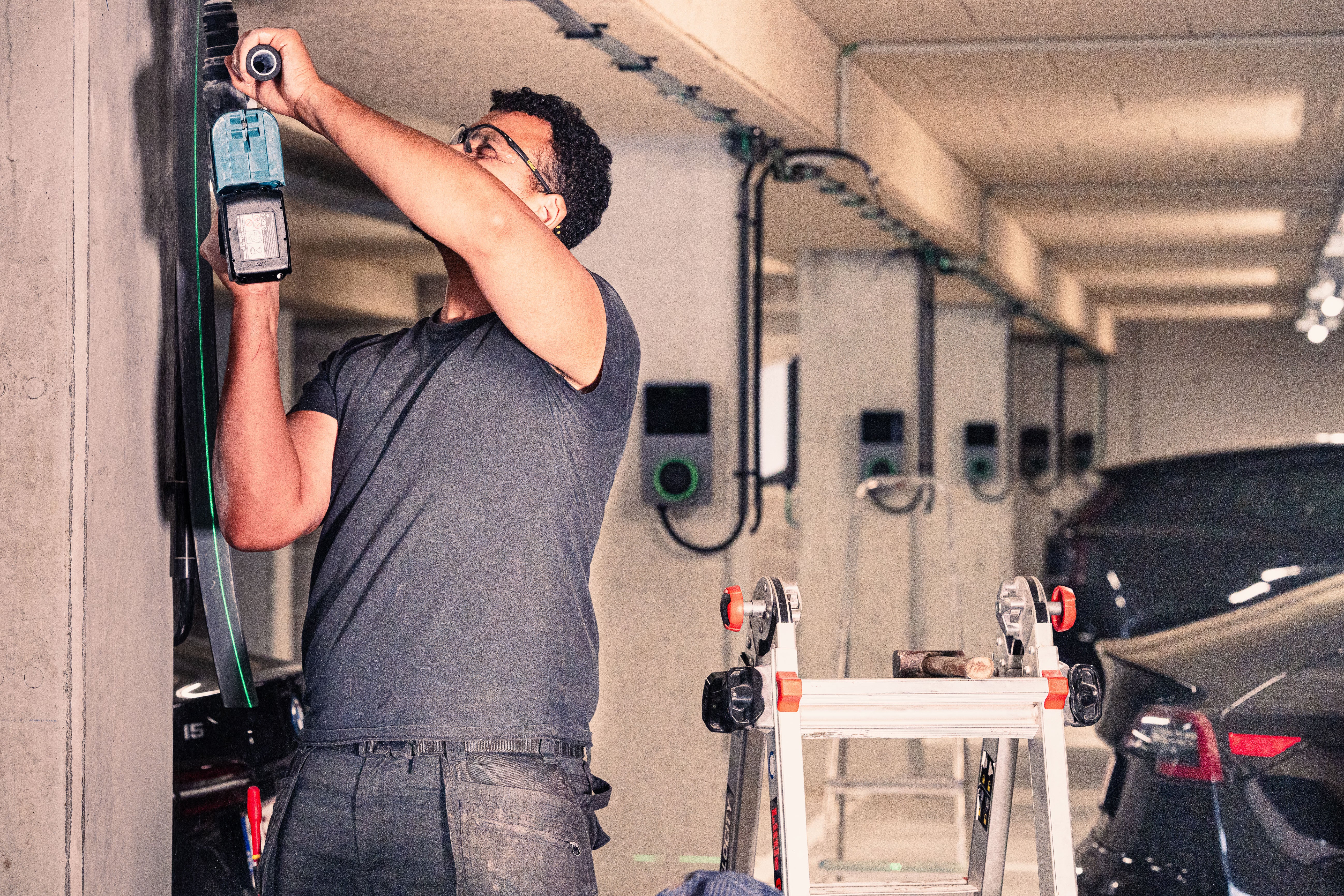


Do you drive electric, or are you considering the switch for your fleet? Then chances are that you the Type 2 plug you have already come across. This plug has become the universal standard for charging electric cars in Belgium and the rest of Europe. Think of it as the USB-C of the automotive world: one streamlined connector that fits almost every modern model, making life a lot easier for everyone. Whether you are charging at home, at work, or at a public charging point, this plug is the key to every alternating current (AC) charging session.
Why the Type 2 connector is the standard
It is no coincidence that the Type 2 plug – officially the IEC 62196 Type 2 connector – is the standard. The European Union established this connector as the official standard for AC charging as early as 2013. That decision was crucial, as it created uniformity across the continent and put an end to the confusion caused by countless different plugs and cables.
Thanks to this standardization, you can invest in charging infrastructure with peace of mind. It does not matter whether your fleet consists of Audis, Teslas, Peugeots, or Polestars; they can all charge at a charging station with a Type 2 connector. This not only guarantees compatibility but also greatly simplifies the management of your charging points. For Belgian companies, this means that the charging solution you install today will still work perfectly tomorrow for all common electric vehicles.
The driving force behind Belgian charging growth
The dominance of the Type 2 connector is directly reflected in the explosive growth of the Belgian charging network, which is primarily built on AC charging. In Belgium, the number of public and semi-public charging points, where the Type 2 plug the cornerstone has increased enormously. According to figures from the European Alternative Fuels Observatory, Belgium already had 106,677 of these charging points at the end of 2023. The number of AC charging points, almost all of which use a Type 2 connector, amounted to 99,341.
These figures underscore how fundamental this standard is to the infrastructure we install daily at Blulinc, both for SMEs and through home charging programs for employees.
The Type 2 connector is to electric driving what the euro is to travel within Europe: a universal standard that makes everything simpler and more accessible. It is the key to a seamless charging experience for your fleet.
For fleet managers and facility managers, this standard offers enormous benefits:
- Future-proof: Your investment remains valuable, because all new EVs on the European market are compatible.
- Ease of use: Employees and visitors do not need to worry about the right cable and can charge effortlessly.
- Flexibility: The same charging stations can be used by a diverse fleet of vehicles with different makes and models.
A good understanding of the role of the Type 2 connector is the first step towards making a smart, sustainable choice for your charging infrastructure. Dive deeper into the world of charging cables and discover the different types in our detailed article on the charging cable for an electric car.
Charging capacity and charging speeds deciphered
When considering charging stations, all the technical information comes down to one simple question: how quickly can your cars get back on the road? The charging capacity, expressed in kilowatts (kW), is the most important factor determining the charging speed. type 2The connector is designed for various power levels, which makes choosing the right charging point for your business absolutely crucial.
Simply put, you can compare the capacity of a charger to the thickness of a water pipe. A low-capacity charging station is like a garden hose; the battery fills up, but it takes a while. A powerful charging station is more like a fire hose, which fills the battery much faster.
From garden hose to fire hose
The difference in charging capacity depends on the type of electrical connection you have: single-phase or three-phase.
-
Single-phase charging: This is the standard connection you find in most homes. The capacity is typically limited to 3.7 kW or 7.4 kW. This is your 'garden hose'—perfect for charging at home overnight, but often too slow for a busy office where vehicles need to recharge during the day.
-
Three-phase charging: This more powerful connection, also known as 'three-phase power', is standard in most Belgian commercial buildings. It delivers significantly more power, allowing charging speeds of 11 kW and 22 kW possible. This is your 'fire hose', which drastically reduces charging times.
The following graph shows how dominant AC chargers, which use the Type 2 connector, are within the public charging network.

As the data shows, AC charging points constitute the vast majority of Belgian infrastructure. This underscores why a good understanding of the different power levels is so important for every company.
The 'sweet spot' for Belgian SMEs
For many Belgian SMEs, a charging station is 11 kW the ideal choice. It offers a fantastic balance between charging speed, installation costs, and the load on your building's electricity grid.
An 11 kW charger can fully charge an average electric car (with a battery of, for example, 60 kWh) in approximately 5 to 6 hours. This fits perfectly in an office environment where cars are parked for a normal 8-hour workday.
Although a 22 kWAlthough a charger is twice as fast on paper, it often entails extra costs and complexity. Surprisingly many electric cars cannot even handle more than 11 kW on alternating current (AC), leaving the extra power unused. Moreover, the installation of a 22 kW charger often requires an expensive upgrade to your building's main connection, which significantly increases the total cost.
Let's look at a practical scenario:
- Scenario: A consultancy firm in Hasselt has a fleet of 10 company cars — a mix of plug-in hybrids and fully electric models. The vehicles are primarily charged at the office during the day.
- The 11 kW solution: The company is installing five dual-output charging stations of 11 kW each. Even if all ten vehicles plug in simultaneously, a smart charging system (with load balancing) can efficiently distribute the available power. By the end of the day, every car has more than enough charge for the drive home. Installation costs remain manageable because no expensive grid modification is required, which can result in savings of thousands of euros.
- The 22 kW pitfall: If the company had opted for 22 kW chargers, the investment in the grid connection would have been significantly higher, while most vehicles could not even utilize the extra power. This would have led to unnecessary expenses.
Choosing the right capacity has a direct impact on your operational efficiency and the total cost of ownership (TCO) of your charging project.For a more in-depth look at how these capacities relate to different charging methods, check out our guide on the different charging modes for electric vehicles.
Fixed cable or just a socket for your charging point?
When installing charging stations for your company, one of the first practical decisions is whether to choose chargers with a fixed cable (English: tethered) or models with only a socket (English: untethered), where drivers use their own cable. Both have clear advantages, and the right choice depends on your specific location and the users. The Type 2 plug is the constant, but the way you offer it makes a big difference.

The convenience of a charging station with a fixed cable
A charging station with a fixed cable is all about convenience. Drivers park, take the plug out of the holder, and connect it to their car. No hassle with pulling a personal cable out of the trunk, which might be wet or dirty.
This makes fixed-cable chargers a fantastic option for locations where speed and simplicity are a priority. Consider private parking for your staff. Your employees will certainly appreciate the fast and effortless charging experience at the beginning and end of their workday.
- Advantages:
- Maximum convenience: There is always a cable available, which speeds up the process.
- Less hassle: Users do not need to bring or unpack their own cables.
- Disadvantages:
- More wear and tear: The cable is exposed to the elements, which can shorten its lifespan.
- Risk of damage: A fixed cable can be inconvenient in a busy parking lot and runs a higher risk of accidental damage.
The flexibility of a charging station without a fixed cable
A charging station without a fixed cable has only a Type 2 socket. The driver uses their own charging cable to connect the vehicle to the charging point. Although this requires an extra step, it offers crucial flexibility and robustness.
This solution is perfect for publicly accessible car parks, such as at a multi-tenant office building, a supermarket, or a shopping center. Without a fixed cable, there is a much lower risk of vandalism or damage due to careless use. The charging station itself is less vulnerable and maintenance is simpler, because the cable—the most wear-prone component—is the responsibility of the driver.
Consider a charging point without a fixed cable as a universal socket: it is robust, neat, and works for anyone who brings the right cable. This makes it the preferred choice for public and semi-public environments.
Let's look at a common scenario: An SME in Ghent leases part of its office building to other companies. The car park is shared by its own employees, tenants, and visitors.
-
The solution without a fixed cable: By opting for charging points without fixed cables, the SME creates a neat and sustainable charging setup. There are no cables lying on the ground that pose a tripping hazard or could be damaged. Any driver with a Type 2 connection can charge using their own cable. This significantly reduces maintenance costs and operational concerns for the building owner.
-
Why a fixed cable would be less ideal here: Fixed cables would wear out quickly due to intensive and varied use.Moreover, the risk of damage – and the associated repair costs – would be much higher.
The choice between a fixed cable or not is therefore a trade-off between immediate ease of use and long-term sustainability. At Blulinc, we help you make the right decision, perfectly tailored to the needs of your business and the unique characteristics of your location.
Public charging in Belgium and Europe
As soon as your employees leave the company parking lot, how can you be sure they can charge on the go? This is a crucial question for any company with a mobile workforce.
The good news is that the Type 2 plug It acts as a universal passport for public charging, not only in Belgium, but across the entire continent. Your team can travel with confidence, knowing that their vehicle is compatible with the vast majority of AC charging stations they will encounter.
This standardization is a game changer. Whether your driver is in Brussels, Berlin, or Barcelona, they will find a compatible socket. This removes a huge barrier to long-distance electric driving and offers peace of mind for both the driver and the fleet manager.
Your key to a unified network
The Belgian charging landscape is a perfect example of this standardization in action. The explosion of type 2 plugs This is directly linked to the EV boom in the country, especially in semi-public and work environments.
To support the growing number of electric cars, the infrastructure has expanded rapidly, with AC Type 2 sockets making up the lion's share of new installations. This ensures that drivers can reliably find a compatible charging point, whether they are in Flanders, Brussels, or Wallonia. For more in-depth information, you can consult the insights regarding public charging stations in Belgium on go-electra.com consult
Although the Type 2 connector is the standard for AC charging, you also hear the term CCS (Combined Charging System), especially at fast charging stations along motorways. It is important to understand how the two work together.
Consider CCS the big brother of Type 2. The CCS connector simply adds two large pins below the standard Type 2 socket, enabling powerful DC (direct current) charging. Crucially, any car with a CCS port can still connect a standard Type 2 cable for everyday AC charging.
This relationship guarantees total compatibility:
- For daily AC charging: At the office, at home, or at public destination chargers (such as at supermarkets or in city centers), you use the Type 2 plug.
- For fast DC charging: During long drives that require a fast charge, use the full CCS connector at a special fast charging station.
The Type 2 port is the basis for both methods, confirming its central role in the entire EV ecosystem. It supports everything from slow overnight charging to ultra-fast stops along the highway.
Seamless access across borders
Knowing that the plug fits is one thing, but starting a charging session and paying is another challenge. In the past, drivers needed a wallet full of different charging cards for different networks — a logistical headache.
This is where an integrated solution becomes essential for every company with a fleet.
A service such as the Blulinc charging card and app breaks through this complexity.We give your employees a single key to a vast network of more than 900,000 charging points throughout Europe. Drivers can find a station, start the session with their pass or app, and hit the road again without worrying about payment.
For a fleet manager, this translates into concrete benefits:
- Simplified administration: You receive one clear, consolidated invoice for all charging sessions — public, at the office, and at home.
- Complete transparency: Our management platform gives you real-time insight into where, when, and how much each employee loads.
- Cost control: You can easily set budget limits and monitor usage to keep your operational costs under control.
With a Type 2 connector as the physical standard and a uniform access solution like Blulinc, public charging becomes a simple, predictable part of your daily business operations.
Unlock efficiency with smart charging solutions
A charging point is just the beginning; the intelligence behind it transforms it into a powerful business tool. A charger with a type 2The connector provides the physical connection, but it is the software that acts as the brain and transforms your entire charging infrastructure into an optimized, cost-efficient system. Without smart management, a series of chargers is merely a collection of individual 'dumb' units all competing for power.

This smart software, often referred to as a charging management platform, gives you full control. It enables you to monitor every charging session, correctly allocate costs, and intelligently manage the energy flow. It is the key to maximizing the efficiency of your charging points and lowering your operating costs.
The air traffic controller for your electricity
One of the most critical functions of smart charging is load balancing, which amounts to the dynamic distribution of the available power. Compare it to an air traffic controller at a busy airport. Without control, all planes would try to land at the same time, which would lead to chaos. The controller ensures that every plane lands safely and at the right time, without overloading the system.
Load balancing does exactly the same for your electrical grid connection. It continuously measures your building's total energy consumption and intelligently distributes the remaining capacity across the active charging stations.
If other parts of your building consume a lot of power – for example, due to air conditioning or heavy machinery – the system automatically reduces the charging speed of the vehicles. As soon as that power becomes available again, the charging speed is increased.
This simple yet powerful feature prevents your main fuse from blowing. More importantly, it can save you the significant costs of upgrading your grid connection, an investment that can easily run into thousands of euros.
A practical example: smart charging in Antwerp
Let's look at a practical scenario. Imagine a logistics company in the Port of Antwerp with a fleet of 20 Electric vans. They all need to be fully charged overnight, ready for the early morning shift.
-
Without smart charging: All 20 delivery vans are plugged in around 6:00 PM and start charging at full power. This creates an enormous power surge that far exceeds the building's capacity.This not only risks overloading but also causes high peak costs on the energy bill – the capacity rate that can plummet a budget.
-
With smart charging via the Blulinc platform: The system knows that the vans are not needed until 6:00 the following morning. Instead of creating an immediate power peak, the software intelligently schedules the charging sessions throughout the night. It prioritizes charging during off-peak hours when electricity is cheaper and ensures that total demand never exceeds the grid's limit.
The result? Every delivery van is fully charged in the morning, the energy bill is drastically lower thanks to avoided peak costs, and no expensive grid modification was required.
Complete control and automation
A management platform like Blulinc's offers much more than just load balancing. It gives you the tools to manage your entire charging ecosystem from one place:
- Set priorities: You can prioritize specific charging points or users. For example, a critical delivery van or the CEO's vehicle can always be charged at full capacity first.
- Cost management: Easily assign charging costs to specific employees, departments, or projects for accurate accounting. You can even set different rates for employees, visitors, or the public.
- Automatic refund: For employees who charge at home using a company-installed charger, the platform can automatically track electricity consumption and process reimbursement correctly and transparently via a split-billing system.
With smart software, your charging infrastructure becomes a manageable, cost-efficient, and scalable business asset. It is the invisible force that ensures your investment in type 2-chargers yield the maximum possible efficiency.
Ready for the future
When you invest in charging infrastructure, you do not just solve today's charging needs. You are making a strategic decision regarding a long-term investment for your business. Choosing the Type 2 plug is a smart move, and when you combine this with end-to-end management, you ensure that your investment retains its value for years.
A well-planned charging solution is future-proof, from the initial location analysis to daily operation and maintenance.
Removing the financial barrier
For many Belgian companies, the initial investment can feel like a major hurdle. That is where flexible models such as Charging-as-a-Service (CaaS) make a difference.
With our CaaS model, we cover the entire investment – from hardware and installation to software and ongoing maintenance – all for a fixed monthly fee. This completely eliminates capital outlay, making the electrification of your fleet a realistic and financially accessible goal for any organization, regardless of size.
Prepared for what is to come
The world of electric mobility is evolving rapidly, and your charging infrastructure must be ready to keep up. The good news is that the Type 2 plug is already being further developed to support the next wave of energy technologies.
One of the most exciting developments on the horizon is Vehicle-to-Grid (V2G) technology.
Imagine your fleet of electric vehicles acting as one giant, collective battery.With V2G, your vehicles will not only draw power from the grid; they will also be able to feed it back. This can mean supporting your building's energy needs during peak hours or even selling excess energy back to the grid at a profit. The latest specifications for the Type 2 standard already include the communication protocols required to enable this bidirectional charging.
This progressive design is crucial, especially in view of Belgium's ambitious climate targets. The national objective is to by 2030 220,000 public charging points to have to almost 2 million EVs to support. As V2G becomes more common, the infrastructure you are building today around the Type 2 plug be ready to play its role in this smarter, more dynamic energy system. You can find more data about the growing Belgian EV charging market on mordorintelligence.com.
Choosing the right partner means that your charging solution not only solves today's problems but becomes a foundation for future opportunities. It ensures that you are ready for the next wave of mobility innovation without having to replace your entire infrastructure.
At Blulinc, we ensure that your charging solution is powerful today and prepared for tomorrow. We build scalable systems that not only meet your current requirements but are also fully equipped to integrate future technologies such as V2G. This approach protects your investment and places your company at the forefront of sustainable mobility.
Ready to build a charging solution that grows with your business? Request a free consultation and let our experts design a future-proof plan for your company.
Frequently asked questions about the Type 2 plug
Although the Type 2 connector is the European standard, we notice that there are still quite a few questions in practice. This is understandable, as the world of e-mobility is full of details. Here, we have compiled the most common questions we receive from Belgian companies and fleet managers, so that you can make the right choices with peace of mind.
Does a Type 2 plug fit every electric car?
Yes, in principle. Virtually every new electric car you buy in Europe today has a Type 2 connector for charging on alternating current (AC). Think of brands like Audi, BMW, Volkswagen, and even the European models of Tesla.
That makes the Type 2 plug the universal standard for charging at home, at work, and at the vast majority of public charging stations. Compatibility is therefore rarely a problem.
Can I use a Type 2 plug with a DC fast charger?
No, that won't work. The Type 2 connector is designed purely for AC charging. For DC fast charging, the powerful chargers you mainly find along highways, cars use a CCS (Combined Charging System) connector.
A CCS port is actually a smart combination: at the top sits the familiar Type 2 port, with two extra, thicker pins underneath for DC.
Good to know: any car with a CCS port can charge perfectly with a standard Type 2 cable. So, for daily AC charging at the office or at home, simply use the top part of the connector.
What charging capacity is ideal for our chargers at the office?
For most company car parks in Belgium, a charging station is 11 kW (Three-phase) the golden mean. This power is more than sufficient to fully recharge a battery during a normal workday.
An 11 kW installation offers a perfect balance between charging speed and installation costs.Unlike 22 kW chargers, which often require an expensive upgrade to the grid connection, an 11 kW charger can usually be connected to an office building's existing electricity supply without major modifications. This makes it the smartest choice, both financially and technically, for most SMEs.
Moreover, many popular electric cars on the market cannot even charge faster than 11 kW on AC. Therefore, the additional investment in a 22 kW charger does not result in a faster charging time in those cases.
Ready to set up or expand your charging infrastructure? Blulinc is ready to assist you with expert advice and tailored solutions. Contact us today via https://blulinc.com and discover what we can do for your company.