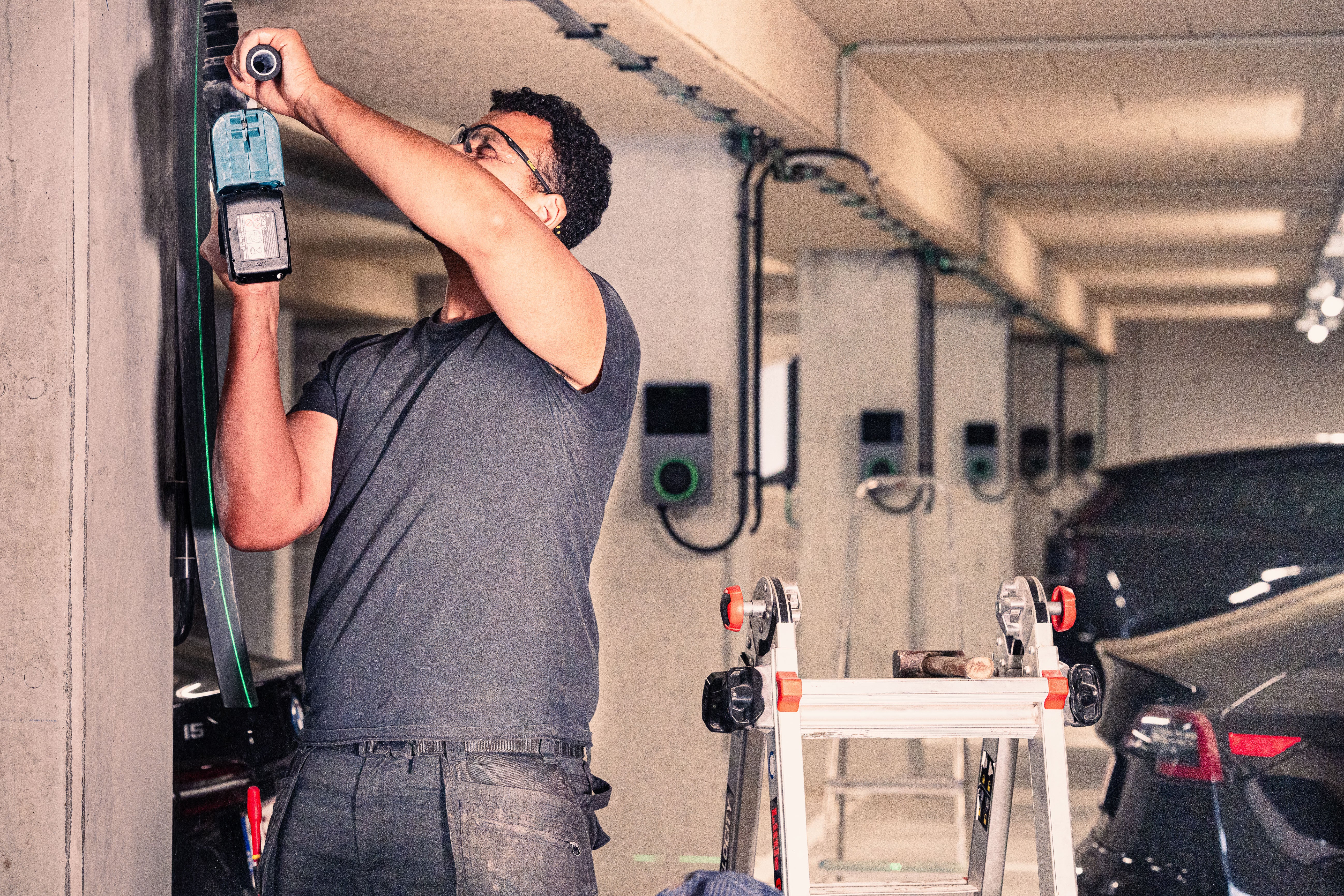


Here is your complete guide to charging your electric car at home. This is the key to maximum savings and unprecedented convenience. Just imagine: you come home, plug in your car, and start every day with a fully charged battery. No more detours to public charging stations and no unexpected costs.
Why home charging is the norm for Belgian EV drivers
The electric revolution in Belgium is unstoppable. The question that every new owner of an electric car asks themselves is therefore not or, but Where where it is best to charge. Although the public charging network is growing impressively, charging at home remains the most logical, cost-effective, and practical choice. It eliminates the so-called 'charging stress' and seamlessly integrates charging into your daily routine.
The Belgian landscape for electric mobility is developing rapidly. By early 2026, Belgium will have more than 100,000 public charging points count, which gives us a nice third place in Europe with 7.6 points per 1,000 inhabitants. Nevertheless, for most drivers – and certainly for the 23% of the Belgian households that now own an electrified car – the convenience of a private charging point is unsurpassed.
Satisfaction with charging options has therefore increased enormously, whereby 95% of the owners indicate experiencing sufficient availability. The tax benefits for home installations, which ran from September 2021 to August 2024, have significantly accelerated this trend. More details about this You can find Belgian charging station developments on go-electra.com.
The benefits in practice
Choosing your own charging point is more than a luxury; it is a smart investment in your comfort and your wallet. The benefits speak for themselves:
- Cost savings: Charging at home is significantly cheaper than public charging. You pay your energy supplier's standard rate, which is almost always lower than the rates at public charging stations, to which start-up costs are often added.
- Optimal Convenience: Your car charges while you sleep, eat, or spend time with your family. You never have to adjust your schedule to the availability of a nearby charging point again.
- Increased Battery Life: Regular and slower charging overnight, as is done with a home charger, is much better for the health of your battery than frequent fast charging at a public charging station.
- Smart Energy Management: With a smart charging station, you can schedule charging during off-peak hours, when electricity is cheapest. Do you have solar panels? Then you charge your car with your own free energy.
For employees with a company car, charging at home becomes even more attractive. Systems like Blulinc ensure automatic and correct reimbursement of charging costs by the employer, without any administrative hassle.
A private charging point transforms the way you use your electric vehicle. It is the most direct route to a worry-free electric driving experience. In this guide, we walk you through every step: from preparing your home and choosing the right charger to understanding the costs and the smart solutions Blulinc offers for both private individuals and fleet managers.
Home charging vs. public charging: an overview
To clarify the difference, we have listed the key points side by side. Although public charging stations are essential for when you are on the road, it is clear why home charging is preferred for your daily routine.
| Characteristic | Home Charging | Public Loading |
|---|---|---|
| Costs | Lower, based on your own energy tariff. No start-up costs. | Higher, often with start-up and/or time-related costs. Rates vary significantly by provider. |
| Ease | Maximum. Your car charges overnight or whenever it suits you, right at your door. | Subject to availability. You will need to look for a free charging point and sometimes wait. |
| Loading speed | Usually AC charging (3.7 kW to 22 kW), ideal for battery health. | Varies from slow AC charging to ultra-fast DC charging (50 kW to 350+ kW), ideal for long rides. |
| Reliability | Very high. You are the only user and manage the condition of the charging point yourself. | May vary. Charging stations may be occupied or out of order, causing unexpected delays. |
| Smart Features | Comprehensive. Scheduling charging sessions, load balancing with household appliances, solar energy integration. | Limited. Usually limited to starting/stopping via an app or charging card. |
| Installation | One-time investment in purchase and installation. | No installation required. |
In short, home charging offers a reliable and cost-effective foundation for everyday use, while the public grid provides the freedom to travel longer distances worry-free. The two complement each other perfectly.
How to prepare your home for a charging station
Before you can enjoy the convenience of charging at home, there are a few practical matters we need to go over. After all, installing a charging station is more than just hanging a device on the wall. The most important first step? Taking a close look at your home's electrical connection. This is the foundation that not only determines the charging speed but also guarantees the safety of your entire installation.
The electrical capacity of your home is the backbone of your charging solution. In Belgium, most homes have a single-phase or a three-phase connection. That may sound technical, but the difference is crucial for the choice of your charging station.
Single-phase versus three-phase connection
A single-phase connection is the standard in many older homes and supplies power via two wires. This is perfect for normal household use, but for charging an electric car, it means a more limited charging capacity, typically up to 7.4 kW. For most drivers, this is more than enough to fully charge the car overnight.
A three-phase connection In contrast, the one that supplies power via four wires is considerably more powerful and is increasingly seen in new-build homes. This connection enables higher charging capacities, such as 11 kW or even 22 kW. This translates into significantly shorter charging times – a major advantage if you often come home with a nearly empty battery.
Not sure what type of connection you have? You can easily check this yourself on your electricity meter or energy bill. Look for indications such as 230V (often single-phase) or 3x230V/3x400V+N (three-phase). If in doubt, a professional from Blulinc can of course quickly check this for you.
The ideal location for your charging station
In addition to the technology, the physical placement of the charging station is an important consideration. The best location is a balance between convenience, safety, and efficiency.Consider the following points for a moment:
- Accessibility: The charging cable must be able to easily reach your car without being taut or posing a tripping hazard.
- Protection: Although most charging stations are weather-resistant, placing them under a carport or in a garage can extend their lifespan.
- Ease of use: Choose a spot that feels logical in your daily routine, so that plugging in and unplugging becomes an effortless action.
The image below perfectly illustrates how simple the home charging routine can be: park, plug in, and leave the next morning with a full battery.
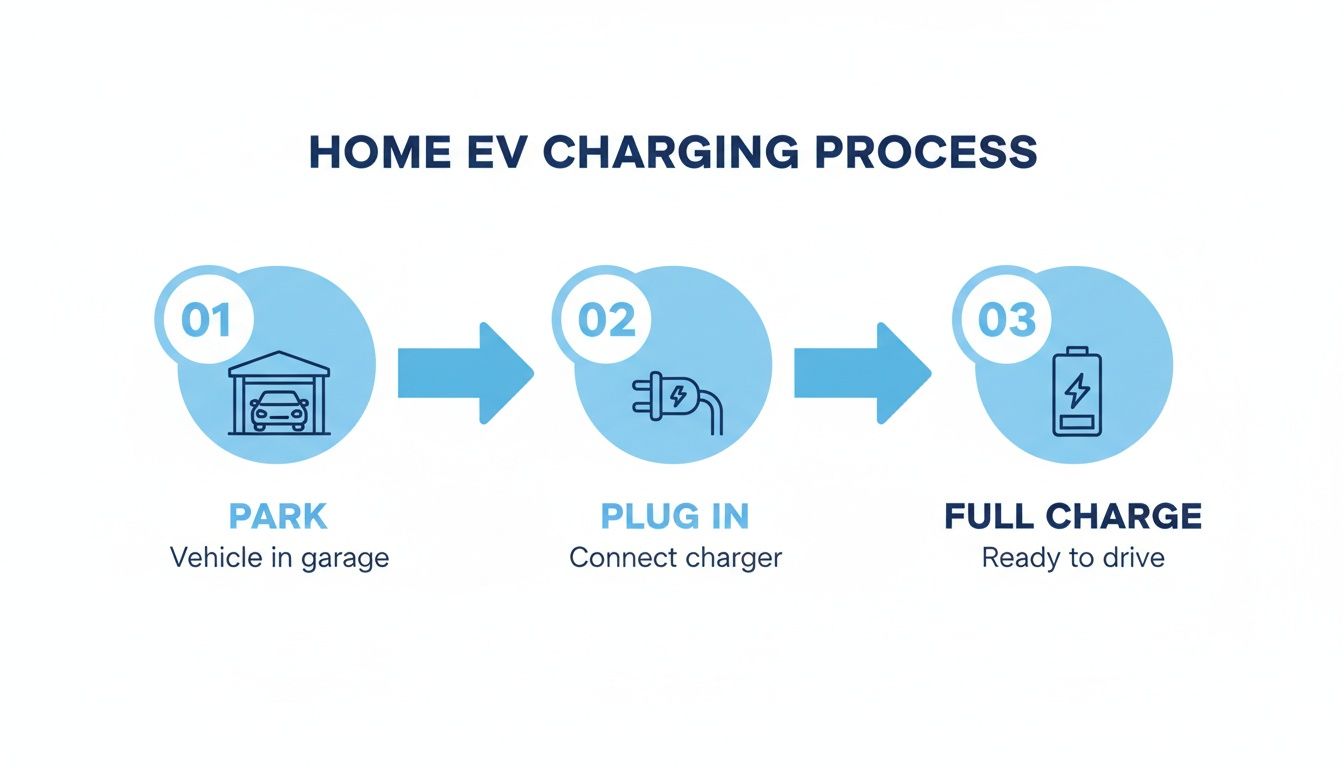
It shows the essence of convenience: charging your car becomes a seamless part of coming home.
The mandatory AREI inspection
A final, but crucial step in the process is the AREI inspection (General Regulations on Electrical Installations). In Belgium, it is legally mandatory to have your electrical installation re-inspected after the installation of a charging station. Do not view this as a formality, but as an essential safety measure.
A recognized inspection body checks whether the new charging circuit is connected correctly and safely. This limits the risk of overloading or fire to an absolute minimum.
A professional installer like Blulinc not only ensures perfect placement and connection, but also arranges this mandatory inspection for you. This way, you are certain that your installation is fully compliant with the law and you can work with peace of mind. can charge your car at home.
Choosing the right charging station for your situation
As soon as your home is ready, it is time to choose the heart of your system: the charging station itself. The right charger depends on your car, your daily driving habits, and the electrical capacity of your home. Making the right choice is crucial for both daily convenience and long-term savings when you charges your car at home.
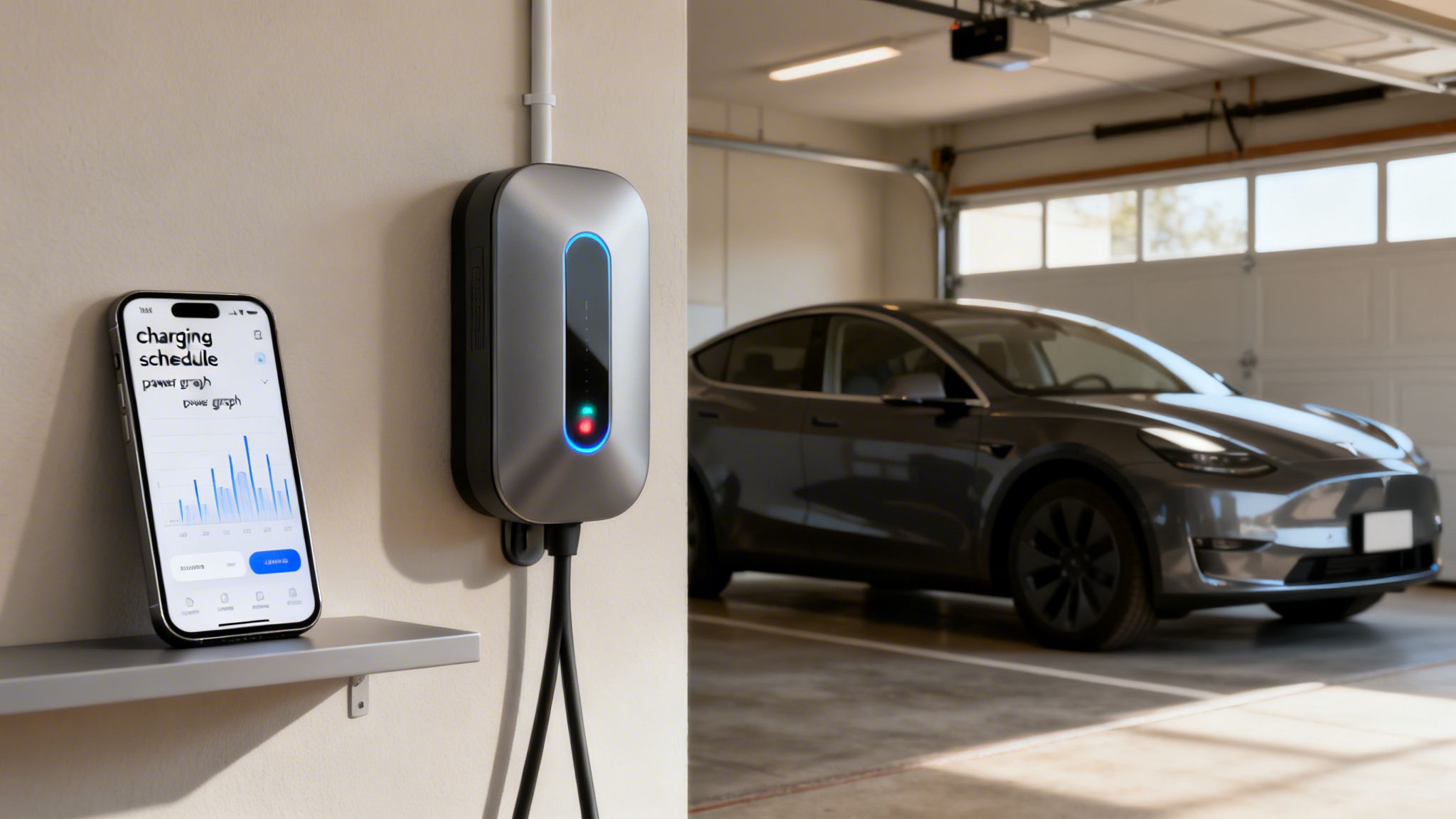
The first thing you should look at is the charging capacity, expressed in kilowatts (kW). This is the biggest factor determining how quickly your car's battery charges. While faster seems better, the ideal solution is a practical balance between speed, cost, and your home's capacity.
Matching the load capacity to your lifestyle
In Belgium, home charging stations typically come in three power levels. Let's take a look at what that means in practice.
- 7.4 kW charging stations: These operate on a single-phase connection and are a solid choice for many households. You can count on approximately 40-50 km extra range per hour of charging time.
- 11 kW charging stations: This is the most popular and recommended option for homes with a three-phase connection. 11 kW The charging station offers the perfect balance and adds approximately 60-70 km increases range per hour. With this, you fully charge any EV overnight.
- 22 kW charging stations: These are the fastest AC chargers, good for up to 120 km driving range per hour. However, they require a heavy-duty three-phase connection and a vehicle capable of handling this power. For home use, this is often unnecessary; it is better suited for business locations.
Power levels and estimated charging times at home
To give you a clearer picture, here is how those power levels translate into real-world charging times for a typical EV battery of 60 kWh.
| Charging capacity (AC) | Connection Type | Estimated Time for Full Charge (0-100%) |
|---|---|---|
| 7.4 kW | Single phase | About 8-9 hours |
| 11 kW | Three-phase | About 5-6 hours |
| 22 kW | Three-phase | About 3-4 hours |
As you can see, the standard is 11 kW Charger more than sufficient to fully charge your car while you sleep, which is the best approach for your wallet and the electricity grid.
The power of 'smart charging'
Speed is one thing, but intelligence is what really makes a home charger work for you. A 'smart' charging station is more than a socket; it is an active manager of the energy in your home.
Smart charging is not a nice-to-have, but an essential tool for controlling costs, keeping your home safe, and making your installation future-proof. It ensures that your charger communicates with your car, your home, and the electricity grid.
One of the most crucial functions is Dynamic Load Balancing. Imagine this: you come home, plug in your car, and start cooking while the washing machine is running. A standard charger could easily blow your fuse. Dynamic Load Balancing prevents this by continuously measuring your home's power consumption. If it detects a peak, it automatically slows down the car's charging speed. As soon as the oven or washing machine is finished, the charging speed is increased again.
Another gamechanger is scheduled loading. Electricity prices in Belgium fluctuate, and it is almost always cheaper at night. With a smart charging station, you can schedule charging only during these off-peak hours. This can significantly reduce your charging costs without you having to do anything. For more technical details, we have an article on how to activate the P1 port on your digital meter: https://www.blulinc.com/blogs/news/p-1-poort-slimme-meter-activeren.
For those with solar panels, a smart charger is a must. You can set it to use only the surplus energy generated by your panels. This means you literally charge your car for free with 100% green energy.
The EV boom in Belgium is undeniable, with an expected increase in the number of public charging points of 27,000 in 2022 to more than 106,000 in 2025. This explosive growth makes efficient home charging more important than ever. For businesses, Blulinc's solutions for both the office and employees' homes are a game changer. Experts recommend one charger per three to four EVs, making smart home charging a cornerstone of every modern fleet strategy.
Costs and payback models in Belgium
Okay, let's talk about the numbers. What does it really cost to install a charging station at home in Belgium? The answer isn't just a single figure, but we can paint a very clear picture. The total investment depends on three things: the charging station itself, the installation, and the mandatory inspection.
For a smart charging station, you can expect an amount between €600 and €1.500. Installation costs can vary significantly depending on the complexity of the work.On average, those costs are between €500 and €2.000. Finally, there is the AREI inspection, which usually takes place around the €150 to €200 cost.
All things considered, you are faced with the charging your car at home so often looking for an initial investment between the €1.250 and €3.700. That might seem like a substantial amount, but view it as an investment that pays for itself in various ways.
Reimbursement models for employees with a company car
For those with an electric company car, the financial puzzle becomes truly interesting. Naturally, you are not supposed to bear the private cost of the electricity consumed by your company car. This is precisely where automated reimbursement models come into play, and a smart charging station reveals its true power.
A smart charging station, equipped with a certified MID meter, knows exactly how many kilowatt-hours (kWh) are going to your company car. This data is automatically forwarded to a management platform, such as that of Blulinc. The system flawlessly splits the charging costs: what is for private use and what is for the work car.
Thanks to this technology, manually tracking charging sessions and submitting expense reports is a thing of the past. The entire process is automated, transparent, and error-free, for both you and your employer.
Your employer can then reimburse the charging costs monthly at an agreed rate. This can be based on your actual energy rate, or on the official CREG tariff, about which you can read more here. This seamless approach makes home charging the preferred solution within the Belgian tax framework for company cars.
A calculation example from practice
Let's make it concrete. An SME in Ghent with 10 electric company cars provides its employees with a smart Blulinc charging station at home. One employee drives annually 20,000 kilometers. The car consumes on average 18 kWh per 100 kilometers and the repayment is made at an average electricity rate of €0,30 per kWh.
- Annual consumption: (20,000 km/100) * 18 kWh = 3,600 kWh
- Annual charging costs: 3,600 kWh * €0,30/kWh = €1.080
- Monthly repayment: €1.080 /12 = €90
With a smart charging system from Blulinc, this amount of €90 Automatically calculated every month and prepared for reimbursement. You only need to plug in your car. Your employer receives a clear invoice and has perfect insight into the charging costs of the entire fleet.
The broader economic impact
The importance of good charging solutions at home and at the office is becoming increasingly clear. It is expected that by 2026 no less than 23% of Belgian households will have an electrified car, of which 9% fully electric. Satisfaction with charging options is with 95% therefore particularly high.
Insights from BNP Paribas Fortis emphasize that fleet managers and employers should prioritize home charging. Smart charging solutions make the mobility budget more versatile and remove barriers, even for employees without their own garage. This is precisely what we at Blulinc are capitalizing on with a platform that offers real-time optimization for over 200 SME clients. The federal tax reduction for charging stations (2021-2024) has given installations a significant boost, which fits perfectly within broader European trends.You can discover more insights about these developments at nextmobility.be.
How Blulinc streamlines your entire charging experience
A smart charging station at home is a powerful piece of technology, but the real magic only happens when that station is part of a larger, intelligent ecosystem. That is exactly what we at Blulinc ensure. We take it charging your car at home from a standalone action to a fully integrated part of your mobility.
For the employee with a company car, this means the end of administrative headaches. For the fleet manager, it opens the door to an unprecedented level of control and insight. We combine charging at home, at the office, and on the road into one seamless and clear whole.
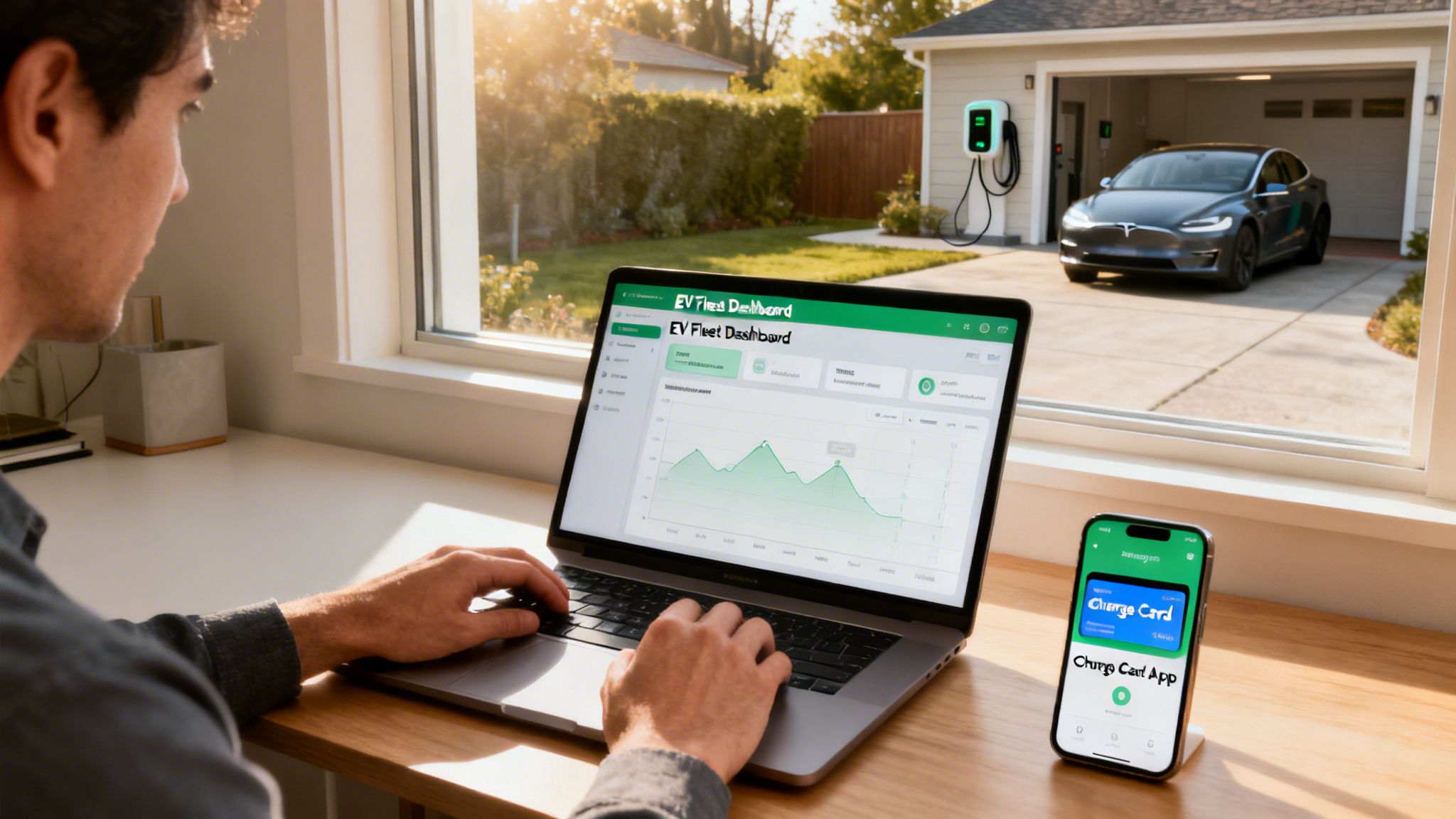
One solution for home, office, and public charging
As an employee, you don't want a jumble of different apps, charging cards, and expense reports. With the approach of Blulinc That is a thing of the past. Your home charging station is directly connected to our platform, ensuring every charging session is automatically recorded for watertight reimbursement.
With the Blulinc charging card and app, you not only manage your home charger but also gain access to one of the largest public charging networks in Europe.
- One charging card: Use the exact same card to start a charging session at home, at work, or at one of the +900,000 public charging points.
- One App: The Blulinc app bundles all your charging sessions, regardless of location. You see the costs, consumption, and duration of each session at a glance.
- No Administration: The costs for charging the company car at home are automatically settled with your employer, accurate to the cent.
This system creates a uniform and effortless experience, wherever you charge. You will never have to wonder again which card to use or how to submit expenses.
Complete control for fleet managers
For a fleet manager, overview and cost control are paramount. The Blulinc management platform is designed precisely for this: it gives you total transparency and control over all charging activities of your fleet, including home charging.
The complexity of a decentralized charging network – with dozens or hundreds of employees charging at home – is transformed by our platform into a surprisingly simple, centralized process.
You manage everything from a single dashboard. You see in real time who is charging where and how much, allowing you to proactively make adjustments and maximize efficiency.
Set limits and automate refunds
The Blulinc platform provides you with powerful tools to accurately enforce your charging policy. For example, you can set very specific limits for each employee.
Imagine this: you manage a fleet of 20 commercial vehicles in the Antwerp region. You can decide that employees monthly up to €100 may incur charging costs via the charging card. You set this limit in the dashboard with just a few clicks. As soon as an employee approaches the limit, this is visible, preventing unpleasant surprises afterwards.
The reimbursement of home charging costs is fully automated. Our system records the charging sessions via the MID-certified meter in the charging station and generates a crystal-clear monthly invoice for your accounting. This saves you hours of administrative work and eliminates the risk of errors.
The benefits of this approach are immediately clear:
- Centralized Overview: Track all charging costs (home, office, public) in one clear dashboard.
- Cost control: Easily set budgets and limits per user or group.
- Automated Invoicing: Receive one clear, consolidated invoice for all charging costs of your fleet.
- Transparent Reports: Generate detailed reports on consumption and costs to optimize your TCO (Total Cost of Ownership).
With Blulinc, the challenge of fleet electrification becomes a manageable and efficient process. This allows you to focus on what really matters: your core activities.
Frequently asked questions about charging your car at home in Belgium
As soon as you consider the practical side of a home charging station, a few questions often arise. That is perfectly normal. We hear them constantly from drivers preparing for the charging their car at home in Belgium.
Let's go over the most common questions to clarify everything.
Can I just use a standard wall socket to charge my car?
Technically speaking can You can connect your car to a standard household socket (a 'Schuko' socket). But frankly, we only recommend this in an emergency. It is not a long-term solution.
Why? First, it is incredibly slow – you could wait more than 24 hours for a full charge. More importantly, there is the safety risk. The wiring in your home is not designed to handle such intense, continuous power consumption for hours on end. This can easily lead to overheating and, in the worst case, fire. A solid, dedicated charging station is always the safer, smarter, and more efficient choice.
Moreover, it is surprisingly inefficient. Research by the ANWB showed that charging via a standard socket can lead to energy losses of up to 30%. That is a third of the electricity you pay for that simply disappears before it reaches your car's battery.
What happens if the power goes out while charging?
You do not need to worry about this. Every modern, smart charging station is designed to handle a power outage without any problems.
If the power goes out, the charging session simply stops safely. As soon as the grid is operational again, a high-quality charger – such as the one we install – will automatically resume where it left off. You do not need to do anything. Your car also has its own built-in safeguards, so there is no risk of damage to the battery or the charger.
Do I need permission from my landlord to install a charging station?
If you rent or live in an apartment building in Belgium, then yes, you will almost certainly have to ask for permission first. For a rental home, this means the green light from your landlord. If you live in an apartment building managed by an association of co-owners (VME), you need their approval, especially if the charger is to be installed in a common area such as an underground parking garage.
The good news is that Belgian law supports you in this. The legislation regarding the "right to plug" makes it much more difficult for a landlord or Owners' Association to refuse without good reason, such as a major structural or electrical problem with the building. Our advice? Start the conversation early and come prepared with a clear plan from a professional installer.
How much maintenance does a home charging station require?
You will be pleased to hear that they require incredibly little maintenance. These devices are built to be robust, with very few moving parts.
We only recommend a quick annual check to ensure everything runs smoothly:
- A quick look: Check the cable and connector occasionally for clear signs of wear.
- Software updates: Ensure that the firmware of your smart charging station is up to date. This usually happens automatically 'over-the-air', giving you the latest features and security patches.
- A professional check: It is not essential every year, but having a technician inspect the installation and wiring every few years offers extra peace of mind.
All in all, a correctly installed charging station will serve you trouble-free for years. It is one of the most reliable devices you will own as an EV driver.
Ready to make home charging a reality? The experts from Blulinc are ready to guide you every step of the way, from the initial analysis to the final installation and beyond.