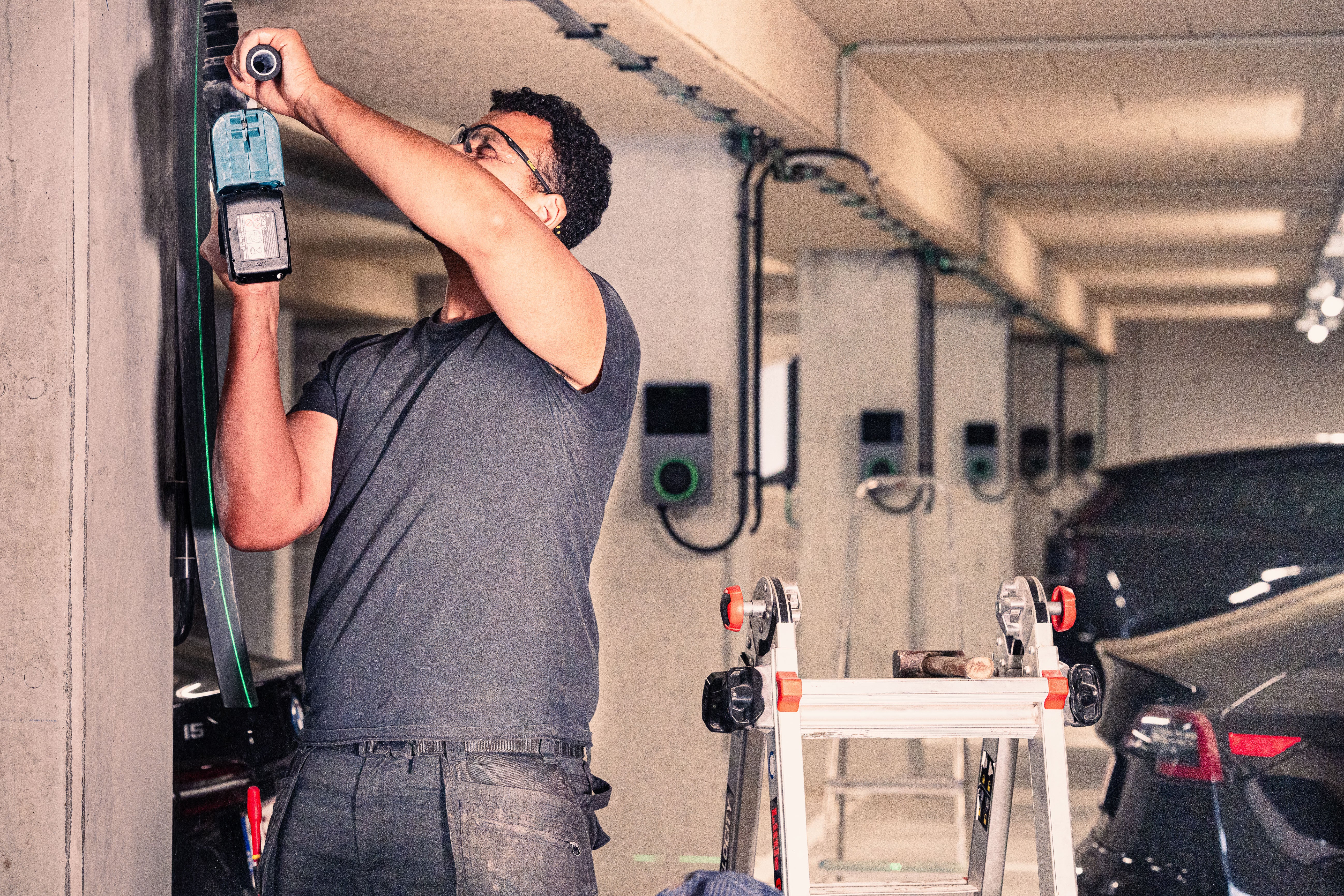


Just imagine: waking up every morning with a fully charged car, completely ready for the day ahead. No more hassle searching for a public charging station. This is the reality of charging points for your electric car at home – the most convenient and cost-effective basis for every electric car owner in Belgium.
The True Value of Home Charging

Your own charging point transforms electric driving from a chore into an effortless part of your daily routine. You are no longer dependent on the availability or fluctuating rates of public charging stations. Instead, you have complete control in your own hands.
Complete Control over Costs and Convenience
Perhaps the biggest advantage of charging at home? The opportunity to benefit from cheaper electricity rates. By smartly charging your car at night during off-peak hours, you can significantly reduce your "fuel costs." That adds up considerably in a country like Belgium, where energy prices are a major expense in the household budget.
A smart charging station, such as the models we install at Blulinc, takes this to the next level. You can schedule charging sessions, accurately monitor consumption, and even have the charging speed automatically adjust to the total energy consumption in your home.
Seamless Integration for Commercial Vehicles
For employees with a company car, a home charging point is the perfect professional solution. No more keeping track of expense reports for public charging sessions. A smart charging station registers exactly how much power is supplied to the company car, after which our platform can process the reimbursement to the employee fully automatically. This makes administration much simpler, for both the employer and the employee.
This approach is a key factor in the Belgian mobility transition. Recent research shows that no less than 95% of EV owners are very satisfied with the charging options, largely thanks to the focus on charging points at home and at the office. This impressive satisfaction rate, a substantial increase compared to previous years, proves how effective having your own charging point is in alleviating charging stress. For SMEs, this means that the transition to an electric fleet is smoother than ever. Discover more about these Belgian mobility trends.
A home charging point is not just an accessory; it is the core of an efficient and worry-free electric driving experience. It offers the freedom to charge whenever it suits you, at the lowest possible cost.
Choosing the Right Home Charging Station
The search for the perfect home charging point might feel a bit technical, but at its core, it revolves around three simple things: your car, your electrical installation, and your daily commutes. Our role is to translate those technical details into a clear, logical choice that seamlessly fits into your life.
One of the first decisions you need to make is between a single-phase and a three-phase connection. Think of it as a road to your car: a three-phase connection simply has more lanes. As a result, more current can flow to your battery simultaneously, which directly translates into shorter charging times.
Aligning Capacity with Your Needs
The charging capacity, expressed in kilowatts (kW), is directly related to that connection. The most common options for home use are 7.4 kW, 11 kW, and 22 kW. Although 22 kW might sound like the fastest and best option, it is often not the smartest choice for most Belgian homes and cars.
Usually, a 11 kW charging station the ideal middle ground.It offers a perfect balance: fast enough to effortlessly fully charge your car overnight, without overloading your electricity grid.
To be concrete: an 11 kW charger charges an average electric car (with a 60 kWh battery) in about 5 to 6 hours – perfect while you sleep. A 7.4 kW charger takes considerably more time for this. A 22 kW charger, on the other hand, requires a heavier and more expensive grid connection that most households do not have as standard.
To give you a clear picture of the differences, we have placed the options side by side.
Home Charging Capacity Comparison
Below you will find an overview of the most common load capacities, their charging speeds, and who they are most suitable for.
| Load capacity | Connection Type | Estimated Charging Time (60 kWh battery) | Most Suitable For |
|---|---|---|---|
| 7.4 kW | Single phase | 8-9 hours | Plug-in hybrids or cars with a smaller battery. |
| 11 kW | Three-phase | 5-6 hours | Most fully electric cars; the ideal balance for home use. |
| 22 kW | Three-phase | 2-3 hours | Homes with a reinforced grid connection and vehicles that can handle this power. |
As you can see, 11 kW offers the 'sweet spot' between speed and feasibility for most drivers.
The Difference Between 'Smart' and 'Dumb' Loading
An even more important consideration is the intelligence of the charging station itself. A 'dumb' charging station does exactly one thing: supply power as soon as you plug in the connector. A 'smart' charging station, the core of Blulinc technology, is a completely different story and offers you crucial benefits.
A smart charging station is not just a charging point; it is an intelligent energy management system for your home and car. It protects your electrical installation and actively reduces your energy costs.
Smart chargers are connected to your home and our platform. This enables a range of features that are essential for affordable and safe charging:
- Scheduled Loading: Set up your charging sessions to start only during off-peak hours, when electricity rates are lowest. This way, you automatically save money.
- Dynamic Load Balancing: This function continuously monitors the power consumption in your home. Do you turn on the oven or does the heat pump switch on? Then the charging point temporarily reduces its speed to prevent overload. No more blown fuses!
- Energy insight: Via our app, you get a crystal-clear overview of every charging session, the kWh consumed, and the exact costs. This is essential for correct reimbursement if you drive a company car.
In short, choosing the right charging point goes much further than just looking at the maximum speed. It is about creating a charging experience that is safe, affordable, and above all, very convenient.
How Does the Installation of Your Home Charging Point Work?
Having a charging point installed at home is often simpler than you think, especially if you know what to expect. We guide you through the entire process, from the initial inspection of your electrical installation to the final inspection. This process underscores why working with a certified installer is not only a good idea, but essential for your safety and compliance with Belgian regulations (AREI).
Everything starts with a thorough analysis of your current electrical installation.Before the installation begins, it is crucial to ensure that your system can handle the extra load; sometimes modifications to your fuse box are necessary. electrical panel services. A professional checks whether your fuse box can handle the additional demand of a charging point and whether a separate, protected circuit can be installed. This is not a formality, but a legal requirement for safe operation.
From Inspection to First Charge
As soon as we have the technical green light, the installation will be scheduled. A standard installation includes mounting the charging station, running the necessary cabling from your fuse box to the charger location, and installing the required residual current devices. The complexity can, of course, vary.
Imagine this: an employee with a company car lives in a typical Belgian terraced house. The installation might require drilling a cable through a wall or routing it neatly along the exterior facade. In older homes, it may even be necessary to modernize the fuse box itself to meet current standards. A Blulinc expert analyzes all of this in advance so that you won't face any surprises.
This guide helps you choose the right charging solution based on your car, connection, and desired speed.  As you can see, choosing a charger is primarily a logical match for your specific situation, which makes the process much simpler.
The Importance of a Professional Inspection
After the installation, the final step follows: the mandatory inspection by a recognized inspection body. This independent inspection guarantees that the installation fully complies with AREI regulations. You may only officially put your charging point into operation after receiving a positive inspection report. We coordinate this entire process for you, ensuring you have a safe, reliable, and fully legal charging solution.
A professional installation is not a cost, but an investment in safety and peace of mind. It guarantees that your charger operates efficiently and is perfectly matched to your home's electrical capacity.
Let's talk about the costs. A clear financial overview is essential when considering the installation of a charging point. The initial investment consists of several components, but thanks to smart Belgian tax benefits, the final cost often turns out to be much more favorable than you might think.
The total price is made up of three main elements. First, there is the cost of the charging station itself. In addition, there are the installation costs, which cover the electrician's labor and all standard materials. Finally, there may be additional costs if your electrical installation requires an upgrade, such as modernizing the fuse box.
A Concrete Cost Example
To put this in perspective, let's take a common scenario. The owner of an SME in Ghent with 10 company cars decides to install home charging points for his employees. He opts for a smart 11 kW wallbox, an excellent choice for most modern electric cars.
- Charging station: The device itself costs about € 800 per piece.
- Standard Installation: A professional installation by a certified electrician, including wiring and mandatory inspection, typically comes to approximately € 1.000.
- Total Initial Investment per employee: This brings up the starting amount € 1.800.
That amount might seem high, but the Belgian government offers significant tax benefits that make the picture much more attractive.
Making Optimal Use of the Belgian Tax Deduction
For everyone installing a home charging point in Belgium, there is a handy tax reduction. For installations carried out in 2024, you can tax reduction of 15% claim on eligible costs, with a maximum of € 1.750 per charging point. This benefit applies specifically to intelligent charging stations – the type that can connect to a broader energy management system.
Let's apply this to our example:
On an investment of € 1.800 does the 15% tax reduction yield a benefit of € 270. As a result, the real, final cost of your fully installed and certified smart charging station drops to just € 1.530.
This financial support makes installing a home charging point much more feasible for private individuals and even tenants. You can delve deeper into how these incentives work in our guide on the tax deductibility of charging stations.
The Win-Win for Employees with a Company Car
What if you are an employee with a company car? Then this setup becomes a brilliant solution for all parties involved.
Typically, the employer covers the full costs of the charging point and the installation at the employee's home. The smart charging station, connected to a platform such as Blulinc, accurately records every kilowatt-hour used to charge the company car.
This data is then processed automatically, and the electricity costs are reimbursed directly to the employee, usually as a tax-free expense allowance. It is a clean, transparent model that eliminates all administrative hassle. The employee enjoys the convenience of charging at home without the costs, and the employer gets a simple, manageable system for charging expenses. It is no wonder that this is such a popular solution throughout Belgium.
Discover Smart Charging and Load Balancing
A modern home charging station does much more than simply pump power into your car; it manages that energy intelligently. This is the world of 'smart charging', a collection of features designed to your charging points for electric cars at home to make it safer, more efficient, and cheaper.
Instead of simply plugging in and immediately drawing maximum power, a smart charger communicates with your home's electrical system and our Blulinc platform. The goal? To optimize every charging session.
This intelligence is crucial to protect your home's wiring. A key feature in this regard is dynamic load balancing, which effectively acts as an air traffic controller for the energy consumption in your home. It constantly monitors your total electricity consumption. If you turn on the oven or washing machine while your car is charging, the system automatically reduces the charging speed to prevent your main fuse from blowing. As soon as the other device switches off, the charger resumes full speed. It is a seamless process that keeps everything safe without you having to pay for expensive upgrades to your electrical installation.

Take Control of Your Energy Costs
Smart charging is also your best friend when it comes to cost management. You can easily schedule your charging sessions to take advantage of lower off-peak electricity rates, which typically apply at night.
The Blulinc app makes this very simple: set your desired charging period, and the system does the rest. You wake up with a fully charged battery that has been topped up at the lowest possible price. To get the most out of this, it is worth understanding the principles behind it. optimizing electricity consumption during off-peak hours to understand.
For everyone with solar panels, the benefits become even greater. A smart charger can be set to an 'eco-mode', which instructs the charger to single to use the excess energy generated by your solar panels. This means that you can literally charge your car for free with 100% renewable energy, enabling you to get the absolute maximum out of your solar investment. Our platform provides you with the tools to monitor all of this, with full insight into your energy consumption and savings. An important step in this is activating the P1 port of your digital meter: https://www.blulinc.com/blogs/news/p-1-poort-slimme-meter-activeren.
Smart charging transforms your home charging point from a simple socket into an intelligent energy management system. It is about smarter charging, not just faster, to ensure safety and maximize savings.
The importance of reliable home charging becomes even clearer when we look at the uneven distribution of public charging points in Belgium. Flanders leads the way with approximately 60,000 charging points, while Wallonia only has about 13,000 has and the Brussels-Capital Region but 10,000.
This inequality makes a robust charging solution at home or at work essential. For employers, this means that facilitating home charging for employees is not just an extra; it is a necessity for a successful fleet transition. Our platform has been built from the ground up to simplify this process.
Questions about home charging? We have the answers.
The decision to install a charging point at home is an important step, and it is normal that you still have some questions. We often receive questions about charging points for electric cars at home, Therefore, we have gathered clear, direct answers to the most common questions. This should help you move forward with complete confidence.
Do I need a permit to install a charging point in Belgium?
This is a common concern, but the answer is usually no. For a standard home installation in Belgium, you do not need a specific building permit.
However, what obliged This involves the inspection and approval of the new electrical installation by a recognized inspection body as soon as the installation is completed. This inspection is non-negotiable. It serves to confirm that everything has been installed safely and complies with the official Belgian AREI regulations.
If you live in an apartment building, there is an extra step: you need approval from the Association of Co-owners (VME). A certified installer like Blulinc handles all aspects of compliance, ensuring everything is done by the book.
Can I install a charging point at home if I rent my home?
Absolutely. As a tenant, you can install a charging point, but you must first obtain written permission from your landlord.It is a significant modification to the home's electrical system, so a clear agreement is crucial to avoid misunderstandings. Ensure that the agreement covers who pays for what and what happens to the charging point if you move.
It is also good to know that the Belgian tax reduction for home charging points was also available to renters, which can make it a financially smart decision if you drive and rent an EV.
How does the reimbursement for a company car work?
This is a very smooth and well-established system in Belgium. Typically, your employer arranges the installation of a smart charging point at your home, often in collaboration with a provider such as Blulinc. This smart device is essential because it accurately tracks every kilowatt-hour used to charge your company car.
Our platform takes care of the rest and automatically reports your charging usage to your employer. They can then reimburse you, usually as a non-taxable expense allowance. It is a clean, transparent way to keep your business and personal electricity costs completely separate.
How does a home charging point with solar panels work?
Combining a home charging point with your own solar panels? That is the smartest move. It is by far the best way to reduce your charging costs. A smart charging point can be configured so that it only the excess energy uses that your panels generate. That means you are essentially charging your car for free with clean, green energy.
The system is quite smart. The charger 'communicates' with your solar inverter and constantly adjusts the charging speed based on the amount of sunlight falling on your roof. On a clear, sunny day, your car charges faster. If clouds appear, it will slow down or even pause to avoid drawing expensive power from the grid. This type of intelligent energy management maximizes the return on your solar investment and reduces your ecological footprint.
Ready to make simple and efficient home charging a reality? The experts from Blulinc are ready to design a charging solution that suits you perfectly, from the initial consultation to the final installation and beyond.