

Do you feel the pressure on that final, crucial step in your delivery process? You are not alone. For a growing number of Belgian companies, the last mile It has become a real headache – a mix of exploding costs, traffic jams in city centers, and customers who want everything delivered yesterday, and preferably with a green conscience.
This final leg, the journey from a distribution hub to the customer's front door, is where the entire operation becomes complex. And did you know that this last mile is often more than 50% of the total shipping costs swallows up?
The Growing Last Mile Challenge in Belgium
That final leg of the delivery is often the most expensive and frustrating part of the entire supply chain. For companies here in Belgium, this is further exacerbated by a number of local factors that severely test your profitability, your customer relationships, and your company's green reputation.
Navigating Urban and Regulatory Obstacles
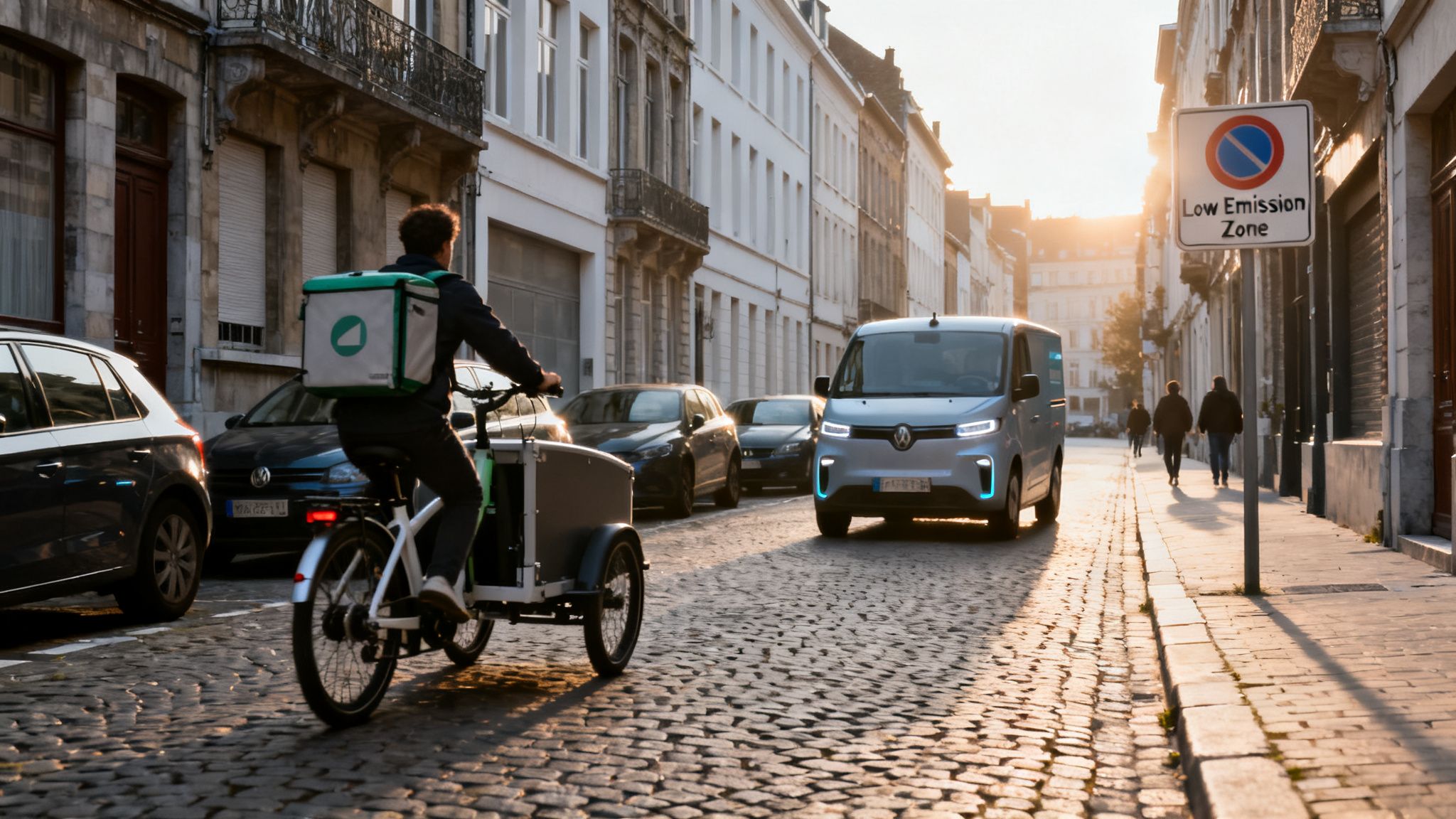
Cities like Brussels, Antwerp, and Ghent take air quality seriously and are continuously expanding their Low Emission Zones (LEZs). What does this mean for you? Your trusted, older diesel vans may soon no longer be allowed into key business areas, leading to hefty fines or a complete, expensive fleet renewal.
This is not a formality. It is a fundamental obstacle that requires a strategic shift towards cleaner transport. Moreover, e-commerce has completely changed customer expectations. They want speed, but they also want to know where their package is and that it is being delivered sustainably. One missed delivery or a cumbersome, polluting service can damage your brand perception in an instant.
The last mile is no longer just about logistics; it is a direct conversation with your customer. Handling it correctly is crucial to building loyalty and staying ahead of the competition.
The Economic and Ecological Impact
The financial drain of a cumbersome last-mile operation is real. Consider rising fuel prices, the hours your drivers lose in traffic, and the costs of failed delivery attempts. Every package shipped under these circumstances eats away at your profit margins.
At the same time, the ecological toll cannot be ignored. Urban deliveries are a major source of CO2 emissions and noise pollution – problems that Belgian cities are determined to tackle. This is precisely where smart last mile solutions, based on e-mobility, cease to be a "nice-to-have" and become an absolute necessity. They offer a clear path to:
- To reduce your operational costs by replacing expensive fossil fuels with affordable electricity.
- to guarantee access to city centers by complying with the latest LEZ standards, and even exceeding them.
- To strengthen your brand image by demonstrating a sincere, visible commitment to sustainability.
As we will discuss further, the transition to electric vehicles and setting up the right charging infrastructure is key to turning these challenges into a significant competitive advantage. The question is no longer or you must adapt, but how you start your transition in a smart, effective way.
Decipher Your Last Mile Delivery Options
Solving the last-mile puzzle is not about finding one magic solution; it is about choosing the right tool for the job. The modern logistics toolbox is much broader than the classic diesel delivery van.Nowadays there are numerous last mile solutions emerged, each designed to tackle specific urban delivery problems – from maneuvering through busy city centers to meeting those increasingly tight delivery deadlines.
Gaining insight into these options is the first step towards a more efficient, cost-effective, and much greener delivery operation. For many Belgian companies, the key is to think smaller and get closer to the customer. This is where smart choices regarding infrastructure and vehicles can make the difference.
Micro-Fulfillment: The Advantage of a Local Hub
Imagine this: instead of shipping everything from one huge, remote warehouse, you bring a small portion of your inventory directly to your customers' neighborhood. That is the simple idea behind micro-fulfillment centers (MFCs). These are compact, often highly automated storage hubs that are strategically distributed in or on the outskirts of busy urban areas such as Antwerp or Brussels.
The impact is virtually immediate. By drastically shortening the final travel distance, you can reduce delivery times from days to hours, lower your fuel costs, and achieve more deliveries per vehicle per shift.
This approach is a game changer for businesses where speed is essential, such as online supermarkets or retailers promising same-day delivery. It breaks down your logistics into smaller, more agile parts, making your entire supply chain more resilient to unexpected traffic jams or delays. When weighing your options, it is crucial to understand How long does shipping take? to manage customer expectations and plan your operations effectively.
Choosing the Right Electric Vehicle for the Job
Once your goods are ready at a local hub, you need the right vehicles to cover that final stretch. Electrification is not a one-size-fits-all approach; it offers a wide range of vehicle options tailored to different delivery needs.
Electric Cargo Bikes: The Urban Agility Experts
For those hyper-local deliveries within a few kilometers, there is nothing better than the electric cargo bike. These agile machines whiz past traffic, use bike paths, and enter pedestrian zones where delivery vans are not allowed. They are perfect for delivering small to medium-sized packages, documents, or even hot meals.
Consider a bakery in Ghent that uses a few e-bikes for its morning rounds of local cafes. It is faster during rush hour, costs almost nothing to operate, and emits zero emissions—a brilliant way to build a positive, green image in the local community.
Electric Vans: The Versatile Workhorses
When dealing with larger loads or routes extending into the suburbs, the electric delivery van remains the backbone of last-mile delivery. Modern e-vans have ample cargo space and a range that can easily handle a full workday on a single charge. They are the ideal choice for a logistics company operating from a hub near Liège or a furniture store delivering throughout Flanders.
A fleet of 20 electric vans Those who charge overnight at a depot can be fully prepared for the next day's routes for a fraction of the cost of refueling with diesel, while complying with all Low Emission Zone regulations in the country.
The choice between an e-bike and an e-van doesn't have to be an either-or issue. In fact, many of the smartest use last mile solutions a mixed fleet.You deploy each vehicle type where it makes the most sense, ensuring that every package reaches its destination in the most efficient manner.
To help you visualize how these different models relate to each other, here is a quick comparison.
Comparison of Modern Last Mile Delivery Models
This table compares the key features of various last-mile solutions to help companies make the best choice for their operational needs.
| Solution type | Best for | Main Advantage | Main Challenge |
|---|---|---|---|
| Micro Fulfillment Center (MFC) | High-volume, same-day delivery in densely populated urban areas. | Drastically shorter delivery times and transport costs. | High initial investment costs and requires strategic location planning. |
| Electric Cargo Bikes | Hyper-local, small parcel delivery in busy city centers. | Unrivaled agility, zero emissions, and low operating costs. | Limited charging capacity and shorter range. |
| Electric Vans | Larger deliveries, routes with multiple stops, and suburban areas. | Substantial cargo space and sufficient range for a full workday. | Higher initial investment and dependence on charging infrastructure. |
By combining local hubs with a smart mix of electric vehicles, you create a powerful, flexible delivery network that is prepared for anything.
Building the EV Charging Backbone for Your Fleet
An electric fleet is only as strong as its charging infrastructure. Think about it – without a reliable, smart way to power your vehicles, even the best electric vans become nothing more than expensive paperweights. For effective last mile solutions Building a solid loading spine is not an afterthought; it is the central nervous system of your entire surgery.
This goes far beyond simply installing a few plugs on the wall. It is about creating a connected ecosystem that ensures every vehicle is ready for its route, keeps your energy costs under control, and can actually grow with your business. It must be planned to support your daily workflow, not disrupt it.
This visualization shows how modern last-mile deliveries work, starting from a central hub and using various vehicle types to efficiently get packages to the customer.
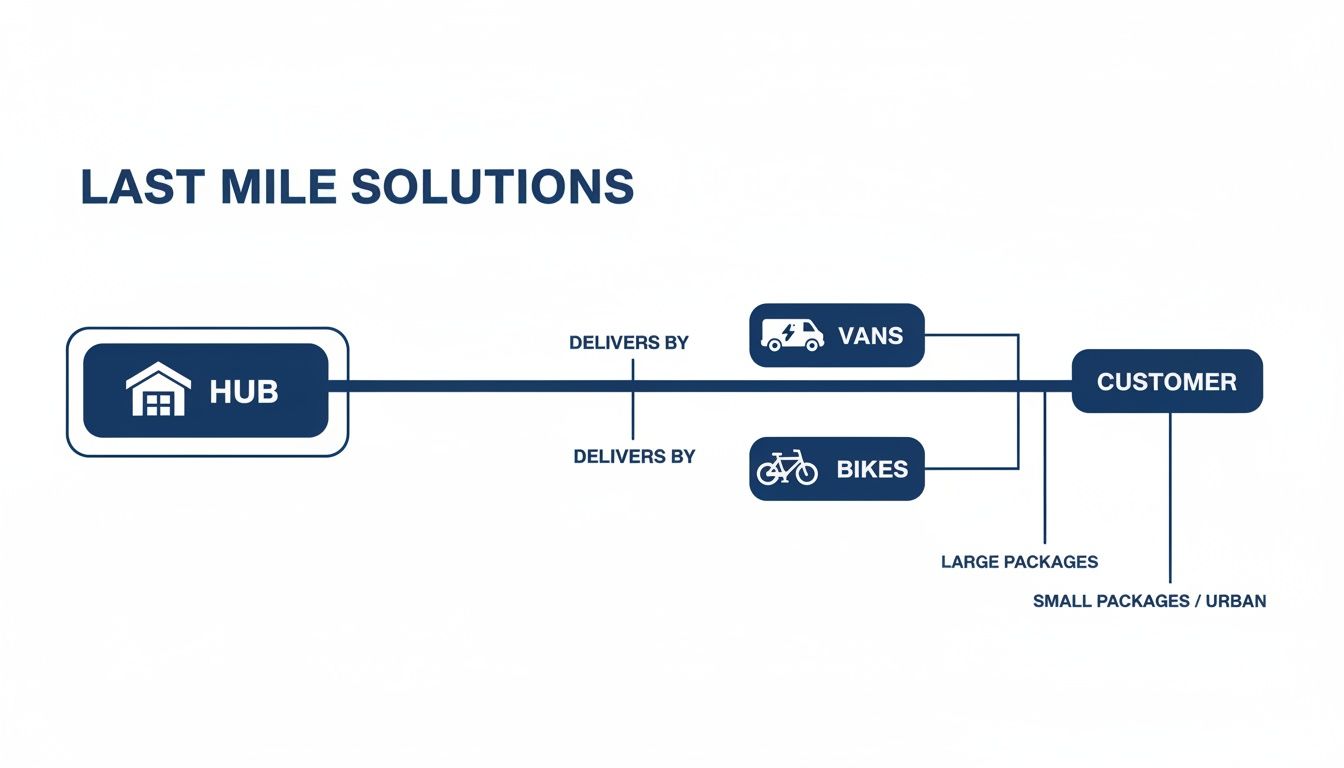
The key conclusion here is how flexible a mixed fleet approach can be. You can deploy the right vehicle for the right task – based on package size and delivery density – to truly maximize your efficiency.
Choosing the Right Charging Hardware
First of all, you must select the right type of chargers for your operation. The two main options are Alternating Current (AC) and Direct Current (DC), and they play very different roles in a busy fleet.
-
AC Charging (The Nightly Standard): This is the most widely used and cost-effective solution for depot charging. AC chargers deliver power more slowly, which is perfect for vehicles parked for several hours overnight. A fleet of 20 vehicles can be fully charged and ready for the morning rush hour without heavily loading your electrical installation.
-
DC Fast Charging (The Quick Stopover): As the name suggests, DC chargers deliver a much faster, more powerful charge. They can in just 20-30 minutes add a significant range. These are ideal for fleets with high daily mileage that need a quick energy boost during a shift, or for hubs where getting vehicles back on the road quickly is essential.
Often, the best strategy is a mix of both. You can rely on AC chargers for the majority of your fleet's needs and install one or two DC fast chargers for urgent situations or for quick top-ups during a driver's break.
Smart Energy Management is Essential
Imagine your entire fleet being connected at 5:00 PM. That could easily overload your building's electrical capacity, leading to blown fuses or exorbitant network upgrades. This is exactly why intelligent load management is not a luxury, but an absolute necessity.
Load management software acts as a traffic controller for your energy consumption. It automatically balances power distribution across all your chargers, ensuring vehicles are charged efficiently without ever tripping the main fuse.
This technology enables you to charge more vehicles using your existing infrastructure, allowing you to avoid costly electrical maintenance. You can also program it to charge vehicles during off-peak hours when electricity is cheapest, which directly reduces your operating costs. Learn more about optimizing your setup in our guide on charging solutions for businesses.
The Software That Connects Everything
Hardware is only half the story. The brain of your entire charging network is a powerful software platform, like the one we have at Blulinc. This central dashboard gives you a complete overview and total control over your charging ecosystem.
With the right software, you can:
- Monitor charge status in real time to see exactly which vehicles are ready to depart.
- Set charging priorities so that your most critical vehicles are always charged first.
- Track energy consumption and costs for accurate financial reporting.
- Manage access to ensure that only authorized drivers can use the chargers.
This level of control transforms your charging setup from a simple facility into a strategic asset that actively boosts the efficiency of your fleet.
Enabling Seamless Home Charging
For many fleets, the efficiency of the day begins even before a driver leaves home. Offering home charging options for employees is a game changer, as it ensures vehicles start every day with a full battery and eliminates time-consuming morning stops at a depot or public charger.
An important part of this puzzle is a simple reimbursement system. We install smart chargers at employees' homes that measure the exact amount of electricity used for the company vehicle. Our software then automates the reporting, making it incredibly easy for you to offer accurate, transparent reimbursement for their energy costs.
This integrated approach – combining depot, public, and home charging – creates a robust and flexible network. The good news is that the Belgian infrastructure is growing rapidly to support this.In fact, the country's charging network grew by in a recent year 72% to 83,111 stations to meet the high demand from corporate fleets. For a deeper dive into expanding your infrastructure, it is worth considering specialized solutions for logistics service providers, such as EV charging for 3PL staff.
Choosing Your EV Charging Model
Let's talk about money. Investing in the charging infrastructure you need for your last mile solutions It does not have to mean a huge, upfront financial blow. How you decide to pay for this critical asset is just as important as choosing the right hardware. The financial model you choose can tie up your valuable capital or give you the breathing room to grow your electric fleet smoothly and sustainably.
It really comes down to finding the most sensible path for your business. For many, this means looking beyond the old-fashioned approach of buying everything at once and exploring more flexible, service-based options that fit today's operational reality. This choice is becoming increasingly critical, especially in the rapidly changing Belgian market.
The Traditional Route: Capital Expenditures (CAPEX)
The classic approach is the CAPEX model, where you simply purchase and own all charging hardware and software yourself. You make a one-time investment to acquire the chargers, cover the installation, and subsequently manage the ongoing maintenance and operational costs internally.
This route gives you full ownership and control over your assets. For large companies with ample capital budgets and dedicated facility teams, this can be a perfect way to build long-term infrastructure. However, for many small and medium-sized enterprises (SMEs), it can be a major obstacle.
That large initial payment can put serious pressure on your cash flow. It also places all responsibility for maintenance, updates, and troubleshooting entirely on you. If a charger fails, it is up to you to have it repaired, which can affect your fleet's uptime and throw a spanner in the works.
The Flexible Alternative: Operational Expenses (OPEX)
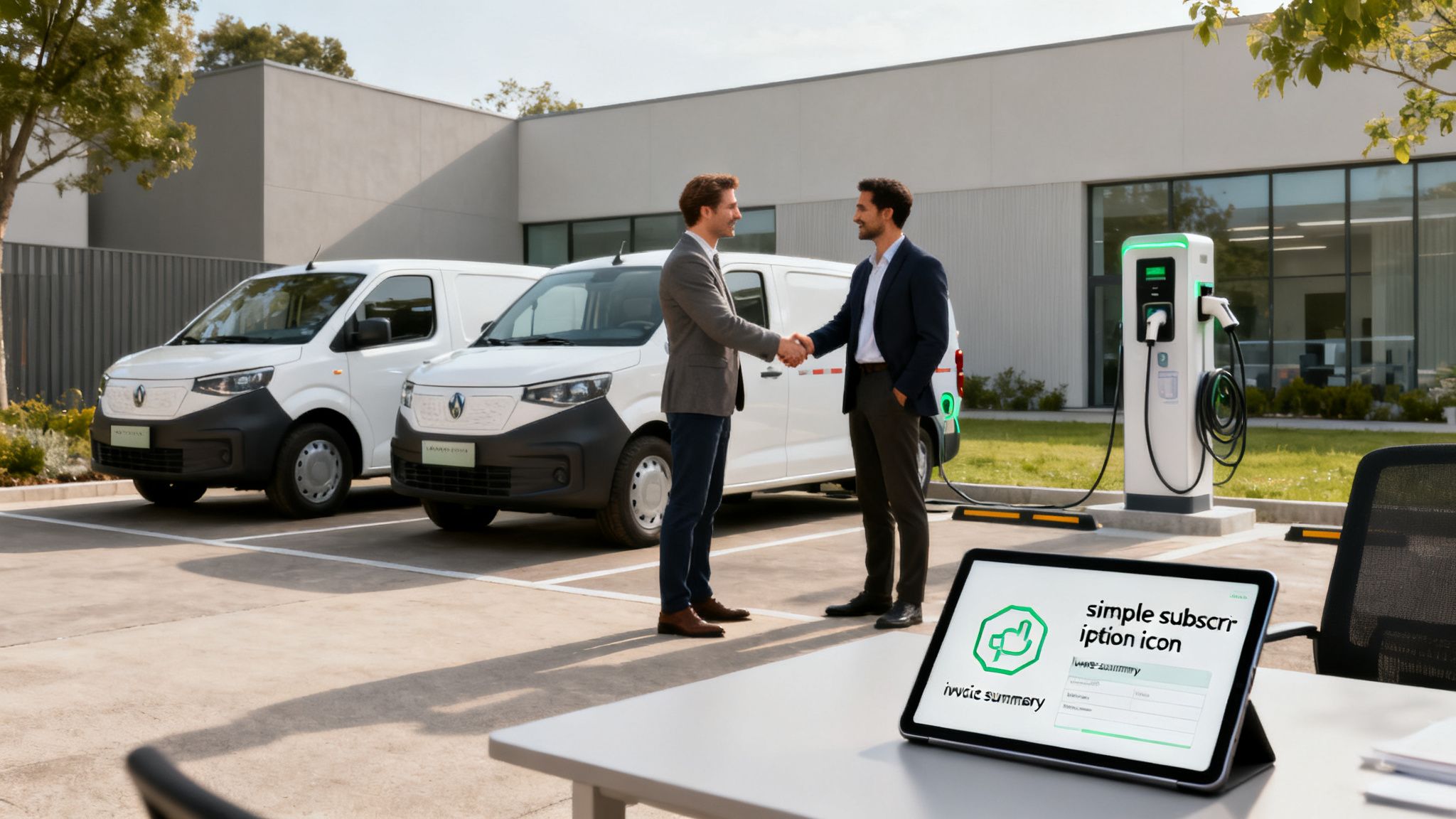
A more modern – and increasingly popular – approach is the OPEX model, best visible in Charging-as-a-Service (CaaS). This completely changes the conversation and turns your charging infrastructure from a major capital purchase into a predictable, manageable monthly subscription.
Think of it as a streaming service, but for the energy of your fleet. With a CaaS model, a provider like Blulinc handles everything from start to finish:
- Hardware and Installation: We supply and install the right charging stations at your depot or workplace.
- Software and Management: You get full access to our smart charging platform to monitor and manage your entire network.
- Maintenance and Support: We take care of all maintenance, repairs, and software updates, so you get maximum reliability.
This model completely eliminates high start-up costs, making advanced charging solutions much more accessible to businesses of all sizes. It transforms a huge, unpredictable expense into a simple item on your monthly budget—something much easier to plan around.
The CaaS model allows your charging infrastructure to grow with your business.As you add more electric vehicles to your fleet, your charging service grows with it, ensuring you always have the power you need without having to make another massive capital investment.
This kind of financial flexibility is worth its weight in gold in the dynamic Belgian market. The country's EV landscape is growing rapidly, with a recent study showing a solid 30% EV sales penetration (BEVs + PHEVs) shows – that is nearly double the global average of 16%. This growth is driven by government measures, such as the requirement that 100% a portion of new commercial vehicles must be electric by 2026, which is scalable last-mile solutions makes it a top priority. You can consult explore detailed findings on Belgium's EV charging index for the full picture.
By choosing an OPEX model such as CaaS, you are not just buying chargers. You are investing in a complete, worry-free service that keeps your fleet charged and moves your business forward. It is a smarter, more agile way to build the backbone of your electric delivery operations.
Get the Most Out of Belgian Regulations to Boost Your ROI
The successful rollout of electric last-mile solutions It is not just about choosing the right vans and chargers. You also need to get a grip on the local financial and regulatory context, especially here in Belgium. There is a whole package of government measures, tax benefits, and subsidies designed to accelerate the transition to e-mobility, and these offer a huge opportunity to reduce your costs and increase your return on investment (ROI).
Navigating these regulations is the key to unlocking the full financial power of your electric fleet. It transforms what feels like a mandatory change into a smart financial move, allowing you to invest in future-proof technology while improving your bottom line.
Understand the Key Belgian Measures
The Belgian government has made its course on corporate mobility crystal clear. The biggest legislative change is that, starting from 2026 every new company car 100% electric must be to remain tax-deductible. Although the law focuses on passenger cars, it sends a strong signal that is already influencing decisions for commercial fleets.
This important legislative push is intended to phase out fossil fuel vehicles from company fleets. It makes adopting electric vans and the right charging setup not only an environmentally friendly choice, but a financial necessity to keep costs low in the long run. Companies that get on board now will be far ahead of the competition, avoid last-minute rushes, and gain a real competitive advantage.
Maximize Financial Incentives and Tax Benefits
To assist with the initial investment, various financial support systems are available at both the federal and regional levels. These benefits can significantly reduce the Total Cost of Ownership (TCO) for your electric fleet.
Here are some important benefits to investigate:
- 100% Deductibility: The costs for the purchase and installation of charging stations at your company are currently 100% tax deductible, as long as they are publicly accessible for at least part of the day.
- Subsidies for Zero-Emission Vehicles: Regional authorities, particularly in Flanders, offer direct subsidies for the purchase of zero-emission light commercial vehicles. This really helps to close the price gap with their diesel counterparts.
- Reduced Benefit in Kind (BIK): For employees who have a company vehicle for personal use, the VAA tax on electric vehicles is much lower than for petrol or diesel models, making it an attractive benefit to offer.
By cleverly combining these incentives, a Belgian SME can extend the payback period for its investment in electric last-mile solutions drastically shorten. In many cases, the TCO for an electric delivery van becomes lower than that of a diesel in just a few years.
Prove the ROI with a TCO Comparison
The true financial gain becomes clear when you look at the Total Cost of Ownership over time. The purchase price of an electric delivery van may be higher, but the savings on operating costs accumulate quickly.
Let's take a concrete example: a delivery company in Brussels with a fleet of 20 vans.
- Diesel Van (5-year TCO): You consider the initial purchase, unpredictable fuel costs, road tax, higher maintenance bills (oil changes, complex engines), and the risk of fines in Low Emission Zones.
- Electric Van (5-year TCO): This includes the higher purchase price (mitigated by subsidies), much lower electricity "fuel costs," no road tax in Flanders and Wallonia, minimal maintenance, and full access to all LEZs.
Over five years, savings on fuel and maintenance for the electric fleet will almost always come out on top, leading to a lower TCO and a healthier profit margin. For a more detailed picture, it helps to understand how factors such as the CREG tariff for charging stations affect your total energy expenses.
Tracking the Right KPIs for Success
To ensure you achieve the best return, you must track the right Key Performance Indicators (KPIs). These figures provide you with the hard data you need to refine your operations.
Focus on keeping track of:
- Vehicle Uptime: How much time are your vans actually on the road making deliveries versus standing still while charging or for maintenance? Smart charging schedules are a game changer here.
- Energy cost per kilometer: Consider this your new fuel efficiency benchmark. Keep a close eye on this to find the cheapest times and places to charge.
- Cost per Delivery: This is the ultimate measure of efficiency. It combines vehicle, energy, and driver costs to show you how profitable your last-mile rides really are.
This data-driven approach enables you to make smart decisions that immediately increase your ROI. And the good news is that Belgium has already reached the milestone of 100,000 public charging points has exceeded, placing it on the European podium for charging density. This growing network makes it even easier to keep your fleet moving and efficient.
Ready to Make Your Deliveries Smarter?
Knowing the theory is one thing, but taking that first step is what really delivers results. We discussed the obstacles for Belgian companies, explained what modern last-mile solutions truly mean, and a blueprint has been outlined for a solid EV charging network. Now it is time to bring everything together into a clear, actionable plan for your business.
The journey to an electric, optimized last mile may seem complicated, but it comes down to a few simple ideas. It is about getting the right vehicle on the right route. It is about smart charging that saves costs and keeps your fleet moving. And it is about finding a financial model that actually works for your budget. The goal? A seamless, efficient, and green delivery operation that boosts your bottom line and keeps your customers satisfied.
Your Partner in E-Mobility
At Blulinc, we don't just sell charging hardware; we build long-term partnerships. We understand that every business is different – from a local baker with a single electric delivery van to a large logistics company managing an entire fleet. Think of us as your expert guide, here to help you at every stage of your transition.
We are here to help you:
- to thoroughly analyze your current fleet to find the smartest way to go electric.
- To design a charging setup that fits your daily workflow, whether that is at your depot, workplace, or at your employees' homes.
- To determine the right financial model, such as our flexible Charging-as-a-Service (CaaS) plan, so that you can avoid a heavy initial investment.
- To provide ongoing support and management to ensure that your system runs like a well-oiled machine and continues to deliver value.
This is not just an operational adjustment; it is a strategic investment in the future of your business. By adopting smarter last-mile solutions now, you position your company to win in a market that demands speed, reliability, and sustainability.
Take the Next Step with Confidence
Moving forward requires no leap of faith – just a practical first step. Armed with the right information, you can make solid decisions that will pay off for years to come. We are here to provide the clarity and expertise you need to get started.
Ready to see what an optimized electric fleet can really mean for your business? It is time to discover the concrete benefits and potential savings waiting for you.
Questions about Last-Mile Solutions? We Have the Answers.
The switch to electric last-mile solutions Naturally, this raises many questions for companies here in Belgium. You are probably wondering about the costs, logistics, and all the practical details of charging. Clear answers are essential, which is why we have answered the most common questions we hear to show you the way forward.
What is the Biggest Obstacle for SMEs Going Electric?
Without a doubt, the biggest concern for most small and medium-sized enterprises is the initial cost and the thought of getting bogged down in complex charging setups. It is a real concern that purchasing a fleet of EVs and the equipment to power them will be a massive capital expenditure that depletes cash flow.
That is precisely why modern approaches such as Charging-as-a-Service (CaaS) have emerged. It completely turns the script on its head. Instead of a huge initial investment, CaaS turns everything into a simple, predictable monthly operating cost. This single amount can cover everything: hardware, installation, software, and even maintenance.
Collaborating with an expert partner also takes all the complexity off your shoulders.We manage the entire project – from analyzing your location and selecting the right chargers to integrating the software and keeping everything running smoothly. You get a setup perfectly tailored to your business, without any technical headaches.
How do I reimburse my employees for charging at home?
Allowing your team to charge at home is a huge efficiency gain. It means that every vehicle starts the day with a full battery, ready to go. We have designed the reimbursement process to be completely seamless and transparent for both you and your drivers.
It works as follows:
- First, we install a smart charger at your employee's home.
- That charger is set up so that it only measures the electricity used for the commercial vehicle.
- Our software automatically records all charging data.
- Subsequently, it produces clear, simple reports so that you can reimburse your employee for his electricity costs with utmost precision.
This automated system means that your drivers are always reimbursed fairly, your administration remains clear, and your fleet is always ready to depart. No administrative nightmares, guaranteed.
Do We Really Need Those Super-Fast DC Chargers?
Not always. In fact, they are superfluous for many delivery fleets. The right loader for you depends on the daily rhythm of your operations. Making the right choice is the key to efficiency and affordability.
For the vast majority of last-mile fleets returning to a depot at night, standard AC chargers are the perfect choice. They are much more economical and can fully charge a van in 8-10 hours – perfect for overnight downtime when energy rates are often lower.
DC fast chargers truly come into their own in very specific, intensive situations. Consider vehicles that cover enormous distances daily and require a quick top-up halfway through a shift to continue. They are also ideal for shared charging hubs where the rapid entry and exit of vehicles is the highest priority.
By closely examining your fleet's daily routes, vehicle parked duration, and energy requirements, we can determine the smartest and most cost-effective mix. Often, a depot full of AC chargers for overnight charging, optionally including one DC unit for emergencies, offers the perfect balance.
Bee Blulinc We know that every fleet is different. Our experts are ready to help you analyze your operations and build a charging strategy that increases efficiency and reduces costs.