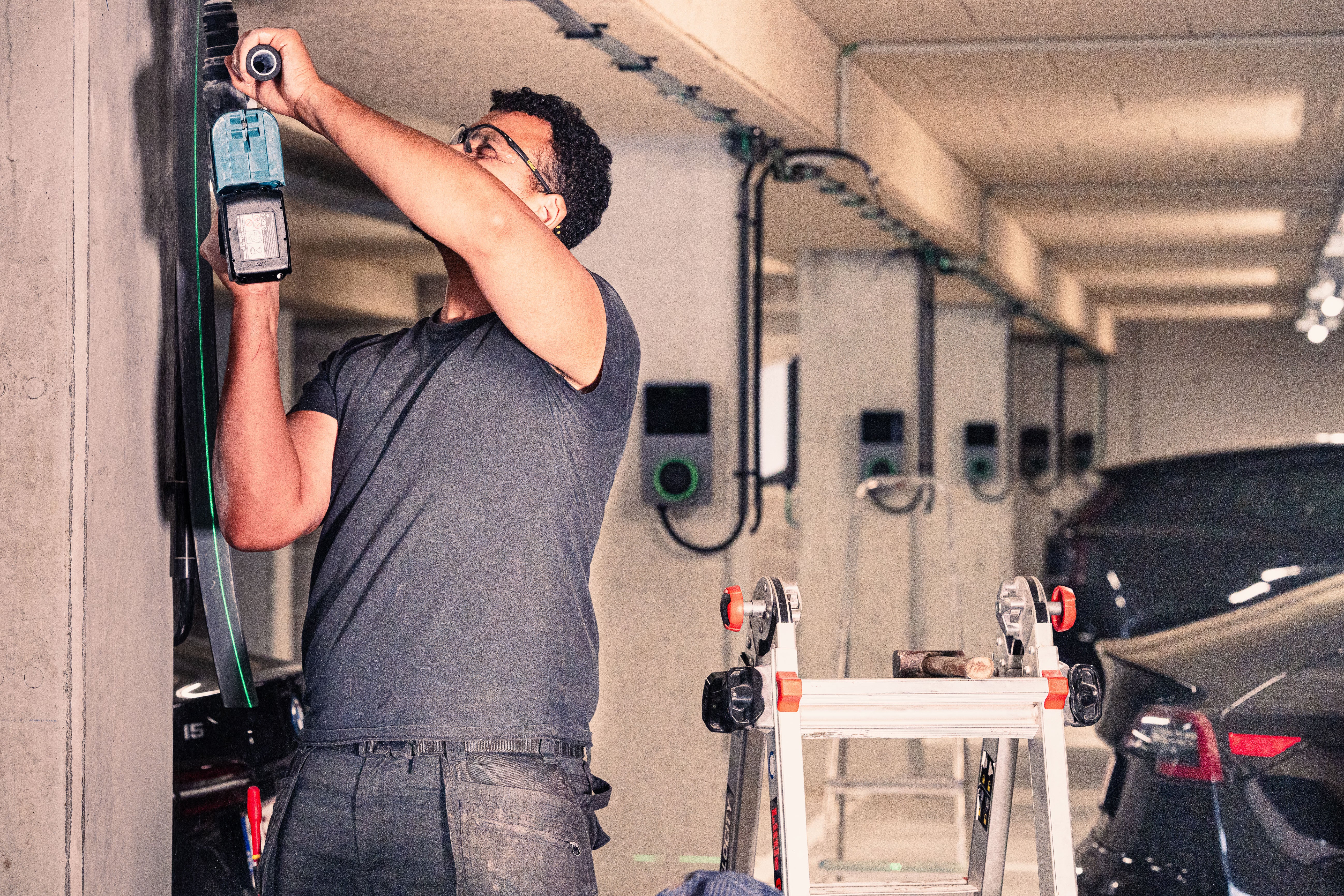


The charging time of an electric car varies enormously. From 30 minutes to a public fast charger until 10 hours or more to a standard socket. The exact duration depends on the type of charging station, the battery size, and the car itself. For Belgian companies, it is crucial to understand these factors to remain operationally efficient. A recognizable problem for many fleet managers: how long does it really take to charge an electric car, and how does this affect my daily schedule?
Understanding the charging time of an electric car
Waiting for a car to charge sometimes feels like watching paint dry, especially when your business operations depend on it. "How long does it take to charge an electric car?" is therefore one of the first questions fleet managers and business owners ask when making the switch. However, the answer is not as simple as you might think. Several factors influence the final charging time.
The transition to an electric fleet requires a different mindset. Refueling with fossil fuels takes a few minutes, while charging requires some planning. Fortunately, this does not mean your vehicles are out of action for hours. The key is understanding the different charging scenarios and how they fit into your daily operations.
Realistic charging scenarios for your business
To understand charging times, you can compare it to filling a water tank. A thin garden hose (a standard wall socket) fills the tank slowly, while a fire hose (a DC fast charger) gets the job done in a fraction of the time. Each type of charger has its own purpose:
- At the employee's home: Usually a specific charging point with lower power (e.g. 3.7 kW or 7.4 kW). Ideal for charging overnight, so that the employee starts every day with a full battery.
- At work: Often AC chargers with a higher capacity (e.g. 11 kW or 22 kW). Perfect for charging employee cars or pool cars during office hours.
- Public and on the road: A mix of slower AC chargers and ultra-fast DC chargers (50 kW to 350 kW). The latter are designed for fast charges during long journeys.
For most Belgian companies, a combination of home and workplace charging is the most cost-effective and practical solution. This approach ensures that vehicles are charged at night or during the workday, drastically reducing the need for expensive and time-consuming public charging sessions.
To give you a clearer picture, here is a quick overview of the charging time for a typical electric company car in Belgium.
Estimated charging times for a typical commercial vehicle (60 kWh battery)
| Charger type | Assets | Typical location | Estimated loading time (20-80%) |
|---|---|---|---|
| Standard socket | 2.3 kW | At home (not recommended) | ~15 hours |
| Home/Workplace charging station | 11 kW | Home, Workplace | ~3.5 hours |
| Public AC charger | 22 kW | Shopping centers, Parking lots | ~2 hours |
| DC fast charger | 50 kW | Highway car parks, Public hubs | ~40 minutes |
| DC ultra-fast charger | 150 kW+ | Specific charging stations | ~15-20 minutes |
As you can see, the right infrastructure makes a world of difference.Choosing the right charger at the right location is fundamental for an efficient electric fleet.
In the following sections, we dive deeper into the technical factors that determine charging speed, show how you can calculate charging times yourself, and explore the impact on your operational planning. With the right knowledge and infrastructure, the charging time of an electric car is no longer an obstacle, but a predictable part of your efficient electric fleet.
What determines the charging speed of your fleet?
Do you ever wonder why one of your electric vehicles can be back on the road after just three hours, while another needs a whole night? It is a frequently asked question. The answer is no magic; it is an interplay of four factors that the charging time of your electric car determine.
A good understanding of these concepts is the first step towards an efficient and predictable charging strategy for your business. This allows you to have smarter conversations with infrastructure partners (like us) and make choices that truly benefit your daily operations.
Let's take a closer look at those factors.
1. Battery capacity (kWh)
The easiest way to find the battery capacity of your vehicle, measured in kilowatt-hours (kWh), as seen, is like a fuel tank. Filling a larger tank simply takes longer.
A compact city EV, for example, has a battery of 40 kWh, while a larger, premium electric van has a battery of 100 kWh may have. If you use the same charger for both, the vehicle with the larger battery will naturally take longer to fully charge. This is the starting point for any estimate of the charging time.
2. Charging capacity (kW)
If the battery is the fuel tank, then the charging capacity of the charging station, measured in kilowatts (kW), the thickness of the hose. A more powerful charger is like a wider hose: it delivers energy much faster.
Chargers generally fall into two main categories:
- AC chargers (Alternating current): These are the most common chargers in workplaces and at home in Belgium, with a power of typically 11 kW or 22 kW. They are ideal for charging at night or during the workday, when vehicles are parked for hours.
- DC chargers (Direct current): Often called fast chargers or ultra-fast chargers, these are the powerhouses. With capacities of 50 kW to more than 350 kW They bypass the car's internal inverter and pump power directly into the battery. These are designed for fast charging when time is limited.
The image below provides a good overview of how different charging environments affect waiting time.

As you can see, at-workplace charging offers the perfect balance between speed and practicality for the daily needs of your fleet.
3. The vehicle's internal charger
This is a crucial part of the puzzle that is often overlooked. Every electric car has a internal charger which converts alternating current (AC) from the grid into direct current (DC) that the battery can store. This component acts as a gatekeeper and sets a strict speed limit for each AC charging session.
You can connect your car to a powerful 22 kW AC charger, but if the car's internal charger only 11 kW can handle, it will never charge faster than 11 kW.
Knowing the specifications of your vehicles is therefore essential.It prevents you from investing in charging infrastructure that your fleet cannot even fully benefit from. However, this limit does not apply to DC fast charging, as that process completely bypasses the internal charger. You can read more about these technical differences in our guide on the different charging modes for electric vehicles.
4. State of Charge (SoC) and other factors
Finally, the current state of the battery also has a major influence on the charging speed. The State of Charge (SoC) – or how full the battery is – is an important factor. An EV battery charges fastest when it is between 20% and 80% is full.
As soon as the battery the 80% once reached, the charging speed decreases significantly. This is a deliberate safety measure to protect the battery's lifespan. Compare it to filling a glass of water: you start fast, but at the end you slow down to prevent it from overflowing.
Some other external circumstances can the charging time of an electric car also influence:
- Ambient temperature: During a cold Belgian winter, the battery management system must first use energy to warm the battery to an optimal temperature before charging can begin at full speed. This can add extra time.
- Battery Health: Like any battery, the ability of an EV battery to hold a charge decreases slightly over its lifespan. While this is usually minimal, it can eventually have a small impact on charging performance.
The good news is that the public charging infrastructure in Belgium is evolving rapidly. The number of powerful chargers of more than 150 kW rose with 57% by 2026, which drastically reduces waiting times for fast charges on the road to just 15-30 minutes. Since commercial vehicles 89% of all BEVs to make a difference, this growth in reliable and fast charging – both public and at work – is more crucial than ever.
Calculate the loading time for your company
That theory is all well and good, but let's get concrete: how can you the charging time of an electric car Want to estimate for your own fleet? You don't have to guess.
There is a simple formula that gives you a solid starting point for every vehicle and every charger. It is the key to making smart decisions about the infrastructure your business needs.
Energy to be added (in kWh)/Charging capacity (in kW) = Charging time (in hours)
Let's apply this to a realistic scenario for a Belgian company to see how this works in practice.

A practical example in Ghent
Suppose your SME is based in Ghent. You manage a fleet of ten identical company cars, each with a 77 kWh battery. To support your team, you have just multiple 11 kW AC chargers installed at the office for charging during and after working hours.
How long does it take to charge one of these cars? Let's look at two common situations.
Scenario 1: Fully charge
One of your representatives arrives with only 10% remaining battery after a long day of customer visits. It has a full charge up to 100% needed for the next morning. This means that we 90% need to add of the battery capacity.
- Energy to be added: 90% of 77 kWh = 69.3 kWh
- Load capacity: 11 kW
- Calculation: 69.3 kWh/11 kW = 6.3 hours
This means that a full charge can easily be completed during a standard workday. However, it is important to note that charging always slows down after approximately 80% to protect the battery, so that last one 20% It will take a little longer. Nevertheless, the car will be more than ready for the next day.
Scenario 2: The daily recharge
This is what you will usually see. An employee consumes approximately 30% of his battery during his daily commute and appointments, and returns to the office with 70% remaining charge. The only thing needed is a top-up.
- Energy to be added: 30% of 77 kWh = 23.1 kWh
- Load capacity: 11 kW
- Calculation: 23.1 kWh/11 kW = 2.1 hours
This simple calculation reveals a crucial point for most companies: you do not always need the fastest, most expensive DC chargers. A standard 11 kW A charging station at the workplace is more than capable of replenishing daily consumption in just a few hours, making it an incredibly efficient and predictable strategy.
From estimates to real-time data
Although this formula is an excellent tool for planning, real-world factors such as battery temperature and the car's unique charging curve always play a role. Manual calculations are fine to start with, but they are not an efficient way to manage an active fleet.
This is where a smart management platform becomes essential. The Blulinc platform replaces estimates with precise, real-time data charging time of an electric car, the exact energy consumption in kWh and the costs for each charging session of your entire fleet.
This data-driven approach is what enables you to truly optimize your operations, control your costs, and ensure that your fleet is always ready.
The impact of loading times on your daily operations
What does the mean charging time of an electric car Is it really affecting your company's profitability? It is more than just a number on a specification sheet. Loading time has a direct, real impact on vehicle downtime, your team's productivity, and the entire rhythm of your operations. If you handle it incorrectly, you risk delays, missed appointments, and highly frustrated staff.
The transition to an electric fleet is not just about buying new vehicles; it is about adopting a completely new way of thinking about your fleet's availability. You simply cannot afford the risk of unpredictable charging schedules. The key is to stop viewing charging as a daily problem, but to proactively integrate it into your daily workflow.
The domino effect of unattended loading
Imagine a logistics company operating from the Port of Antwerp. Their electric vans must be fully charged and ready for the first delivery run at 6 a.m. If they rely on public charging stations that may be occupied or out of order, they create a logistical nightmare.
Just one delayed vehicle is enough to cause a domino effect:
- Productivity loss: A driver waiting for a loader is not a driver on the road. It is paid time that is not spent delivering goods or visiting customers.
- Rising costs: Last-minute trips to expensive public fast chargers can quickly erode your profit margins. The price components of public charging (start fee, kWh price, time component, occupancy costs) are often complex and more expensive than charging on your own premises.
- Planning chaos: Your dispatching team has to reorganize ad hoc routes, a recipe for inefficiency.
- Reputational damage: Nothing damages a customer relationship faster than a late delivery or a missed service appointment.
For every Belgian company that depends on its vehicles, uncontrolled loading is an unacceptable risk. The solution is to take loading in-house. This transforms a potential logistical headache into a streamlined, reliable operation and a real competitive advantage.
From downtime to guaranteed availability
Here is a crucial shift in mindset: the real impact of the charging time of an electric car It is not the raw time a vehicle is plugged in. It is about whether that charging time coincides with your company's natural downtime. A delivery van charging overnight or a car plugged in while an employee is sitting at their desk does not experience "downtime"—it is simply refueling while already parked.
If you look at it that way, everything changes. A well-planned, dedicated charging solution, smartly managed, guarantees that every vehicle is ready exactly when you need it. This is more important than ever, now that the Belgian infrastructure is in a race against time to keep up with demand.
The figures speak for themselves. By 2026, the Belgian charging network grew by an impressive 23% to 106,677 points. This was fueled by a massive increase in EVs, where 89% of the new battery-electric vehicles were commercial vehicles. Although the increase of 57% While powerful DC chargers are great for quick top-ups on the go, for most companies, optimized on-site AC charging remains the most reliable and cost-effective strategy for daily operations. This growth is essential to meet the expected 600,000 to support EVs on our roads. You can read more about this in the report on the Growth of EVs in Belgium and what this means for businesses.
The Blulinc approach to operational efficiency
By implementing a tailored charging strategy, you regain control over your fleet's readiness. At Blulinc, we don't just sell chargers; we analyze your unique operational needs to design the perfect mix of hardware and software. We ensure that charging takes place when your vehicles are not in use, effectively removing "charging downtime" from the equation.
This approach transforms charging from an unpredictable variable to worry about into a fixed, reliable part of your business operations. It ensures that your fleet is always an asset, never a burden.
Strategies to reduce loading time and increase efficiency

Waiting for a car to charge can feel like wasted time. Fortunately, you are not powerless.You can the charging time of your electric cars actively shorten and improve the efficiency of your entire charging setup. This is not just about buying faster chargers; it is about investing smartly and managing wisely.
When you apply the right strategies, loading becomes a controlled, productive part of your daily operations. Let's look at three powerful, practical approaches that are already making a real difference for companies across Belgium.
1. Invest in the right infrastructure
The most direct way to reduce charging times is to invest in the right infrastructure for your specific needs. Although DC fast chargers seem tempting, the reality for most companies is that 22 kW AC chargers on site be the smarter choice. They offer the perfect balance between charging speed, installation costs, and the impact on your electricity grid.
For many fleets, a 22 kW charger is more than powerful enough to fully charge a vehicle during a workday or overnight. This avoids the extremely high investment and operating costs of a full DC installation, leading to a much lower Total Cost of Ownership (TCO) and a faster return on investment.
By matching the charging capacity to your vehicles' parking time, you optimize for efficiency. There is little point in paying for an ultra-fast charger if a car is parked for eight hours anyway.
2. Implement Smart Charging and Load Balancing
What happens when ten employees plug in their cars at the same time? Without smart management, you risk overloading your electrical system, which can lead to expensive grid upgrades or even power outages. This is exactly where Smart Charging and Load Balancing make their entrance.
This technology, a core component of the Blulinc platform, intelligently distributes the available power across all connected vehicles. Instead of each charger drawing maximum power and burdening the grid, the system ensures that the total demand remains within the limits of your connection. It can prioritize vehicles that need to depart the fastest, while others are charged more efficiently during the day or night.
A concrete scenario: An SME in Ghent has a limited grid connection but wants to install ten charging points for its fleet of 20 vehicles.
- Without Load Balancing: They would likely have to pay for grid reinforcement, a process that can cost thousands of euros and take months. The annual savings they had in mind evaporate due to the high initial cost.
- With Blulinc's Load Balancing: The system dynamically distributes the available power. The 20 cars charge at night, with the system spreading the charging sessions to avoid peaks. All cars are fully charged in the morning, without the need for expensive grid reinforcement. This not only saves an initial investment of €10.000 to €20.000, but also optimizes ongoing energy costs.
3. Encourage smart charging habits
Technology is only part of the puzzle. The habits of your employees and drivers have a huge impact on efficiency. Encouraging smart charging habits is a cost-free way to the charging time of an electric car to optimize and reduce the pressure on your infrastructure.
Teach your team these best practices:
- Charge during off-peak hours: Encourage charging at night or outside peak hours, when electricity rates in Belgium are often lower. Our platform can even automate this for you.
- Recharge regularly: It is better for the efficiency and health of the battery to perform short, regular charging sessions rather than constantly draining the battery and then recharging it to 100%.
- Prevent 'charging station hogging': Implement a driver-friendly policy where drivers move their cars as soon as they are fully charged, freeing up the charging station for a colleague. The Blulinc platform can assist with this by providing systems for reserving charging points.
To help you weigh your options, we have prepared a simple comparison of these key strategies and their potential impact on your business.
Strategy comparison for reducing charging downtime
| Strategy | Main objective | Typical Cost Impact | Operational Advantage |
|---|---|---|---|
| Upgrading to faster chargers | Reduce physical charging time per vehicle. | High (hardware, installation, possible grid upgrades). | Significantly shorter charging sessions; ideal for vehicles with high turnover. |
| Implement Smart Charging | Load maximum number of vehicles with existing capacity. | Low to medium (software subscription, smart chargers). | Prevents expensive grid reinforcements; guarantees that all vehicles are ready when needed. |
| Promote better habits | Reducing wasted time and energy caused by user behavior. | Very low (internal communication, policy making). | Increases the availability of chargers for everyone; lowers electricity costs. |
Each strategy offers clear benefits, but the most powerful results come from a combination.
By combining the right hardware, intelligent software, and informed users, you evolve from a passive spectator to the active manager of your energy. At Blulinc, we don't just install chargers; we act as your strategic partner to help you control your energy management and streamline your operations.
Your partner for optimal charge management in Belgium
We have discussed quite a lot. You now know how battery size, charging capacity, and even the weather affect charging time of an electric car influence. You are also aware of the risks of unattended loading to your daily operations and the strategies to work more efficiently. Now it is time to turn that knowledge into action.
Long loading times and volatile energy prices can throw a spanner in the works for any business. That is where Blulinc makes the difference. We offer a complete service, starting with an expert consultation to map out your exact infrastructure needs, followed by professional installation and a powerful software platform that gives you total control.
Take control of your fleet's energy
Our entire system is designed to put you firmly in the driver's seat. We replace guesswork and operational headaches with clarity and predictability. With Blulinc, you get a partner dedicated to optimizing every component of your charging setup.
Here are some ways we achieve that:
- An intuitive management app: From a single dashboard, you view the real-time charging status, track energy consumption, and monitor costs for your entire fleet.
- One uniform charging card: We provide your drivers with a single pass that works on your own private network and with more than 900,000 Public charging points throughout Europe. Budget control and setting limits on employee charging cards becomes child's play.
- Intelligent Load Balancing: Our technology allows you to charge multiple vehicles simultaneously without expensive modifications to your grid connection. You can learn more about how we implement smart load balancing to save you money.
This integrated approach is essential, especially now. Flanders set the pace for the Belgian charging network and reached in 2026 72,646 stations with an enormous capacity of 1,026,906 kW. This infrastructure is crucial for the 337,127 registered EVs in the region and has the average charging time of an electric car significantly shortened. Although an overnight AC charge still takes several hours, the proliferation of 50-150 kW DC chargers means that a quick top-up on the go takes only 30-60 minutes can be completed. You can discover more about these Belgian charging trends.
For our customers, such as Brody and Nippon Gases, our platform translates this growing infrastructure into a real advantage. They benefit from effortless management across multiple locations, real-time data to minimize downtime, and full control over their costs.
Your next step towards efficient e-mobility
Let the charging time of your electric car Stop dictating your company's schedule. It is time to take control with a charging solution tailored to your real operational needs. A smart, managed system not only guarantees that your vehicles are ready for departure; it actively lowers your total cost of ownership (TCO) and gives you a stronger competitive advantage.
The switch to electric is a big step, but you don't have to take it alone. Let us show you how a partnership with Blulinc can transform the efficiency of your fleet and prepare your business for a sustainable future.
Request a free consultation today. We examine your specific needs and show you exactly how we can make your electric fleet more powerful, predictable, and profitable.
Frequently asked questions about EV charging time
When switching to electric driving, one question always comes up: 'How long does it really take to charge?' We get it. For fleet managers and drivers, time is money.
Let's answer the most frequently asked questions from Belgian companies with clear, practical answers that help you make the switch with confidence.
How much faster is a DC charger compared to a standard AC charging station?
The difference is night and day. A DC fast charger is significantly faster because it bypasses the car's internal charger and delivers power directly to the battery.
Look at it this way: a standard 11 kW AC charger at the office takes about 3.5 hours about to an average EV battery (60 kWh) by 20% Unpleasant 80% to load. A 150 kW DC fast charger? It gets the same job done in just 15-20 minutes.
Does the Belgian weather affect loading times?
Yes, that is possible. The outside temperature, and especially the cold, certainly has an impact on the charging time of an EV.
In winter, the car's battery management system (BMS) must first warm the battery to the ideal temperature before it can start charging at full speed. This warm-up phase can add a few minutes to your total charging session, especially when you plug in the car on a freezing cold day.
Is it bad for the battery to always charge to 100%?
Constant to 100% Charging and leaving the vehicle fully charged for extended periods can put slightly more strain on the battery and slightly accelerate aging over time. For daily use, most EV batteries are happiest when they are between 20% and 80% cargo be held.
A shipment of 80% or 90% is more than enough for most daily commutes. If you have a long journey ahead, it is of course fine to charge the battery fully to 100% to charge.
It is a myth that you the battery always must be kept between 20% and 80%. Modern EVs have smart, built-in buffers to protect the battery. However, for daily use, it is more efficient and better for the battery's lifespan not to charge to 100% every time.
Can I shorten the charging time without buying a faster charger?
Absolutely. The most powerful tool you have is adopting smart charging habits.
'Top-up charging' with shorter, more frequent charging sessions is often much faster than waiting until the battery is nearly empty and then requires a full charge. By plugging in the car while you are at the office or at home overnight, the charging time simply becomes part of the vehicle's natural downtime. Suddenly, the perceived waiting time drops to zero.
Do you have other questions about the electrification of your fleet? The team at Blulinc is ready to help you with expert, personal advice. Contact us for a free consultation.