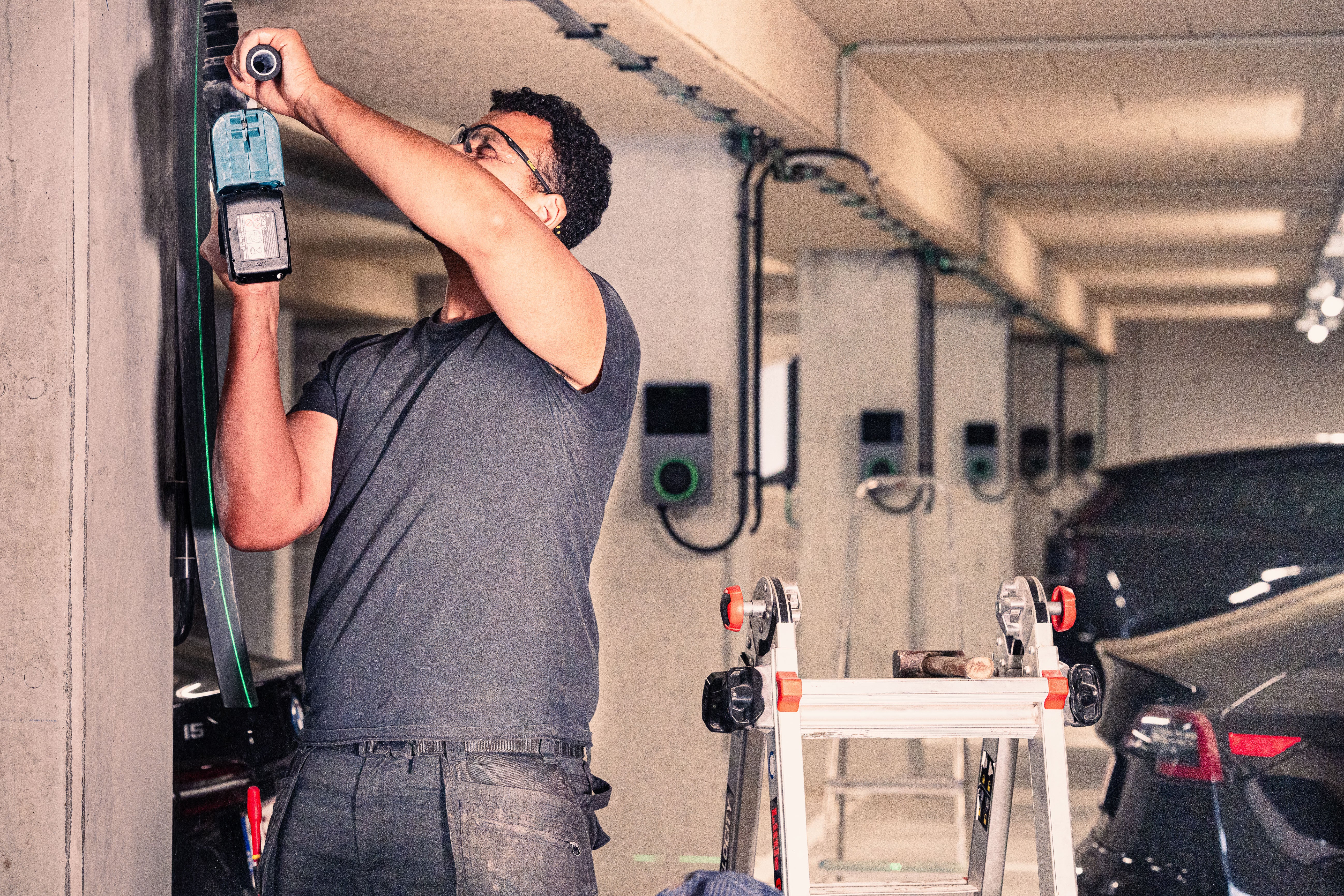


Imagine this: it is Monday morning and your employees arrive at the office. A growing number of them are driving electric. The real challenge is not or you need to install charging points, but how you efficiently address the increasing demand for power at your location. With a well-thought-out approach, you turn this challenge into a tangible competitive advantage.
Why Your Company Needs an EV Charging Strategy
The electric revolution is no longer a thing of the future in Belgium; it is here and now. This shift is already having a direct impact on your business operations today. Employees with electric company cars, customers who value sustainability, and the electrification of the vehicle fleet… they all ask for one thing: reliable and accessible charging points. Without a clear plan, you will quickly run into operational bottlenecks and missed opportunities.
Installing charging stations is much more than simply hanging some hardware on the wall. It requires a strategy perfectly tailored to your needs of today and tomorrow.
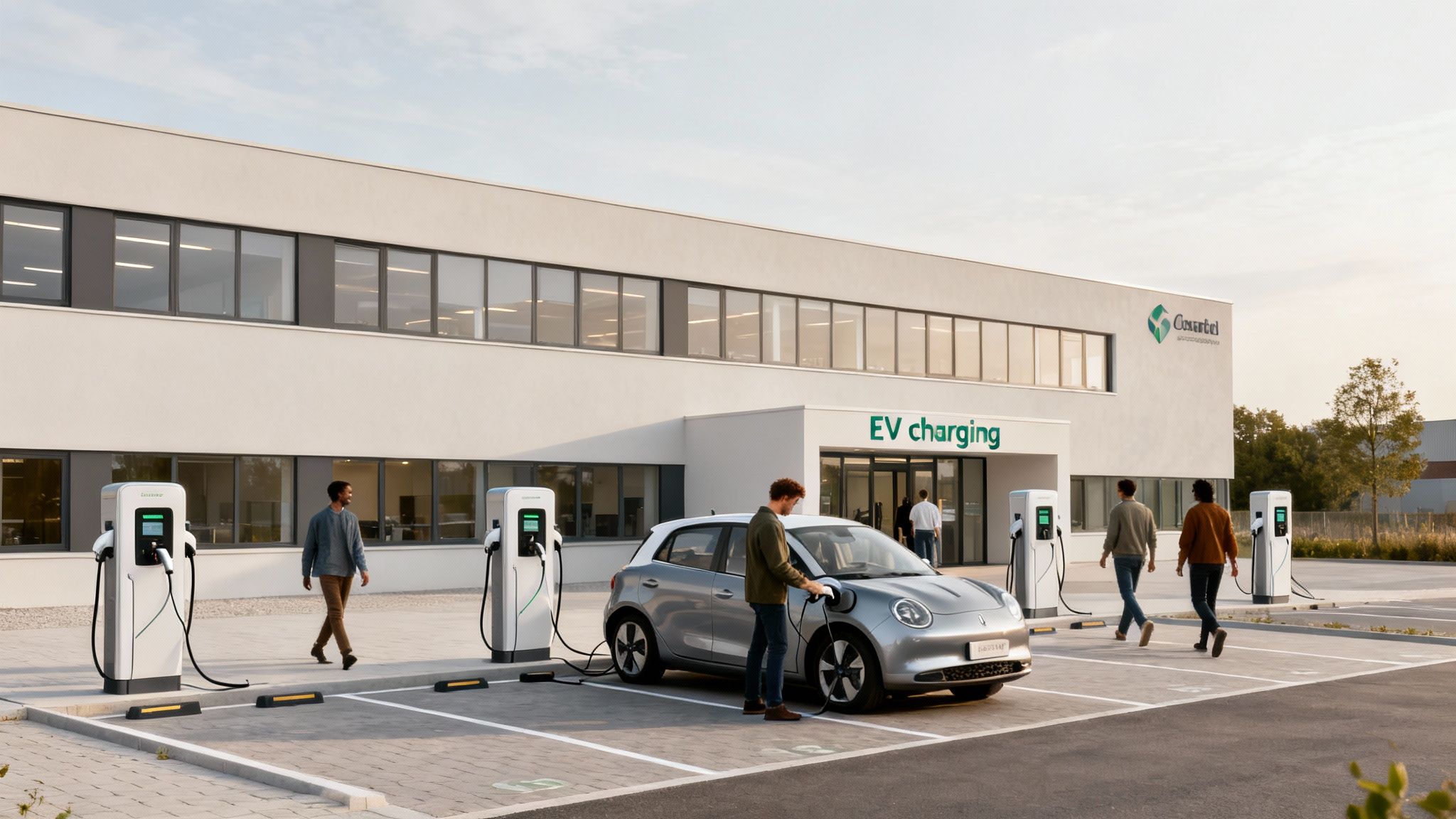
Being Prepared for Future Growth
The adoption of electric cars is accelerating rapidly. According to the FPS Mobility and Transport, by early 2023, 1 in 8 newly registered cars in Belgium is fully electric. And that is just the beginning. Driven by fiscal incentives and the requirement that all new company cars must be zero-emission from 2026, this number will only increase.
A proactive charging strategy ensures that your infrastructure can grow with this demand. This way, you avoid expensive, hasty solutions and stay behind when a large part of your staff or fleet is driving electric.
Creating a Competitive Advantage
Offering good charging options sends a powerful signal to the outside world. It shows that your company is modern, sustainable, and ready for the future. And that yields direct benefits:
- Attracting talent: For many professionals, the ability to charge at work is a decisive factor in their job choice.
- Better customer experience: Customers and visitors with an EV will choose your company over competitors that do not have charging facilities.
- Stronger brand image: You position your company as a leader in sustainability and innovation.
A smart charging strategy is not an operational burden, but a strategic investment. It transforms a potential headache into a valuable asset that prepares your company for the electric future.
Imagine a consultancy firm with 50 employees, 15 of whom drive electric. Without a well-thought-out system, a race ensues every morning for the few available charging points, leading to frustration and wasted time. A smart approach using charging stations that dynamically distribute power solves this efficiently.
At Blulinc, we help you navigate this process from A to Z. We don't see ourselves as salespeople, but as your partner who guides you, from analysis to operational management. Together, we build a charging solution that seamlessly aligns with your unique situation.
Choosing the Right Commercial Charging Stations
Not all charging stations are created equal. Choosing the right hardware is the foundation of a successful charging network for your business. The technology may seem complex at first glance, but it comes down to a simple question: how are your vehicles used and how quickly do they need to be back on the road?
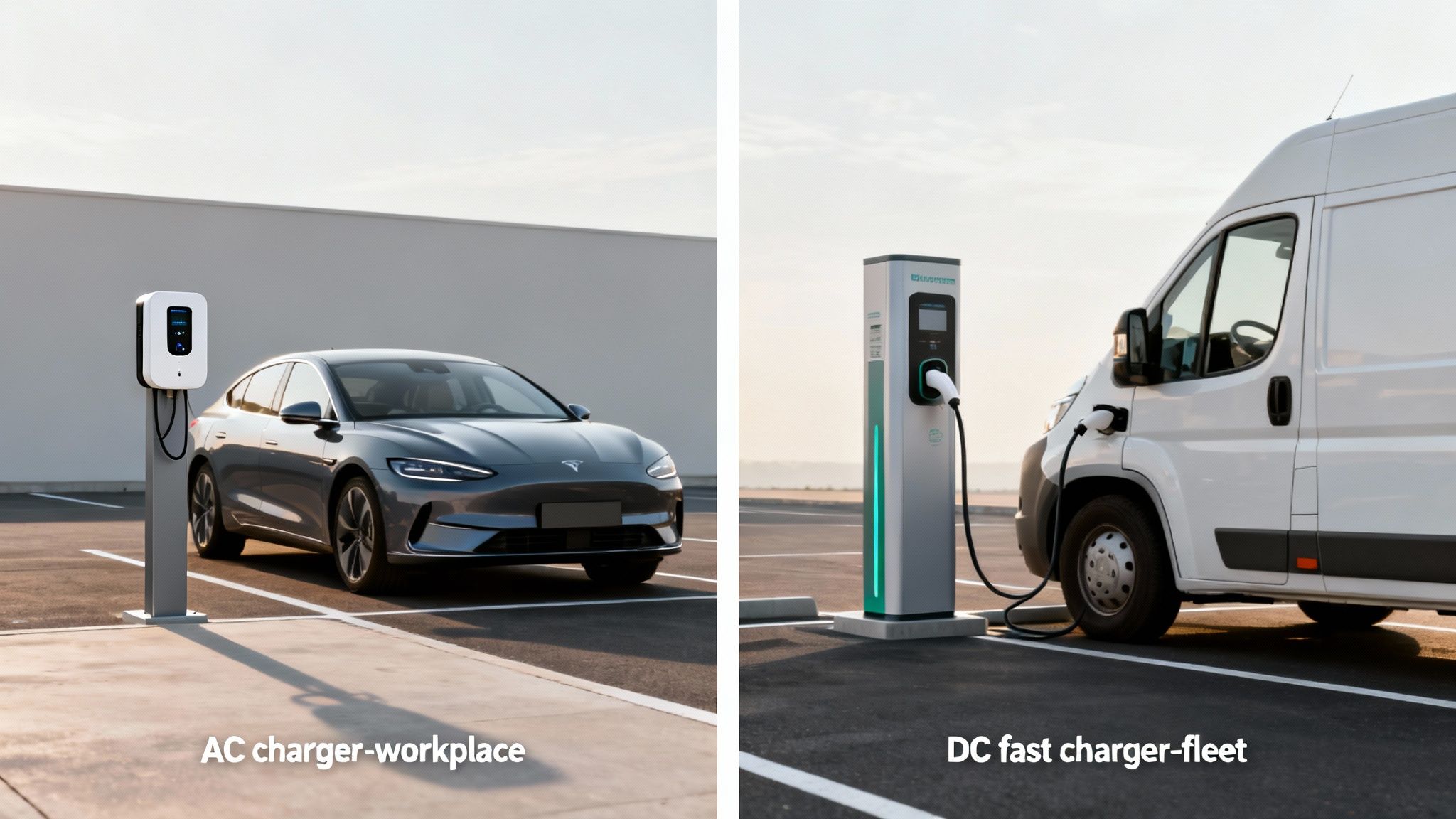
In the world of charging stations for businesses There are two main players you need to know: AC chargers and DC fast chargers.Each has a specific role, and understanding the difference is essential to get the most out of your investment. The right mix gives you an efficient, cost-effective, and future-proof setup.
AC Chargers: The Workhorse for Everyday Use
AC chargers are the most common and cost-effective solution, especially in office environments. They are perfect for situations where vehicles are parked for extended periods, such as during a typical workday. The car's built-in charger converts the AC power from the grid into DC power to charge the battery.
Consider an AC charger as a garden hose that steadily fills a swimming pool. It does its job reliably and over an extended period. This makes it the ideal solution for:
- Employees who charge during the day: A car parked for eight hours can easily fully charge with a standard 11 kW or 22 kW AC charger.
- Visitors staying for a few hours: They can recharge their battery while sitting in a meeting.
- Home charging for staff: AC chargers are also the standard for home installations, which is a crucial part of an integrated charging strategy.
The popularity of this solution is reflected in the national figures. Belgian charging infrastructure is experiencing explosive growth, and this is particularly relevant for businesses. In 2023, the country had approximately 44,000 publicly accessible charging points, an enormous increase of 82% compared to the 24,100 in 2022. The growth in AC points demonstrates how scalable this solution is for corporate car parks. You can find more insights in the report on the Belgian charging market at Mordor Intelligence.
DC fast chargers: Speed When It Counts
DC (direct current) fast chargers work differently. They bypass the car's internal inverter and deliver power directly to the battery, resulting in drastically shorter charging times. To use our earlier analogy: this is the fire hose, designed to deliver large volumes quickly.
DC chargers are essential for:
- Operational fleets: Vans or service vehicles that cannot afford to lose time and need to get back on the road quickly.
- Public charging stations: Locations with heavy traffic where drivers cannot wait for hours.
- Strategic business locations: Companies along busy routes can offer fast charging as an attractive service for customers.
Although the initial investment is higher, DC chargers offer an indispensable service for specific business needs where time really is money.
AC vs DC Fast Chargers: A Comparison for Businesses
To help you weigh the options, here is a clear comparison between AC and DC chargers. This table lists the key features so you can see which solution, or combination of solutions, best suits your operational needs and budget.
| Feature | AC charger (Level 2) | DC fast charger (Level 3) |
|---|---|---|
| Loading speed | Slow to medium (3-8 hours for a full charge) | Very fast (20-60 minutes for 80% charge) |
| Best for | Daily charging at work, fleets charging at night, visitors | High-turnover rafts, public access, short stops |
| Installation costs | Lower | Significantly higher |
| Impact on the grid | Minimum to average | High, often requires net reinforcement |
| Hardware size | Compact, wall-mounted or on a pole | Large, detached units |
| Compatibility | Universal (all EVs) | Most modern EVs (CHAdeMO or CCS connector) |
Ultimately, the best strategy is often not about choosing one or the other. It is about finding the right balance. A smart mix of reliable AC chargers for daily use and a few strategically placed DC chargers for fast charging is often the most powerful and efficient setup.
The Brains Behind the Hardware: Smart Charging
The chargers themselves are only part of the puzzle. The real magic happens with the 'brain' of the system: smart charging and load balancing. These technologies manage the entire charging process intelligently to save you money and headaches.
- Smart Charging adjusts the charging speed based on factors such as electricity prices or the availability of your own renewable energy. For example, you can set the system to primarily charge vehicles when your solar panels are producing power.
- Load Balancing dynamically distributes the available power capacity of your building across all active charging points. This is absolutely crucial to prevent overloading of your electricity grid and to avoid costly infrastructure upgrades.
Imagine you have ten charging stations, but your grid connection can only handle six at full capacity simultaneously. Without load balancing, the seventh car plugging in would blow the fuse. With load balancing, the system intelligently shares the available power so that all ten cars are charged—albeit slightly slower—without shutting down your entire network.
These smart features are indispensable for building a scalable and cost-effective charging infrastructure. They ensure that you get the most out of your existing grid connection while keeping energy costs under control.
Are you unsure which combination of hardware and software is suitable for your company? Request a free consultation today, and our experts are happy to assist you.
A Guide to Belgian Financial Incentives and Regulations
The switch to electric driving is not only an operational upgrade, it is also a smart financial move, especially with the strong support of the Belgian government. Gaining insight into the available incentives for charging stations for businesses is the first step towards a solid business case. These measures are designed to mitigate the initial investment and allow you to achieve a return much faster.
The Belgian government has rolled out a robust framework of subsidies, tax deductions, and premiums to push companies towards e-mobility.This support is available at both the federal and regional levels, offering you multiple ways to reduce costs. It may seem like a lot to navigate, but the financial return is more than worth the effort.
The Federal Tax Deduction Analyzed
At the federal level, the most important measure is the increased cost deduction for the purchase and installation of charging infrastructure. This makes the initial bill much less daunting for companies of all sizes. The incentive targets intelligent charging stations that are publicly accessible, creating a win-win situation: you support your own fleet while simultaneously serving the wider community.
For your company, this means a significant reduction in your taxable income, which directly lowers your tax assessment. It is the government's way of saying: "We want you to do this."
And here comes the best part: you can a tax deduction of 200% receive for publicly accessible smart chargers. This incredible incentive is intended to rapidly grow the public charging network, and your company can contribute to this while enjoying significant financial benefits.
Naturally, there are a few conditions. The chargers must be "intelligent," which means they can transmit usage data. They must also be accessible to third parties, at least during or after your company's opening hours. If you meet these conditions, your car park suddenly becomes an asset to the community and a potential new source of income.
Regional Support in Flanders and Brussels
In addition to federal support, each region has its own package of incentives. This tiered system of financial benefits enables more targeted support that reflects local priorities.
The incentives for charging at work and at companies in Belgium are a real game changer for SMEs and fleet managers. The federal government offers a tax deduction of 35% for investments in BEVs and their charging points. In the Brussels-Capital Region, companies can up to €75 per office parking space which is equipped with chargers saves, while the 200% tax reduction for public and smart charging investments is available until August 31, 2024. In Flanders, the Ecologiepremie+ program provides an extra boost for both private and municipal projects, towards the goal of 100,000 charging points. You can find more details at Belgium's strategic EV initiatives on ampeco.com.
View these regional programs as a way to stack benefits on top of the federal ones, making your financial case even stronger.
A Practical Example of the Impact of Incentives
Let's put this in a realistic context. Imagine a logistics company in Flanders with a fleet of 20 electric delivery vans. They decide to install 10 smart AC chargers and one DC fast charger. The total costs for hardware and installation amount to €80.000.
This is how the incentives could work for them:
- Federal Deduction: By making the chargers publicly accessible outside office hours, they can the 200% tax deduction claim on their investment.
- Flemish Subsidy: They apply for the Ecologiepremie+, through which they receive direct financial support that reduces the initial costs.
- Operational Savings: From day one, they start saving on fuel and maintenance, which means their return on investment is achieved much faster.
This mix of direct subsidies and powerful tax benefits can the effective cost of installing charging stations for businesses drastically reduce. It transforms what looks like a major capital expenditure into a smart, manageable, and profitable investment. We can guide you through this in more detail; view our guide on unlocking government support for EV charging stations in Belgium.
Ready to build your business case? Calculate your savings together with our experts.
Your Step-by-Step Installation Plan
Are you considering transforming your parking lot into a modern charging hub? It might seem like a huge undertaking, but it is actually a simple process if you break it down into steps. Let's go through the step-by-step plan and turn your vision into a fully operational network of charging stations for your business.
Everything starts with a thorough analysis of your location. This is not just about selecting a few spots; it is about laying the right foundation for your complete charging setup.
Phase 1: Site Analysis and Design
Before even a single cable is laid or a charger ordered, we need to get a clear picture of the electrical capacity and the physical layout of your location. This initial in-depth analysis answers the big questions: how much power can we actually draw? Where is the smartest place to install the chargers? And crucially, how do we build something today that won't be obsolete tomorrow?
This first phase includes several important steps:
- Electrical Capacity Audit: We carefully inspect your main switchboard and grid connection. This tells us the maximum load your location can handle and signals whether an upgrade is necessary before we proceed.
- Analysis of the Parking Layout: We map out your car park to determine the best spots for chargers. This means considering cable routing, ensuring accessibility, and understanding how people use the space daily.
- Future-Oriented Design: We don't just plan for the cars you currently have. We look at your future fleet objectives to design a scalable system, so you don't have to replace everything in a few years.
Imagine a consultancy firm with 50 employees that 12 wants to install charging stations. Our analysis could demonstrate that their current grid connection can handle eight chargers with smart load balancing. We would then design a plan to make those eight operational now, while we prepare the foundation for the last four. This makes future expansion a simple, cost-effective task.
This infographic provides an overview of the key incentives available in Belgium – from federal tax deductions to regional premiums in Brussels and Flanders – that can really help with your project.
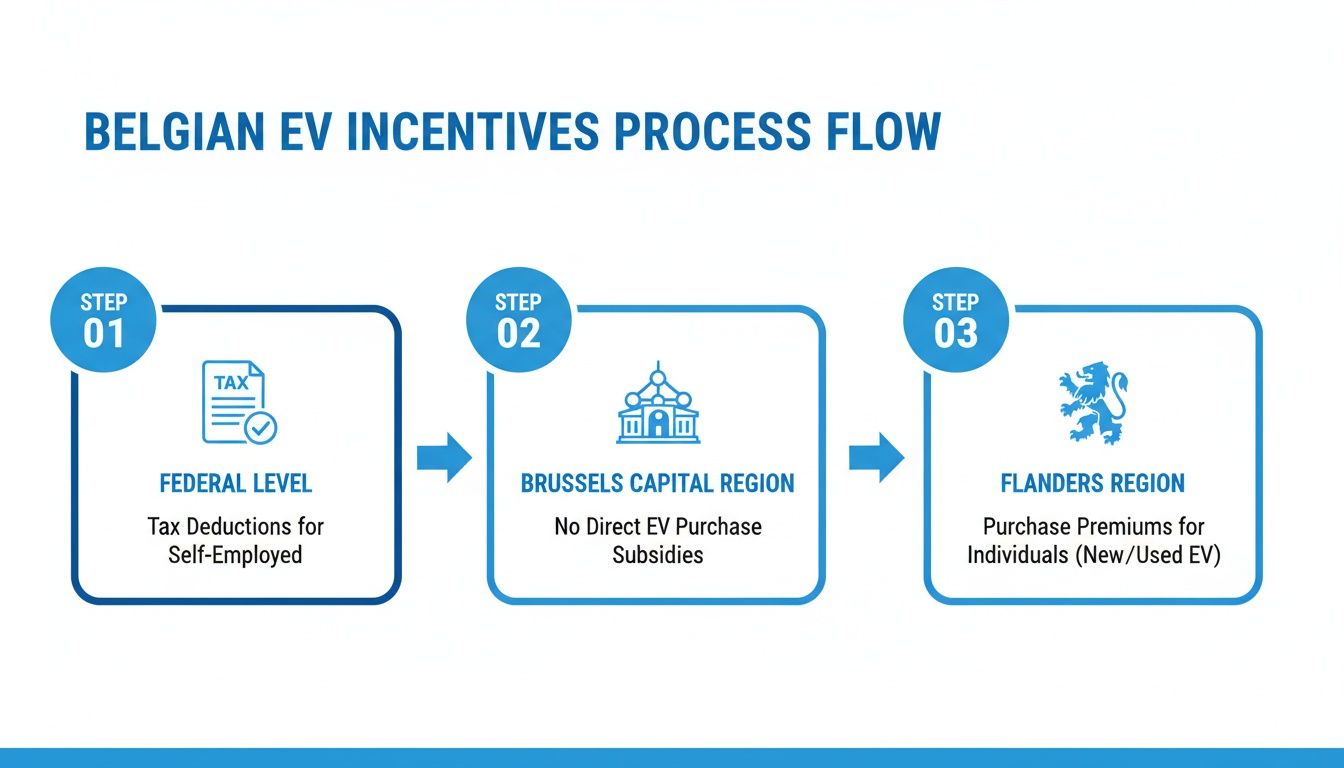
As you can see, by strategically utilizing federal and regional support, companies can significantly reduce the initial investment in their charging infrastructure.
Phase 2: Selection of Hardware and Software
With a solid plan, it is time to choose the right equipment. Here, we tailor the technology to your needs. Do you need slow charging overnight for your fleet, or are you looking for fast charging for visitors? The answer determines whether we opt for AC or DC chargers.
Equally important is the management software. This is the brain of the entire operation. With it, you can see who is loading, manage access for different groups (such as staff versus the public), and handle billing automatically.It is the key to keeping everything under control.
Phase 3: Physical Installation and Earthworks
Now the plan is becoming a reality. Our certified electricians and installation partners roll up their sleeves and take care of every part of the physical installation, from applying for permits to connecting the last wires.
The main activities here are:
- Permit applications: We handle all the paperwork to ensure that your installation complies with all local regulations.
- Earthworks and Excavation: If new cabling is required, this is done with absolute precision. Excavation work requires a responsible approach, which is why we always follow best practices for safely digging near utilities.
- Assembly and Wiring: The chargers are physically installed – on walls or poles – and securely connected to your electrical system.
Our Promise: Professional installation is non-negotiable. We work only with certified experts to guarantee that your charging stations are installed safely, efficiently, and in full compliance with all Belgian standards.
Phase 4: Commissioning and Go-Live
The final hurdle is commissioning. This is more than just flipping a switch. It involves methodically bringing your new chargers online, testing them thoroughly, and ensuring they integrate perfectly with the management platform.
We check whether every charger communicates with the software, whether the payment systems are working, and whether your team knows exactly how to use the system. Once all of that is done, your charging hub is officially operational. To see what this looks like in practice, you can read about the implementation of charging infrastructure for Nippon Gases.
Calculate the Costs and Return of Your Investment
A successful charging project for your company stands or falls with a solid financial plan. It is tempting to look only at the purchase price, but the real calculation goes much deeper. By correctly estimating the costs and benefits over the entire lifespan, you lay the foundation for a rock-solid return on your investment (ROI).
The financial picture of charging stations for businesses is actually twofold: you have the initial investment and the ongoing operational costs. Together, these form the Total Cost of Ownership, in other words, the TCO.
Mapping out the Initial Investment
The initial expense is more than just the charging station itself. A clear overview of all start-up costs is crucial to avoid surprises.
Usually, your start-up costs consist of these three components:
- Hardware: This is the price of the AC or DC chargers themselves, together with the necessary mounting material and any charging cables.
- Installation: Consider preparatory studies, any excavation work, the cabling from the distribution panel to the charging points, and, of course, the labor costs of the certified installer.
- Software: The license fees for the management platform. This is the software you use to monitor charging sessions, set rates, and track consumption.
Those costs can be quite substantial at the beginning, causing some companies to hesitate. Fortunately, there are flexible models that significantly lower this barrier.
Two Financial Models Compared: CapEx vs.OpEx
At its core, you have two ways to finance your charging infrastructure: you purchase everything outright (CapEx) or you opt for a subscription model (OpEx), which we often Charging-as-a-Service (CaaS) to call it.
| Financial Model | Direct Purchase (CapEx) | Charging-as-a-Service (OpEx) |
|---|---|---|
| Investment | High one-time upfront investment. | No or low start-up costs; a predictable monthly contribution. |
| Property | You are the owner of the hardware. | Blulinc remains the owner and bears the responsibility. |
| Maintenance | You are responsible for maintenance and repairs yourself. | Fully included in the monthly price. No worries. |
| Balance | The assets appear on your balance sheet and are depreciable. | The costs are booked as an operating expense. |
| Flexibility | Less flexible in the face of technological evolutions. | Easily scale up or down and grow with new technology. |
For many Belgian SMEs, Blulinc’s CaaS model is a real godsend. It eliminates that large initial investment and replaces it with a manageable, predictable operational cost. This allows you to start offering charging facilities immediately, without taking a hit to your cash flow.
From Expense to Source of Income
Your charging stations don't have to be a pure expense. In fact, they can become a new source of revenue. By opening your charging points to the public—for example, outside office hours—you create an additional revenue stream. With a smart management platform, you can easily set a rate for external users, while your employees can charge for free or at a more favorable rate.
The potential of this only becomes truly clear when we look at large-scale projects in Belgium. Take, for instance, EnergyVision's contract to achieve no less than by 2032 2,500 AC charging stations to install in NMBS car parks. This ten-year project, which includes installation, financing, and operation, perfectly demonstrates how profitable long-term investments in publicly accessible charging infrastructure can be.
The return on your charging infrastructure is more than just direct revenue. Consider also the indirect benefits, such as an enhanced sustainability image and attracting top talent, which further increase the value of your investment.
When assessing the financial feasibility of your project, specialized tools can be of enormous help in estimating your potential ROI. It is comparable to using a solar return on investment calculator. Although that tool is aimed at solar energy, it perfectly illustrates the principles of an efficiency calculation.
Would you like to get a crystal-clear picture of the costs and revenues for your specific situation? Request a free consultation, Then we will make a detailed, customized calculation together.
So, why choose Blulinc?
Choosing the right hardware for your charging stations for businesses is one thing, but finding the right partner? That makes the difference between a project that just works and a project that is successful for years.
Your switch to e-mobility is not just about installing chargers.It involves navigating complex regulations, managing a significant investment, and thinking ahead. At Blulinc, we have structured our entire service offering to make this journey easier for you. Think of us less as a supplier and more as your dedicated guide, from the initial sketch to final commissioning.
We understand the challenges because we solve them every day. Our entire approach is aimed at providing you with a complete, stress-free solution that tackles every piece of the puzzle.
A Complete Solution, Tailored to Your Company
What truly sets us apart is how we bring everything together. We have combined smart technology with flexible financial models to take the headache out of the process.
With Blulinc you get:
- A Powerful Management Platform: Our software is simple and gives you real-time control over everything. You can see who charges when, set different rates for employees versus the public, and request clear reports – all from one central location.
- A Flexible CaaS model: High start-up costs can be a major hurdle. Our Charging-as-a-Service (CaaS) model removes that barrier. Instead of a massive capital investment, you pay a predictable monthly fee that covers the hardware, installation, software, and all maintenance. It neatly shifts costs from heavy CapEx to simple, manageable OpEx.
- An Extensive Public Network: The Blulinc charging card gives your drivers access to more than 900,000+ public charging points throughout Europe. This means they can recharge wherever the road takes them, without problems.
Expertise You Can Build On
We have been doing this for a while. With more than 15 years of combined experience we have successfully guided numerous companies through their transition to electric driving. We have more than 200 companies like yours helped to implement smart, scalable charging solutions.
We are proud of the successful projects we have delivered for well-known names such as Brody and Nippon Gases. That practical experience means we know what to look out for and how to ensure your installation runs smoothly.
We are not just a supplier. We sincerely see ourselves as your long-term partner. Our goal is to build a charging setup that fits you perfectly today and has the flexibility to grow with you tomorrow.
Ready to take the next step with a partner you can trust?
Request a free consultation, and let's plan your future-proof charging strategy together.
Frequently Asked Questions
You have questions, and that is a good sign. It means you are taking this seriously. Here are some of the most common questions we hear from companies looking to install charging points, along with clear answers to help you move forward with confidence.
How Much Power Do I Need for Commercial Charging Stations?
This really depends on how many chargers you want and what type they are. A standard AC charger – the type that is perfect for topping up at work during the day – has its own separate 32A required circuit. DC fast chargers, on the other hand, are a completely different story and require a much more powerful three-phase power supply.
That is why a professional site analysis is not just a good idea; it is the essential first step. It tells us exactly what your current electrical installation can handle and points out any upgrades needed to keep your charging infrastructure running safely and smoothly.
Can I Set Different Rates for My Staff and the Public?
Absolutely. A smart charging management platform, such as Blulinc's, gives you full flexibility to create different user groups and tariff plans. This is essential for properly managing your charging points.
For example, you can set:
- Free loading for your employees as an attractive benefit.
- A reduced rate for registered visitors or important customers, to offer them something extra.
- A standard public rate for everyone else, making your parking lot a new source of income.
You can manage all of this from one central dashboard. It gives you full control over who charges, when, and at what price.
What Happens If a Charging Station Becomes Defective?
Reliability is everything. An out-of-service charger leads to frustrated operators and headaches for your business operations. That is precisely why a good partner like Blulinc offers remote monitoring and support. We can diagnose and resolve most software issues remotely within minutes, without anyone needing to be on-site.
For hardware problems, a solid service plan is your safety net. This guarantees on-site maintenance and repairs, so that your charging stations for the company be operational as much as possible.
How Long Does the Entire Installation Process Take?
The timeline can vary significantly, from a few weeks to several months. Everything depends on factors such as the processing time for permits, the complexity of the site, and whether grid reinforcements are required. A detailed project plan from your installation partner is crucial in this regard – it will outline all key milestones and give you a clear picture of the entire process.
Ready to take the next step in the electrification of your business? The Blulinc The team is ready to design a charging strategy that perfectly suits your needs.