

Let's be honest, the first question every new electric car owner in Belgium asks themselves is always the same: what are the real costs to charge an electric car at home? In short, you typically look at a cost between € 0,25 and € 0,35 per kWh. That is a world of difference compared to the prices at a public charging station. This means that you can fully charge your car for an amount between € 15 and € 25, depending on your energy tariff and your car battery.

Your Guide to Home Charging Costs in Belgium
Switching to an electric vehicle is more than an environmentally friendly choice; it is a strategic move for your budget. Getting a grip on the "costs of charging an electric car at home" is the first step to making that investment truly pay off. Don't worry, this is not a complex formula – it is simply a sum of a few clear factors that are within your control.
In this guide, we break down every piece of the puzzle that determines your total costs. We look not only at the price per kilowatt-hour (kWh) from your energy supplier, but also at the one-time investment in a charging station and the Belgian tax benefits that can significantly mitigate the initial outlay.
What Determines the Price?
View this article as your personal roadmap. We help you not only understand your charging costs, but also actively manage and optimize them. The key factors we will cover are:
- Your electricity tariff: The difference between a single rate, day/night rate, or dynamic rate has a huge impact.
- The initial investment: This includes the purchase and professional installation of your home charging station.
- Belgian tax benefits: We show you how the government helps you recoup your investment faster.
- Smart charging and consumption: The efficiency of your car and your charging habits directly affect your final bill.
Charging at home is so much more than just convenience. It is a financial leverage that gives you control over your mobility costs, especially with the unpredictable fuel prices in Belgium. By charging smartly, you can drastically reduce your annual expenses.
Imagine an SME in Antwerp with a fleet of ten electric company cars. By charging the vehicles at night at a cheaper night rate, the company saves thousands of euros annually compared to using public charging points. The same principle applies to you at home: every charging session at your own wallbox is a direct saving.
Let's delve deeper into the details so you know exactly where your money is going and how to make the most of every euro. First, here is a quick overview of the key cost factors.
Quick Overview of Home Charging Costs in Belgium (2026)
This table summarizes the key factors that influence the total cost of charging an electric vehicle at your home in Belgium.
| Cost factor | Average Cost Price (€) | Key Consideration |
|---|---|---|
| Energy price per kWh | € 0,25 - € 0,35 | Depending on your energy contract (fixed, variable, dynamic) and the time you charge. |
| Purchase Charging Station | € 600 - € 1.500 | Price is influenced by load capacity, brand, and smart features. |
| Installation costs | € 500 - € 2.000 | Including the official inspection, but excluding major modifications to your fuse box if necessary. |
| Tax Benefit (Individuals) | To € 450 (30%) | A tax reduction on the purchase and installation of a smart charging station, for an investment up to € 1.500. |
As you can see, the costs are a mix of one-off investments and ongoing operational expenses. However, with smart planning and by utilizing government incentives, the overall picture is very favorable.
Determine Your Actual Electricity Cost for Home Charging

The biggest factor influencing the cost of charging your electric car at home is, of course, your electricity price. However, to know the real figure, you must look beyond the rate on your bill and take a close look at your specific energy contract.
In Belgium, most of us have one of three types of tariffs. Each tariff changes the rules of the game for how and when best to charge your EV. Gaining insight into these contracts is your first real step toward control over your charging costs and realizing significant savings.
What energy tariff do you have?
The type of electricity contract you have directly determines when you need to plug in your car to get the best price. Let's take a look at the options you typically find in Belgium.
-
Single Rate: Nice and simple. You pay one fixed price per kWh, regardless of the time. This is predictable, but you miss the opportunity to save by charging when electricity is cheaper.
-
Day/Night rate: This contract gives you two different rates. You pay a higher price during peak hours (daytime) and a much lower price during off-peak hours (night and weekends). This is a fantastic setup for EV owners who can simply leave their car charging while they sleep.
-
Dynamic Rate: This is the smartest approach. Your electricity price changes every hour based on what happens in the energy market. With a smart charger, your car can automatically start charging when prices hit a low, which is often in the middle of the night or on very sunny or windy days.
Consider a dynamic rate as booking a flight. If you are flexible and can charge when demand is low, you secure the cheapest rates. The reduction in your monthly energy bill can be significant.
Research consistently shows that home charging is by far the most budget-friendly option for Belgian EV drivers. Looking ahead to 2026, electricity costs are expected to be somewhere between € 0,22 and € 0,30 per kWh will lie. For an average EV, that amounts to a cost price of only € 3,30 to € 4,50 for a full charge – a world of difference compared to public charging prices.
If you break this down per 100 kilometers driven, Belgian EV drivers give approximately € 5,93 out, which puts Belgium on the map as one of the most affordable places in Europe to drive an electric car.
Your Electricity Bill Analyzed
To find out what you Real when paying, you cannot simply look at the energy price. Your bill consists of three separate parts, and understanding them is the key to managing your home charging costs.
-
Energy cost: This is the base price per kWh from your energy supplier.This is the only part of the invoice where you have the power to shop around for a cheaper supplier or switch to a better rate.
-
Net costs: These costs come from your grid operator (such as Fluvius) for the service of bringing electricity to your home. In Flanders, this now includes the new capacity tariff, which is designed to reward you for spreading your energy consumption and avoiding major power peaks. Smart charging is your best friend here, as it helps keep these costs low.
-
Taxes and Levies: These are the various federal and regional taxes, including VAT and other surcharges, that are added to your final invoice.
To make optimal use of a dynamic tariff and the capacity tariff, you need a digital meter. If you have one, you can activate the P1 port to unlock its true potential. This small port allows your smart charger to read real-time data directly from your meter, so it knows exactly what the perfect, cheapest moment to charge is.
You can read more about this in our guide about how to activate the P1 port on your smart meter. By using these levers, you gain full control over what you spend on home charging.
Let's look beyond your daily energy bill for a moment. There is the one-time investment in your own charging station – often called a wallbox – to consider. Although it is an initial cost, think of it as laying the foundation for years of cheaper and easier driving. This smart move is what the costs for charging your electric car at home really brings it down in the long run.

The price tag of the charging station itself can vary. For a high-quality, reliable model, you should expect to pay an amount between € 600 and € 1.500. This range is due to some important differences between the models.
What Determines the Price of Your Charging Station?
Not all charging stations are created equal. The price is primarily determined by the charging capacity, the brand reputation, and the presence of smart features. These elements not only determine the purchase price; they also define how efficient and future-proof your installation will be.
-
Load capacity: The most common home charging stations are 11 kW and 22 kW. For most electric cars and home electrical installations, an 11 kW charger strikes the perfect balance between charging speed and cost. A 22 kW unit is faster but often requires a more expensive, upgraded grid connection, which is not a simple option for every home.
-
Brand and Quality: As with any other major purchase, you pay for reliability and durability. Established brands typically offer better warranties, more sophisticated software, and a sturdier construction that lasts for years.
-
Smart Features: A "smart" charging station can communicate with your digital meter, your solar panels, or a management platform. This unlocks features such as load balancing (which automatically adjusts the charging speed to prevent overloading of the home electricity grid) and automated reimbursement by your employer. This intelligence adds real, tangible value.
The Installation: A Practical Example
In addition to the hardware itself, there are the installation costs. These typically vary from € 500 to € 2.000, depending on the complexity of the job.This price covers the labor of the certified electrician, all necessary cabling, and the mandatory electrical inspection (the AREI inspection).
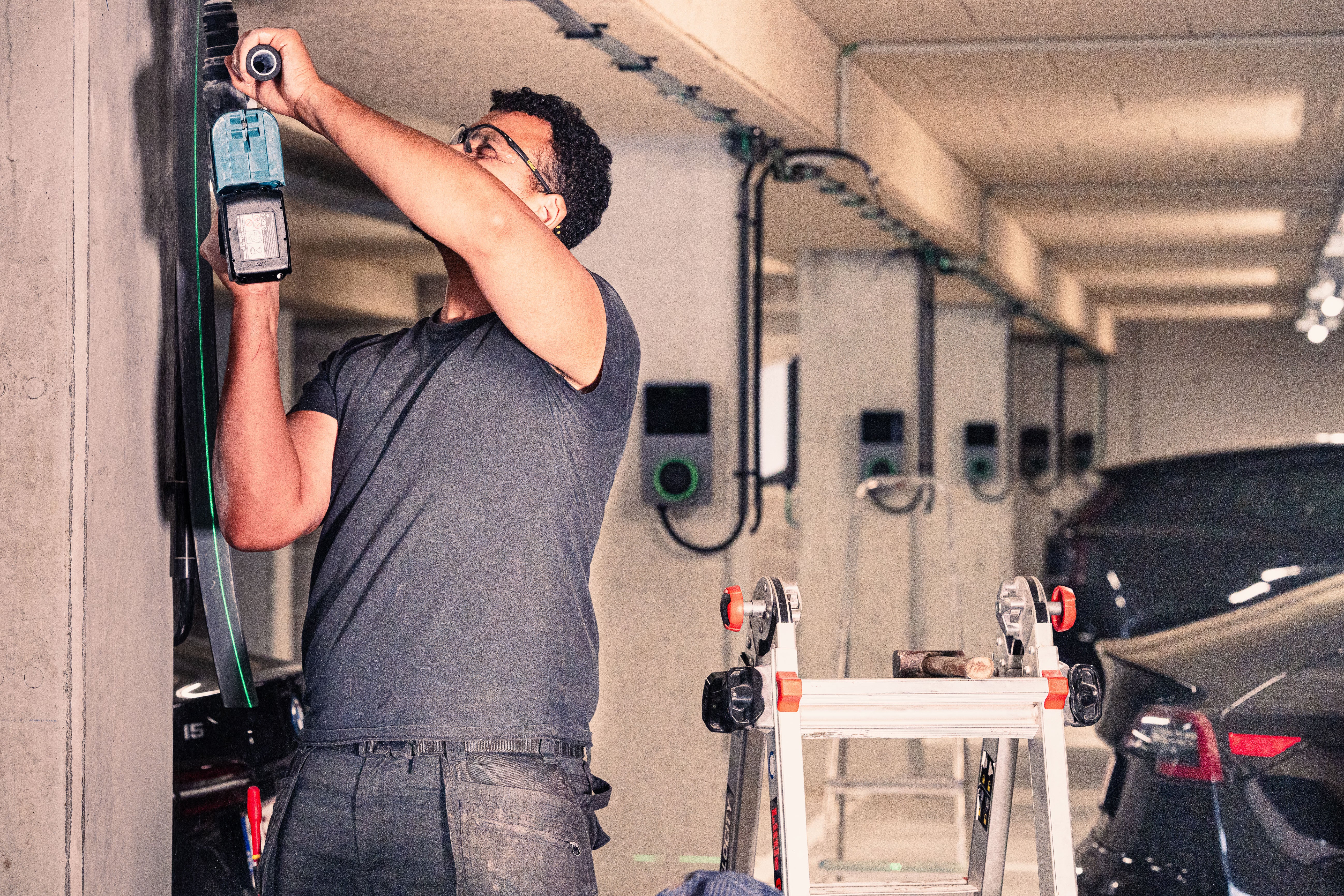
Let's walk through a typical scenario. Imagine a family in Ghent opts for a smart 11 kW charging station. This is what the installer does:
- Inspection: First, he checks the existing electrical panel (the fuse box). The installer determines that a new, separate circuit is required for the charger.
- Installation: He runs a new cable from the fuse box to the driveway, where the charger is mounted on the wall. A new circuit breaker and a type A residual current device (or type B, if required by the charger manufacturer) are added to the panel.
- Inspection: After the work has been completed, an independent inspector will visit to check whether everything has been installed in accordance with the strict Belgian safety standards. Without this positive inspection report, you are legally not permitted to use the charger.
This is absolutely not a do-it-yourself project. Professional installation by a certified expert is not only a legal requirement, it is what guarantees the safety of your home, your car, and your family.
The Tax Benefit in Belgium
The Belgian government lends you a hand here and encourages the switch with an attractive tax incentive. As a private individual, you can tax reduction of 30% receive on the purchase and installation of a smart charging station. This benefit is calculated on an amount up to a maximum € 1.500.
In practice, this means that you until € 450 you can reclaim on your investment via your tax return. The main condition is that it must be an "intelligent" charging station – one that can manage and track its energy consumption. This measure significantly lowers the effective costs of a home charging station and shortens the payback period.
Smart Charging and Reimbursement via Your Employer
If you drive a company car in Belgium, charging at home raises an important question: how do you get reimbursed for the electricity you consume? This is precisely where a "smart" charging station evolves from a simple convenience into an essential financial-technological tool. The real value lies in how it can automatically and accurately separate your car's power consumption from the rest of your household usage.
This system, that we split billing The secret to receiving a reimbursement from your employer without hassle or tax headaches is to mention this. It transforms what could be a nightmare of receipts and spreadsheets into a simple process that runs in the background. For most employees, the "costs of charging an electric car at home" become a non-issue as a result, since the company covers them.
How Exactly Does Automatic Refund Work?
The beauty of the system lies in its simplicity. A smart charging station is equipped with a calibrated MID-certified meter. Think of it as a separate, highly accurate electricity meter specifically for your car. It ensures that every kilowatt-hour is recorded with perfect precision.
That data is then securely sent to a management platform, such as the platform we manage here at Blulinc. Our system uses that information and handles the entire reimbursement process for your employer. It is a fully automated setup, both for you and for your company's finance department.
It all happens in three simple steps:
- Register: The charging station's MID meter records the exact amount of kWh used to charge your company car.
- Send: The consumption data is automatically forwarded to our central platform.
- Repay: Our platform calculates the costs based on the agreed rate and processes the payment, which typically appears on your next payslip or is issued as a separate refund.
What this means for you is no more manual expense reports, no more guesswork, and no more complicated calculations. The system creates a clear, verifiable overview that fully complies with Belgian tax legislation, giving both you and your employer total peace of mind.
A Quick Example in Brussels
Imagine an employee in Brussels coming home from work and plugging in his electric company car for the night. While he relaxes, the smart charging station does all the work.
- The car has 20 kWh needed to be fully charged again.
- The MID meter of the charging station records this exact consumption.
- The data is processed at the end of the month. With an agreed repayment rate of € 0,30 per kWh, becomes a total of € 6,00 (20 kWh x € 0,30) calculated for that one charging session.
- This amount is then automatically added to his next payslip as a non-taxable expense allowance.
The employee does not need to keep receipts or fill out forms. The entire system is built for convenience and accuracy, ensuring that "costs for charging an electric car at home" are reimbursed fairly and correctly, without administrative hassle.
This technology is becoming a cornerstone of modern corporate mobility in Belgium. It enables companies to offer home charging as a fantastic benefit, and employees start every day with a full battery, knowing that the costs are fully covered. For a more in-depth look at the details, check out our guide on Split billing and VAT rules for employee refunds. It is a system where everyone wins.
Comparison: Home Charging vs. Public Charging
To get the full financial picture, we need to compare the costs of charging at home with what you would pay at a public charging station in Belgium. While plugging in at home is your convenient daily solution, the public network is your lifeline for longer journeys. Understanding the difference in costs underscores the powerful value of having your own charging point.
Simply put: charging at home is almost always the most affordable way to power your EV. The price you pay is directly linked to your personal energy contract, which you can adjust to benefit from the lowest rates. Public charging, on the other hand, entails a different set of costs that are passed on to you, the driver.
Why is Public Loading More Expensive?
The higher price you see at a public charging station is not just about profit. Operators have significant overhead costs to cover, which are naturally factored into their price per kWh.
Look at it this way:
- Infrastructure costs: The hardware for public stations, particularly the DC fast chargers you see along highways, is much more expensive than a home charging station. This also includes the costs of land, heavy grid connections, and ongoing maintenance.
- Operational Costs: Someone has to manage the billing, customer service, and the software platforms that keep everything running. All these matters entail operational costs.
- Location premiums: A charging station in a prime location along the highway has much higher rental and installation costs than one in a municipal parking garage, and this is reflected in the price.
- Profit margins: Ultimately, charge station operators (CPOs) are commercial companies. They must make a profit to stay afloat and expand their networks.
Here, the financial benefit of charging at home becomes crystal clear. Every time you plug in at home, you bypass all these extra layers of costs and pay only for the pure energy you consume at your household rate.
Cost Comparison Home vs. Public Charging per kWh in Belgium (2026)
The table below gives you a clear picture of the typical price differences you will encounter as an EV driver in Belgium. It is a quick and simple way to see how much you can save by making home charging your primary method.
| Charging method | Average cost per kWh (€) | Ideal For |
|---|---|---|
| Home Charging (Off-peak hours/Night) | € 0,25 - € 0,30 | Charge daily, top up overnight, and realize maximum savings. |
| Home Charging (Peak Hours/Day) | € 0,30 - € 0,40 | Charging when charging during off-peak hours is not an option; still much cheaper than public charging. |
| Public AC Charging (City/Street) | € 0,45 - € 0,65 | Recharge during work, shopping, or a visit to a city center. |
| Public DC Fast Charging (Highway) | € 0,65 - € 0,85+ | Fast charging during long journeys when speed is the priority. |
As you can see, the savings from charging at home, especially at night, are significant. It reinforces the idea of your home as your personal, low-cost "gas station".
The infographic below shows the simple, three-step process that makes home charging and employer reimbursement so efficient. It all revolves around registering usage, sending the data, and automatically processing the payment.

This automated flow is a game changer for employees with a company car. It ensures that they are accurately reimbursed for the electricity consumed, making the costs of charging at home a net-zero operation for them.
The conclusion is simple: your garage becomes your personal, cheap gas station. By using it for the 90% of the charging sessions that take place at night make a huge difference to your annual operating costs. Public charging stations are the essential, albeit more expensive, solution for the remaining 10% when you are on the road.
The Belgian public network is expanding rapidly to perfectly support this model. In 2025 alone, the country's public and semi-public charging infrastructure grew by an impressive 23%, to a total of 106,677 units. This included an enormous increase in 57% in DC fast chargers above 150 kW, which shows a clear commitment to making long-distance travel by electric car easier.You can explore more data about this growth at the European Alternative Fuels Observatory.
We have looked at the numbers and the technology, but let's put all the pieces of the puzzle together. The number of electric vehicles on Belgian roads is exploding, the government is making the mobility budget mandatory from 2026, and the cost savings from home charging are undeniable. This is your chance to lead the way.
The shift to electric driving in Belgium is accelerating at a pace never seen before. Sales of battery-electric vehicles (BEVs) experienced explosive growth, from approximately 38,000 cars sold in 2022 to nearly 93,000 in 2023. That is a stunning increase of more than 144% in just one year. This trend is only continuing and is enormously stimulating the demand for charging infrastructure. You can read more about this market evolution in this analysis of the Belgian EV market.
A Future-Proof Decision
Installing a home charging station is not just about saving money today; it is a strategic move to future-proof your mobility. The "costs of charging an electric car at home" are significantly lower than public charging or refueling, which will save you thousands of euros in the long run.
For homeowners, SMEs, and fleet managers, acting now is the key to success. By investing today, you ensure convenience, financial control, and a seamless transition to a fully electric future.
It is no longer a question or you will make the switch, but when. Those who invest in their own charging solution now will reap the benefits for years to come, both financially and practically.
Ensure Your Convenience and Control
Imagine: no more detours to a public charging point or waiting for a station to become available. You start every day with a full battery, charged at the lowest possible rate. That is the reality of home charging.
It becomes even more interesting for employers. From 2026, every employer offering company cars is required to provide a mobility budget. This budget gives employees the freedom to choose sustainable alternatives, including electric vehicles. A dedicated charging network for your employees, both at home and at the office, will become an essential part of a modern and attractive compensation package.
This guide has shown you the 'how' and 'why'. The next step is to discover how these savings apply specifically to your situation. We invite you to see what a personalized plan might look like for you.
Frequently Asked Questions about Home Charging Costs
We have covered the key building blocks of home charging costs, but you may still have some questions. It is a fascinating world, that of e-mobility, and it is normal that you want to know all the details.
Here are some practical answers to the most common questions we hear from new and future EV drivers across Belgium.
Do I need to upgrade my home's electrical installation?
Not always. Many modern homes are already equipped to a standard 11 kW to be able to charge the charger without major modifications. However, a professional inspection of your installation is not just a good idea – it is indispensable for safety and compliance.
A certified electrician will carefully inspect your electrical panel (your 'fuse box') to confirm that it can handle the sustained power demand of an EV charger.If an upgrade is necessary, he will outline the best approach, whether that involves installing a separate circuit or arranging a capacity increase with the grid operator, Fluvius. At Blulinc, this assessment is a core part of our process to guarantee a safe and reliable installation every time.
Can I Just Use a Normal Wall Socket to Charge?
Although it is technically possible with a special Mode 2 cable, we strongly advise against relying on a standard wall outlet for your daily charging needs. Firstly, it is incredibly slow; you would need more than 24 hours can wait for a full load.
More importantly, it poses a serious fire risk. Your outlets are simply not designed to handle such high power for hours on end. A specific charging station is not only to 10 times faster, but is also packed with essential safety features that protect your home, your car, and your peace of mind.
Consider a power outlet as a spare wheel – it is only there for emergencies. For daily use, a dedicated home charging station is the only safe and practical choice.
How Do Solar Panels Affect My Charging Costs?
For EV owners, solar panels are a complete game changer. They give you the opportunity to charge your car with your own, self-generated green power, which can reduce your charging costs to almost zero during sunny periods.
A smart charging station can even be programmed to prioritize the use of your solar energy before drawing power from the grid. This setup maximizes your self-sufficiency and makes a huge difference to the net. costs for charging your electric car at home. Combining an EV with a solar panel installation is one of the smartest financial moves you can make for your home or business today.
Ready to see what a state-of-the-art home charging solution would look like for you? Blulinc offers expert advice and an end-to-end installation, tailored to your exact situation.