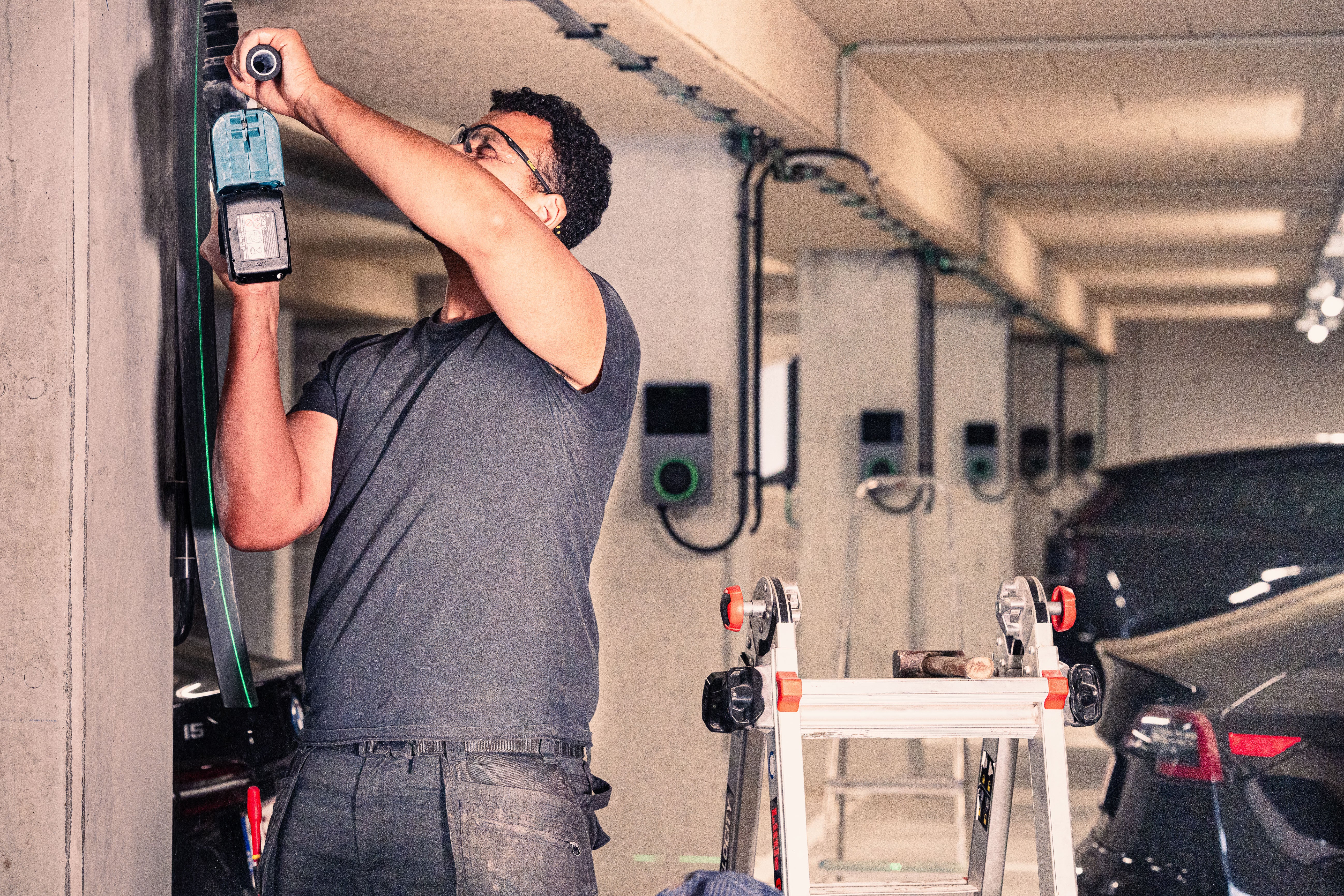


Have you noticed it too? There are more and more electric cars in your company car park. You are certainly not alone. Beyond the question Why if you were to invest in charging infrastructure, this guide focuses on the how. In Belgium, installing a charging station for an electric car is no longer a perk for employees, but a strategic necessity.
Why smart charging is now essential for Belgian companies

The transition to electric driving has gained momentum in Belgium. Offering reliable charging stations at work is gradually becoming as commonplace as Wi-Fi. The question is no longer or your employees and customers need charging points, but rather when and how many.
This rapid evolution is fueled by various factors that directly impact your business. Consider, for example, attracting and retaining talent, achieving sustainability goals, and future-proofing your mobility policy. Ignoring this trend is no longer really an option; it is an opportunity to position your company as a progressive and attractive employer.
The figures speak for themselves.
The demand for charging infrastructure is fueled by an explosive growth of electric vehicles. In 2023, the number of fully electric vehicles (BEVs) in Belgium rose to around 190,000, a substantial increase of 111% compared to the 90,000 in 2022.
Trade association EV Belgium predicts that there will be nearly 2 million electric vehicles in our country by 2030. This means that 20,000 to 30,000 new charging points must be added annually to meet that demand.
Take, for instance, an SME in Ghent with 10 company cars that are going electric. Installing charging points is no longer a luxury. It guarantees that the fleet is fully charged and operational every morning, without being dependent on public charging networks that are often occupied or more expensive.
More than just a plug
The decision to install charging stations goes much further than simply providing power. It is a smart investment that touches various aspects of your business:
- Sustainability objectives: It makes the transition to a green fleet easier and reduces your company's CO₂ footprint. A good understanding of green energy and business decarbonization is a crucial first step in this process.
- Employer appeal: For a growing number of employees, the ability to charge at work is a decisive factor when choosing an employer.
- Operational efficiency: By choosing smart charging solutions, you maintain control over charging costs and optimize your building's energy consumption.
This guide provides a clear step-by-step plan. We make the complex process of planning, regulations, and installation manageable, so that you can make informed decisions for your business.
Checklist for the analysis of your site
Before you even consider installing a charging station, a thorough analysis of your location is essential. This is the crucial first step that lays the foundation for a successful project and helps you avoid costly surprises later on. Think of it as the blueprint for a solid charging infrastructure.
A successful installation does not start with choosing a charging station, but with an in-depth analysis of your current electrical installation. This process helps you determine what is technically feasible, find the best locations, and draw up a realistic budget.

Evaluate your electrical capacity
The crucial question here is: can your current electrical system handle the extra load from charging stations? Most commercial buildings are simply not designed for the constant, high power demand of multiple chargers.
Start by checking your main connection and the fuse box. A qualified electrician can tax analysis to carry out to determine how much reserve capacity you actually have. This entails measuring your building's peak consumption and comparing it to the maximum capacity of your grid connection.
Suppose you have a 3x80A connection, but your peak consumption already reaches 3x60A. In that case, very little room remains for multiple charging stations without smart solutions or an upgrade to your grid connection. And be warned: an upgrade via Fluvius (in Flanders) or another grid operator can take weeks, or even months, and entails significant costs.
Determine the optimal locations for the charging points
Finding the ideal location for a charging station is a balancing act between ease of use, installation costs, and future-proofing. You need to weigh a few factors:
- Distance to the fuse box: The shorter the distance, the lower the costs for cabling and excavation. Every extra meter of cable drives up the final bill.
- User experience: Place the charging stations in logical, well-lit parking spaces where employees and visitors can easily access them. Take into account the daily traffic flow in your parking lot.
- Future expansion: Don't just plan for today, but also think about the next five years. Ensure sufficient space and consider laying empty conduit pipes now for future charging stations to avoid having to excavate the parking lot again.
- Signal strength: Smart charging stations require a stable internet connection (Wi-Fi, 4G, or Ethernet). Check the signal strength at the proposed locations to avoid communication problems later.
It can be tempting to place a charging station directly next to the entrance for visibility, but if your fuse box is on the other side of the building, excavation and cabling costs can unnecessarily drive up the project price. Sometimes, a less visible but technically smarter location is much more cost-effective.
A detailed site analysis is crucial for every charging project. This table provides an overview of the key considerations, specifically for Belgian companies, to guarantee a smooth and successful installation.
| Analysis area | Important considerations for Belgian companies | Potential pitfalls |
|---|---|---|
| Grid connection | Check the capacity with your grid operator (e.g. Fluvius). Is it 3-phase? What is the current rating (e.g. 3x40A, 3x63A)? | Single-phase connection, low current, or a connection that is already approaching its peak load. |
| Fuse box | Is there physical space for new circuit breakers? Is the cabinet modern and compliant with AREI standards? | Old or full cabinets, signs of wear, or non-compliant wiring. |
| Cable routes | How far is the cabinet from the parking spaces? Do you have to go through concrete, asphalt, or green areas? | Long distances (>50m), complex excavation works, or crossings with public domain. |
| Parking layout | Are the places clearly marked and accessible? Is there protection against collisions (e.g.posts)? | Tight spaces, heavy traffic, or lack of lighting and security. |
| Connectivity | Is there stable Wi-Fi or 4G coverage for smart charging functions? Is an Ethernet cable feasible? | Dead zones with a poor mobile signal or weak Wi-Fi that does not reach the parking lot. |
By carefully considering these factors, you can anticipate challenges and plan a more robust and cost-efficient charging infrastructure from the start.
The right questions for your installer
When you hire an electrician or a specialized partner like Blulinc, be prepared. A good partner will ask proactive questions, but your own list helps steer the conversation:
- Is my current grid connection sufficient for the number of charging stations I want now and in the future? This is the core question that determines the complexity and costs of your project.
- What impact does the installation have on my existing electrical system, and is a new AREI inspection required? Any significant modification to your installation requires a new inspection.
- Which smart charging solutions (such as load balancing) do you recommend to avoid an expensive upgrade of the grid connection? Load balancing intelligently distributes the available power across the active chargers, often making an expensive upgrade unnecessary.
- What are the estimated costs for the excavation, cabling, and the installation itself? Always ask for a detailed quote in which every component is broken down.
After the site analysis, an accurate quotation for the electrical work is of the utmost importance. Tools such as Exayard electrical estimating software can help companies meticulously plan and budget the wiring, components, and labor for the installation of charging stations. This ensures transparency and prevents financial surprises. By carefully going through these preparatory steps, you lay a solid foundation for an efficient and cost-effective charging infrastructure.
Navigating Belgian rules and financial benefits
Installing a charging station is more than just choosing the right hardware. You also need to understand local Belgian regulations, from municipal permits to strict electrical standards. If you handle this correctly, the entire project will run smoothly. The good news? The government offers substantial financial incentives to make this investment much less burdensome.
If you understand these rules and subsidies from the start, you avoid headaches and delays, and maximize your return. It may seem a bit complicated at first, but once broken down, there is a clear path for every Belgian company.
Getting the green light: permits and conformity
Before even a single cable is laid, your first stop is the municipality. While a simple wallbox on a private driveway often goes unnoticed, larger projects—especially those involving earthworks or publicly accessible charging stations—almost certainly require a permit. Therefore, always check with your local authority first to avoid potential fines.
Then there is the most important rule: every electrical installation in Belgium must meet the AREI (General Regulations on Electrical InstallationsThis is non-negotiable. Every time you modify your main fuse box, which is standard when installing a charging station, the law requires a new inspection by a recognized body. That is why working with a certified installer is so crucial; they guarantee that the work complies with the standards, ensuring you pass the inspection smoothly.
Federal and regional support measures
The Belgian government actively encourages companies to invest in charging infrastructure with very attractive tax benefits. These are designed to accelerate the transition to electric mobility and can significantly reduce your initial investment.
The most important federal stimulus is a increased cost deduction for the installation of smart, publicly accessible charging stations. The rules have been adjusted, so pay close attention to the deadlines:
- Installation before August 31, 2024: Your company can claim a tax deduction of 150% claim on the depreciation of the investment.
- From September 1, 2024 to December 31, 2026: This deduction drops back to 100%.
To qualify, the charging station must be "intelligent"—meaning it can transmit its status and usage data—and be available to third parties, at least during or just outside your normal business hours. For a deeper insight into these tax benefits, learn more about how EV charging stations are tax-deductible in our detailed guide.
Main conclusion: Timing is everything. Acting before the end of August 2024 secures that much higher tax deduction, which makes the business case for installing a charging station incredibly strong.
A concrete example: a Flemish SME
Let's put this into practice. Imagine a medium-sized company in Flanders. They decide to install four smart, 22 kW charging points in their car park and make them publicly accessible when the office is closed. The total cost for hardware, installation, and inspection amounts to € 20.000.
If they complete the project by August 2024, the company can the 150% apply tax deduction. That means that they € 30.000 (€ 20.000 can deduct x 150%) from their taxable profit. With a corporate tax rate of 25%, this results in a net tax saving of € 7.500 (€ 30.000 x 25%). Suddenly, the net cost of the project drops from € 20.000 to only € 12.500.
In addition to federal support, do not forget regional or local subsidies. The Flemish, Walloon, and Brussels-Capital Regions sometimes offer their own grants, particularly for projects that contribute to the public charging network. You can often combine these with federal benefits, further shortening your payback period. With a little strategic planning, what appears to be a regulatory hurdle can turn into a very smart financial move.
Choosing the right charging hardware and software
The technology you choose today lays the foundation for the charging experience of years to come. It is therefore crucial to look beyond just the physical charging station. You are building a complete, future-proof charging ecosystem, and the right mix of hardware and software is the key to efficiency, control, and a smooth experience for every user.
Everything starts with the hardware. It is important to understand the distinction between the two main types of chargers, as each serves a very different purpose. Your choice depends entirely on how the charging points will be used: for cars that remain parked for hours or for a fast throughput.
AC chargers vs. DC fast chargers
For most company car parks, the AC charger (alternating current), Also known as a Level 2 charger, the most logical choice. These chargers are perfect for employees who park their car for the entire workday.
- Assets: They usually deliver between 11 kW and 22 kW.
- Loading time: Ideal for fully charging a battery during an 8-hour workday.
- Costs: Both the purchase and the installation are significantly cheaper than with DC chargers.
- Application: Made for workplace and home charging, where carts stand still for hours.
At the other end of the spectrum, we find the DC fast chargers (direct current). These are the real powerhouses, designed for pure speed. They are a strategic choice for very specific scenarios.
- Assets: This varies from 50 kW up to 350 kW and more.
- Loading time: They can have a battery in 20 to 40 minutes to 80% to upload.
- Costs: The investment is significantly higher, not only for the hardware, but also for the heavier mains connection that is required.
- Application: Indispensable for commercial fleets that need to get back on the road quickly, or for public charging stations along busy traffic arteries.
Both types of charging points are experiencing remarkable growth in Belgium. The most recent figures show a huge leap in 2025. The number of AC charging points increased by 22% up to 99,341, while the number of powerful DC chargers (above 150 kW) even with 57% increased to 5,547. This evolution, together with Flanders' ambition to have a fast charger every 25 kilometers along motorways, clearly demonstrates the growing demand for both solutions. You can Discover more about the continued growth of the Belgian EV network.
The brain of the operation: the control system
A charging station is just the tip of the iceberg. The real potential is hidden in the software that controls everything: the Charge Point Management System (CPMS). This central platform is simply indispensable for every professional installation.
Without an intelligent CPMS, a charging station is little more than a glorified socket. The software gives you the control and insights needed to manage your charging infrastructure efficiently and profitably.
A powerful CPMS allows you to:
- To manage user access: Determine who can charge using charging cards (RFID cards) and set different access rights for employees, visitors, or the public.
- To set rates: You can offer free charging to employees, but set a commercial rate per kWh for external users to generate revenue.
- To be monitored in real time: Keep a close eye on consumption, the status of each charger, and charging sessions via an online dashboard.
- To implement smart features: Activate load balancing to intelligently distribute the available power. This way, you avoid an expensive upgrade of your grid connection.
This infographic provides an overview of the key steps involved in installing a charging station in Belgium, from permits to financial incentives.

The diagram makes it clear that a successful installation stands or falls with proper navigation through the specific regulations and technical and financial aspects of the Belgian market.
Consider flexible models
The initial investment in hardware and installation can take a significant bite out of your budget, especially for larger projects. Fortunately, flexible models exist that considerably lower the barrier.An increasingly popular model is Charging-as-a-Service (CaaS).
With a CaaS model, you pay a monthly fee to a partner such as Blulinc. In return, we take on the entire investment, installation, management, and maintenance. This has a number of clear advantages:
- No high start-up costs: You avoid a large capital outlay.
- Complete peace of mind: We take care of everything, from installation to maintenance and updates.
- Predictable costs: You work with a fixed monthly amount, which makes budgeting much easier.
This model is perfect for companies that want the benefits of charging infrastructure but not the burdens of ownership and management. This allows you to focus on your core activities, while we ensure that your charging network always performs optimally. Choosing the right hardware, software, and model is therefore a strategic decision that determines the efficiency, scalability, and return on your charging infrastructure in the long term.
What you can expect during installation and handover
The big day has arrived. You have done the planning, chosen the hardware, and now it is time to bring your charging station to life. Knowing what to expect during installation and commissioning can make the entire process much less intimidating and ensure that everything runs smoothly.
View it less as a simple delivery and more as a carefully managed project. It is about more than just attaching a cabinet to the wall; it is about creating a secure, compliant, and intelligent asset for your business. Let’s walk through what the day actually looks like.

From earthworks to electrical connections
First of all, the physical work often begins with earthworks. If your charging stations are located in a parking lot far from the main building, this means our team needs to carry out excavation work to safely lay the armored power and data cables underground. This is the foundation of the entire setup, so it is crucial that this is done correctly.
As soon as the earthworks are completed, the real work begins. electrical work. You will see our certified installers at work:
- They install new, separate circuit breakers in your main fuse box for each charging station.
- Next, they lay all the necessary cabling from that cabinet to the location of the charging stations.
- Finally, they mount the charging hardware securely, whether it is a sleek wall unit or a robust freestanding pole.
Working with installers who know the Belgian standards inside out is a must. They ensure that every connection complies with the AREI, which is non-negotiable for safety and your insurance.
The delivery process explained
As soon as the hardware is physically installed, we move on to the most critical phase: the delivery. Here, we transform a piece of hardware into a smart, integrated part of your business. It is not simply a matter of flipping a switch and hoping for the best.
The handover includes a whole series of technical checks and configurations. Our technician connects the charging stations to your chosen management software – the brain of the operation. This is what unlocks remote monitoring, user management, and smart charging capabilities.
A common mistake is rushing through the delivery phase.This is our chance to fine-tune load balancing to protect your grid connection, test payment systems with various charging cards, and set specific rates for employees versus public users. Doing this right from day one prevents so much headache in the future.
Imagine a logistics company in the Port of Antwerp with a fleet of 20 Electric delivery vans. They need every vehicle fully charged and ready for departure by 6 a.m. During delivery, we set up a smart charging schedule that tells the system to prioritize charging at night during the cheaper off-peak hours. This simple configuration can drastically reduce their electricity bill while simultaneously guaranteeing that the fleet is always ready for the morning shift.
Your handover and final checklist
The last puzzle piece is the transfer. Our installation partner will guide you through the entire system, hand over all documentation, and ensure your team is comfortable using everything. Do not sign anything until you are completely satisfied.
Here is a quick checklist of what you need to have on hand before we consider the job done:
- Warranty documentation: Clear details regarding the warranty for both the hardware and our installation work.
- User training: A solid demonstration for your key employees on how to use the loaders and the management platform.
- Contact details for support: You know exactly who to call for a technical problem or a quick question.
- Certificate of Conformity: The definitive AREI inspection certificate, which is your proof that the installation 100% is compliant and safe.
With this process completed, our team can leave your location knowing that you have a fully operational, secure, and optimized charging network that is ready for use.
Management and optimization of your charging network
Your charging stations have been installed and the physical work is done. So, job finished? Not quite. Now the real work begins: the transition from hardware installation to smart, daily management. This is where you create long-term value and transform your chargers from a simple facility into a valuable business asset.
Handling this properly means more than just keeping the power on. It is a delicate balance of proactive maintenance, smart pricing, and a firm grip on your energy consumption. Once you have mastered this, you guarantee high availability, keep your drivers satisfied, and maintain control over your operational costs.
Proactive maintenance for maximum availability
An out-of-service charging station is more than just an inconvenience. For drivers, it is a source of real frustration, and for you, it is lost revenue. That is why proactive maintenance is indispensable if you want a reliable network.
Modern, connected chargers are a huge help in this regard. They send real-time notifications as soon as a malfunction occurs, allowing us to often diagnose the problem remotely and even resolve it before your users are affected.
Of course, regular physical check-ups remain crucial. This means:
- Inspection of cables and connectors for signs of wear.
- Cleaning the units to maintain a professional, well-groomed appearance.
- Testing of software and payment systems to ensure that the user experience is always flawless.
High availability is not merely a technical metric; it is a direct reflection of your company's reliability. A well-maintained network builds trust among both employees and visitors and demonstrates that you seriously support their transition to electric mobility.
Develop a smart pricing strategy
Not all drivers are the same, so why should your pricing be one-size-fits-all? Your Charge Point Management System (CPMS) gives you the flexibility to create different tariff structures for different groups. This allows you to balance your costs, encourage specific charging behavior, and even tap into a new revenue stream.
For example, you can easily set up different user profiles:
- Staff: Offer charging at a reduced rate – or even for free – as a fantastic employee benefit.
- Visitors: Set a competitive public rate per kWh, allowing you to recover your electricity costs and potentially make a profit.
- Fleet: Implement specific rates for your own company fleet. This makes it easy to accurately track and allocate charging costs internally.
This level of control ensures that your charging infrastructure directly serves your business goals, whether it involves providing a valuable benefit to your team or creating a profitable, publicly accessible charging hub.
Save costs with smart energy management
This is where real optimization comes into play. Unattended charging, especially when multiple vehicles plug in simultaneously, can cause enormous spikes in your building's energy demand. In Belgium, these spikes can be much higher. capacity rate cause a rise on your energy bill, which can lead to sky-high costs.
This is exactly why dynamic load balancing is so essential.
Imagine this: a Belgian logistics company with a fleet of ten electric delivery vans and five employee cars. Everyone arrives and plugs in between 8 and 9 in the morning. Without smart management, that sudden demand could easily overload the site's grid capacity. The result? At best, a blown fuse; at worst, sky-high peak rates.
With dynamic load balancing, the system intelligently monitors the building's total energy consumption in real-time. It automatically adjusts the charging speed of each vehicle to ensure that total power consumption never exceeds a preset limit. Delivery vans might be given priority to ensure they are ready for deliveries, while employee cars charge slightly more slowly throughout the day. You can discover how dynamic load balancing works to avoid these expensive network upgrades.
This type of smart energy management transforms a potential cost into a highly efficient operation. By avoiding those peak rates and getting the most out of your existing grid connection, you drastically reduce total cost of ownership and ensure that your charging network operates as cost-effectively as possible.
Frequently Asked Questions
Are you diving into the world of business charging stations for the first time? Then you undoubtedly have a few questions. We have listed the most common questions Belgian companies ask us. This way, you are perfectly prepared and can take the next step with confidence.
How long does the installation of a business charging station take in Belgium?
The installation time can vary enormously.A simple wallbox at a location with ample electrical capacity? That can sometimes be installed in just a day or two. But the reality for a typical commercial installation involving multiple charging points, excavation work, and modifications to the fuse box is different. In this case, expect several weeks, from the initial audit to final delivery.
Also, do not forget the permit process with your municipality; this can affect the lead time. A realistic timeframe for a complete project, from start to finish, is therefore often 4 to 8 weeks.
What is load balancing and why is it important for my business?
Load balancing is a smart technology that dynamically distributes the available power at your location across all active charging stations. For example, suppose your grid connection has a limit of 50 kW, but ten cars are charging simultaneously. The system then automatically adjusts the charging speed per vehicle to prevent the fuses from blowing.
For every Belgian company that wants to install more than a handful of charging points, this is an absolute must. It saves you expensive upgrades to your grid connection and keeps energy costs under control.
Load balancing makes the difference between an exorbitantly expensive charging network and a cost-efficient, smart solution. You get the most out of your existing infrastructure, without unnecessary additional investments.
Can I generate income with my business charging stations?
Absolutely. With an advanced Charge Point Management System (CPMS), you set the rules yourself. You can set different rates for those who come to charge at your location. For example, give your own employees the option to charge for free, while setting a public rate per kWh for visitors or passers-by.
This way, you not only recoup your investment but also transform your parking lot into a potential new source of income.
Is an internet connection required for smart charging stations?
Yes, a stable internet connection (via Ethernet, Wi-Fi, or a 4G SIM card) is indispensable for every 'smart' function. This connection is the lifeline between your charging stations and the central management platform.
Without that connection, you cannot use crucial business features, such as:
- Payment processing
- Access control with charging cards
- Remote monitoring and management
- Dynamic load balancing
Although a basic charging session might still start offline, all features that offer real added value for your business are fully dependent on that online connection.
Ready to take the leap and prepare your business for the future with smart charging infrastructure? Our team of experts is ready to assist you. Request a free, no-obligation consultation with Blulinc and discover the perfect charging solution for your situation.