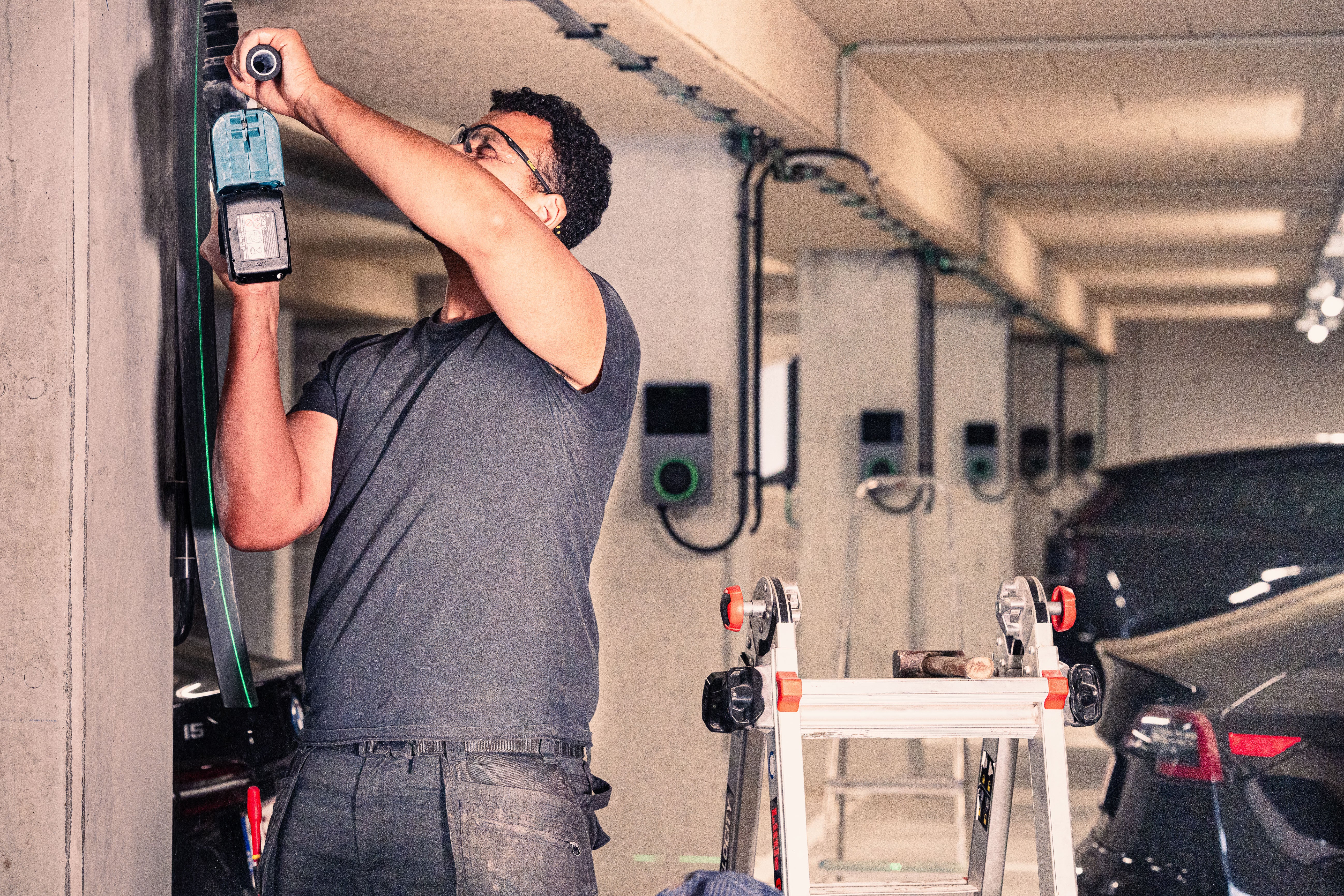


The switch to electric driving is a reality. The smartest, most efficient way to charge your car is simply at home, with your own charging point. Just imagine: leaving every day with a full battery, charging when it suits you, and at a much lower rate. That is the key to a carefree and affordable electric driving experience.
Why a home charging point is indispensable in Belgium

Welcome to the new era of mobility in Belgium. With the rapid rise of electric cars – especially as company cars – the question is no longer or you will charge, but how. In a short time, having your own charging point at home has evolved from a luxury extra to a daily necessity. The reasons are simple: pure convenience, significant cost savings, and reliability.
The growing need
The Belgian market for electric cars is growing exponentially, a trend strongly driven by the company car market. Thanks to favorable tax incentives and a growing focus on sustainability among companies, we are seeing a massive shift. The forecasts for 2025 are impressive: no fewer than 145,170 electric vehicles sold, an increase of 13.6% compared to 2024, resulting in a market share of 35%.
What really stands out here is that, by estimate, 89% of these battery-electric vehicles (BEVs) are company cars. These figures, which you can explore in more detail on the European Alternative Fuels Observatory, demonstrate that the demand for charging infrastructure is exploding. Public charging stations alone simply cannot keep up with this growth.
Practical convenience and cost savings
The absolute biggest advantage of having your own charging point? The unprecedented convenience. You never have to search for a free public charging station again or plan your day around charging times. You come home, plug in the car, and leave the next morning with a fully charged battery. It is that simple.
Charging at home is not only more convenient, it is also significantly cheaper. Electricity rates for private individuals are substantially lower than prices at public charging stations, especially when using the night rate.
A smart charging point, such as the solutions we offer at Blulinc, adds even more benefits to that:
- Automatic refund: As an employee with a company car, your charging costs at home are automatically and correctly settled with your employer. No more hassle with receipts and expense claims.
- Safety and speed: A professionally installed charging point is not only safer, but also charges your car much faster than a standard socket.
- Increase in the value of your home: A fixed charging installation is a real asset and is increasingly becoming a standard feature that increases the value of your home.
The combination of tax benefits for installation and lower daily costs makes investing in your own charging point financially very smart today. It is a choice that quickly pays for itself, both in terms of comfort and your wallet.
Your pre-installation checklist
Before you can enjoy the convenience of your own Home charging point, A little preparation is essential. By taking the right steps now, you ensure a smooth, safe, and cost-effective installation. Consider this checklist the foundation for a reliable charging system that will last for years.
First of all, we need to look at the electrical capacity of your home, or what we your mains connection to call.This determines the maximum amount of power your home can consume simultaneously, which has a direct impact on how quickly you can charge your car. Every professional installer will check this as the very first point.
At the same time, it is a good idea to familiarize yourself with your home's electrical safety systems. Know What to do if a residual current device trips is valuable knowledge for every homeowner, especially when adding a powerful new device such as an EV charger.
Understand your electrical connection
In Belgium, most homes have a single-phase or three-phase connection. That might sound technical, but the concept is simple and crucial for your charging speed.
- Single-phase connection: This is the standard in many Belgian homes, usually with assets of 40 amperes. With this, you can load up to 7.4 kW, which is more than enough to fully charge your battery overnight.
- Three-phase connection: This connection, which is more common in new-build homes or houses with heavy power consumers such as a heat pump, delivers more power. It enables charging speeds of 11 kW or even 22 kW possible, which significantly shortens your charging time.
Not sure which connection you have? Your electricity bill or digital meter will give you the answer. If you have a digital meter, you can also access this information directly. You can learn more about how to activates the P1 port of your digital meter for detailed insights. Of course, a professional installer can also determine this for you in an instant.
Choosing the perfect location
Where you place your charging point makes a big difference in your daily life. It is worth taking the time to think carefully about the most practical and logical location.
The ideal location is a balance between daily convenience and technical feasibility. Always take the distance to your fuse box into account, as a longer cable can increase installation costs.
Keep these points in mind when searching for a location:
- Your parking space: Where do you normally park? The charger must be located close to your car's charging port.
- Cable length: Ensure that the standard charging cable (usually 5 to 7.5 meterscan reach comfortably without stiffening or posing a tripping hazard.
- Weather protection: Although our loaders are built to withstand the elements, installation in a garage, carport, or under a canopy will help extend their lifespan.
- Thinking ahead: Are you considering a second electric car in the future? It is smart to take this into account now when planning your placement.
Engaging a certified Belgian installer for an on-site inspection is not just a good idea; it is an essential step. They will not only evaluate your electrical system but also advise you on the optimal location and ensure that the entire installation complies with the strict AREI safety standards. This lays a safe and efficient foundation for years of worry-free charging.
So you are ready to start charging at home. An excellent choice, but choosing the right charging point can seem overwhelming. Not all charging points for home After all, they are the same. Your final choice depends on your car, your driving style, and what your home's electrical system can handle.
Let's go over the options and find the perfect match for you.
Your first major decision is whether to choose a standard, functional charging point or a modern "smart" charger.A standard device is simple: you plug it in and it charges your car. A smart charger, on the other hand, connects to the internet, and that is where the magic really happens.
The power of smart charging
With a smart charger, you are in control. You get full control over when and how charges your car, all via an app on your phone. This isn't just about convenience; it's a serious cost saving. You can easily schedule charging during off-peak hours, when electricity rates in Belgium are lowest, and thus immediately lower your energy bill.
But perhaps the most important function is load balancing (or dynamic charge management). This smart feature monitors your home's total electricity consumption in real time. If you start using other energy-hungry appliances – such as the oven or washing machine – while your EV is charging, the system automatically slows down the charging process. This prevents you from overloading your home's main circuit.
Think of load balancing as an electrical safety net for your home. It protects your connection against outages and means you can often avoid an expensive upgrade to your main connection, even with a powerful charger.
The flowchart below shows you a simple path to check if your home is ready. It also shows when it is better to simply call in a professional.

As you can see, a quick assessment of your home's layout is the first step. But if you ever have any doubts, hiring a professional installer is always the safest and smartest move.
Smart charger versus standard charger
Although a standard charger may seem cheaper at first glance, a smart charger is an investment that pays for itself through efficiency, safety, and convenience. Here is a quick comparison.
| Function | Standard charger | Smart charger (Blulinc) |
|---|---|---|
| Planning | Manual plugging in and unplugging | Automatic charging during off-peak hours via an app. |
| Cost savings | None. Charges at the current rate when plugged in. | Significant savings through the use of cheaper off-peak electricity. |
| Load Balancing | No. Risk of overloading the home circuit. | Yes. Automatically adjusts power to prevent power outages. |
| Remote control | No | Start, stop, and monitor charging from anywhere via an app. |
| Energy insight | No insight into consumption. | Detailed reports on energy usage for cost management. |
| Refund | Manual follow-up and submission required. | Automatic reimbursement for company car drivers. |
Choosing a smart charger like a Blulinc device means making your home future-proof and getting the most out of your EV from day one.
Understanding load capacities
Chargers are also classified based on their power, measured in kilowatts (kW). Simply put, this number tells you how fast your car will charge.
- 3.7 kW to 7.4 kW: These are very common power ratings for homes with a single-phase connection and ideal for charging overnight.A 7.4 kW The charger gives you approximately 40-50 km range for every hour it is connected.
- 11 kW: This is the gold standard for most Belgian homes with a three-phase connection. It is the perfect balance for most modern EVs and ensures a full charge in approximately 6-8 hours.
- 22 kW: The fastest AC charging you can get at home. It requires a heavy-duty three-phase connection and, frankly, is often more power than needed for daily use. Not all cars can handle this speed.
For the vast majority of drivers, a 11 kW Smart charger: the perfect blend of speed, efficiency, and future-proofing. To discover what is best for your car and home, you can get a tailored recommendation with our EV charger calculator.
Charging-as-a-Service: a worry-free alternative
If you have a company car, we offer an even faster option. With Blulinc's Charging-as-a-Service (CaaS) with this model, you can completely skip the initial investment.
We take care of everything: the hardware, the professional installation, all ongoing maintenance, and even the automatic reimbursement of your charging costs by your employer. You get all the benefits of a premium smart charger at home, without the costs or the administration. It is the ultimate hands-off solution.
Insight into the costs and benefits in Belgium
Let's get straight to the point: what does installing a home charging point in Belgium really cost? To make a smart decision, you need the full financial picture – not just the purchase price, but also the long-term savings and tax benefits that can make it a surprisingly good investment.
Knowing the figures helps you budget correctly. The final cost is not a single amount; it is a combination of the charger itself, the installation work, and any modifications required to your home's electrical system.
A clear breakdown of what you pay
Normally, you can expect a complete installation of a home charging point between €1.500 and €3.000 costs. This amount covers the essential components to get you started:
-
The charger itself: The hardware is your first major expense. Although a simple, non-connected charger seems cheaper at first glance, we always steer our customers toward a smart charger. Why? Because features such as load balancing and automatic refund really save you money in the long run. A high-quality smart charger usually starts around €800.
-
Professional installation: This is not a do-it-yourself project. A certified installer is indispensable to guarantee that everything is safe and complies with Belgian regulations (the AREI). A standard installation can take between €700 and €1.500 costs, depending on how much work is required to run the wiring from your fuse box to your parking space.
-
Possible electrical upgrades: Sometimes an older person has fuse box simply not enough capacity for an EV charger. In that case, an upgrade may be necessary. Although this can cost a few hundred euros extra, it is crucial for safety. A smart charger with dynamic charge management can often help you avoid this extra cost.
It is easy to focus on the initial cost, but the true value of a home charging point only becomes clear when you factor in the fuel savings and the available tax benefits from the Belgian government.
Making optimal use of Belgian tax reductions
The Belgian government is strongly committed to electric driving and supports this with very attractive tax incentives. This can make a huge difference for both private individuals and companies.
As a private individual (this also includes sole proprietorships and liberal professions), you can receive a tax reduction for the purchase and installation of a smart charging station at home. Until August 31, 2024, you can 30% recover of the costs, with a maximum of €1.750 per charging point. After that date, the reduction will be adjusted to 15%. The most important conditions are that the charger must be "smart" (controllable by an energy management system) and run on green power.
For companies, the deal is even better. Companies can a 150% increased cost deduction claim for the installation of charging stations that are publicly accessible. This is a powerful incentive to expand the public charging network and a huge financial gain for companies that can open up their chargers to third parties.
Hassle-free reimbursement for company car drivers
What if you have a company car? The system is designed for total simplicity. Most employers use a "split-billing" model, where the electricity you consume at home to charge your company car is automatically tracked and reimbursed to you.
For example, an SME in Ghent with 10 company cars saves thousands of euros per year in administrative costs by automating this process. The fleet manager no longer has to process 10 separate expense reports, but receives one consolidated invoice.
This is where a system managed by Blulinc really comes into its own. Our platform takes all the administrative work off your hands.
- First, the smart charger accurately measures every kilowatt-hour consumed by your car.
- That data flows directly to our management platform. No more manual logs or complicated expense reports for you.
- At the end of the month, your employer receives a simple, clear invoice for electricity, and you are automatically reimbursed based on a pre-agreed rate.
It is a fully automated process that ensures you are reimbursed correctly and on time, without any headaches for you or your fleet manager. This is the cornerstone of the seamless home charging experience we proudly offer.
The Blulinc home charging experience

A Home charging point Installation isn't just about the hardware you mount on the wall. It's about creating a charging routine that feels effortless and fits perfectly into your daily life. At Blulinc, we've thought of every detail, from your initial inquiry to your daily charge. The process starts with a professional site survey to ensure the installation is perfectly tailored to your home.
As soon as your smart charger is installed, the real magic begins. We designed our entire system to take the hassle out of EV ownership, especially if you are a company car driver. Your command center for all of this? The Blulinc app.
Control and insight at your fingertips
The Blulinc app completely changes the way you manage your charging sessions. It gives you a crystal-clear, real-time overview of every session.From your phone you can:
- Start and stop charging remotely: No more late-night trips to the garage. Manage your charging session from the comfort of your armchair.
- Track your energy consumption: See exactly how many kilowatt-hours (kWh) you have consumed per session, day, or month.
- Monitor charging costs: The app automatically calculates the cost of each charge based on your electricity rate.
This kind of detailed tracking is the secret to simple and hassle-free expense management. For employees, the app automatically prepares all the data needed for reimbursement. Say goodbye to manual logs and cluttered spreadsheets.
Simplified management for employers
Our platform also provides fleet managers and employers with a powerful set of tools. A central dashboard offers a complete, real-time overview of all home charging sessions for the entire fleet. This significantly simplifies administration.
Imagine a fleet manager responsible for 50 employees who charge at home. Instead of sifting through 50 separate expense reports, he receives one consolidated, automated invoice from Blulinc. This drastically reduces the administrative burden and guarantees that every reimbursement is accurate and transparent.
Employers can also easily set up charging policies, manage their users, and monitor budgets. It ensures that the entire program remains cost-effective and easy to manage, even as your fleet grows.
One card for everything
The experience doesn't stop at your driveway. The same Blulinc charging card that activates your home charging point also gives you access to one of Europe's largest public charging networks, with more than 900,000 charging points.
Whether you are traveling for business or a weekend getaway, you can find, use, and pay for public charging with the same card and app. It is a fully connected ecosystem that connects your home, your workplace, and the public road into one seamless charging experience.
Your questions about home charging, answered
Are you considering a Home charging point? It is a smart move, but we know it raises many questions. Whether you are a homeowner looking to future-proof your property, an employee with a new company car, or a fleet manager planning a broader rollout, getting clear answers is the first step.
Here are some of the most common questions we hear from our customers throughout Belgium, along with clear answers from our team.
How long does an installation take?
For a standard installation, a certified professional can assist you in approximately two to five hours to help on your way. It's that simple.
Of course, every home is different. The final timing depends on factors such as the complexity of your electrical installation and the distance from the charger to your fuse box. If we need to carry out minor excavation work – such as a trench for the cabling – it may take a little longer. That is why we always start with a technical site survey. This enables us to provide you with a clear, transparent quotation and a realistic schedule before we begin, so there are no surprises on installation day.
What happens if I move?
Taking your charger with you is usually no problem at all. If you have purchased the hardware, a certified electrician can professionally uninstall it and then install it in your new home. It is a fairly routine job for them.
And if you use our Charging-as-a-Service (CaaS) model? Then it is even simpler.Just let us know that you are moving, and we will arrange the entire move as part of your service agreement. Your loading routine will not be interrupted for a single moment.
How does the electricity reimbursement for my company car work?
This is where a smart charging system truly proves its value. The Blulinc charger installed at your home accurately measures every kWh of electricity used to charge your company car. This data is then automatically and securely sent to our central management platform.
At the end of the month, we prepare a detailed invoice for your employer for the electricity consumed. We then arrange an automatic reimbursement that is transferred directly to you, based on a pre-agreed rate. This completely eliminates the need for manual expense reports and makes life easier for everyone.
Can I charge both a company car and a private EV on the same charger?
Absolutely. Our smart charging points are designed precisely for this situation. They can easily distinguish between different charging sessions.
All you need to do is use a different charging card or select a user profile in the Blulinc app. This tells the system whether a session is for your company car (which activates automatic reimbursement) or for your private EV. It keeps your professional and personal energy consumption completely separate, giving you total flexibility and accurate billing without any guesswork.
Ready to make home charging a reality? The experts from Blulinc are ready to guide you every step of the way, from initial advice to seamless installation and management.