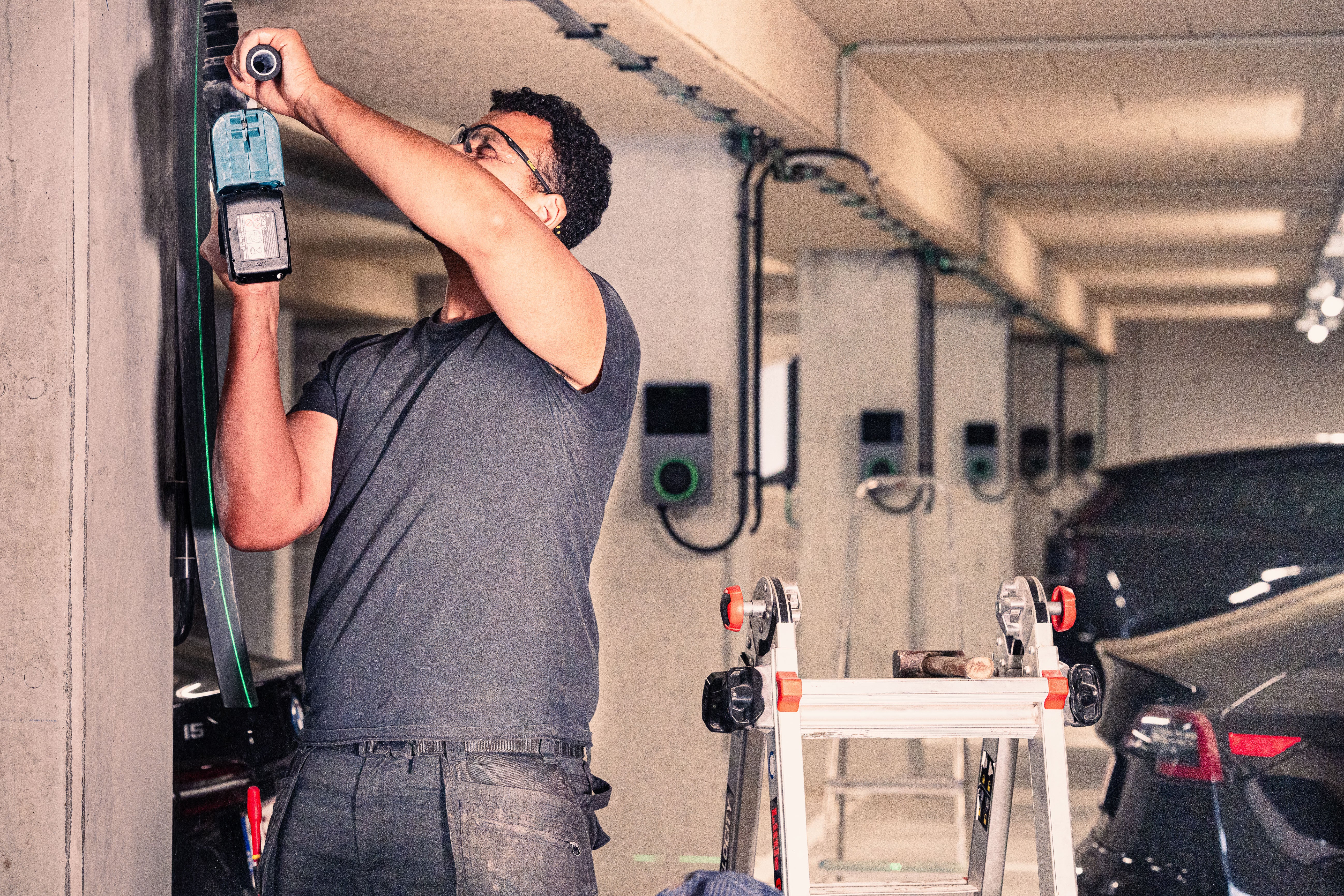


Just imagine this: you are a sales manager, rushing from one appointment to another in Brussels, and you see your electric car's battery level dropping faster than expected. The search for "nearby fast chargers" is suddenly no longer a minor inconvenience, but an urgent business necessity. This is the new reality for countless Belgian professionals and a challenge for which we at Blulinc provide solutions every day.
The Real Challenge of Fast Charging for Belgian Companies
The transition to electric mobility is no longer a distant prospect; it is a daily, operational reality for companies throughout Belgium. Particularly for commercial fleets, where time is literally money, the availability of fast and reliable charging points is crucial.
Waiting hours for a vehicle to charge at a standard AC charger is simply not an option. When an employee is on their way to the next customer, downtime has a direct, negative impact on productivity and revenue.
Why Standard Charging Is Unsatisfactory
The difference between AC and DC fast charging is fundamental, especially for professional use.
- AC (alternating current) charging: This is the ideal solution we recommend for home at night or during the day at the office, where vehicles are stationary for hours. It is cost-effective, but slow.
- DC (direct current) fast charging: This is essential for on the go. A DC charger can charge a battery in 20-40 minutes to 80% recharge, so your team can get back on the track in no time.
Consider a fleet of 20 delivery vans. They cannot afford to stand at a public AC charger for three hours in the middle of the day. A short 30-minute stop at a DC fast charger makes the difference between a successful and a delayed delivery run, which directly impacts the TCO (Total Cost of Ownership).
The Growth of the Belgian Charging Network
Fortunately, Belgian infrastructure is evolving rapidly to meet this growing demand. The number of publicly accessible charging points is increasing spectacularly. According to the FPS Economy, Belgium will reach the symbolic milestone of 100,000 public charging points reach by August 2025.
That is an impressive increase of 82% in barely two years, compared to the 44,000 points in 2023. Thanks to this rapid rollout of fast chargers along major traffic arteries and in commercial zones, the fear of a dead battery on long distances has virtually disappeared. Discover more insights into the Belgian EV market.
This guide is your essential toolkit for efficiently navigating the Belgian charging landscape. We help you turn a potential operational bottleneck into a competitive advantage, ensuring your search for "fast chargers nearby" is always quick and successful.
Your Toolkit to Find DC Fast Chargers Instantly
Finding a fast charger when you really need one shouldn't be a gamble. With the right tools, you can stop guessing and turn every search for "fast chargers nearby" into a quick, predictable stop. The trick is to look beyond generic map searches and use platforms developed specifically for EV drivers.
Your best asset here is a specialized charging app. The Blulinc app, for example, is your key to our network of more than 900,000 charging points throughout Europe. Instead of just showing pins on a map, you can filter your search with real precision.Do you need a DC charger with at least 150kW power and a CCS plug for your van? You can apply those filters to see only the stations that are useful to you, saving you a frustrating trip to a busy or incompatible charger.
The growth of charging infrastructure is rapid, which is good news for drivers.
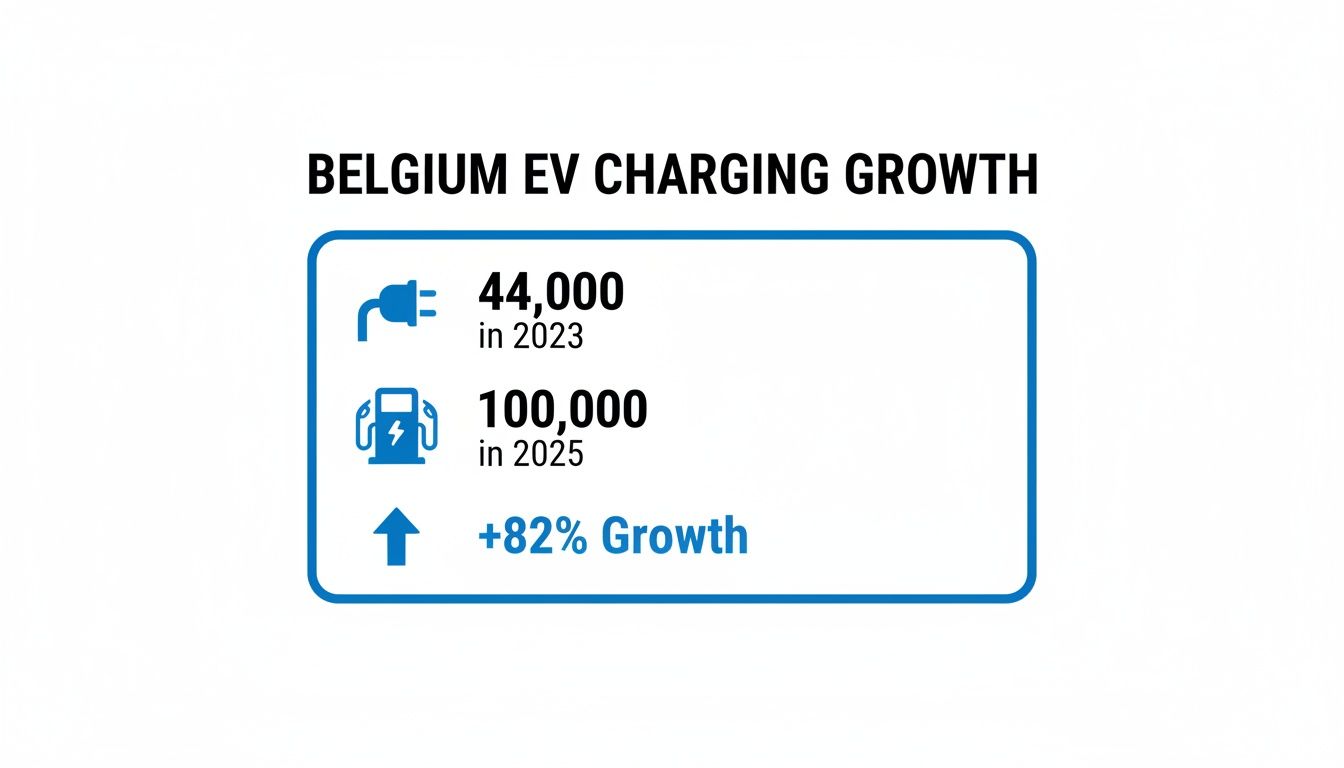
This rapid expansion means you have more options than ever, but it also makes a reliable tool essential for efficient navigation.
Smarter Use of Daily Navigation Apps
Although a specialized app is your best choice, you can get more out of the tools you already use daily, such as Google Maps or Waze. The secret is to be much more specific in what you ask for.
Instead of a vague search query like "EV charging point", try searching for "150kW CCS charger" or "DC fast charger. That small adjustment often yields much better results and filters out the slower AC chargers that won't help if you want to get back on the road quickly. It is a handy trick to find what you need faster, but these apps often lack the live availability data that a specialized charging app does offer.
The real advantage of an integrated solution like the Blulinc app and charging card is simplicity. It combines finding a station, checking the real-time status, starting the charging session, and payment into one seamless system.
Comparison of Tools for Finding Fast Chargers
Every tool plays a role in a driver's toolkit. By knowing their strengths, you can choose the right one for the task, ensuring you never run out of power. Here is a quick comparison of the most common options.
| Tool | Best for | Key Features | Blulinc Integration |
|---|---|---|---|
| Blulinc App | All-in-one charge management | Live availability, filters for power/plug, integrated payment | Full integration with the Blulinc Charging Card for seamless use |
| Google Maps/Waze | General navigation and quick searches | Wide coverage, familiar interface, voice commands | No direct integration; requires a separate payment method |
| Other Loading apps | Network-specific information | Detailed data about the network of a specific operator | Often fragmented; requires multiple apps and accounts |
For business drivers, choosing the right tool makes a tangible difference in the workday. Imagine a delivery driver in Antwerp who needs a quick top-up between deliveries. A generic card might show a 22kW AC charger at a nearby supermarket—a two-hour stop. The Blulinc app, on the other hand, filters for DC chargers and points out a 100kW-station is just five minutes away, meaning the driver is back on the road in less than 30 minutes. That is the kind of detail that turns a potential delay into an efficient break.
To make finding a charging point completely simple, we recommend that you download the Blulinc app to download and discover these features yourself. When you have the right tools at hand, finding a fast charger is no longer a challenge, but simply part of the plan.
Understanding Charge Types and Power Levels
Not all chargers are the same, and when your business relies on vehicles that keep moving, knowing the difference is essential. A quick search for "fast chargers nearby" yields a mix of options, but they offer very different speeds. By understanding the technology, you can make the right decision every time.
The most fundamental distinction is between AC (alternating current) and DC (direct current) charging. Your EV's battery can only store DC power. Therefore, when you use an AC charger—like the ones you typically find at home or in the office—the inverter in your vehicle has to convert the electricity from AC to DC. That conversion process slows things down, which is why AC charging is fine for an overnight charge, but not suitable for a quick stop during a busy workday.
This is where DC fast chargers come into play. They completely bypass your car's internal inverter and deliver power directly to the battery. This results in dramatically higher speeds, turning a wait of several hours into a short break of 20-40 minutes. That is a game changer for every commercial operation.
Decoding Power Levels and Plugs
In addition to simple AC/DC separation, it is the power level—measured in kilowatts (kW)—that really determines how quickly you are back on the road. Higher kW power means faster charging, but it is important to remember that your vehicle also has a maximum speed it can accept.
Here is a brief overview of what you will typically find in Belgium:
- AC chargers (7kW - 22kW): Perfect for long-term parking, whether at the office or in a depot. 22kW-charger can approximately 120 km add hourly range.
- DC fast chargers (50kW - 150kW): These are the workhorses of the public charging network. 50kW-unit can charge most EVs in about an hour to 80% to upload.
- DC ultra-fast chargers (150kW+): Usually found along major highways, these are built for fast charges during long drives. They can add hundreds of kilometers of range in less than 30 minutes.
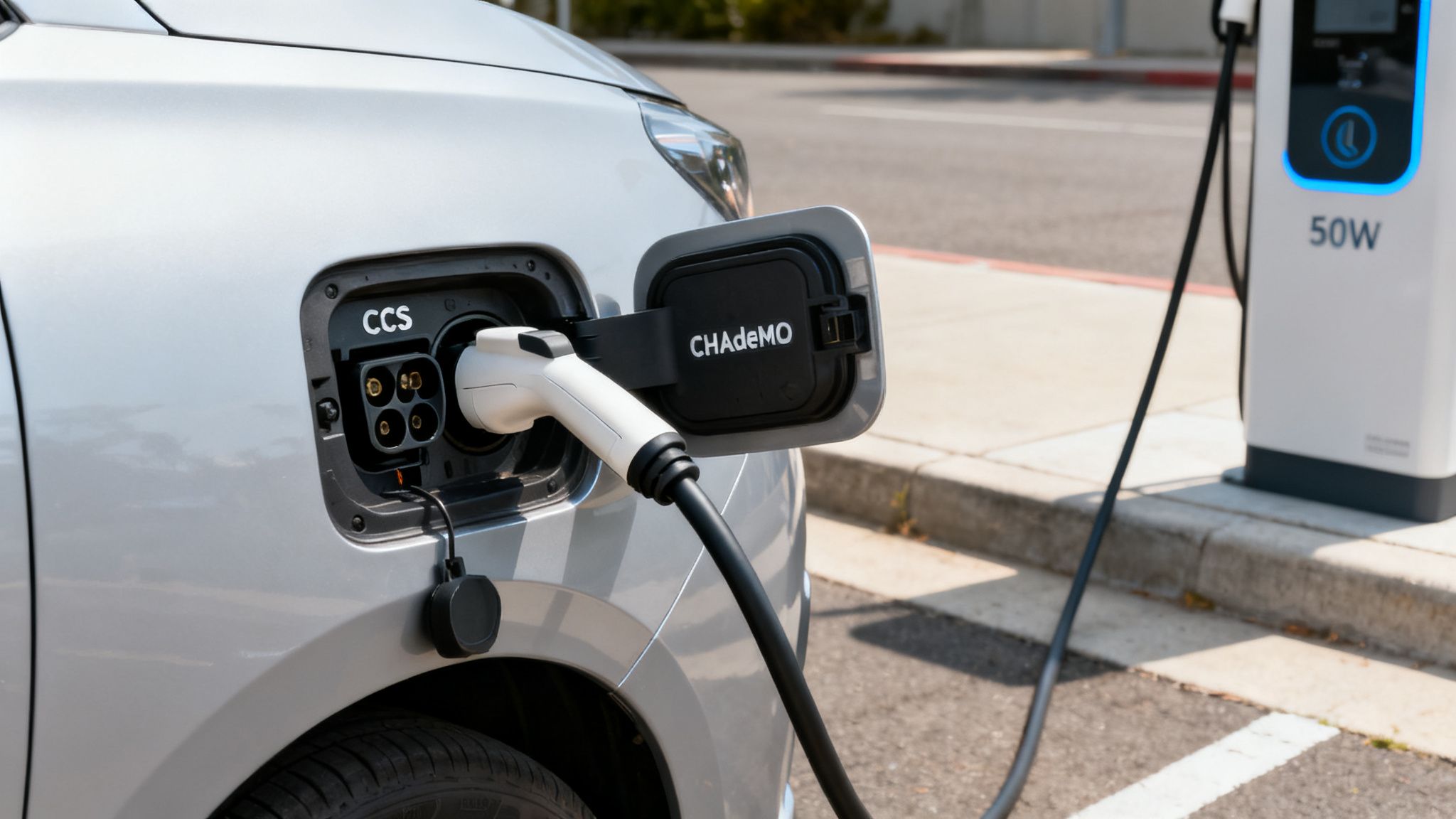
Just as crucial as the capacity is the physical plug. For DC fast charging in Belgium, you will mainly encounter two types:
- CCS (Combined Charging System): This is the standard for almost all modern European EVs.
- CHAdeMO: You will see this less often, because it is primarily used by some Asian manufacturers such as Nissan.
There is nothing more frustrating than arriving at a station and discovering that the plug does not fit your vehicle. It is a completely avoidable mistake. Always use your charging app to filter for stations that match your vehicle's specific plug and power. before You are leaving.
A Practical Example
Let's put this in a practical scenario. A delivery van with a 75kWh battery has almost no power left on his route through Ghent. The driver sees two nearby options on the map:
- A public 22kW AC charger in a shopping center parking lot.
- A 50kW DC fast charger at a special charging hub close to the main road.
If the driver were to choose the AC point, a full charge would take well over three hours—a huge delay that throws the entire daily schedule into disarray.But moving on to the 50kW DC station to go, the driver can in just one hour approximately 250 km range add. That is enough time for a quick lunch break before he heads out again to complete the day's deliveries on time.
This simple decision has a direct impact on your operational efficiency and, ultimately, your bottom line. By equipping your team with the practical knowledge to distinguish these chargers, you ensure that they make the smartest and most time-efficient choice every time they need to charge.
Mastering Payments and Loading Etiquette
So, you’ve found a fast charger. Great. But that’s only half the job. Practical experience with connecting, paying, and following the unwritten rules determines whether your workday runs smoothly. Let’s be honest, it can sometimes feel a bit fragmented. Some stations require a specific app, while others accept a contactless card.
This is exactly where a simple, uniform solution makes the difference. The last thing your team needs is the hassle of juggling multiple apps and credit cards to charge. A single tool like the Blulinc Charging Card cuts through the noise and offers you one consistent way to pay at a vast network of charging points, including those of other operators. To see how this simplifies fleet management, take a look at the advanced charge card management options that Blulinc offers.
Your First Time at a Fast Charger
Once you are in the parking lot, the process is usually quite simple, but it pays to get it right from the start.
- Purposeful Park: Position your vehicle so that the charging cable can easily reach your charging port. You do not want the cable to be stretched taut or block another driver.
- Start the Session: Authenticate your charging session by scanning your Blulinc Charging Card, opening the app, or using a contactless bank card. The station screen will guide you through the steps.
- Fits Tightly: The heavy DC cable must be securely connected to your vehicle. Listen for a clear click as it locks into place, and your car or the station will provide visual confirmation that everything is connected correctly.
- Keep an eye on it (from a distance): With most modern EVs and charging apps, you can monitor the progress directly from your phone. You can see the charging speed and get a good estimate of when it will be finished, so you can grab a cup of coffee without having to stay by the car.
The Unwritten Rules of Public Loading
Fast chargers are a shared, highly sought-after resource. Good etiquette is not just about being polite; it is about keeping the entire network running efficiently for everyone. Think of it as being a good neighbor on the electric highway.
One of the most important things to remember is how your battery's charge status affects the charging speed. DC fast charging slows down significantly once your battery is approximately 80% capacity reached. Occupying a fast charger to slowly trickle in that last 20% is inefficient and holds up other drivers who might be desperately looking for a quick boost.
Pro Tip: Unless you absolutely 100% if you need it to reach your next destination, it is considerate to unplug and move your vehicle as soon as you 80% reached. This frees up the charger for the next person in line.
Imagine this common scenario: a sales representative is running late for a client appointment and stops at a busy charging hub with a low battery. The only available fast charger is occupied by an EV that is already at 92%. If the first driver had followed the etiquette and left after 80%, he would have spared the second a stressful, unnecessary delay. A little consideration makes the EV experience better for the entire community.
Build a Strategic Charging Plan for Your Company
For any company managing a fleet of electric vehicles, it is about more than just a quick search for "fast chargers nearby." It is about building a smart, integrated strategy that balances costs, convenience, and the demands of your daily operations. The ultimate goal is to create a seamless ecosystem where your drivers are always charged and ready to go, whether they are at the office, at home, or on the road between client appointments.
A winning plan is proactive, not reactive. This means giving your team the right tools, such as the Blulinc Charge Card for easy public charging, and set up clear, simple processes for matters such as reimbursement for home charging. When all these pieces come together, you create a reliable framework that keeps your business moving smoothly.
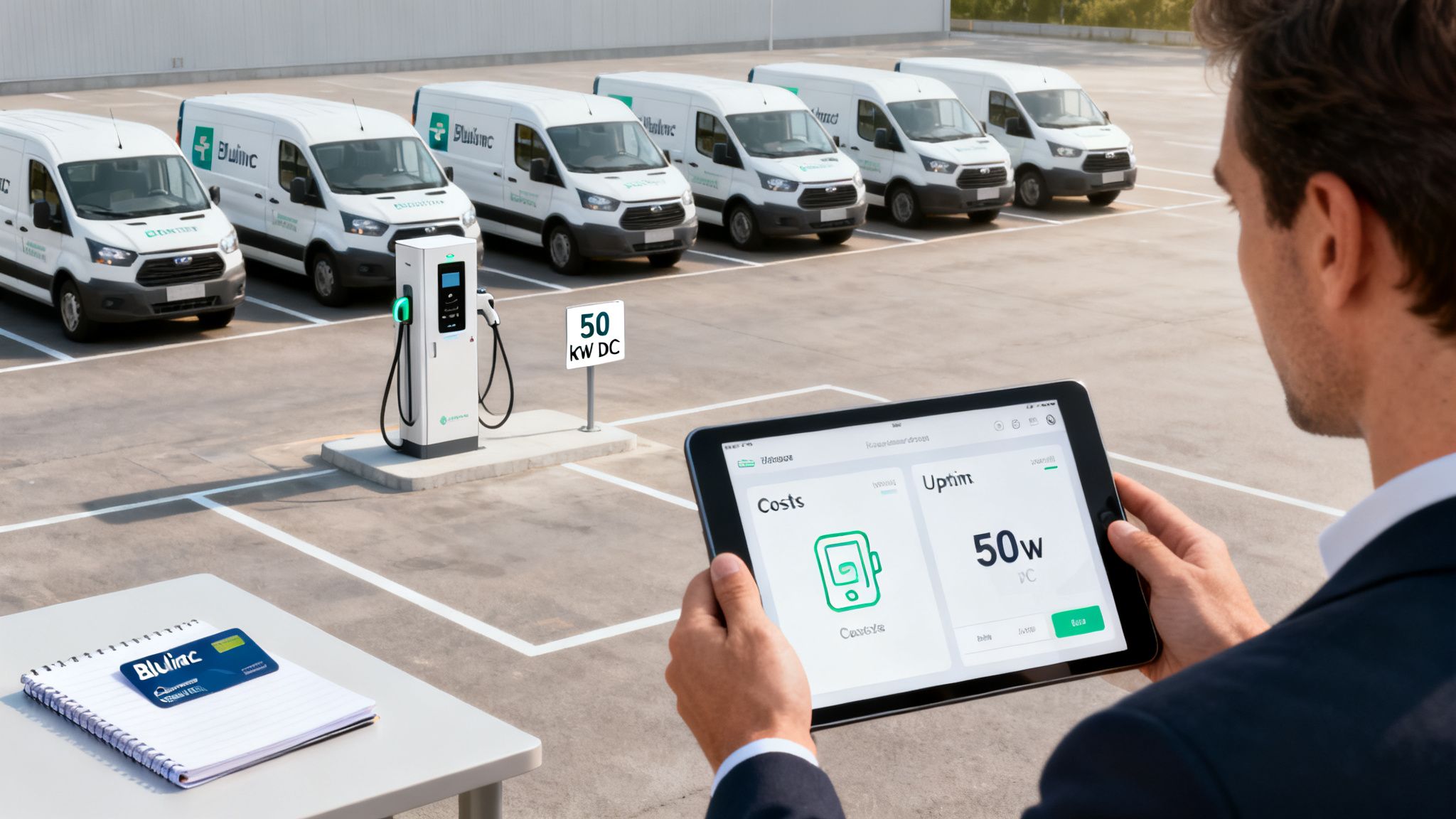
This approach is not just about making life easier; it is about gaining a firm grip on your Total Cost of Ownership (TCO). By tracking every charging session—public, private, or at home—you unlock valuable data on energy consumption, actual costs, and driving behavior.
The Power of On-Site DC Fast Chargers
Public networks are a must for drivers on the road, but installing your own DC fast chargers on your company premises? That can be a complete game changer. It transforms your workplace from a simple home base into a powerful charging hub for your entire fleet.
Imagine a company with a fleet of 10 sales vehicles. These cars are out all day visiting customers. The installation of just one 50 kW DC charger On-site charging enables drivers to get a substantial charge during short stops at the office, for example during lunch or a quick team meeting. This simple addition ensures they always have sufficient range to complete the day's appointments without range anxiety, which increases productivity and makes your operations much more agile.
And the benefits go far beyond just speed:
- Cost control: Charging on-site with your commercial electricity rate is almost always more cost-effective than relying on public DC fast chargers.
- Guaranteed Availability: Your chargers are for your fleet. No more wasting time searching for a free public station.
- Smart Energy Management: With solutions such as those of Blulinc, you can schedule charging during off-peak hours, thereby actively lowering your energy bill.
An Integrated Platform for Total Visibility
The true power of a strategic charging plan comes from having a single platform to view and manage everything. The Blulinc management platform gives you the clear data you need to oversee your entire charging ecosystem. You can track the costs of public, workplace, and home charging in one place, manage energy taxes to avoid expensive peak hours, and generate clear, simple reports.
This type of inspection is essential now that the Belgian charging infrastructure continues to expand.The commercial rollout of fast charging stations by major players such as TotalEnergies demonstrates the country's commitment to meeting the needs of businesses. With projections to annually 20,000 to 30,000 charging points to be added by 2030, is a robust management system that will help you effectively navigate this growing landscape. You can learn more about the Belgian EV charging market findings to see the trend for yourself.
By centralizing all your charging data, you stop simply to manage of vehicles and you start with the real optimize of your entire mobility operation. You make informed decisions that actively reduce costs and improve the performance of your fleet.
A smart charging plan is a powerful business asset. By combining on-site infrastructure with seamless public and home charging solutions, you create a resilient, cost-effective system that fully supports your business goals.
Ready to build a smarter charging strategy for your fleet? Request a free consultation today with one of our experts.
Frequently Asked Questions about Fast Charging
Even with the best tools and a solid plan, questions can arise along the way. The world of fast charging has its quirks, but with the right answers, you can handle almost anything with confidence. Here are some of the most common questions we receive from drivers.
Why is my EV charging slower than the station's maximum power?
This question comes up frequently. You stop at a powerful 150kW-station, connect and see that your car only 75kW pulls. Why is that?
It is easy to assume that the charger is to blame, but it is actually your vehicle that is in control. The car's brain determines the charging speed based on several key factors to protect its most valuable component—the battery.
- Battery temperature: An EV battery has a temperature "comfort zone". If it is too cold or too hot, the car's management system will deliberately reduce the speed to prevent damage.
- Charge status (SoC): Compare it to filling a glass of water. You can pour quickly when it is empty, but you slow down as it fills up to prevent spills. Fast charging is fastest when your battery is nearly empty and slows down significantly as soon as you 80% passes. This is completely normal and helps preserve the battery life in the long term.
- Vehicle capacity: Not all EVs are created equal. Your car has a maximum DC charging speed it can handle. Even if you connect to a lightning-fast 350kW-station, will a car with a limit of 100kW never go one kilowatt above that speed.
Is it bad to only use DC fast chargers for my EV?
Although they are a lifesaver on long drives, relying exclusively on DC fast charging is not the best strategy for your battery's longevity. The high power and heat can contribute to slightly faster degradation over the years compared to gentler, slower AC charging.
A healthy balance is key. Use slower AC charging at home or at the office for your daily needs. Save the powerful DC fast chargers for long journeys or those days when you really need a quick charge. Our platform helps fleet managers monitor this charging behavior to keep the entire fleet healthy.
What should I do if a public charger doesn't work?
First of all, don't panic.Check the station screen for any error messages—these can often tell you what is wrong.
Most chargers have a support number directly on the device, and a phone call is usually the fastest way to report the problem. If you the Blulinc app used, you can also mark the station as defective, which helps us and warns other drivers in the area.
This is why having a backup plan is so important, especially when you are running low. A little planning ahead can turn a potential disaster into nothing more than a small detour.
Ready to build a smart, reliable charging strategy that meets all your company's needs? Blulinc offers the tools and expertise to keep your fleet charged and productive.