

The fear of being stranded by the side of the road with a dead battery? That feeling, better known as range anxiety, is a familiar concern for many drivers of electric cars. Yet that fear is becoming less and less justified in Belgium. Thanks to a fast-growing network of charging points A reliable charging station is virtually always within reach, whether you are in the city, in the countryside, or on your way to a client.
The end of charging stress in Belgium
Fortunately, the days when you had to embark on an entire search for a free charging station are long behind us. The Belgian charging infrastructure has grown spectacularly in recent years. This rapid expansion means that the question "where can I find charging stations nearby?" is now easier to answer than ever.
The figures speak for themselves. While there were only about 10,000 public and semi-public charging points in Belgium in 2021, that number has increased exponentially. In 2023, the network already numbered approximately 44,000 publicly accessible charging points, a substantial increase of no less than 82% compared to the previous year. And that trend is continuing strongly: by the third quarter of 2024, there were already in Belgium 77,443 public charging points available. That is an increase of 72% on an annual basis. You can read more about these market developments at mordorintelligence.com.
Access to an extensive European network
For Belgian companies, fleet managers, and private drivers, it is crucial to be able to charge worry-free, not only locally but also across borders. A fragmented landscape with countless apps and subscriptions is impractical and downright time-consuming. That is why, at Blulinc, we offer an integrated solution that puts an end to that chaos.
With the Blulinc app and charging card, you get access to a gigantic network of more than 900,000 charging points spread across Europe. This means that you or your employees can load effortlessly with a single card and app, whether the journey is to Antwerp, Arlon, or Amsterdam.
The key to a carefree electric driving experience is not only the car itself, but above all the certainty of a reliable and accessible charging network. The goal is to make charging just as natural as refueling.
This convenience is essential for commercial fleets. Consider a sales representative who travels across the country. With our solution, they no longer need to worry about compatibility or different payment methods with charging station operators. Everything is centrally managed and settled via one clear invoice, which significantly simplifies administration. You can discover more about how to efficiently find charging stations in our detailed guide on locating electric charging stations.
Our goal is clear: we want you and your team to hit the road with complete confidence, knowing that a charging solution is always close at hand.
Chargers, speeds, and connectors deciphered
Not every charging station is the same. When searching for "charging stations nearby", it is essential to know the difference between AC charging (alternating current) and DC charging (direct current). That single difference determines how quickly you can get back on the track.
You most often encounter AC chargers at work, at hotels, or in public parking garages. They are perfect for times when your car has already been parked for a while. DC chargers, better known as fast chargers, on the other hand, deliver significantly more power and are ideal for a quick top-up on the go.
The right charger for the right situation
The connector and the power of a charging station directly determine your charging speed.In Belgium and the rest of Europe, the Type 2 connector the standard for AC charging. For DC fast charging, that is the CCS (Combined Charging System)-connector.
The power, expressed in kilowatts (kW), indicates how quickly energy is transferred. An AC charger usually delivers 11 kW or 22 kW. DC fast chargers start at 50 kW and can amount to more than 350 kW.
Imagine this: a sales representative needs to recharge quickly between two appointments. A short 20-minute stop at a 150 kW DC fast charger is often enough to reach the next client. A hotel guest, on the other hand, can comfortably charge their car overnight at an 11 kW AC charger. With the Blulinc app, you can easily filter by power output and connector type, ensuring you always find the perfect charging point for your schedule.
A smart charging strategy goes beyond simply finding a charging station. It is about choosing the right charging speed for the time you have, so that your journey runs smoothly and without unnecessary waiting time.
A look at the financial benefits
The right charging choice impacts not only your time but also the costs. For companies planning their own infrastructure, it is crucial to know what incentives exist. In Belgium, there is a increased tax deductibility for the installation of charging stations. For charging points that are publicly accessible, the cost deduction can amount to 150% (assessment year 2025). This measure makes investing in private charging infrastructure even more financially attractive.
The number of charging points has grown spectacularly in recent years, giving drivers more choice than ever.

To give you a better idea of what these different power capacities mean in practice, we have listed the most common charging types in Belgium for you.
A practical guide to loading speeds
| Charger type | Typical power (kW) | Connector type | Time for 100 km range |
|---|---|---|---|
| AC charger (Standard) | 11 kW | Type 2 | Approx. 1.5 - 2 hours |
| AC charger (Accelerated) | 22 kW | Type 2 | Approx. 45 - 60 minutes |
| DC fast charger | 50 kW | CCS | Approx. 20 - 30 minutes |
| DC ultra-fast charger | 150+ kW | CCS | Less than 10 minutes |
As you can see, choosing a fast charger can drastically shorten your travel time, but for daily use or overnight charging, a standard AC charger is more than sufficient.
The rise of ultra-fast charging
For those often on the go, every minute counts. Ultra-fast charging, better known as High Power Charging (HPC), is therefore an absolute game changer. These powerful charging stations are changing the way we travel long distances and have become indispensable for commercial fleets that must remain constantly on the move.
The days of having to wait half an hour or longer are increasingly a thing of the past. These ultra-fast charging points are strategically appearing along major Belgian motorways, at petrol stations, and in retail parks. As a result, a charging stop is no longer an annoying interruption, but an efficient break. While you have a coffee or make a phone call, your car is charged in record time for the next leg of your journey.

A network in full expansion
The growth of the ultra-fast charging network in Belgium is downright impressive.In the third quarter of 2024, our country already counted 3,162 fast chargers with a power output exceeding 100 kW. That is a staggering increase of nearly 119% in barely one year.
This rapid expansion demonstrates that the infrastructure is growing along with the rising number of electric vehicles on our roads. Major players such as Ionity, Fastned, and TotalEnergies are constantly expanding their networks, and Tesla Superchargers are also increasingly being opened up to all brands. You can read more about this evolution and how it changes the driving experience in this in-depth overview of gireve.com.
A perfect example of what is to come is the future Allego hub in the Mechelen Retail Park. With no less than 24 ultra-fast charging points This will become the largest charging hub in Belgium, where drivers can recharge quickly and efficiently.
The availability of ultra-fast charging points is transforming long journeys. What used to require careful planning is now a flexible trip with short, productive stops.
Easily find the fastest chargers
But how exactly do you find those powerful charging points when you need them? Platforms like the Blulinc app make it very easy for you. With a few taps on your smartphone, you filter the map so that only the ultra-fast chargers in your area or along your route appear. The app shows not only the location, but also the capacity and real-time availability.
For fleet managers, this is a huge advantage. Your employees no longer waste valuable time searching for a suitable charging station. They can plan their route with confidence, knowing that a fast charging solution is always within reach.
Need more tips? Then be sure to check out our guide on locating fast charging stations. This is how we ensure your fleet remains efficient and operational, wherever the road leads.
Navigating the regional charging networks in Belgium
Finding a charging station in Belgium is not an equally simple task everywhere. The experience can differ drastically depending on whether you are located in Flanders, Wallonia, or the Brussels-Capital Region. For any company operating nationally, understanding these regional differences is essential to keep the fleet mobile and operations running smoothly.
Each region is building the charging infrastructure at its own pace. A driver from Ghent planning a trip to Liège must be able to rely on finding a reliable charger at his destination, just as a Brussels employee expects one on the way to the coast.
Flanders: the ambitious frontrunner
Flanders is currently setting the pace in Belgium and boasts the densest and fastest-growing charging network. The Flemish government has set very ambitious targets, and this proactive approach means that finding an available charging station is generally quite simple, especially around major cities and along key traffic arteries.
Wallonia and Brussels: closing the gap
In Wallonia and Brussels, the situation is different. Although the networks there are certainly expanding, the density of charging points is not yet comparable to that in Flanders. This fragmented approach throughout the country highlights the need for a unified charging solution.
The figures speak volumes: Flanders is the clear leader with approximately 27,000 public charging points and strives for 100,000 by 2030. Wallonia, on the other hand, has such a 3,300 charging stations, while Brussels aims at 11,000 by 2035 – but significant grid upgrades must first be implemented to support more fast chargers.You can read more about these regional trends in the official guide of the International Trade Administration.
For companies with branches in different regions, these differences can cause logistical headaches. How do you guarantee that all your employees have consistent access and can pay easily, wherever they are?
A unified solution is no longer a luxury, but a necessity for business continuity in a fragmented market. It transforms regional challenges into a seamless, national charging experience.
This is exactly where a solution like Blulinc makes the difference. Our network transcends regional borders and, with our app and charging card, offers you a single point of access to thousands of charging stations throughout Belgium and the rest of Europe. This consistency means your drivers can charge with confidence, whether they are in a busy city center or a more rural area. It eliminates juggling different apps and payment methods, simplifies your administration, and ensures your entire fleet stays on the road, wherever business takes you.
Bringing charging solutions to your business
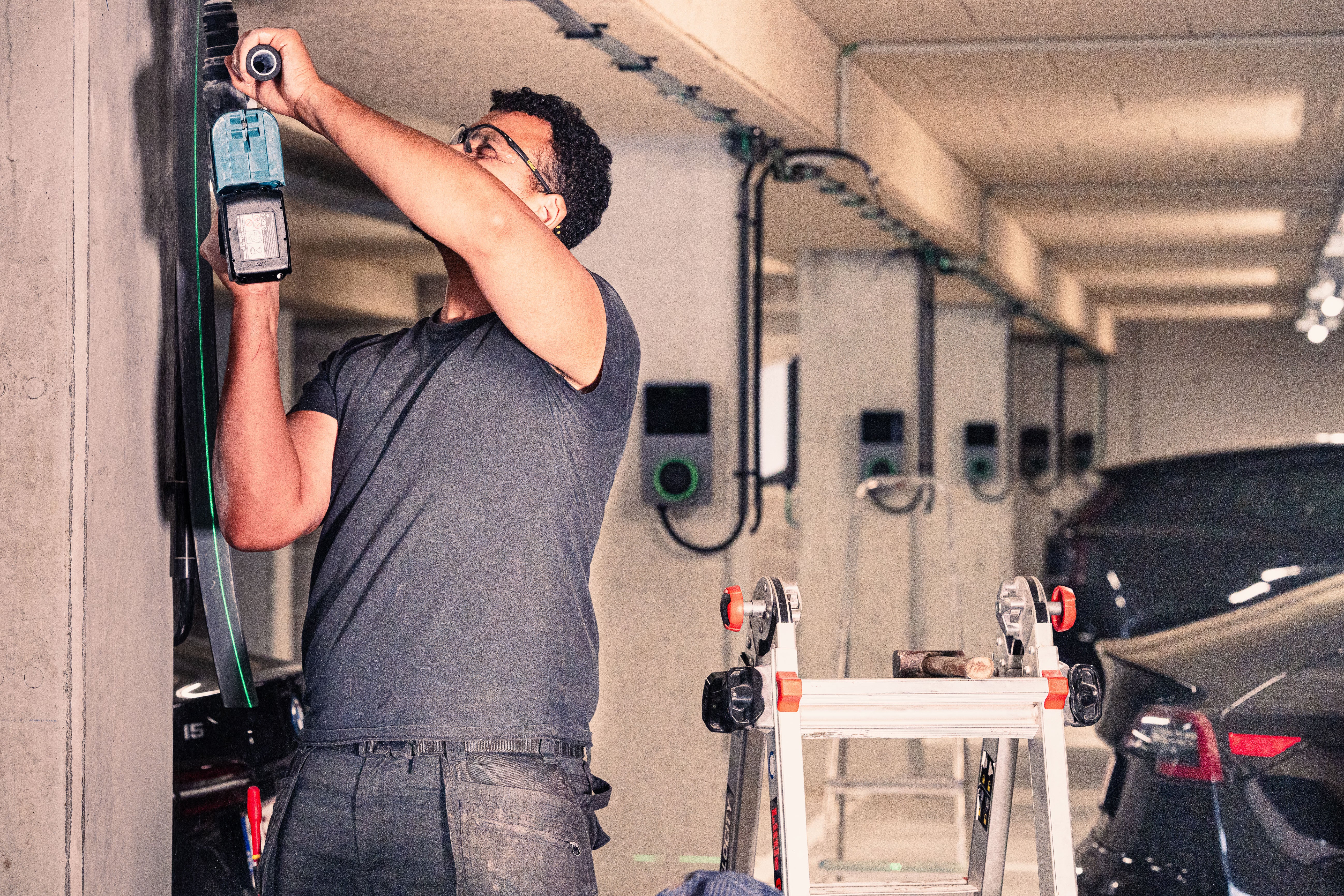
The search for "charging stations nearby" does not always have to end at a public charging point. After all, the most reliable and cost-effective charging station is the one you manage yourself, whether it is located at the office, at your employees' homes, or at a commercial location.
For SMEs, fleet managers, and property owners, installing their own charging infrastructure is a smart move. It not only offers convenience but also gives you full control and can yield significant savings.

We understand that switching to your own charging network can seem complex. That is why, at Blulinc, we take the entire process off your hands. From initial advice and installation to daily management, you can count on us for a worry-free solution.
An integrated approach for your business
A common concern when installing multiple charging points is the impact on the existing electrical installation. Our systems are therefore equipped with smart load management.
This technology intelligently distributes the available power across all active charging points. This prevents overloading and ensures that all vehicles charge efficiently, often without the need for expensive modifications to your grid connection.
Moreover, our central dashboard gives you a complete overview of every charging session, wherever it takes place. You track usage, manage costs, and can even set charging limits for employees. This allows you to maintain ultimate control and transparency over your entire charging network.
The true power of your own charging infrastructure lies in control. You are no longer dependent on public rates or availability, but create a predictable and efficient ecosystem for your fleet.
A concrete example from practice
Suppose you are an SME in Antwerp with a fleet of 15 company cars. Your employees need a charging solution at the office and at home. Our Charging-as-a-Service (CaaS)-model is perfect for this.
- Installation without investment: We install the charging points at the office and at employees' homes, without you having to make a large initial investment.
- Automatic refund: Home charging sessions are automatically registered. The electricity costs are reimbursed to the employee correctly and without administrative hassle.
- Complete cost management: Via the dashboard, you can easily set budgets per employee and receive one clear, consolidated invoice for all charging costs.
This model not only drastically simplifies administration but also gives you full control over your operational costs. Instead of reacting to fluctuating public network prices, you build a stable and cost-efficient charging strategy perfectly tailored to your company's needs. This makes the search for "charging stations nearby" much easier for your team: the best charging station is right on your doorstep.
Frequently asked questions about finding charging stations
Even with the daily growing charging network in Belgium, a few practical questions always pop up on the road. We have collected some of the most common questions we hear from drivers and provided clear, direct answers.
How can I see if a charging station is available before I drive there?
Nothing is as annoying as arriving at a charging station and discovering that it is occupied. The best way to avoid this is with a specialized app like the Blulinc app.
Our platform shows you the real-time status of charging stations, so you know immediately whether a station is available, occupied, or out of service. You can even filter the map to single to show available stations, which makes your travel planning significantly smoother.
What are the average costs for public charging in Belgium?
The costs for public charging can vary significantly. They depend on the operator, the location of the charging station, and the speed (AC vs. DC). Usually, you pay per kilowatt-hour (€/kWh), but some stations – especially fast chargers – may also charge a starting fee or a cost per minute.
This is where the Blulinc charging card and app truly simplify life. With one card, you get access to thousands of charging stations from various networks, with transparent rates.
For companies, the real added value is that all charging sessions – public, at work, and at home – appear on a single, clear monthly invoice. This completely eliminates the headache of expense reports and receipts from dozens of different providers.
What should I do if a public charging station is not working?
It is frustrating to arrive at a charging station that is out of service. First, check the station's screen for error messages; these often provide a hint. Sometimes a quick reset is sufficient, such as unplugging the cable from your car and plugging it back in.
If it still doesn't work, look for a support phone number on the charging station itself. That number connects you directly to the charging station operator (CPO) responsible for maintenance. As a plan B, we always recommend using your Blulinc app to find the nearest one. available find a charging station. This way, you keep any delay to a minimum.
Can I use my Blulinc top-up card outside Belgium?
Absolutely. Making cross-border travel completely seamless is one of the biggest benefits of our solution.
Your Blulinc charging card gives you and your team access to a gigantic European roaming network of more than 900,000 charging points. You do not need to take out new subscriptions or download other apps when traveling abroad. All your international charging sessions simply appear on your standard monthly invoice, billed in euros. This simplifies your administration and keeps your fleet mobile, wherever the journey takes you.
Ready to take control of your charging strategy and simplify your fleet operations? Blulinc offers end-to-end solutions that make electric mobility work for your business.