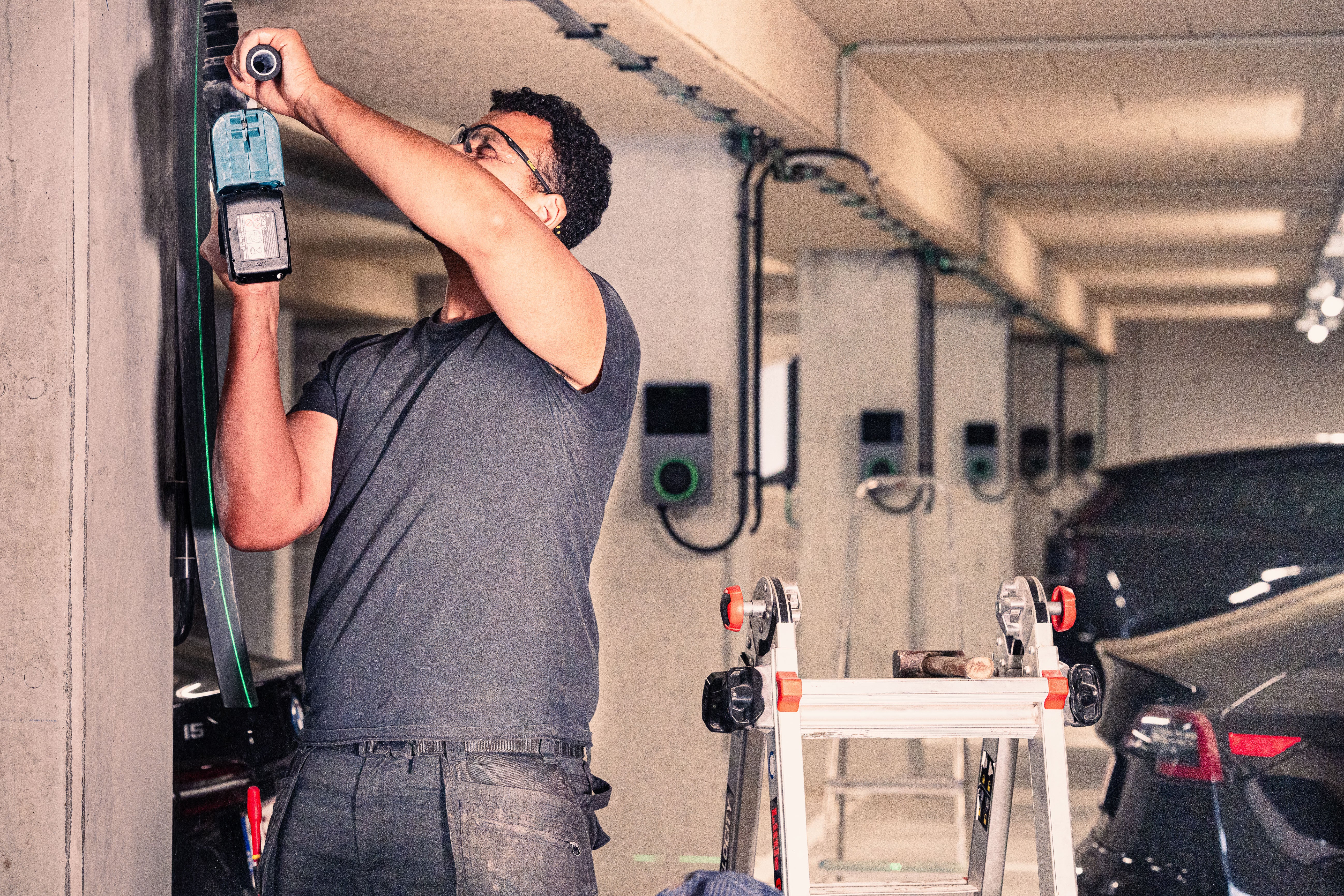


A successful installation of charging stations It doesn't start with excavation, but with a solid plan. This single step determines whether your project becomes a strategic asset or an unexpected expense. It ensures that your charging infrastructure is ready for today. and tomorrow.
The Foundations of Your Charging Project
The shift to electric mobility in Belgium is increasing exponentially. This growth offers enormous opportunities for forward-thinking companies. Installing charging points is no longer an afterthought; it is a strategic move to future-proof your business, whether you are an SME, fleet manager, or owner of commercial real estate.

The first – and most important – phase is the needs analysis. This goes much further than simply counting the number of electric cars you currently have. View it as a strategic exercise that lays the foundation for a scalable and cost-efficient charging solution.
Define your Objectives
Start with the simple question: Why Do we want to install charging stations? The answers will determine the full scope of your project.
- Benefit for employees: Do you offer charging as an perk to attract and retain top talent?
- Electrification of the vehicle fleet: Does your fleet of vans or commercial vehicles need to be fully charged and ready for departure every morning?
- New source of income: Would you like to open the charging stations to the public and generate a new revenue stream?
An SME in Antwerp that 20 A company that needs to charge commercial vehicles at night has completely different requirements than a retail park that wants to offer fast chargers to visitors. Your objectives directly influence the type of charger, the number of charging points, and the software features you will need.
Evaluate your Electrical Capacity
One of the most common mistakes we see is underestimating the impact on your electrical installation. Before you even consider ordering a single charger, you must analyze your current grid connection. A professional tax analysis maps out how much electricity your building has already consumed and, crucially, how much capacity is left.
Ignoring your existing electrical capacity can lead to unexpected and significant costs for upgrading your grid connection by your grid operator, such as Fluvius or ORES. A thorough analysis beforehand prevents expensive surprises.
This analysis helps us determine whether smart charging strategies, such as load balancing, are sufficient, or whether a complete upgrade of your connection is unavoidable. It is a fundamental step to keep your project within budget. For every Belgian company embarking on this path, understanding effective local SEO strategies for electricians also crucial to attract your first users and build a strong local presence.
Once you have mapped out your initial needs, it is time to move on to practice: choosing the right hardware and planning the physical layout of your charging station. This is where the vision becomes reality.
These decisions are fundamental. They determine not only your initial budget but also the entire charging experience for your employees and visitors, and dictate how efficiently your installation will function in the coming years. A wrong choice can lead to substandard charging performance, frustrated drivers, and costly repair work.

The Belgian market offers a huge range of charging hardware, but for businesses, it mainly comes down to two types: AC (alternating current) and DC (direct current) fast chargers.It is essential to understand what distinguishes them to ensure that your investment aligns with your objectives.
AC vs. DC Fast Chargers: A Comparison for Belgian Companies
Wondering which type of charger is right for you? That depends on who is charging and for how long. AC chargers are the workhorses for daily use, while DC chargers are the sprinters, built for speed when time is critical. This table lists the key differences to help you decide.
| Feature | AC (Alternating Current) Chargers | DC (Direct Current) Fast Chargers |
|---|---|---|
| Loading speed | Slower (3-8 hours for a full charge) | Very fast (20-60 minutes for a full charge) |
| Ideal For | Workplace, fleet and overnight charging | Public charging, shopping centers, highway stations |
| Costs | Lower initial hardware & installation costs | Higher initial hardware & installation costs |
| Impact on Network | Lower load on your electrical connection | Requires a substantial, often reinforced, grid connection |
| Typical Use | Employees parked all day; fleet vehicles charging at night. | Drivers who want to recharge quickly on the go. |
For most companies, a mix of both types is often the best solution. You can meet your employees' daily needs with affordable AC chargers, while offering a premium, fast charging option for visitors or urgent charges for your fleet with a strategically placed DC charger. It is about striking the right balance between cost and ease of use.
The demand for more powerful charging is undeniable. In Belgium, the number of ultra-fast chargers – which more than 100 kW deliver – in the 12 months to the third quarter of 2024 with an incredible 119% increased. This is not a trend; it is a clear signal of the market direction, making long-distance travel by EV more practical than ever. You can learn more about the evolution of ultra-fast charging across Belgium in recent sector analyses.
Essential Hardware Features to Look Out For
In addition to the basic choice between AC/DC, modern chargers have features that can make or break the long-term value of your investment. This is what we always advise our customers to look out for:
- Smart Charging Options: This is absolutely indispensable. Smart chargers give you control. You can schedule charging sessions during off-peak hours, distribute the electrical load across multiple stations, and the high costs of capacity rate to avoid.
- OCPP connectivity: The Open Charge Point Protocol (OCPP) is the universal language for charging stations. It ensures that your hardware can communicate with any management software, giving you the freedom to switch providers without being tied to a single supplier's ecosystem. This is crucial to future-proof your investment.
- Durability and Weather Resistance: Your chargers are exposed to the Belgian weather outdoors, so they need to be robust. Look for high IP (Ingress Protection) and IK (Impact Protection) ratings. This guarantees they can handle anything, from torrential rain to accidental collisions, and protects your hardware in the long term.
Strategic Location Planning for Optimal Use
Where you place your chargers is just as important as which ones you buy.We have seen it all – poorly placed chargers can pose a safety risk, drive up installation costs, or simply remain unused.
Let's take a concrete example. Imagine an SME in Ghent with 10 Company vehicles that need to go electric. The smartest move is to place their AC chargers in parking spaces close to the main building. Why? To keep excavation and cabling costs to a minimum. These spots must also be clearly marked, well-lit, and accessible to everyone.
Take these important points into account when planning your location:
- Proximity to the power supply: The closer your chargers are to your main electrical panel, the less you spend on installation. It's that simple.
- Visibility and Accessibility: Ensure that they are easy to find and use. Is there enough room for cars to park and maneuver without any hassle?
- Safety First: A well-lit area is a must. All cables must be properly concealed to prevent tripping hazards, and we often recommend installing bollards to protect the chargers from accidental collisions.
By handling the hardware and location planning properly from the start, you ensure that your installation of charging stations is not only functional, but becomes a cost-effective, future-proof asset for your entire organization.
Navigating Belgian Licenses, Grid Connections, and Regulations
The administrative part of a installation of charging stations It can seem daunting, but don't worry, we are here to clarify everything. Let's outline the essential steps for Belgian companies, from permits and grid connections to compliance with all regulations.
A smooth project depends on three key administrative steps: the local permit, the application for grid connection, and full compliance with regulations. By addressing these matters from the start, you can draw up a realistic schedule and avoid costly delays.
Obtaining the Right Permits
Before the first spade hits the ground, you will likely need an environmental permit. The exact requirements can differ significantly between Flanders, Wallonia, and Brussels, and often depend on the size and location of your project.
- Flanders: If your charging points are publicly accessible, an environmental permit is almost always required. You manage this via the online Environmental Desk.
- Wallonia & Brussels: The rules may differ slightly here. Whether you need a permit often depends on factors such as the number of charging stations, their capacity, and whether you are creating new parking spaces.
We guide our clients through this entire process, assist with the preparation, and submit all necessary documents to the local authorities. It is crucial to submit this application well in advance, as the assessment and approval can take several weeks to even months.
Coordination with your Grid Operator
This is perhaps the most crucial step in the administrative process. You must inform your distribution network operator (DNO) – such as Fluvius in Flanders or ORES in Wallonia – formally notify that you plan to install charging infrastructure. This is done with a connection application.
The DNB will then conduct a study to determine whether your current connection can handle the additional electrical load.
A common pitfall is underestimating the lead time. If the study shows that your connection is not powerful enough, a grid reinforcement is necessary. Such an upgrade can be expensive and significantly delay your project, sometimes with 6 to 12 months.
To prepare you for that meeting with the DNB, we are helping you put together a checklist of important information:
- The total number of planned charging stations.
- The capacity (in kW) of each pole.
- Your expected usage patterns (e.g. for employees only during the day, or 24/7 public access).
- Details about your smart charging strategy to manage peak load.
By providing this detailed information immediately, the DNB can make an accurate estimate, giving you a much clearer picture of the expected costs and timing.
Imagine: a logistics company in the Port of Antwerp that ten 22 kW wanting to install AC chargers for his fleet has a very different impact on the grid than a retailer who two 150 kW installs DC fast chargers for customers. The logistics company might be able to suffice with the existing connection and smart charging, but the retailer will almost certainly require a grid upgrade, with the associated additional investment.
Ensuring Full Compliance with Regulations
Finally, every electrical installation in Belgium must comply with strict safety standards. The most important one you need to know is the AREI (General Regulations on Electrical Installations).
Before your new charging station can be put into operation, a recognized inspection body must certify that it is fully compliant. This inspection confirms that all wiring, circuit protection, and grounding are correctly installed to protect your users and property.
Moreover, if your charging stations are publicly accessible, you must also comply with specific accessibility standards so that they can be used by people with disabilities. At Blulinc, we work exclusively with certified installers who are experts in AREI regulations. This guarantees that your installation is not only efficient but also perfectly safe and legally compliant from day one.
The Installation Process and Software Integration
With the permits and grid approval in hand, the project evolves from paper plans into physical reality. This is the exciting part where your installation of charging stations truly comes to life. It is a two-phase process: first we build the body – the physical hardware – and then we activate the brain – the smart software that makes everything work together seamlessly.
The physical installation is a well-orchestrated combination of civil and electrical works, all carried out by certified professionals. For a typical commercial installation, we often start with the earthworks. This may involve digging trenches for underground cabling or pouring concrete pedestals for the charging stations themselves. The goal is to create a foundation that is stable, safe, and neatly integrated into your property.
As soon as the groundwork is complete, our qualified electricians will get to work. They will run the necessary cables from your main electrical panel to the designated charging locations. A crucial part of this is guaranteeing the safety and long-term reliability of your installation. This means installing the appropriate safeguards, such as overcurrent protection devices, to prevent overloading and to keep everything fully compliant with Belgian regulations.The final piece of the puzzle is assembling and commissioning the chargers, where each unit is connected and tested to ensure it is ready for use.
From Hardware to Intelligent Operation
A charging station without smart software is like a new phone without apps. Technically, it works, but you miss all the powerful features that make it truly useful. This is where a Charging Management Platform – the 'brain' of your operation – comes into play. This software layer transforms your standalone chargers into a connected, intelligent, and even profitable network.
Our platform at Blulinc is built for exactly this. It is the central hub where you can see who is charging, set your rates, and fine-tune every part of your charging ecosystem.
For every Belgian company, the most critical software feature you need is smart loading. It is absolutely essential for the management of the capacity rate. The system automatically shifts charging to off-peak hours or intelligently balances the load across multiple vehicles, allowing you to avoid expensive power peaks and significantly reduce your electricity bill.
This is non-negotiable for an efficient charging network. You can get a much more in-depth look at how all this works in our guide on the essentials of load balancing for your charge point.
Before any installation work can even begin, you must, of course, go through the Belgian permitting process. This infographic outlines it.

As you can see, obtaining your permit, coordinating with the grid operator, and achieving AREI compliance are sequential steps. Completing them correctly is the key to a smooth, legal installation.
Streamline the Entire Process with CaaS
Let's be honest – managing a complex installation and ongoing operations can be a major distraction from running your actual business. That is exactly why it Charging-as-a-Service (CaaS)-model is such a gamechanger for many of our customers.
With CaaS, you can forget the headache. Instead of a huge upfront investment, you simply pay a predictable monthly amount. This single amount covers everything:
- The initial consultation and location analysis.
- All hardware and professional installation.
- The subscription to the management software.
- Ongoing maintenance, support, and even future hardware upgrades.
Imagine this: a medium-sized company in Brussels wants to offer charging facilities for its 20 employees with EVs. Through the traditional route, they could count on an initial cost between €20.000 and €40.000 for hardware and installation alone. With CaaS, that one-off sum disappears and is replaced by a manageable monthly operational cost. This frees up their capital, while our team at Blulinc manages every detail of their charging infrastructure.
This isn't just about financing; it's about relinquishing risk and complexity. We take full responsibility for the uptime and performance of your chargers, ensuring your drivers always have a great experience. You get all the benefits of a state-of-the-art charging solution without the burdens of ownership. You can simply focus on what you do best.
Costs, Financing, and Keeping Your Chargers Operational
A installation of charging stations It is not just a one-time purchase. Consider it a long-term investment in the future of your company.To make a smart, sustainable decision, you need to understand the full financial picture – from the initial price tag to the costs of keeping everything operational for years to come.
Many companies make the mistake of focusing solely on hardware costs. The reality is that this is only one piece of the puzzle. A true cost analysis encompasses everything: installation, grid connection costs, software, and essential maintenance. Getting this right from the start is the key to avoiding budgetary surprises and ensuring your project delivers real value.
Breaking Down the Total Cost of Ownership (TCO)
When drawing up a budget for a charging project, you must look beyond the price of the chargers themselves. The Total Cost of Ownership (TCO) gives you a much clearer, more realistic picture of what you will actually spend over the lifespan of the system.
A large part of your initial budget goes towards the installation work itself. This typically includes:
- Civil Works: Excavation work, pulling cables, or pouring concrete foundations for the chargers.
- Electrical Works: This is the biggest item. It involves pulling new cables from your main electrical panel, installing circuit breakers, and ensuring that everything is fully AREI compliant is.
- Grid connection costs: If your location requires more power than is currently available, you may need a grid reinforcement from a grid operator such as Fluvius or ORES. This can be a significant one-off cost.
In addition, you have ongoing costs, which are a crucial part of the TCO. Think of software subscriptions for your management platform (essential for smart charging and automatic billing) and a budget for routine maintenance to keep your chargers online and reliable.
Key Insight: The initial purchase of hardware often represents only a fraction of the total lifecycle costs. A comprehensive TCO analysis that includes installation, software, and maintenance is the only way to accurately budget for your investment.
To give you a better idea, let's look at an example calculation of the TCO for a typical project.
Estimated TCO Breakdown for a Workplace Project with 4 Charging Points
This table provides an example calculation of the Total Cost of Ownership (TCO) over 5 years for a typical installation of four chargers at a Belgian SME, and shows the breakdown of costs excluding the initial purchase of the hardware.
| Cost component | Year 1 (Initial/Annual) | Years 2-5 (Annual Costs) | 5-Year Total Estimate (€) |
|---|---|---|---|
| Hardware (4 x 22kW AC chargers) | €8.000 | €0 | €8.000 |
| Installation & commissioning | €12.000 | €0 | €12.000 |
| Software Platform Subscription | €960 | €960 | €4.800 |
| Maintenance- & Support contract | €800 | €800 | €4.000 |
| Possible Grid Reinforcement | €5.000 - €15.000 | €0 | €5.000 - €15.000 |
| Estimated Total | €26.760 - €36.760 | €1.760 | €33.800 - €43.800 |
Please note: these are only estimates. Your actual costs depend on the complexity of your location, the chosen hardware, and the requirements of your grid operator. Remember that Belgian tax benefits can significantly reduce your initial investment.
How to Pay: Direct Ownership vs. CaaS
Once you have mapped out the costs, the next question is how to finance all of this. The traditional way is to purchase the equipment directly – a capital outlay, or CapEx. This gives you full ownership, but also requires a large initial investment.
There is another way: Charging-as-a-Service (CaaS).
This model is a gamechanger. It transforms your charging project from a major capital expenditure into a predictable, manageable operational expenditure (OpExInstead of buying everything, you pay a fixed monthly amount that covers the hardware, installation, software, maintenance, and support. This is hugely popular with SMEs because it frees up capital for other parts of the business.
For example, a fleet manager in Wallonia can get a fully managed charging solution without the headache of owning and maintaining the assets. It just works. You can learn more about how charging rates are determined in our guide on the CREG tariff for charging stations.
Keeping Your Chargers Operational: Management & Maintenance
Your work is not finished as soon as the chargers are installed. Correct management and maintenance (O&M) are absolutely crucial to protect your investment and ensure that drivers have a good experience. A charger that is always out of service is more than just frustrating – it is a missed opportunity.
A solid O&The M-plan must always include the following:
- Remote Monitoring: Use your management platform to monitor the status of the chargers in real time. This helps you detect problems before they become major failures.
- Regular Physical Check-ups: Periodically inspect the units for physical damage, check cables for wear, and keep the environment clean and safe.
- Firmware updates: Keeping your chargers' software up to date is essential for safety and access to the latest features.
Although Flanders is the frontrunner in the Belgian rollout of charging infrastructure, forecasts show that by 2030 there will be a capacity increase of 39% is necessary to keep up with demand. This emphasizes how vital strategic installations by companies like yours are. With a solid plan for financing and long-term management, your charging project can become a huge success.
Your Questions about the Installation of Charging Stations, Answered
Entering the world of electric charging can feel like navigating unfamiliar territory. It is normal to have questions. We understand that. That is why we have gathered answers to some of the most common questions we hear from Belgian companies like yours.
Our goal is simple: to cut through the noise and give you the clear, practical advice you need. Let's clarify the details regarding planning, technology, and costs so you can move forward with confidence.
How Long Does the Installation of a Commercial Charging Station Take in Belgium?
To be honest, that depends. The lead time for a commercial installation of charging stations can vary significantly depending on the unique situation of your location. For a simple installation where your existing electrical network can handle the load, we can typically take you from our initial agreement to fully operational chargers in approximately 4 to 8 weeks.
However, if the project is more complex, patience is crucial. A new grid connection or a major upgrade by a grid operator such as Fluvius or ORES entails significant administrative work and technical studies. In these scenarios, the process can easily 6 to 12 months to last.
Our best advice? Start the application for the grid connection as soon as possible. At Blulinc, we manage this entire process for you, providing you with a clear and realistic schedule from the start to avoid unpleasant surprises.
Starting that conversation early is the very best thing you can do to keep your project on schedule.
What is Smart Charging and Why Does My Company Need It?
Think of smart charging as an intelligent conductor for your energy consumption. Instead of simply sending power to a vehicle at maximum speed, it intelligently adjusts the charging speed. It takes into account factors such as the current load on your building's grid, real-time electricity prices, and even when your on-site solar panels are producing energy.
For every Belgian company, this is not just a nice-to-have position – it is essential for two important reasons:
- Enormous Cost Savings: Smart charging is your best weapon against the expensive capacity rate. By automatically shifting charging to off-peak hours or distributing the load across multiple chargers, it prevents those expensive peaks in your energy consumption that drive up your bill.
- Grid stability is indispensable: It protects your building's entire electrical circuit. When multiple cars are connected, a smart system dynamically adjusts the power to ensure you never blow a fuse or exceed your connection limits.
The magic happens via a robust management platform, such as the one we offer at Blulinc. It gives you the control to fine-tune your energy consumption and significantly reduce your operating costs.
Can I set different charging rates for employees and public users?
Absolutely, and you should do the same.A flexible load management platform is built precisely for this type of control. It enables you to create different user groups, each with their own prices and access rules.
For example, you can easily configure your system to:
- To Reward Your Team: Offer free or discounted charging as a fantastic benefit for your employees.
- To Create a New Source of Income: Set a commercial rate for public visitors and turn your car park into an asset that pays for itself.
- Rates to be Adjusted: Be specific with your pricing. You can set a price per kWh, add a fixed session fee, or even apply 'idle fees' to prevent drivers from occupying a spot after their car is fully charged.
This level of control is not just a 'nice-to-have'. It is a core component of a smart, successful charging strategy that allows you to meet everyone's needs while achieving your own business objectives.
What is the difference between a turnkey solution and CaaS?
Understanding these two models is crucial to choosing the right financial and operational path for your company.
A turnkey solution is a classic project-based approach. A supplier like Blulinc handles the entire installation – from the initial site analysis and hardware selection to the installation and software configuration – for a one-time project price. Once it is finished, you own the hardware.
Charging-as-a-Service (CaaS) In contrast, there is a subscription model. Instead of a large initial investment, you pay a predictable, fixed monthly amount. This amount covers everything: the hardware, installation, software, ongoing maintenance, and even future hardware upgrades. In essence, CaaS converts a large capital expenditure (CapEx) into a simple, manageable operational expense (OpEx), making it much easier to budget and scale your charging network over time.
Ready to take the next step in your journey for the installation of charging stations? The team of Blulinc is ready to answer all your other questions. We are happy to help you design a solution that fits your company perfectly.