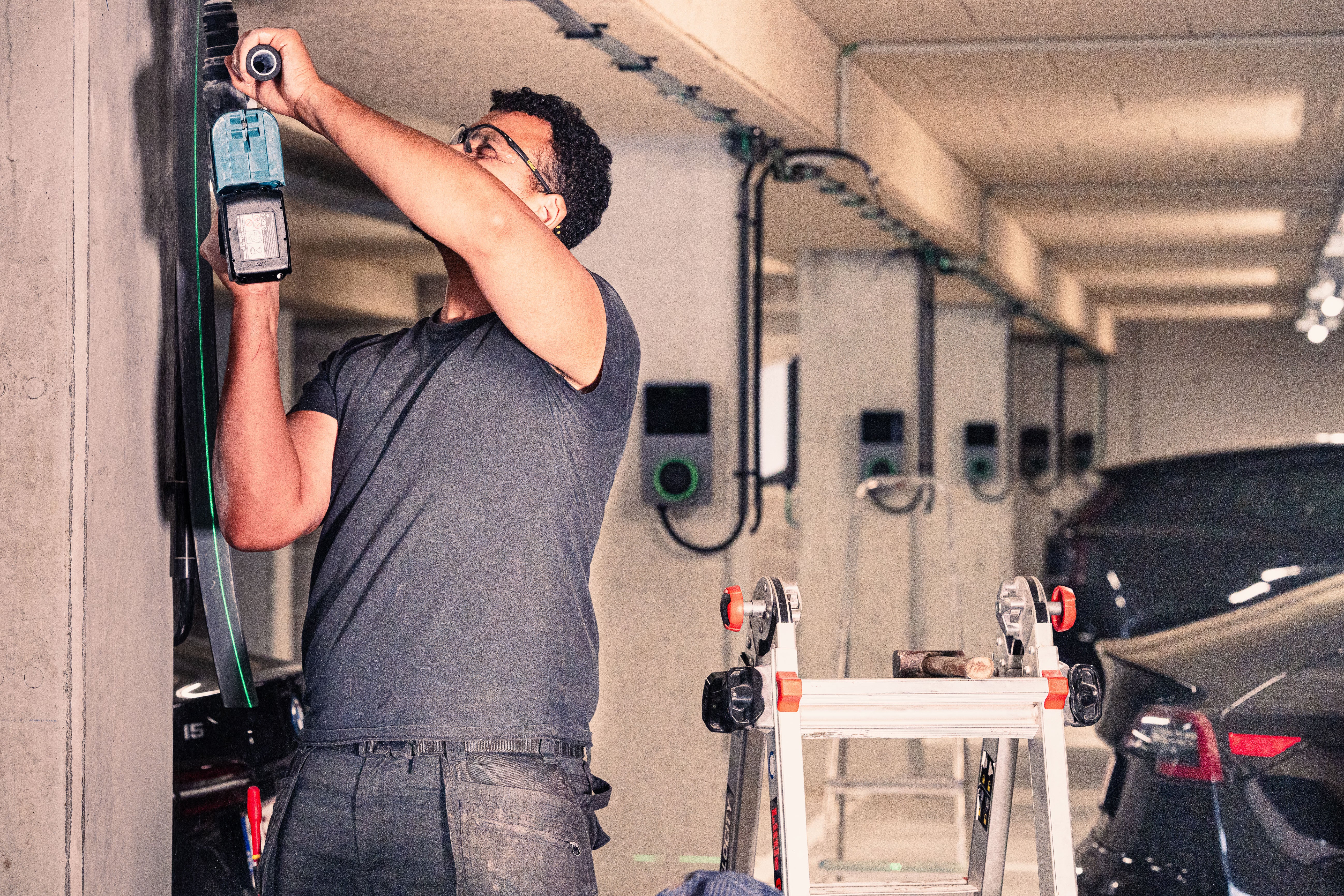


For every Belgian company, the installation of charging stations has evolved from a vague 'what if' to a concrete 'when and how'. Due to the rapid rise of electric vehicles and attractive tax benefits, the switch is not only smart, but essential. This guide walks you through the entire process, from the initial inspection of your site to the flawless maintenance of your charging stations for years to come.
Your journey for the installation of charging stations in Belgium
The transition to electric driving is happening at lightning speed throughout Belgium. If you are a business owner, fleet manager, or real estate manager, the transition goes beyond simply installing new hardware. It is a strategic move to future-proof your company, attract top talent with modern benefits, and genuinely improve your company's environmental and social performance. A well-planned charging project pays for itself immediately and continues to deliver value in the long term.
But let's be honest, the process can feel overwhelming at first.
Imagine this: an SME in Ghent with a fleet of 20 vehicles, a mix of commercial vehicles and vans. They need to determine whether their current electrical installation can handle the extra load, which charging stations are suitable for their needs, and what the total costs will be. An incorrect assessment can lead to expensive, unnecessary grid upgrades or a system that cannot grow with the business.
A structured approach is crucial
The secret to a successful installation is a clear step-by-step plan. We have found that it is best to divide the project into three main phases: planning, installation, and ongoing management. Each phase has its own checklist, from technical site surveys and arranging permits to integrating software and onboarding your team. By splitting the project in this way, a complex process becomes much more manageable, and you are assured of a clear return on your investment.
This diagram shows the fundamental workflow for a successful installation of charging stations.

By thinking in terms of these separate phases – Planning, Installing, and Managing – you can rest assured that every detail is taken care of, from your initial strategy to long-term operation.
The need for companies to arrange this is only increasing. Belgium's public charging network is growing explosively; it doubled from 50,000 points in April 2024 and is on track to more than by early 2026 100,000 to achieve. This places us in third place in Europe in terms of charging station density. This incredible growth, particularly in Flanders, is crucial to support the country's electric vehicle fleet, which is expected 450,000 will reach vehicles. For every company, your private charging stations work hand in hand with this public infrastructure, creating a complete and reliable ecosystem. You can read more about Belgium's rapid EV charging growth on go-electra.com.
By thoroughly understanding the entire process and preparing you for every phase, you can invest with confidence in a charging solution that works for you today and is ready for the future. This guide is your partner every step of the way.
The planning of your site and electrical capacity
Before you even think about ordering charging stations or laying a single cable, there is a crucial first step: a thorough site audit. We see it time and again: companies rush through this phase and end up with unexpected costs or a charging system that cannot handle the demand.Taking the time to properly evaluate your property's electrical installation and predict your future needs is the foundation for a smooth and cost-effective installation.
This isn't just about counting parking spaces. It's about knowing your power capacity. Your building's main electrical panel is the heart of the entire operation. You need a certified electrician to assess the total capacity and your current peak load. This tells you exactly how much power you have left for charging electric vehicles. Skipping this can lead to an overloaded system or, worse still, the need for expensive and time-consuming grid upgrades.

Calculate your future charging needs
Thinking about future demand is more than just counting who has an electric car today. You need a realistic growth plan. To get a clear picture, ask yourself a few important questions:
- Your fleet: How many commercial vehicles will the coming 3-5 will everything go electric this year? Will these be fully electric vehicles (BEVs) or plug-in hybrids (PHEVs)?
- Your staff: What percentage of your team is likely to switch to an EV? Offering charging options at work is a huge benefit that can accelerate this transition.
- Loading times: Will most cars charge at night, during working hours from 9 to 5, or a mix of both? This has a direct impact on how much power you need at any given time.
- Visitors & Audience: Do you want to offer charging to customers or even to the public? This can become a new source of revenue, but you must include this in your capacity planning.
An important part of this is understanding your electrical load calculation. This process translates all those usage patterns into a concrete power requirement, measured in kilowatts (kW), and ensures that your setup is both safe and efficient.
A practical example of scalable infrastructure
Imagine a commercial project developer in Antwerp building a new office park for 500 employees. They predict that within five years 20% of the staff will drive electric, which means that they 100 must be able to operate vehicles.
Instead of all 100 Instead of installing charging stations all at once, which would be a huge upfront investment, they opt for a much smarter, scalable approach. They start with the installation of 25 Charging stations, all connected to a central management system. The smart part about this? During the initial earthworks, they lay the underground cabling and conduits for all. 100 future parking spaces. This foresight saves them a fortune in the long run, because they avoid the enormous disruption and costs of breaking up the ground again later.
Most important tip: Always plan for future capacity during your initial installation. Pre-wiring additional parking spaces is much more cost-effective than having to lay everything from scratch later. It allows you to add new charging stations as demand grows, without major new construction.
Understanding your power supply and avoiding grid upgrades
Most commercial properties here in Belgium have a three-phase power connection. This is fantastic news for EV charging, as it delivers power much more efficiently and easily supports higher-capacity charging stations (such as the common 11 kW and 22 kW models).A single-phase connection, often found in older homes, simply cannot compete with this. Your installer will confirm your connection type during the site audit.
The greatest fear for many companies is the dreaded grid reinforcement via Fluvius. It can be an incredibly expensive and lengthy process, but it can often be completely avoided.
The solution is smart charge management, also known as load balancing. This technology acts as a traffic controller for your power, intelligently distributing the available electricity across all active charging stations. If many cars plug in at the same time, the system automatically reduces the power to each vehicle to ensure you never exceed the total capacity of your building. Once cars are fully charged, that power is released and redirected to others that still need it. You can learn more about how this works in our guide on load balancing for charging stations. By using smart software like this, you can often install many more charging stations on your existing connection, saving thousands of euros and months of waiting time.
Choosing the right charging stations and the right business model
Right, you have mapped out your site's electrical capacity. Now comes the interesting part: choosing the right hardware and, just as importantly, the right way to pay for it. The world of charging stations can seem a bit overwhelming at first with all its different power levels and features, but it actually comes down to a few key differences. Getting this right is what distinguishes a successful installation from a costly mistake.
The first choice you make is between AC (alternating current) and DC (direct current) charging stations. We always explain to customers that they should think of it as a tap versus a fire hose. AC charging is your steady tap, perfect for cars parked for a few hours. DC fast charging is the fire hose – designed for a quick burst of energy when time is limited.

AC vs. DC charging stations: A Belgian company perspective
For the vast majority of the companies we work with in Belgium, are AC chargers The clear winner. They are much more affordable to purchase and install, making them the perfect choice for charging at the workplace and in depots, where cars and vans stand idle for hours.
- 11 kW AC chargers: These are the workhorses you see in most company parking lots. They comfortably charge an EV overnight or add a significant amount of range during a typical 8-hour workday.
- 22 kW AC chargers: A step up in speed, but remember that the vehicle itself must have an on-board charger capable of handling this power. We see them as a good way to future-proof your installation, especially for locations where vehicles may not be parked for a full day.
DC fast chargers on the other hand, start at 50 kW and go much higher from there. They represent a huge investment, with installation costs that can easily run into tens of thousands of euros for a single unit. Frankly, unless you are setting up a public charging hub or a gas station, they are usually superfluous for a business environment.
It is important to note that to qualify for the Belgian tax benefits, your charging station intelligent must be. This simply means that it must be connected to a central management system to report usage data – a standard feature on all professional smart charging stations we supply.
The right purchasing model: CAPEX vs. OPEX
Once you have chosen the hardware, how do you purchase it? This decision has a huge impact on your budget, cash flow, and who is responsible if something goes wrong. You essentially have two main routes: a capital expenditure (CAPEX) or an operating expenditure (OPEX).
- Direct purchase (CAPEX): You purchase the hardware directly. It is yours, which gives you full ownership. However, it requires a large initial investment, and you are responsible for all maintenance, software updates, and repairs.
- Leasing: Think of it as a company car. You pay a fixed monthly amount for a specific term. This spreads the costs, which can be much more budget-friendly in the beginning.
- Charging-as-a-Service or CaaS (OPEX): This is the all-in-one, turnkey solution that has become incredibly popular. You pay one predictable monthly amount that covers everything: the hardware, professional installation, software, all maintenance, and 24/7 support.
TCO scenario: A fleet manager in logistics
Let's go through a practical example. Imagine a logistics company in Wallonia with a growing fleet of electric vans. The fleet manager has 10 AC chargers needed to fully charge every van overnight. He looks at the Total Cost of Ownership (TCO) over five years.
Option 1: Direct purchase (CAPEX)
- Initial cost: € 2.500 per charging station (hardware + installation) = € 25.000
- Running costs: € 30 per charging station/month (software + maintenance) x 10 charging stations x 60 months = € 18.000
- Total TCO over 5 years: € 43.000
This route requires a large initial budget. Moreover, the fleet manager must resolve technical issues or arrange repairs themselves, which entails the risk of vehicle downtime – a nightmare for logistics.
Option 2: Charging-as-a-Service (OPEX)
- Initial cost: € 0
- Running costs: € 95 per charging station/month (all-inclusive) x 10 charging stations x 60 months = € 57.000
- Total TCO over 5 years: € 57.000
Although the total amount over five years appears higher on paper, the CaaS model completely eliminates the heavy initial investment. More importantly, it offers total peace of mind. All maintenance, software, and support are taken care of for you, guaranteeing maximum availability for their critical fleet.
For any company that values predictable costs and wants to avoid operational headaches, the OPEX model is often the smarter strategic move. It transforms a large capital project into a simple, manageable monthly service.
Navigating through permits, installation, and grid connection
You have chosen your charging stations and determined a business model. Now it is time for the administrative and physical work of the charging station installation. This part of the project – dealing with paperwork, permits, and grid operators – can feel like an obstacle, but with an experienced partner, it is a straightforward process.
For every project in Belgium, this means collaborating with local municipalities and the grid operator, Fluvius, to ensure that all requirements are met. Let's take a closer look at exactly what that entails, from the initial permits to the final safety inspection.
The permit and reporting process in Belgium
The good news? In Flanders, the process is often simpler than you might think. For most private charging station installations on business premises, you probably do not need a full environmental permit. Instead, a simple notification to the local authorities is usually sufficient, as long as your total connection capacity remains below a certain threshold.
But don't take this for granted. Rules can vary slightly from one municipality to another, so it is always best to check your local authority's specific requirements early in the process. For larger projects, or work involving excavation on public property, a permit is almost a certainty. At Blulinc, it is our job to guide you through this administrative maze and ensure that all the correct paperwork is submitted to both the municipality and Fluvius.
Most important tip: Do not underestimate the paperwork. Although a simple notification is often sufficient for commercial installations, checking local regulations early and talking to Fluvius can save you from major delays, especially if grid reinforcement is being considered.
What you can expect during the physical installation
This is where the plan becomes reality. All installation work must be carried out by a certified installer to ensure that everything is safe, compliant, and sustainable. The process typically proceeds in a few key steps.
- Preparatory earthworks: This may involve digging trenches to lay armored cables from your main electrical panel to the charging station locations. When digging near existing underground lines, the use of advanced methods such as Non-Destructive Digging a smart and safe approach.
- Cabling and installation: Your installer will lay the high-voltage cables and securely mount the charging stations, either to the wall or on special poles.
- Electrical connection: The charging stations are then connected to your electrical panel. This usually involves adding new, dedicated circuits and the appropriate circuit breakers to handle the load.
The grid reinforcement
One of the biggest questions is whether your current grid connection can handle the additional power demand from the new charging stations. If your site audit reveals that your capacity is too low, you must request an upgrade from Fluvius.
This is not a quick fix. It involves a formal application, a technical study by Fluvius, a quotation, and subsequently the physical upgrade itself. The lead time for an increase in capacity can easily run up to three to six months – sometimes longer – and the costs depend on the complexity of the work. This is precisely why smart charge management is so crucial; it can often help you avoid this entire process, saving a huge amount of time and money.
As the Belgian charging infrastructure expands, the pressure on the grid also increases. By 2025, the country had 106,677 public and semi-public charging points, an increase of 23% compared to 2024. This growth, which peaked at 57% includes in powerful DC chargers, emphasizes how important intelligent grid management has become. You can read more about how Belgium's EV growth continues to break records.
Before even a single car can plug in, a mandatory inspection by an accredited body is unavoidable. This final check verifies that your entire charging station installation complies with all Belgian safety standards (the AREI).As soon as this is approved, your charging stations will be officially put into operation and are ready for use.
Smart software and continuous management
Consider your charging stations as just one piece of the puzzle. The other, equally crucial piece is the management software that brings everything to life. A charging station is not just a physical box on the wall; it is an active service that requires smart control. The right software is what transforms a simple socket into a smart, efficient, and even profitable charging service.
This software is the brain behind your entire charging network. It enables you to manage electricity consumption with 'smart charging', distribute the load across multiple vehicles to avoid costly grid upgrades, and have full control over who can use the charging stations and when.

Access control and automated payments
One of the most powerful features of a good management platform is the ability to various user groups to set up. This is absolutely essential to tailor your charging service to different people and create a smooth experience for everyone.
For example, you can easily set rules for:
- Employees: Grant them access with a company pass or an app, optionally at a reduced rate or as part of their benefits package.
- Visitors: Offer them charging as a courteous service while they are on your site, perhaps with time limits to keep the charging stations available.
- Public users: Open your charging stations to the public during your company's off-peak hours and create a new revenue stream. You can set a completely separate rate for these public sessions.
The best part? The software handles the entire payment process automatically. It processes transactions ranging from charging cards to mobile apps and ensures that all revenue is correctly tracked and allocated. This completely eliminates the administrative burden for your team.
Scenario: An HR manager implements charging at work
Imagine an HR manager at a Brussels consultancy with 50 employees. Her mission is to launch a workplace charging program that is fair to everyone, complies with all tax regulations, and does not create a mountain of paperwork.
With the help of the Blulinc platform She quickly creates two user groups: "Employees" and "Home Charging Users". For the charging stations at the office, she sets a preferential rate per kWh, specifically for the staff. For employees who also have a Blulinc charger at home, the platform manages automatic split-billing. This smart feature automatically reimburses the employee for their home charging sessions at a pre-agreed rate and deposits the money directly into their personal energy bill. No more expense reports.
It also sets monthly charging budgets on each employee's charging card. This gives the company total control over costs, prevents misuse, and keeps the entire program within budget. The platform even generates detailed monthly reports that the finance department can use directly for tax deductions.
For the HR manager, the software transforms a potentially complex administrative nightmare into a fully automated, transparent, and hassle-free employee benefit. She has a complete overview of usage, costs, and reimbursements at her fingertips.
Monitoring, analyses and future-proofing
A solid management platform does more than just control access; it provides you with invaluable insights. Through a central dashboard, you get a bird's-eye view of your entire infrastructure in real time.
You will be given important operational roles such as:
- Real-time status: See immediately whether charging stations are free, in use, or out of service. This enables you to perform proactive maintenance before anyone complains.
- Usage analysis: Track charging patterns, see your peak hours, and understand energy consumption so you can optimize your setup.
- Financial reporting: Generate clear, detailed reports on income, expenses, and reimbursements for simple accounting.
The most important thing is that modern, professional platforms like ours are built on the Open Charge Point Protocol (OCPP). Think of OCPP as a universal language that enables our software to communicate with a wide range of hardware from various manufacturers. Choosing an OCPP-compliant system for your charging station installation is essential. It means you are never tied to a single hardware supplier, giving you the freedom to customize and upgrade your charging stations as technology improves.
This open-standard approach makes your investment future-proof and ensures that your infrastructure remains effective and relevant for years to come.
Budget, subsidies and project timelines
Working out the finances for a charging station installation can seem daunting. But once you have a clear picture of the costs, the available Belgian subsidies, and a realistic timeline, it turns into a perfectly manageable investment.
Looking at the Total Cost of Ownership (TCO) means looking beyond the purchase price of the hardware. You are essentially budgeting for the entire project, from the initial consultation to final delivery. This includes the charging units themselves, professional installation, software subscriptions for smart management, and any costs for grid reinforcement by Fluvius. Naturally, the final invoice will vary significantly depending on the scale of your project.
Estimated costs
To give you a better idea of what to expect, here are some typical budget ranges we see for various setups in Belgium:
-
One home charging point for an employee: A standard 11 kW wallbox installation, including the charger, all labor, and the mandatory inspection, typically costs between € 1.500 and € 2.500.
-
Small business (5-10 charging stations): For a small office parking lot, you should budget between € 2.000 and € 4.000 per charging point. This amount takes into account more complex cabling, potential earthworks, and the costs of a smart charging management system.
-
Large corporate site (20+ charging stations): For larger projects, costs can increase. This is usually because new electrical sub-boards are required, substantial trenches for cables must be dug, and more advanced load balancing solutions must be implemented to protect your grid connection.
You can work out various scenarios and get a more personalized estimate with our handy EV charger calculator.
Belgian tax benefits in 2026
The Belgian government offers some excellent tax incentives for companies willing to invest in charging infrastructure.For 2026, companies can still benefit from the increased cost deduction for publicly accessible charging stations.
To qualify for this tax benefit, your charging stations must be "intelligent" (connected to a management platform) and available for use by third parties, either during your company's opening hours or closing hours. It is a smart incentive designed to help the public charging network grow for everyone.
An example of a project timeline
Setting realistic expectations for your project timeline is crucial. While a simple job can be completed quickly, more complex installations require a bit more patience.
-
Consultation & Site audit (1-2 weeks): This begins with our initial conversations to understand your goals, followed by a visit to your site by a technical expert.
-
Quote & Agreement (1 week): Based on the audit, we will send you a detailed quotation and a clear project plan.
-
Permits & Application to the Grid Operator (2-16 weeks): The timeline here can really vary. A simple notification is quick, but if you require a grid reinforcement, the application with Fluvius can take several months.
-
Installation & Commissioning (1-3 weeks): This is the practical part – the physical installation, electrical work, and the final inspection.
-
Delivery & Training (1 day): We guide your team through the software and officially hand over your new, fully operational charging system.
All in all, a simple project can go from initial contact to fully operational in about 4-6 weeks be realized. However, if grid reinforcement is required, it is wise to plan for a timeline of earlier 4-6 months.
Your questions about charging station installation answered
When you start planning a charging station installation, many questions naturally arise. Based on our practical experience in the Belgian market, we have gathered answers to the most frequently asked questions. Our goal is to provide you with the clarity and confidence you need to move forward.
How long does a typical installation take?
To be honest, the timeline can vary quite a bit. A simple home installation for an employee, including the official inspection, can be completed in just a few weeks.
For a larger commercial project, especially one that requires grid reinforcement, you should count on a much longer term – think of three to six months. The biggest delay is usually the administrative process at Fluvius, so it is absolutely crucial to get the ball rolling early.
What are the most important costs besides the charging station itself?
The hardware is only one piece of the puzzle. When budgeting, you must not forget these other essential costs:
- Installation works: This covers the labor, all necessary cabling, and any excavation or trenching work that may be required.
- Mandatory inspection: An essential step to guarantee safety and compliance with all regulations.
- Possible grid reinforcement: The costs to upgrade your connection to the grid if your current capacity is insufficient.
- Software subscription: This is for smart charging functions, remote management, and continuous monitoring.
A turnkey solution such as Charging-as-a-Service (CaaS) can make budgeting much simpler. These all-in-one packages often bundle all these costs into a predictable, fixed monthly amount.
Can I open my charging stations to the public?
Yes, that is certainly possible. In fact, many Belgian companies are already doing this to create an additional revenue stream and accelerate the return on their investment.
To make this work seamlessly, a smart charging management platform is a must. It enables you to easily set different charging rates for your employees, visitors, and the general public. Even better, the software handles the entire payment cycle automatically, so you don't have to worry about anything.
An important note regarding tax benefits: To qualify for the increased cost deduction in 2026, your charging stations must be 'intelligent'. This means they must be connected to a management system that can monitor and report charging data. This is a standard feature in all professional charging solutions and a crucial requirement to financially optimize your investment.
Ready to take the next step and launch your charging project? The team at Blulinc is ready to guide you through the entire process. Request your free consultation call today And let's get to work.