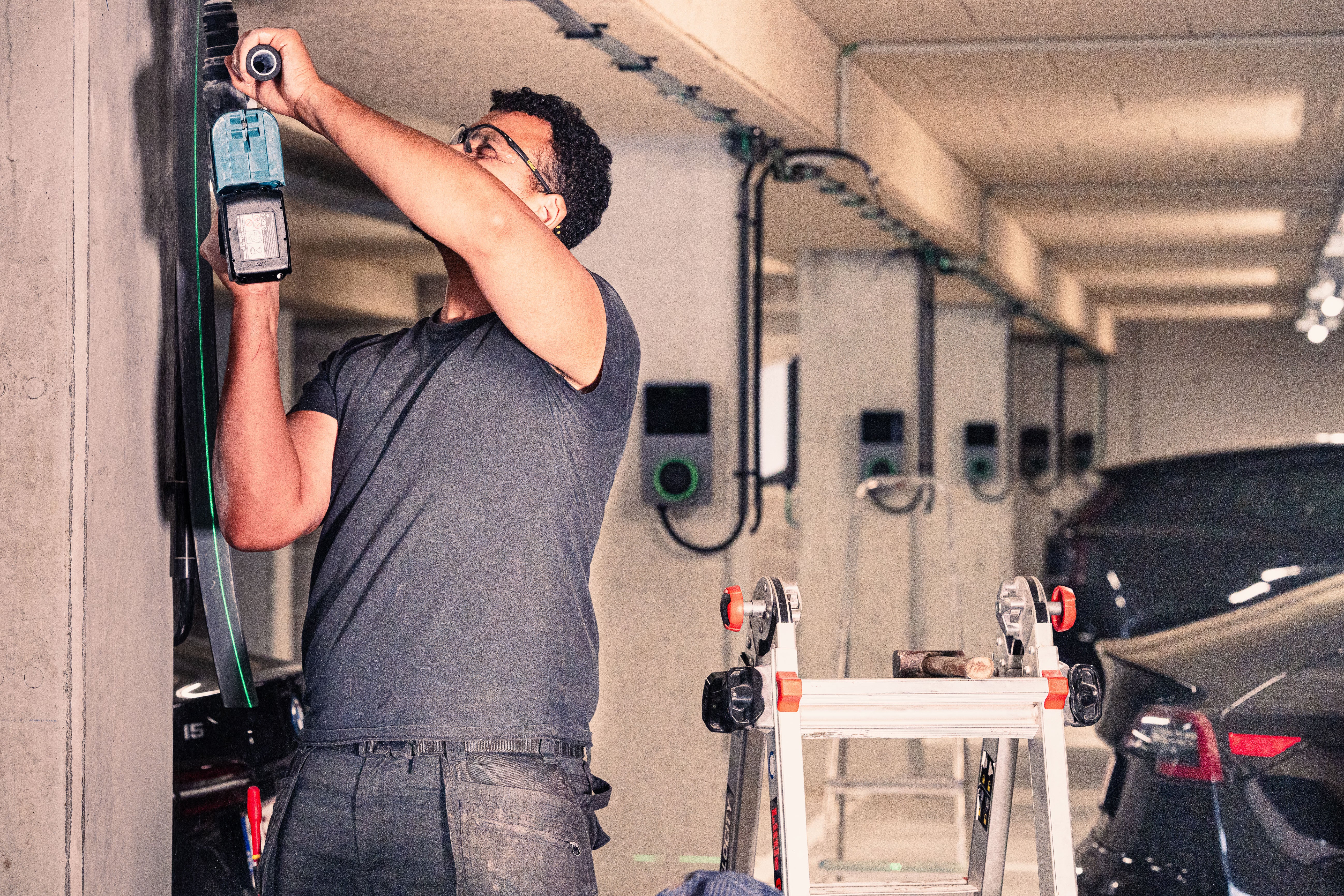


Just imagine: your employees charge their electric company cars at home and start every workday with a full battery. No more stress about finding a public charging point. This is not only convenient, but a strategic move that significantly increases the efficiency and reliability of your fleet. In a country where 95% of journeys are already shorter than 100 km, home charging is the key to success.
Why Home Charging is the Strongest Card for Your EV Fleet
Your sales team leaves in the morning with a fully charged car. No range anxiety, no wasted time, but immediately ready for the first appointment. That is the reality that gives the efficiency of your business operations a huge boost. Focusing on 'charging electric cars at home' is therefore a logical step for every Belgian company making the switch to electric.
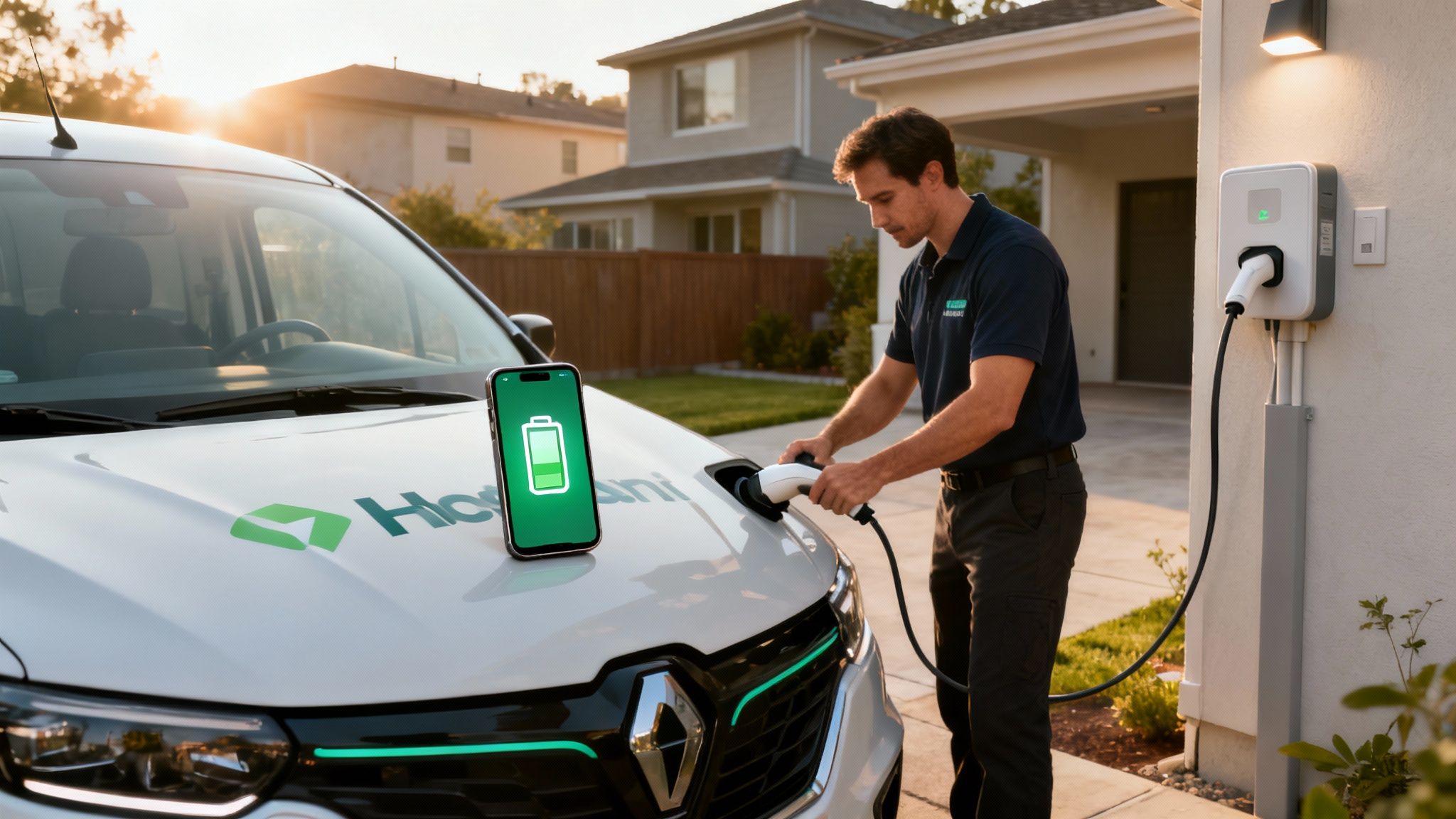
Installing a reliable network of home charging points offers benefits that extend far beyond mere convenience. It becomes the backbone of an efficient electric fleet and makes you independent of the often unpredictable public charging infrastructure.
The Business Benefits of a Home Charging Program
When your employees charge at home, you see this reflected immediately in your operational figures. The time they would otherwise lose at a public charging station is now converted into productive time on the road or at a client's. Take, for example, a fleet of 20 vehicles charging at night: In the morning, this fleet is 100% operational. No delays. This not only increases productivity but also the satisfaction of your employees, who view this as a major asset of their job.
Moreover, the perception of charging infrastructure in Belgium has improved significantly. Recent figures show that satisfaction among electric vehicle owners regarding charging options has risen to 95%. Since 95% of the daily trips in Belgium less than 100 kilometers amounts to, home charging is more than sufficient for most journeys. Read more insights here about the electrification of vehicle fleets in Belgium..
An integrated home charging program is not an perk for employees. It is an investment in the continuity and efficiency of your business. Moreover, it lowers total cost of ownership (TCO) by benefiting from lower nighttime electricity rates.
To make the benefits concrete, we have listed the key points for you.
Key Benefits of a Home Charging Program
| Benefit category | Impact on Business Operations | Benefit for Employee |
|---|---|---|
| Operational Efficiency | Vehicles start the day fully charged, maximizing uptime and productivity. | No more searching for public charging stations; the day starts stress-free. |
| Cost savings | Makes use of lower night rates for electricity, which reduces total energy costs. | Automatic reimbursement of charging costs, no down payments required. |
| Employee satisfaction | Is seen as a valuable benefit, which improves retention and recruitment. | The ultimate convenience of home charging, seamlessly integrated. |
| Data & Control | Centralized platform offers full insight into consumption and costs. | Transparent and fair system for electricity consumption. |
As you can see, a well-thought-out home charging program creates a win-win situation for both your company and your employees.
A Seamless Integration with Blulinc
Bee Blulinc We understand that managing those home charging points must be simple and transparent above all. As your partner, we make it a seamless whole. We integrate charging at home and at work into one smart ecosystem, which simplifies management and reduces costs for your entire fleet. Our platform handles everything:
-
Automatic refund: No more hassle with expense reports. Home charging sessions are automatically registered and reimbursed correctly.
-
Full overview: You maintain control via a central dashboard that provides clear insight into usage, costs, and the status of all charging points.
-
Scalability: Whether you start with five vehicles or manage a fleet of fifty, our system grows smoothly with you.
The Right Preparations at Home for a Charging Station
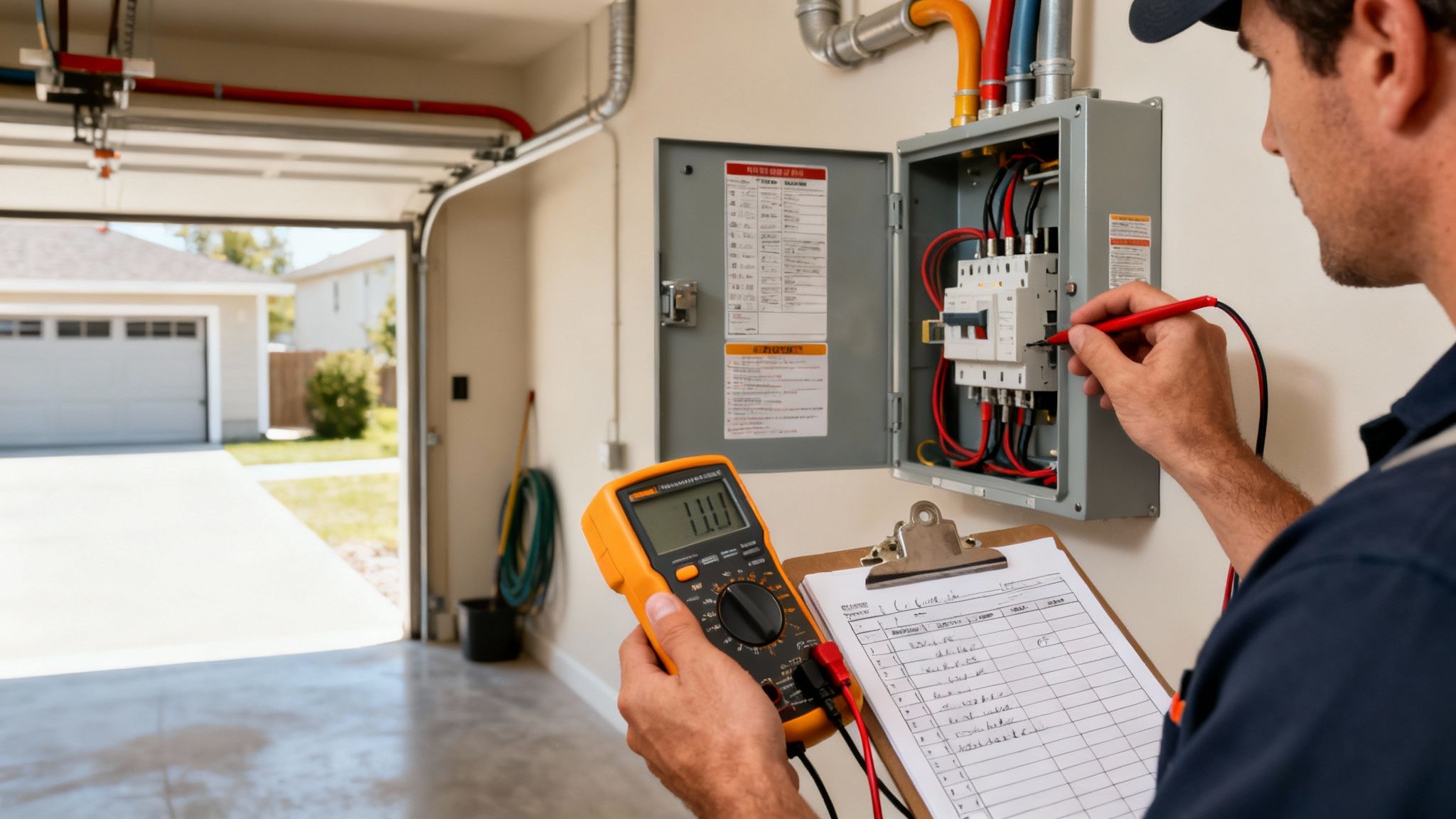
Before having a charging station installed for your employees, it is crucial to first check the electrical installation on-site. Without a thorough prior check, you run the risk of unexpected costs, problems, and a charging solution that does not function optimally. Think of it as the foundation of a house: it simply has to be solid.
A professional on-site inspection, or 'site survey', is therefore not a luxury, but a pure necessity. The starting point is always the meter cupboard. The total capacity of the connection determines which type of charging station you can install and how fast charging can take place without overloading the power grid.
Check the Electrical Base
The first thing we look at is the grid connection. Does the home have a single-phase or a three-phase connection? That is the key question that determines the maximum load capacity.
-
Single-phase (1-phase): You often find this connection in older homes. As a result, the charging capacity is usually limited to 3.7 kW or maximum 7.4 kW.
-
Three-phase (3-phase): This is the standard in most new-build homes and enables much faster charging, up to 11 kW or even 22 kW.
The challenges can vary enormously. An installation in an older terraced house in Brussels, with a single-phase connection and the meter cupboard far from the driveway, requires a very different approach than a modern new-build home in Flanders with a three-phase connection and sufficient space.
Before you take the first practical steps, this comprehensive guide to home EV charger installation can help you better understand the entire preparation process.
Practical Considerations for the Perfect Place
In addition to power capacity, practical matters also play a major role. Our technicians go through a complete checklist during their inspection. This is how we guarantee the best, safest, and most cost-effective installation.
Consider, for example:
-
The distance to the meter cupboard: Simply put, the further the charging station is located from the meter cupboard, the more cabling is required. And this is reflected in the installation costs.
-
Possible obstacles on the route: Do the cables need to be drilled through walls, run under the driveway, or routed along ceilings? Every obstacle has its own solution.
-
Safety and accessibility: The charging station must be installed in a safe, easily accessible location, preferably somewhat sheltered from the weather, and where it cannot be easily damaged.
The biggest mistake we see companies make? They focus purely on the charging station itself and forget about the existing infrastructure. A professional check beforehand ensures that your charging solution not only works today but is also fully ready for the future.
At Blulinc, we take this entire process off your hands. We always start with a detailed site survey to determine what is technically feasible and prepare a clear quotation based on that. This ensures you a safe, compliant, and future-proof installation, perfectly tailored to the situation at your employee's home.
Choosing the Right Home Charging Solution
Not all charging stations are the same, and the best choice is not always about pure charging speed. When you delve into 'charging an electric car at home', you will find two main types: standard, non-connected AC chargers and intelligent, connected models.
A standard charger does its job: it charges the car. But that is where its functions stop. It does not connect, which means you cannot track data, manage it remotely, or automate expense reports.
For a company, this is where smart technology truly shows its value.
Why Smart, Connected Chargers Are a Game-Changer
A Blulinc smart charger is much more than a power outlet. Think of it as a network device that constantly communicates with our central management platform. This connection opens up a world of features designed to streamline your operations, control costs, and protect your assets.
Suppose you manage a fleet of 50 vehicles with drivers spread across Belgium. With standard chargers, you would drown in a sea of manual expense reports for their electricity consumption every month.
With Blulinc's smart chargers, that entire headache is automated.
Our system automatically records the exact amount of electricity used for every company car charged at an employee's home. It then calculates the costs based on their specific energy tariff and processes a perfect, automated reimbursement. No paperwork, no errors—just smooth, seamless financial management.
You simply do not get that level of control and automation with a standard, non-connected charger. When weighing the options, our article on choosing a charging station at home or at the office valuable additional insights.
To really see the difference, here is a clear comparison.
Standard AC Charger vs Blulinc Smart Charger
| Function | Standard AC Charger | Blulinc Smart Charger |
|---|---|---|
| Connectivity | No | Wi-Fi/4G |
| Expense allowance | Manual paperwork required | Fully automated and accurate |
| Remote Management | Not possible | Full remote monitoring and control |
| Load Management | None (risk of overloading) | Dynamic Load Management prevents fuses from blowing |
| Usage data | No data available | Detailed insights and reports |
| Software updates | Not applicable | Over-the-air updates for new features |
The table makes it clear: investing in a smart charger is not just a matter of convenience; it is about gaining control, visibility, and security for your entire charging operation.
More than Reimbursement: The Essential Smart Features
The benefits go far beyond just managing payments. Our smart solutions are packed with crucial features that make the installation safe, efficient, and future-proof.
This is what you get:
-
Dynamic Load Management: This is absolutely essential for home installations. The charger monitors the total power consumption in the house. If someone switches on the oven or a heat pump, the charger automatically reduces the charging speed to prevent overloading the system. It is a simple, but crucial safety net.
-
Remote Monitoring and Control: Through our platform, fleet managers can see what is happening with each charger in real time. You can monitor usage, track costs, and even resolve issues from your desk.
-
Data-driven Insights: Get a crystal-clear picture of your fleet's energy habits. This data is invaluable for optimizing charging schedules, predicting expenses, and making smarter decisions.
While reviewing various chargers, it is essential to get a good idea of the real EV charger installation costs to budget correctly. The initial investment in a smart charger pays for itself many times over in the long run.
A Guide to Belgian Regulations and Premiums
When setting up 'electric car charging at home' for your team, it is crucial to understand the local financial and regulatory landscape. This turns a good plan into a great plan. In Belgium, a mix of federal and regional regulations determines what you can do and, more importantly, how much you can save. If you handle this correctly, your home charging program will not only be compliant but also highly cost-effective.
The central focus is AREI (General Regulations on Electrical Installations). This is not a bureaucratic formality, but a mandatory regulation stating that every new charging station must be inspected and approved by a recognized body. Think of it as a crucial safety check that guarantees the new installation is sound and does not overload the home network.
Making Optimal Use of Financial Benefits
In addition to the safety regulations, there are serious financial benefits on the table. Belgium has made home charging a key part of its national strategy to get more people into electric cars. The federal government supported this with a tax reduction for private individuals who between September 1, 2021 and August 31, 2024 installed a charging station at home.
This support has been a game-changer. Just look at Flanders, which its objective of 35,000 surpassed charging points for 2025 as early as May 2024. More about the Belgium's electric car transition on go-electra.com.
The real insight here is that compliance and financial benefits go hand in hand. A correctly installed and certified charger is not just a legal requirement—it is your ticket to tax benefits. It turns a hurdle into a direct financial gain for both your company and your employees.
Licenses and Certified Installers
How do you ensure that you meet all requirements? The process typically looks like this:
-
Checking Permits: A simple home charging station does not always require a permit, but local regulations can vary. It is always best to check with the specific municipality first.
-
Hiring a Certified Professional: The installation must are carried out by a certified professional. They know not only the technical aspects, but also the AREI inspection process inside and out.
-
The Official Inspection: As soon as the charging station is installed, an independent inspector must give it official approval.
For many companies, all of this feels like a huge headache. You coordinate with employees, installers, and inspection bodies; it is a logistical puzzle that keeps you away from your actual work.
This is exactly where we help you. Blulinc’s comprehensive service takes this entire burden off your shoulders. Our team handles everything: we take care of the paperwork, utilize our trusted network of certified installers, and schedule the final inspection. We ensure you reap every financial benefit while remaining fully compliant.
Your Professional Installation and Blulinc Onboarding
A wall-mounted charging station is just the beginning. The real value is created when it is integrated into a smart, connected ecosystem, and that is where our expertise makes the difference. At Blulinc, we have refined our process to be completely seamless, ensuring your employee's home charging solution is safe, efficient, and fully online from day one.
Our team handles everything, from the final site inspection to the professional electrical work and the full commissioning of the unit.
But the process doesn't stop there. As soon as the hardware is installed, we bring it to life by onboarding the charger onto the Blulinc platform. This step transforms a simple device into a powerful tool for managing your fleet.
Seamless Platform Integration
One of the first things our certified technicians configure is dynamic load management. This smart feature monitors the total electricity consumption in the home. When the washing machine and the oven are running, the charger knows to adjust its speed to avoid blowing the fuse. It is a crucial safety net.
At the same time, we connect the charger to our network.This gives you a live overview via your fleet management dashboard, allowing you to track charging sessions, monitor energy consumption, and manage costs without drowning in paperwork.
Support Your Driver From Day One
The last piece of the puzzle is guiding your employee in the use of the Blulinc app. We want them to feel completely comfortable with how everything works, so that they can get the most out of their 'charging an electric car at home' experience.
This is what our support team goes through with them after installation:
-
Getting Started with the App: We help them download the app and connect directly to their new charger.
-
Hassle-free Refunds: We show how the system automatically tracks their home charging costs and handles the reimbursement, so they can say goodbye to manual expense reports.
-
Smart Charging: We assist them in planning charging sessions during off-peak hours to save on their electricity bill and in monitoring their personal consumption.
From the start, the charging station is more than just a plug—it is a fully managed business asset. It provides you with essential data to optimize your fleet, while your driver receives a smooth, rewarding experience. This is more than an installation; it is the beginning of a smarter way to manage your electric fleet.
Keeping Your Home Charging Installation Running Smoothly
The new home charging station has been installed. What now? The installation is a great first step, but the real gain lies in keeping it running efficiently in the long term. A charging station should not be just an ordinary device, but a sustainable asset for your fleet. A little smart management can make a big difference.
We are here to help you handle this properly. It revolves around two things: keeping your chargers online and keeping your energy costs low.
That is where a smart, connected charger from Blulinc really pays off. If a common problem such as a poor connection occurs, our support team can often diagnose and resolve it remotely. This means less downtime for your drivers and no waiting times for a technician.
We Are Ready for You with Proactive Support
Even the best technology sometimes has a bad day. One of the most common problems we see is a temporary loss of Wi-Fi, which can disrupt data synchronization for refunds. Nine out of ten times, we can resolve this on our end by simply restarting the charger's connection via our platform.
For more complex cases, our system signals detailed diagnostic codes. This tells our technicians exactly what is wrong before they even arrive, ensuring repairs are quick and painless. Think of it as our partnership in action.
Smart Charging Means Lower Bills
In addition to keeping it operational, let's discuss saving money on your 'electric car home charging' installation. Electricity prices in Belgium are not constant; charging during off-peak hours can make a huge difference to your bottom line. By encouraging your employees to adopt a few simple habits, you can realize significant savings across the entire fleet.
-
Schedule Your Charging Sessions: With the Blulinc app, you can set charging to start at night, when electricity rates are lowest.
-
Use the Sun: If an employee has solar panels, the system can be set to prioritize charging when the sun is shining brightest.
-
Even Smarter: For ultimate control, you can have smart charging activated. This synchronizes your charging behavior with real-time energy data from the grid.
The goal is to make charging intelligent, not just convenient. A few small adjustments to charging habits, multiplied across your entire fleet, will significantly reduce the total cost of ownership (TCO) of your electric vehicles.
This kind of long-term thinking is essential, especially now that more and more EVs are appearing on the road. Belgium is already a European frontrunner, with 29% of the new cars that are fully electric. By 2030, there are expected to be almost 2 million EVs are driving on Belgian roads, all of which need a place to charge. By optimizing your home charging network today, you prepare your business for the future. You can find more on EV adoption trends in Flanders here.
Bee Blulinc We are not just installers. We are your long-term e-mobility partner. We provide you with the tools, support, and knowledge to ensure that your home charging infrastructure remains a reliable, cost-effective, and powerful asset.