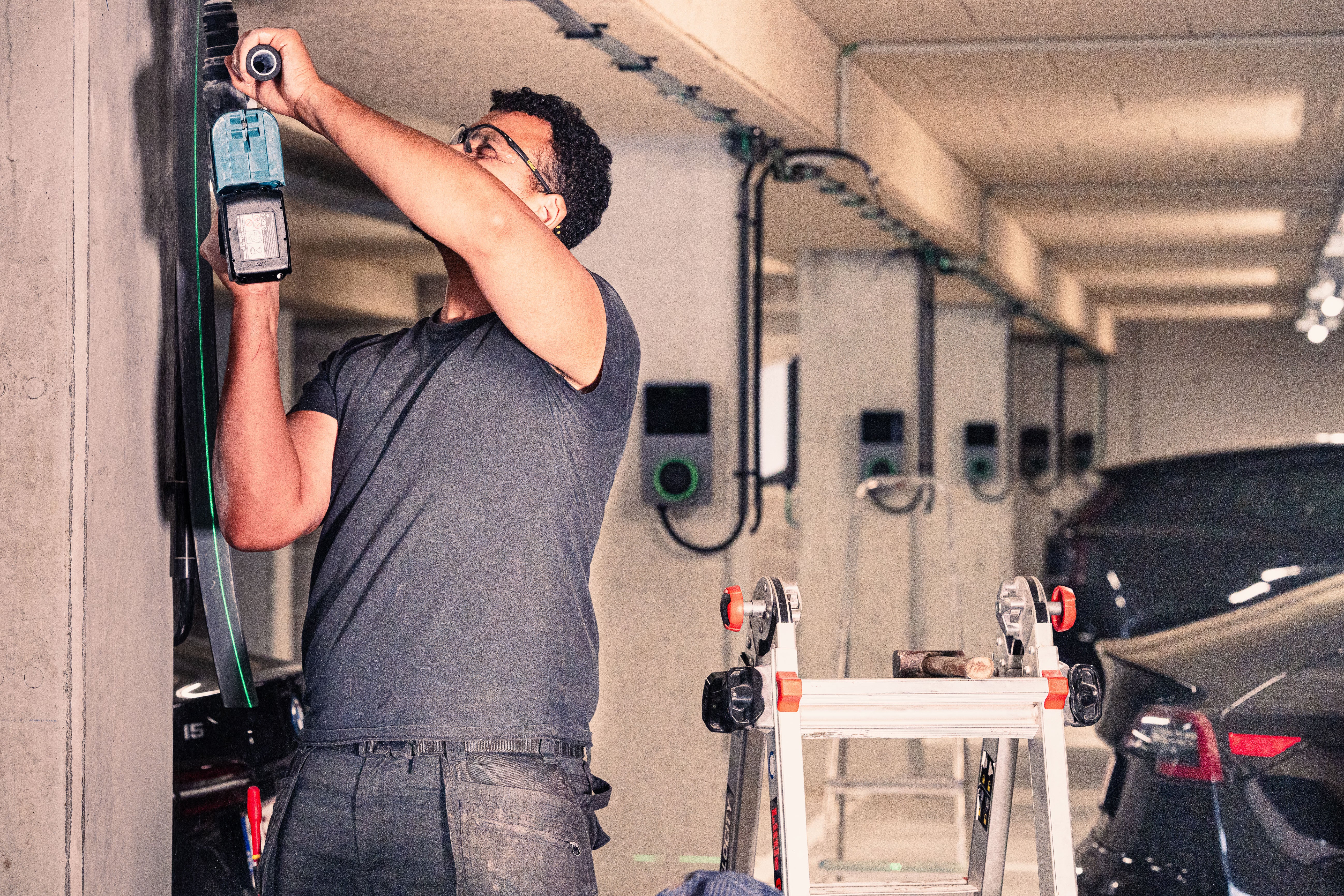


The switch to electric driving is no longer a distant dream, but the reality of today throughout Belgium. This suddenly makes a reliable charging infrastructure an indispensable business asset for enterprises, fleet managers, and even private individuals. Consider this article your personal guide to the installation of charging stations for electric vehicles.
Your Roadmap to a Successful Charging Station Installation
We skip the technical jargon and provide you with a clear step-by-step plan to navigate the entire process with confidence. From the initial analysis of your location and the selection of the right hardware to managing the installation and calculating your return on investment, we cover everything you need to know. We explain the differences between charging station types in plain language, unravel the mysteries of smart energy management, and show you how to maximize Belgian tax benefits to make your project a financial success.
Whether you are electrifying a company fleet, offering charging points as a public service, or installing a charging station at an employee's home, you will find practical advice here, specifically for the Belgian market. Installing a charging station is more than just placing a device; it is a strategic investment in the future of your mobility and energy efficiency.

From Vision to Reality
A good project always starts with a clear plan. The art is to translate your goals into concrete technical and operational requirements. Consider the following:
- Needs analysis: Determine how many charging points you need now and in the future. An SME with 10 Company vehicles that are primarily parked at the office during the day have very different needs than a logistics company where 50 vans must charge at night.
- Location research: Analyze the electrical capacity of your building and the physical possibilities. Where is there space for the charging stations, and what is the best way to install the cabling?
- Budget and TCO: Look beyond just the purchase price. Calculate the Total Cost of Ownership (TCO), including installation, maintenance, management software, and energy costs. Be sure not to forget to include the significant tax benefits in Belgium.
The goal is not simply to install charging points, but to build a smart and scalable charging ecosystem that grows with your organization and supports the energy transition.
As part of your strategic planning, it may also be wise to look further into complementary energy solutions. A complete solar installation can, for example, be enormously beneficial for your savings and long-term sustainability. By generating your own power, you significantly reduce the operational costs of your charging infrastructure and become less dependent on the electricity grid.
Choosing the Right Charging Station for Your Needs
Choosing the right hardware is the foundation of every successful installation of charging stations for electric vehicles. But this decision goes much further than just technical specifications; it is about understanding how a charging station fits into your daily operations.
At its core, you choose between two main types: AC (alternating current) and DC (direct current) chargers. This choice has a direct impact on charging speed, total costs, and the user experience at your location. Making the wrong choice could result in frustrated drivers or an unnecessarily expensive investment.

AC Chargers: The Marathon Runners for Everyday Use
AC chargers are the most common solution at locations where vehicles are parked for longer periods.Think of them as the marathon runners of the charging world. They aren't the fastest, but they deliver a stable, efficient charge over several hours. This works because the car's built-in charger itself converts the power from the grid (AC) into the power the battery needs (DC).
These chargers are perfectly suitable for:
- Workplaces: Employees can fully charge their car during their workday from 8 o'clock.
- Home use: Charging overnight is the most cost-effective way to ensure the car is ready to go every morning.
- Fleet depots: Logistics fleets that are idle at night can take full advantage of cheaper night rates for electricity.
For a medium-sized company in Antwerp with 5 For commercial vehicles, a set of dual-connector AC chargers is often the perfect, cost-effective solution. The initial investment is lower and the installation is much less complex than with DC chargers.
DC fast chargers: The Sprinters for Fast Throughput
DC fast chargers are the sprinters. They completely bypass the car's internal charger and deliver direct current directly to the battery. The result? Drastically shorter charging times.
A single session can charge a battery up to 80% charging in just 20-40 minutes, depending on the car and the power of the charger.
This speed makes them essential for locations with high throughput:
- Public locations: Think of shopping centers, supermarkets, or highway rest areas where drivers want to recharge quickly and cannot wait long.
- Commercial fleets with high daily mileage: Taxis, vans, and other heavily used vehicles must be able to get back on the road quickly.
- A Premium Customer Service: Companies that want to attract EV drivers can offer fast charging as a valuable additional service.
The investment for a DC charger is significantly higher — often starting from €25.000 — and typically requires a more powerful grid connection. The return here comes from a high usage volume and the ability to charge a higher price for the fast, premium service.
AC vs. DC Chargers at a Glance
To make the choice clearer, here is a simple comparison to help you decide which charger is suitable for your situation in Belgium, based on speed, cost, and typical application.
| Feature | AC charging (Level 2) | DC fast charging (Level 3) |
|---|---|---|
| Best suited for | Long-term parking (work, home, hotels) | Fast charging, locations with high traffic (highways, shopping parks) |
| Typical loading time | 3-8 hours for a full charge | 20-60 minutes to 80% to reach |
| Costs | Lower initial investment and installation costs | Significantly higher investment, often requires grid adjustments |
| Ideal application | Employee parking, residential complexes, fleet depots (night loading) | Public charging hubs, taxi stands, commercial fleets that need to get back on the road quickly |
| Assets | Typical 7.4 kW to 22 kW | 50 kW to 350 kW+ |
Ultimately is a AC charger your standard choice for situations where cars are stationary for several hours or longer. For any location requiring a fast "in and out" service, is DC fast charging the only right choice.
Connector types: Speaking the Universal Language
Fortunately, the charging world in Europe is largely standardized. To ensure that your investment is future-proof and accessible to everyone, you only need to focus on two key connectors.
- Type 2 connector: This is the universal European standard for AC charging. Almost every electric car on the Belgian market uses this connection for regular charging.
- CCS (Combined Charging System): This is the standard for DC fast charging in Europe. It is essentially a Type 2 connector with two extra pins underneath, which means that cars with a CCS connector can charge without problems at both AC and DC chargers.
By choosing charging stations equipped with these standards, you guarantee that your infrastructure is accessible to the vast majority of electric vehicles on the road today – and in the coming years.
Understanding the Technical and Electrical Requirements
A first-class installation is safe, efficient, and ready for the future. Let’s go over the essential technical preparations required before the first screw is tightened for your installation of charging stations for electric vehicles. A little foresight will save you major headaches and costs later on.
The entire process begins with one indispensable step: a electrical analysis of the location. We absolutely need to understand the current electrical capacity of your building to determine how many charging stations it can handle without tripping the fuses or compromising safety.
This analysis involves thoroughly inspecting your main electrical panel, mapping your typical energy consumption, and precisely calculating how much capacity you have available. This tells us directly whether your current connection is sufficient or if we need to schedule an upgrade.

The Power of Smart Charging and Load Balancing
What if the electrical capacity of your location is already being utilized to the fullest? This is a common problem in Belgium, but it does not mean you have to shelve your EV plans or pay a huge bill for a grid upgrade.This is exactly where smart charging, also dynamic load balancing mentioned, plays a role.
Imagine dynamic load balancing as an intelligent traffic controller for the electricity in your building. Instead of allowing all charging stations to draw maximum power simultaneously and risking a power outage, it smoothly distributes the power where it is needed most. The system constantly monitors your building's total energy consumption and automatically adjusts the power flowing to each EV.
This technology is a game changer. It means that a company with limited connectivity can install an entire fleet of charging stations without an expensive and time-consuming electrical upgrade, often saving tens of thousands of euros. You can dive deeper into the details in our guide on load balancing for charging stations.
Practical scenario: An SME in Ghent wants 10 AC chargers install for her team, but discovers that the grid connection can only handle six chargers at full power. Instead of a grid modification of €20.000, we implement dynamic load balancing. The system ensures that total power consumption never exceeds the building's limit by intelligently distributing the available energy across all 10 vehicles. Cars that arrive early initially receive a faster charge, and as more people plug in, the power is distributed so that every car is ready to depart by the end of the day.
Earthworks and Physical Installation
Once the electrical plan is finalized, we can focus on the physical groundwork. A professional installation is neat, compliant with regulations, and built to last for years.
This phase includes several important components:
- Cabling and Excavation Works: We need to route armored cables from your electrical cabinet to the charging station locations. This may involve mounting them discreetly along walls in an underground parking garage or digging a trench across an above-ground car park. Good planning minimizes disruption and ensures a neat result.
- Safety and Fuse Boxes: Every charging station requires its own separate circuit with proper protection. A crucial part of safe electrical work, especially in high-power applications such as EV charging, is knowing how to choose the right circuit breakers. This prevents overloading and guarantees reliability.
- Mounting and Signaling: Charging stations can be mounted on a wall or installed on freestanding poles. You also need clear signage to guide drivers to the charging spots and explain how the stations work. It is a small detail that makes a big difference to the user experience.
By carefully planning both the electrical and physical aspects of the project, your installation of charging stations for electric vehicles Not only safe and compliant, but also user-friendly and ready for future growth. It is all about laying a solid foundation from day one.
When it comes to your installation of charging stations for electric vehicles In Belgium, the financial picture is determined by a powerful mix of regulations and incentives. Understanding these rules is not just a formality; it is the key to significant savings and turning your charging points into a profitable investment. For any company considering EV charging, the current tax framework offers a very strong argument to start now.
Central to this is the increased cost deduction. This is a tax benefit specifically designed to reward companies for installing publicly accessible charging infrastructure. By opening your charging stations to the public, you can deduct a much larger portion of the investment from your taxable profit, which directly lowers your tax bill.
Of course, not just any charging station qualifies. The Belgian government has established clear criteria that must be met to benefit from this increased deduction.
Eligible for the Increased Expense Deduction
To receive the best possible tax treatment, your charging stations must:
- Being intelligent and connected: Your chargers need to be 'smart'. This means they require a robust management system to track usage, manage charging sessions, and communicate with a central backend platform, such as the platform we offer at Blulinc.
- Be accessible to the public: The charging stations must be available for public use, at least during your normal opening hours. You must also register their accessibility so that EV drivers can find them on charging maps.
This simple diagram shows how these stimuli can convert an initial cost into a real return.

As you can see, aligning your project with Belgian tax policy creates a direct path from investment to profit.
VAT Recovery and Rules for Home Charging
In addition to cost deduction, there is also VAT recovery. The rules for reclaiming VAT on the purchase and installation of charging stations depend on how they are used. If you offer public charging as a paid service, you can generally reclaim the full VAT. However, if it is offered as a free perk for your team, the situation can be more complex.
And what about employees with a company car who need to charge at home? A solid reimbursement system is essential here. As an employer, you can reimburse your employees for the electricity they use to charge their company car. This is usually handled with a split-billing system via a smart home charging station, which keeps the accounting clear and transparent for everyone. You can read the details of charging rates in our article on the CREG tariffs for charging stations.
Practical scenario: Imagine that a Brussels consultancy firm €50.000 invests in a new, publicly accessible charging setup with five dual-connector AC chargers. Because they qualify for the increased cost deduction — let's say to 150% with a corporate tax of 25% — the real cost of the investment drops drastically.
Here is an overview of the figures:
- Total investment: €50.000
- Tax-deductible amount: €50.000 x 150% = €75.000
- Tax savings: €75.000 x 25% = €18.750
- Net investment cost: €50.000 - €18.750 = €31.250
This quick calculation shows that the net cost of the project by more than 37% decreases, and that is single through the tax deduction. This does not yet include the revenue you can generate from public charging or the daily benefits of your own charging solution.By making smart use of these Belgian incentives, your will be installation of charging stations for electric vehicles A powerful financial instrument for your business.
Your Step-by-Step Installation Project Plan
A successful installation of charging stations for electric vehicles This doesn't happen by chance. It is the result of careful planning and a proven process that ensures your project is delivered on time, within budget, and perfectly aligned with your company's needs.
We have divided the entire process into a clear, four-phase approach. Consider it our blueprint to take you from an initial idea to a fully operational charging hub, without the usual headaches.
Phase 1: Analysis and Planning
Everything starts with a solid plan. This is the phase in which we determine together with you what you want to achieve and, equally important, what is possible at your location. Rushing this phase is the main cause of costly surprises later on, so we take the time to lay a solid foundation.
We help you map out your primary goals: is this for your employees, a public revenue source, or your own fleet? Next, we conduct a thorough analysis of the location to check your electrical capacity. This is the phase where we help you weigh the pros and cons of AC versus DC chargers and determine whether smart charging is a necessity for you.
Phase 2: Procurement and Design
With a clear strategy in hand, we proceed to select the right equipment and finalize the technical details. Here, your vision is transformed into a concrete blueprint, ready for the installation team.
Here, we help you choose the best hardware (the chargers themselves) and the right software (the CPO platform you will use to manage everything). Next, our team creates a detailed installation design that includes everything from electrical diagrams and cable routing to the exact placement of each charger.
Phase 3: Installation and Commissioning
Now comes the exciting part: seeing everything come to life. Our professional team gets to work on-site and transforms your parking spaces into a high-quality charging station. Our priorities are always safety, quality, and minimizing disruption to your daily operations.
The work includes the necessary excavation and earthworks, the installation of all electrical components and chargers, and securing the official grid connection. Afterwards, we carry out a series of thorough tests — a process called commissioning — to ensure that every charger is online, communicates with the software, and works perfectly before your first user plugs in.
Phase 4: Operation and Maintenance
Your chargers have been installed, but our work is not yet finished. This final phase is entirely about the long-term success of your investment. We ensure that the experience for your drivers is seamless and that you get the maximum value from your new infrastructure.
This means that we familiarize your users, assist you with setting up rates and access rules via your CPO platform, and develop a proactive maintenance plan. With Blulinc, you receive continuous support to ensure your chargers remain online and any issues are resolved quickly.
A well-executed project does not end when the power is switched on. It marks the beginning of seamless operation, satisfied users, and long-term value for your business.
A clear, step-by-step project plan removes the complexity from the installation of EV chargers.Below you will find a summary of the key activities and goals for each phase of the process.
Project Plan for the Installation of EV Chargers
| Phase | Key Activities | Primary Goal |
|---|---|---|
| 1. Analysis & Planning | Defining goals, location analysis, electrical capacity check, initial consultation. | Create a clear, actionable strategy aligned with business needs and location constraints. |
| 2. Purchase & Design | Hardware (chargers) & Select software (CPO), detailed schedules & Draw up site plans. | Finalize the technical blueprint and purchase all necessary components for the installation. |
| 3. Installation & commissioning | Civil works (excavation), installation of chargers, grid connection, system-wide tests. | Build the physical infrastructure safely and efficiently and ensure that it functions perfectly. |
| 4. Operation & Maintenance | Introducing users, rate/access management, continuous monitoring, proactive maintenance. | Guaranteeing high availability, user satisfaction, and a long-term return on investment. |
This structured approach ensures that every detail is taken into account, from the initial conversation to years of reliable operation, making the entire process predictable and manageable.
Asking the Right Questions
Choosing the right partner is likely the most critical decision you will make. A good partner does not just install chargers; they provide a future-proof solution. To help you evaluate your options, here is a checklist of questions you should ask every potential installer.
- Experience & References: Can you show examples of similar ones? installations of charging stations for electric vehicles which you completed here in Belgium?
- Platform options: Does your software support smart charging, tariff management, and detailed reporting? Can I get a demo?
- Hardware independence: Are we tied to one brand of chargers, or can your system work with different types of hardware?
- Post-installation support: What exactly does your maintenance and support contract cover? What are your response times if a charger fails?
- Scalability: How easy is it to add more chargers to our system in a few years as our needs grow?
A partner who answers these questions with confidence and transparency is a partner you can trust. By following this plan — and asking these questions — what seems like a complex project becomes a fully manageable process.
Your Questions about EV Chargers, Answered
Are you considering investing in the installation of charging stations for electric vehicles? It is a big decision, and we know you probably have many questions. It is only natural that you want a clear picture before committing, especially with all the variables such as costs, technology, and regulations.
We understand. That is why we have gathered clear answers to the most common questions we hear from businesses and individuals throughout Belgium.Our goal is to cut through the noise and provide you with the practical, no-nonsense information you need to move forward with confidence.
Let's tackle them one by one.
What are the real costs of a charging station installation in Belgium?
The price tag for installing EV chargers can vary widely. For a simple home installation, you should expect an amount between €1.500 and €3.000. If you equip a business park, a standard AC charger with two ports will cost you approximately €3.000 to €6.000 per installed unit. DC fast chargers are a much bigger leap, often starting from €25.000.
So what determines the price? It comes down to a few important factors:
- The type of charger: DC fast chargers are a world of difference compared to AC chargers in terms of cost.
- Electrical works: The more complex the job, the higher the price. If you need to upgrade your grid connection or install a new transformer, this will increase the bill.
- Earthworks: The distance and type of ground between your electrical cabinet and the location of the charger determine how much excavation is required.
- Management software (CPO platform): You need software to manage the charging points and handle the billing for charging sessions.
It is absolutely crucial to request a detailed quote that breaks down every component. And do not forget that tax benefits in Belgium can significantly reduce your net investment.
What is Smart Charging, and Why Do I Need It?
See smart charging, or dynamic load balancing, acting as an intelligent traffic controller for the electricity in your building. Instead of every EV demanding full power simultaneously and risking an overload, the system intelligently distributes the available power to prevent power outages.
This is not just a nice extra; it is essential for any location with more than one charger. It helps you avoid costly grid modifications by making optimal use of your existing electrical capacity. Moreover, having an 'intelligent' charging station in Belgium is a requirement to qualify for certain tax deductions, making it a smart move both technically and financially.
Can I Earn Money with My Charging Stations?
Yes, absolutely. The most direct way is to set a public price for charging sessions — for example, a price per kWh, a starting fee for the session, or a time-based rate. This works perfectly for publicly accessible businesses such as shops, restaurants, or parking garages where you as Charge Point Operator (CPO) acts and sets your own prices.
Another popular route is to connect to a roaming network via a e-Mobility Service Provider (e-MSP). This opens your station to a huge audience of EV drivers who can pay with their charging card. How profitable it is depends on your location, electricity costs, and the pricing strategy you choose.
What is the difference between a CPO and an e-MSP?
Understanding these two roles is essential in the world of installations of charging stations for electric vehicles. They work hand in hand, but have very different tasks.
- Charge Point Operator (CPO): The CPO is the owner and manager of the physical charging equipment. He is responsible for the installation, maintenance, and smooth operation of the chargers. When you install charging points on your property, you become the CPO.
- e-Mobility Service Provider (e-MSP): The e-MSP is the service provider for the EV driver. They offer access to a network of charging stations via a charging card and an app. They handle the billing with the driver and subsequently pay the CPO.
For a company, this means that you are the CPO of your own site. You would then partner with a company like Blulinc, which provides the CPO software you need and can also act as an e-MSP to offer directors access and a payment method.
Ready to take the next step towards a future-proof charging solution? The team at Blulinc is ready to guide your project from start to finish, with advice tailored to your specific needs in Belgium.
Request a free consultation and discover what we can do for you.