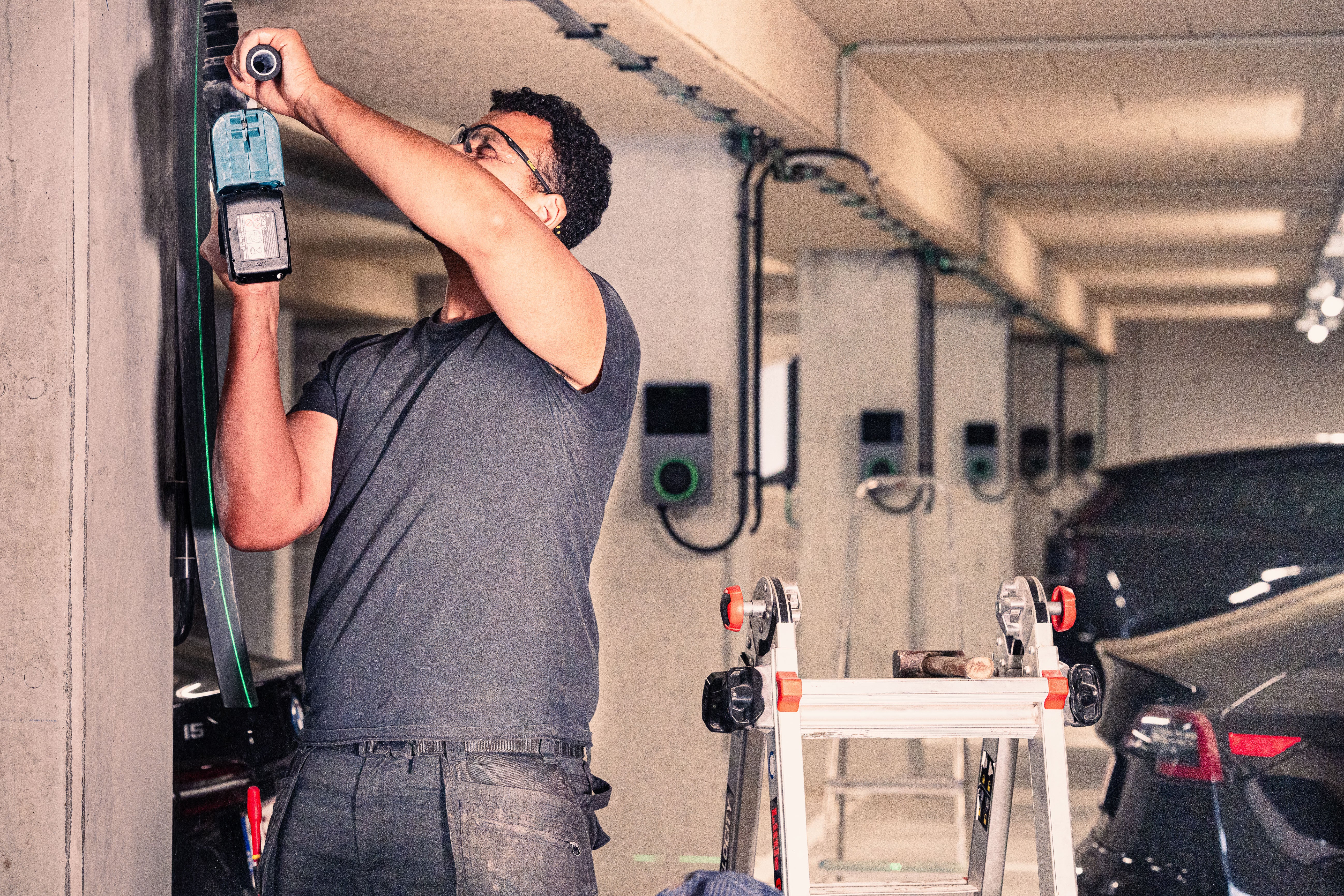


The installation of charging points for electric vehicles is a significant step for your company. It is more than just hanging a plug on the wall; it is a strategic project that starts with a thorough analysis of your location and ends with a fully operational and cost-saving system. To handle this properly, you need a clear plan that covers everything from the technical design and hardware to navigating specific Belgian regulations.
The goal? A future-proof and cost-efficient charging solution that not only meets your current needs but also grows with your ambitions.
Your Blueprint for a Successful Charging Project
So, you are ready to bring charging infrastructure to your company. Although this can feel like a huge undertaking, the key to success is a structured approach. A well-thought-out plan not only helps you avoid costly mistakes but also ensures that you get the most out of every euro of your investment.
For every Belgian company, this process is shaped by local legislation, the requirements of grid operators such as Fluvius or Ores, and attractive tax benefits. Whether you have a small fleet of 10 vehicles Whether you manage a large commercial property, this blueprint is your first step towards flawless execution.
The Four Core Phases of an Installation
Every successful installation we have overseen follows a logical path. By dividing the project into manageable phases, the process becomes much clearer, and we ensure that nothing is overlooked. Consider it a step-by-step plan from idea to reality, guaranteeing that your charging infrastructure is reliable, compliant, and ready for the future.
This diagram provides a clear overview of the essential steps for a typical commercial installation.

As you can see, a methodical approach is crucial. A well-thought-out transition from planning and selection to installation and daily management is what distinguishes successful projects from those that cause headaches.
This structured process transforms a potentially overwhelming task into a clear and feasible plan. It forces you to think about everything from the start – from your initial power requirements to long-term maintenance.
Why a Blueprint is Essential for Belgian Companies
Starting work without a clear plan is asking for trouble. We have seen companies face unexpected costs, frustrating delays, and installations that are already outdated after a year. A classic mistake is fixating on the price of the charging station itself, while overlooking larger costs such as upgrading the grid connection, earthworks, and software integration.
A solid plan is not just about installing charging stations; it is about creating an intelligent energy system. A correctly designed installation can significantly reduce your operational costs by utilizing off-peak rates and smart charging, turning an expense into a strategic advantage.
Let's make this concrete. A logistics company in the Port of Antwerp has completely different needs than an SME in Brussels. The logistics company will likely prioritize powerful DC fast chargers to get their delivery vans back on the road as quickly as possible. The office in Brussels? More affordable AC chargers will probably suffice there for employees who are parked all day.
Your blueprint must reflect your operational reality.A thorough plan always includes:
- A detailed site analysis: A realistic view of your current electrical installation and parking facilities.
- A strong business case: A calculation of the ROI, taking into account Belgian tax deductions, subsidies, and energy savings.
- A future-proof technical design: The choice of hardware and smart management software that grows with your business.
- A clear operational strategy: Determine who is allowed to charge, how payment is made, and how you arrange maintenance.
By following such a strategic blueprint, the installation of your charging stations predictable and you create a project with high added value.
A commercial charging project can be divided into several key phases. The table below provides an overview of what you can expect, from the initial idea to a fully functional charging station.
Core phases of your Commercial Charging Project
| Phase | Core activities | Main objective |
|---|---|---|
| 1. Plans & Analyze | Location research, load capacity analysis, consultation with stakeholders, drafting a business case, investigating subsidies. | Define the scope, budget, and ROI of the project based on your specific needs and on-site circumstances. |
| 2. Design & Select | Technical design, selection of charging stations (AC/DC), power capacity planning, grid connection evaluation, software selection. | Develop a detailed and future-proof technical plan and select the appropriate hardware and software. |
| 3. Install & commissioning | Applying for permits, earthworks, electrical installation, mounting of charging stations, network configuration, testing. | Safely and physically install the infrastructure and ensure that it complies with all technical and legal standards. |
| 4. Manage & Maintain | Registering users, processing payments, monitoring, software updates, preventive maintenance, reporting. | Guarantee reliable daily operation, optimize energy consumption, and maximize availability. |
Each phase builds upon the previous one. A correct approach to the initial phases is absolutely crucial for a smooth and successful outcome.
The Planning of your Installation and the Drafting of a Business Case
Purchasing hardware directly is one of the biggest mistakes we see. A successful charging infrastructure does not start with unpacking charging stations, but with a rock-solid plan and a sound business case for your organization.
This is the fundamental preparatory work. If you do this right, you are building a future-proof investment that meets your mobility objectives and pays for itself. If you rush this process, you will almost certainly face unexpected costs and an installation that does not meet your real needs.
Everything starts with a detailed site analysis. This is much more than simply choosing a spot on the wall. We need to dive deep into your entire electrical installation to determine what capacity you currently have and what is available for charging infrastructure.
The Site Analysis: What Do You Really Need?
Before we even consider a specific charging station, we need to know exactly what you need – not only today, but also for the coming years.This means that we delve into:
- Your fleet: How many electric vehicles do you have now? And what does the growth look like for the coming years? 2 to 5 years? The type of vehicle (fully electric or plug-in hybrid) and the battery size are crucial pieces of the puzzle.
- Your daily rhythm: When are your vehicles parked? Office staff arriving at 9 am and leaving at 5 pm have completely different charging needs than a fleet of delivery vans that need to be fully charged overnight. This "parking duration" determines whether slower AC chargers suffice or if you need to consider faster DC options.
- Your electrical capacity: We analyze your current connection with the grid operator (such as Fluvius or Ores) and look at your building's total consumption. This tells us exactly how much power is available for charging vehicles without overloading the main fuse.
This analysis gives us a crystal-clear picture of your energy needs. This way, you avoid the classic pitfall of expensive grid reinforcement that could have been completely avoided with smart solutions such as load balancing.
Developing a Convincing Business Case
As soon as the technical specifications are clear, it is time to let the numbers speak for themselves. installation of charging stations is an investment, and like any good investment, it must yield a return. For Belgian companies, there are significant tax benefits that make the business case particularly attractive.
The Belgian government encourages the installation of (semi-)publicly accessible charging points with an increased cost deduction. Until August 31, 2024, this deduction could amount to 150%. Simply put: for every euro you invested, you could € 1,50 deducting as a business expense, which significantly reduced your taxable profit.
Let's look at a concrete example. Imagine an SME in Ghent with a fleet of 20 electric vans. They want to charge at night to take advantage of cheaper off-peak rates.
- The Investment: The initial cost for 10 smart charging stations with dual charging points and the necessary management software amounts to € 40.000.
- The Tax Benefit: Thanks to the 150% cost deduction can the company € 60.000 (€ 40.000 x 1.5) claim as a business expense. With a corporate tax of 25% this results in a direct tax saving of € 15.000 (€ 60.000 x 0.25). As a result, the net investment drops to only € 25.000.
- The Operational Saving: By charging at night at an off-peak rate of, for example, € 0,25/kWh instead of the daytime rate of € 0,40/kWh, the savings add up quickly. If each delivery van charges 1,500 kWh at the site annually, the annual energy saving amounts to approximately € 4.500 (20 cars x 1,500 kWh x € 0,15 savings/kWh).
The combination of tax incentives and lower operating costs means that the payback period is often much shorter than expected. You can find more details on how grid operators influence your energy costs in our guide on the CREG tariff for charging stations.
Getting Your Stakeholders On Board
A successful project requires support throughout the entire company. Your business case is the most powerful tool to get everyone on the same page.
- For the CFO: Focus on the Total Cost of Ownership (TCO), the ROI, and the attractive tax benefits. Frame it as an investment that pays for itself while simultaneously reducing operational costs.
- For the Mobility Manager: Show how the right infrastructure simplifies fleet management, increases driver satisfaction, and makes the transition to electric driving seamless.
- For the Facility Manager: Emphasize the scalability of the solution. Highlight how smart technology such as load balancing minimizes the impact on the existing electrical system, which facilitates his or her work.
By presenting a thorough plan and a strong business case from the start, you change the conversation. It is no longer about a 'necessary cost', but about a smart, strategic investment in the future of your company.
The Selection of Hardware and the Design of your Technical Installation
Choosing the right hardware is about more than just selecting a charging station; it is about designing a future-proof ecosystem that serves your business for years to come. Your technical setup must be smart, scalable, and perfectly aligned with your daily operations. This is where a clear understanding of the available technology really pays off.
The decision does not depend solely on the initial cost. It is about aligning charging speed and functionalities with the real needs of your drivers and, crucially, with the electrical capacity of your location. If you do this right, you create a seamless experience. If you do it wrong, you risk frustrating waiting times, dissatisfied drivers, or expensive and unnecessary grid reinforcement.
AC versus DC Chargers: Which Is Right for Your Business?
The first major decision you make is the choice between AC (alternating current) and DC (direct current) chargers. They serve very different purposes, and the best choice almost always depends on how long your vehicles are parked.
- AC chargers: These are the reliable workhorses for locations where vehicles are stationary for several hours. Think of employee parking lots, depots for charging a fleet overnight, or apartment buildings. They are more cost-effective to install and place much less strain on your electricity grid.
- DC fast chargers: Here, it is all about speed. If your vehicles need to get back on the road quickly – such as a delivery van between trips or a customer stopping by for less than an hour – DC charging is the answer. The downside is a higher initial cost and a much greater demand for power.

For many Belgian companies, a hybrid approach works best in practice. A logistics company, for example, can install a few DC fast chargers for quick charging sessions during the day, supplemented by a larger number of AC chargers for the rest of the fleet that charges at night.
To help you decide, here is a brief comparison between AC and DC chargers for commercial use.
AC versus DC fast chargers for commercial use
| Feature | AC charging (e.g. 22kW) | DC fast charging (e.g.50kW+) |
|---|---|---|
| Ideal for | Nighttime loading of fleets, staff car parks, apartments (long-term parking) | Public charging points, logistics depots, taxi stands (short-term parking) |
| Loading speed | Several hours for a full charge | 20-60 minutes for a substantial load |
| Installation cost | Lower | Significantly higher |
| Impact on the grid | Lower, easier to manage on existing connections | High, often requires net reinforcement |
| Practical example | The cars of a sales team that charge at the office all day. | A delivery van that needs a quick boost between two deliveries. |
Ultimately, the right choice depends on your operational rhythm. An analysis of how your vehicles are used is the key to a wise investment.
The Importance of Smart Charging Features
Modern charging hardware is so much more than a glorified socket. The "smart" features turn a basic installation into an intelligent energy system for your business. The most critical of these is Dynamic Load Management (DLM).
Consider your building's electricity supply as a limited resource. DLM acts as a traffic controller that constantly monitors the total power consumption on the site. If other high-consumption appliances are switched on (such as air conditioning or heavy machinery), DLM automatically and temporarily reduces the power to the charging stations to prevent overloading. This single function is often the key to avoiding expensive grid reinforcement.
We delve deeper into this topic in our detailed article about the benefits of EV load balancing.
Practical example: an SME in Ghent A Ghent-based SME with 10 company cars does not need the high cost of DC fast chargers. Their employees park all day. A setup with five smart AC chargers with dual charging points and Dynamic Load Management is the perfect solution. It meets their charging needs without forcing an immediate – and expensive – grid upgrade, and the system can be easily expanded as their fleet grows.
Choose an Open and Secure Platform
Your charging stations need a brain to control them, and that is where the management platform comes into play. It is absolutely essential to choose hardware that OCPP (Open Charge Point Protocol) compatible is. This is the industry standard that ensures your charging stations can "communicate" with any compatible management software. It gives you the freedom to switch providers in the future without being tied to a single supplier's ecosystem.
A good platform gives you full control to:
- To set access rights and rates for users
- Monitor charging sessions in real time
- To generate detailed reports for invoicing and refunds
- Perform remote diagnostics and troubleshooting
And do not forget safety. Because charging stations are connected devices, their security is of the utmost importance. When selecting your hardware, it is becoming increasingly important to take into account regulations such as the Cyber Resilience Act of the European Union. This helps ensure that the chosen hardware meets strict cybersecurity standards to protect your network and user data.
With the rapid rise of electric vehicles and strong government incentives, the market is growing at lightning speed. The Belgian market for charging infrastructure is estimated at 55,670 units in 2025 and is expected to Reach 180,470 units by 2030. This incredible growth underscores the need to select scalable and secure hardware from day one.
The Management of the Installation and Commissioning
This is where your detailed plans become reality. The installation and commissioning phase revolves around converting construction drawings into fully functional, smart charging stations. It is a carefully coordinated process, from digging the first trench to configuring the final software, all subject to strict Belgian safety standards.
The most visible part is, of course, the physical installation. This consists of two work streams: civil and electrical works. The civil works prepare the site, which can vary from digging trenches for underground cabling to pouring concrete pedestals for freestanding charging stations.
The correct execution of these preparatory works is crucial. The use of safe and efficient excavation methods is non-negotiable. Techniques such as non-destructive hydro-excavation can be a lifesaver, for example, because they drastically reduce the risk of accidentally hitting existing underground utility lines. Believe us, avoiding such costly mistakes and delays is worth its weight in gold.

Complies with Belgian Safety and Conformity Standards
As soon as the site is prepared, the electrical work begins. This includes running dedicated power cables from your main distribution board to each charging station and installing all necessary circuit protection. This is not a job for just any electrician; it must are carried out by a certified professional who knows Belgian regulations inside out.
The most important regulation here is the AREI (General Regulations on Electrical Installations). This framework is the bible for all electrical installations in Belgium. It is there to ensure that everything is installed safely, reliably, and correctly. Compliance is not a suggestion, but a legal requirement that protects your property, your people, and your investment.
With the exponential growth of electric vehicles, these standards are more important than ever. Belgium is rapidly expanding its charging infrastructure to keep pace with the rising number of vehicles – forecasts indicate more than 380,000 electric cars by 2026, against a target of more than 100,000 charging points. This demonstrates why every installation must be robust and sustainable.
The Commissioning Checklist: What You Can Expect
Once the hardware has been safely mounted and connected, we proceed to the commissioning phase. This is a meticulous, step-by-step process of testing and configuration to ensure that all components work together flawlessly as one intelligent system. Think of it as the final quality check before we hand over the keys.
Commissioning is perhaps the most critical step. Here we check not only whether the system works, but whether it smart works. Correct commissioning prevents future headaches and ensures that you can fully benefit from the smart charging features from day one.
A thorough commissioning always includes the following checks:
- Individual Charger Tests: We switch on each charging point and perform a full series of diagnostic tests. Is it supplying power correctly and safely? Check.
- Network connectivity check: We ensure that every charging station communicates with the central management platform via the network connection, whether that is 4G or your local LAN.
- Platform integration: We confirm that the charging stations appear correctly on your management dashboard, ready for real-time monitoring and control.
- User Access Configuration: Time to set up your initial user groups, assign charging cards, and configure the access rules and payment methods established during planning.
- Verification of Smart Features: This is an important one. We rigorously test features such as Dynamic Load Management to confirm that they actively balance the power and protect your building's main fuse.
Team Handover and Training
The final piece of the puzzle is the official handover. We don't just flip the switch and leave. We provide extensive training for your team – whether it's the facility manager, fleet manager, or office manager – on how to get the most out of the management platform.
This training covers all essentials: monitoring live charging sessions, managing users, requesting financial reports, and handling common issues. Our goal is to enable you to operate your new charging infrastructure with complete confidence from the moment it goes live, thereby guaranteeing a seamless experience for you and every driver.
Keeping Your Charging Stations Operational: Management and Maintenance
Your installation of charging stations is live. But this is the beginning of the real work. The long-term value of your investment depends on the reliability of the system, day in, day out. A smart management and maintenance strategy is what protects that investment and keeps your drivers satisfied.
You are now switching from the one-time installation phase to ongoing, intelligent management. This means taking care of the hardware, using data to make better decisions, and maintaining a firm grip on your operational costs. Let's be honest: even the most advanced hardware is useless if it doesn't work.

Proactive Maintenance and Maximum Availability
Waiting for a charging station to break down is not a strategy; it is waiting for trouble. To maximize availability (uptime) and driver satisfaction, you must be proactive. This involves a mix of physical inspections and digital maintenance behind the scenes.
Simple, regular inspections can detect minor problems before they escalate. Check for worn cables, damaged connectors, or other irregularities. Equally important are the manufacturer's software and firmware updates. These contain not only new features but often essential security updates and performance improvements as well.
The Value of a Service Level Agreement (SLA)
For every commercial installation, a Service Level Agreement (SLA) is an absolute must. Think of it as your insurance for support when you need it most.A solid SLA must put a few key things in writing:
- Guaranteed Uptime: What percentage of the time will your charging stations be operational? Aim for figures around the 98%.
- Response times: How quickly does a technician arrive on site in the event of a defect?
- Solution times: What is the deadline to solve the problem?
- Included Services: Does the agreement cover remote diagnostics, on-site repairs, and replacement parts?
A good SLA gives you peace of mind and converts unpredictable repair costs into a fixed, budget-friendly operating expense.
Using Data for Smarter Management
Your charging management platform is a treasure trove of data. By analyzing this information, you can optimize your energy costs and truly understand how your charging points are being used. You can track charging patterns to identify peak times and find opportunities to save money.
By analyzing your charging data, you can set up smart charging schedules that automatically shift consumption to off-peak hours. This simple adjustment can significantly lower your electricity bill by avoiding the most expensive rates, making your charging stations a much more cost-effective asset.
This data-driven approach means you make informed decisions instead of gambling. You can see which charging stations are the most popular, how long cars are connected, and what your total energy consumption is per day, week, or month.
The growth of charging infrastructure in Belgium is impressive. The network is expected to grow from approximately 50,000 points in April 2024 to more than 100,000 public points by early 2026. This rapid expansion places Belgium third in Europe in terms of charging point density and demonstrates how crucial efficient station management is to meet demand. You can find more insights on this at public EV charging in Belgium on go-electra.com.
User management and budget control
Proper user management is essential to keep your costs under control, especially when employees are involved. A good management platform allows you to set very specific rules and limits.
Practical Example: Managing a Sales Team Suppose you manage a sales team with electric company cars. To prevent misuse and control expenses, you can set a monthly charging budget of € 150 assign to each employee's charging card. As soon as they reach that limit, the platform automatically blocks further charging sessions. This gives you absolute certainty regarding your budget.
Moreover, the system can automate split billing for staff who charge both at the office and at home using a company-funded charging station. The platform can distinguish between business and personal charging, which simplifies reimbursement and provides your accounting department with transparent and simple reports. This type of control ensures that your charging program is fair, efficient, and financially sustainable.
Your Questions about Charging Station Installations, Answered
The step towards charging infrastructure for your company always raises questions. We understand that. To give you a clearer picture, we have answered the most frequently asked questions from Belgian companies.
What Are the Real Costs of a Commercial Charging Installation?
The final cost of a commercial installation goes far beyond the charging stations themselves. To budget correctly, you must look at the complete picture.
First, there is the hardware – the AC or DC chargers you choose for your location. Then there is the installation work, which includes everything from pulling new cables and installing circuit protection to any groundwork such as digging trenches or pouring concrete foundations.
Don't forget the ongoing costs either. This usually means an annual subscription for the management software you use to monitor your stations, plus any optional maintenance and support plans (an SLA) you choose for peace of mind.
A good quotation should specify all of this for you, without hidden surprises. We can also guide you through various commercial models, such as Charging-as-a-Service (CaaS), which converts a large initial investment into a predictable monthly operating cost.
How Long Does an Installation Take from Start to Finish?
The project timeline depends heavily on the size and complexity of the assignment. For a simple installation with a few wall-mounted AC chargers, we can often complete everything in just four to eight weeks, from our first conversation to commissioning.
Larger, more complex projects naturally take longer. If you are thinking of powerful DC fast chargers, major earthworks, or (the most important factor) an upgrade of the grid connection, this can six months or more take. Obtaining approval for grid reinforcement from operators such as Fluvius or Ores involves technical studies and extensive planning, which often dictates the pace. We guide you through this entire process and ensure you receive a realistic schedule from day one.
Do I Need a Permit to Install Charging Stations?
In Belgium, permits are a regional competence, so the rules in Flanders, Wallonia, and the Brussels-Capital Region differ slightly. Figuring this out is an important part of early planning.
In general, you probably won't need a permit for a handful of charging stations on private property, especially if no major structural changes are required. However, you will almost certainly need one for:
- Larger installations with many charging points.
- Publicly accessible charging stations which everyone can use.
- Projects that substantial civil works require, such as breaking up your parking lot.
Our team delves deep into the local regulations for your specific address. We determine exactly what is required and manage the entire permit application for you, ensuring your project is 100% compliant with the law.
Why is Dynamic Load Management a must-have?
If there is one smart feature you shouldn't miss, it is Dynamic Load Management (DLM). Think of it as an intelligent energy traffic controller for your entire building.
DLM continuously monitors your building's total electricity consumption. It knows the absolute limit of your grid connection and ensures that you never exceed it. When a power-hungry device is switched on – such as air conditioning, a large machine, or even an elevator – DLM immediately and automatically reduces the power to the charging stations.
This smart balancing prevents your main fuse from blowing and, even more importantly, helps you a to avoid premature and very expensive grid reinforcement. This means that you can install ten charging stations on a system that, technically speaking, can only power six at full capacity simultaneously. DLM distributes the power between the charging stations so that everything continues to operate smoothly without overloading the circuit.It is the secret to getting the most out of your existing infrastructure.
Ready to turn these answers into action? The expert team of Blulinc is ready to guide you through every step of the installation of your charging infrastructure. We offer clear, practical advice tailored to your specific business needs in Belgium.