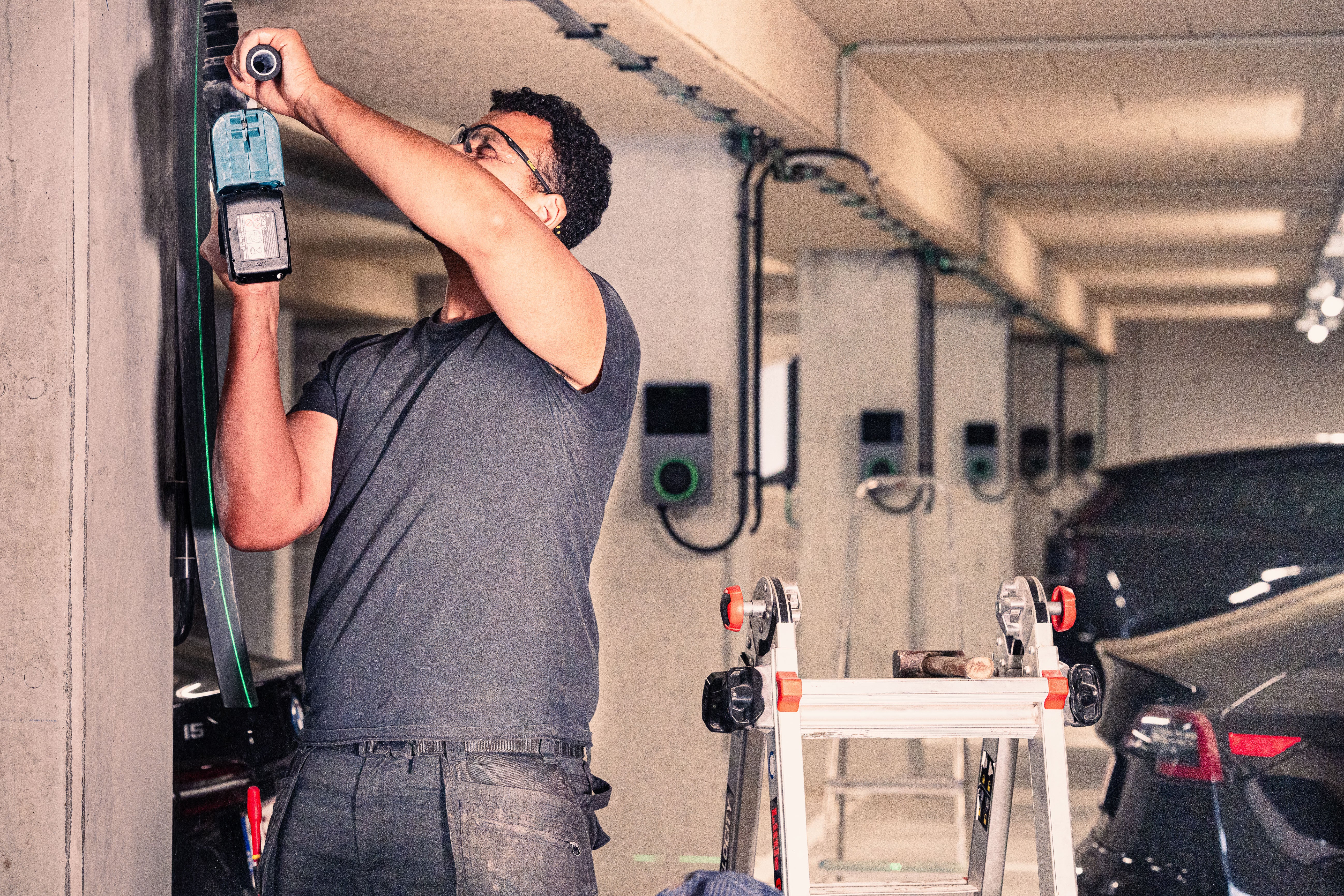


Do you ever experience that slight feeling of 'charging stress' when you wonder where the next charging point is? It is a feeling most electric vehicle (EV) drivers are familiar with. But here in Belgium, the charging landscape is expanding so rapidly that this old concern is gradually becoming a thing of the past. This guide provides practical, realistic advice to help you find your way through the network of charging stations for electric cars in your neighborhood, so that you always feel confident and in control.
Your guide to effortless charging in Belgium
Electric driving in Belgium should be simple, and fortunately, it is becoming easier every day. Thanks to the rapid expansion of public charging infrastructure, finding a reliable charging point is no longer a headache, whether you are commuting or making a longer journey. Consider this guide your expert co-pilot, helping you master e-mobility.
We go over the essential things you really need to know – from using the best apps on the market to understanding the difference between the various charging station types. The goal is to go beyond just the find of a charging station and making smart charging decisions that save you time and money. For example, it makes a huge difference to your planning and your wallet whether you look for a fast DC charger or use a standard AC charger.
If you know the tricks of the trade, the whole process is incredibly simple. It is actually a dance in three steps.
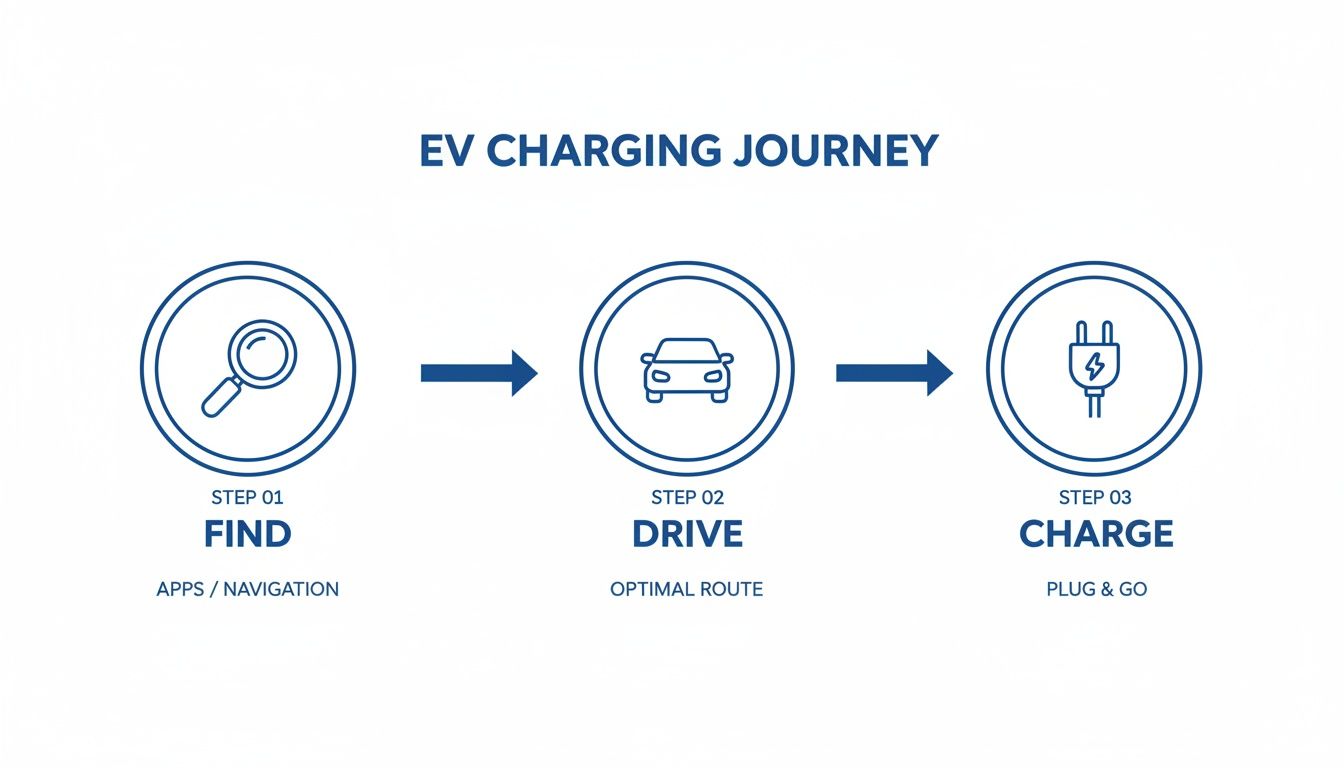
Everything starts with finding a suitable charging station, driving there, and starting the charging session. Modern tools have made this entire process extremely efficient.
These principles apply both to the individual driver planning a weekend getaway and to the fleet manager coordinating multiple vehicles. Self-confidence stems from having the right information at the right time.
Take a fleet manager who is responsible for 20 vehicles. By incorporating optimal charging stops into the routes, he can realize enormous annual savings on energy costs and reduce driver downtime. This type of planning is not only practical; it is a core strategy for the company.
This guide provides you with the practical knowledge to make every charging session a smooth and predictable part of your routine.
When you are looking for an electric vehicle charging station nearby, a generic pin on the map is the last thing you want. Although standard navigation apps like Google Maps are getting better at showing charging locations, they are not sufficient for the serious EV driver, especially if they depend on their car for work.
For a seamless experience, you need a specialized EV app. This is where a tool like the Blulinc app proves its value. It is not just about access to a gigantic network of more than 900,000 charging points throughout Europe; the real power lies in the details. The best features are those that take the guesswork out of it and save you precious time.
Look beyond the nearest pin
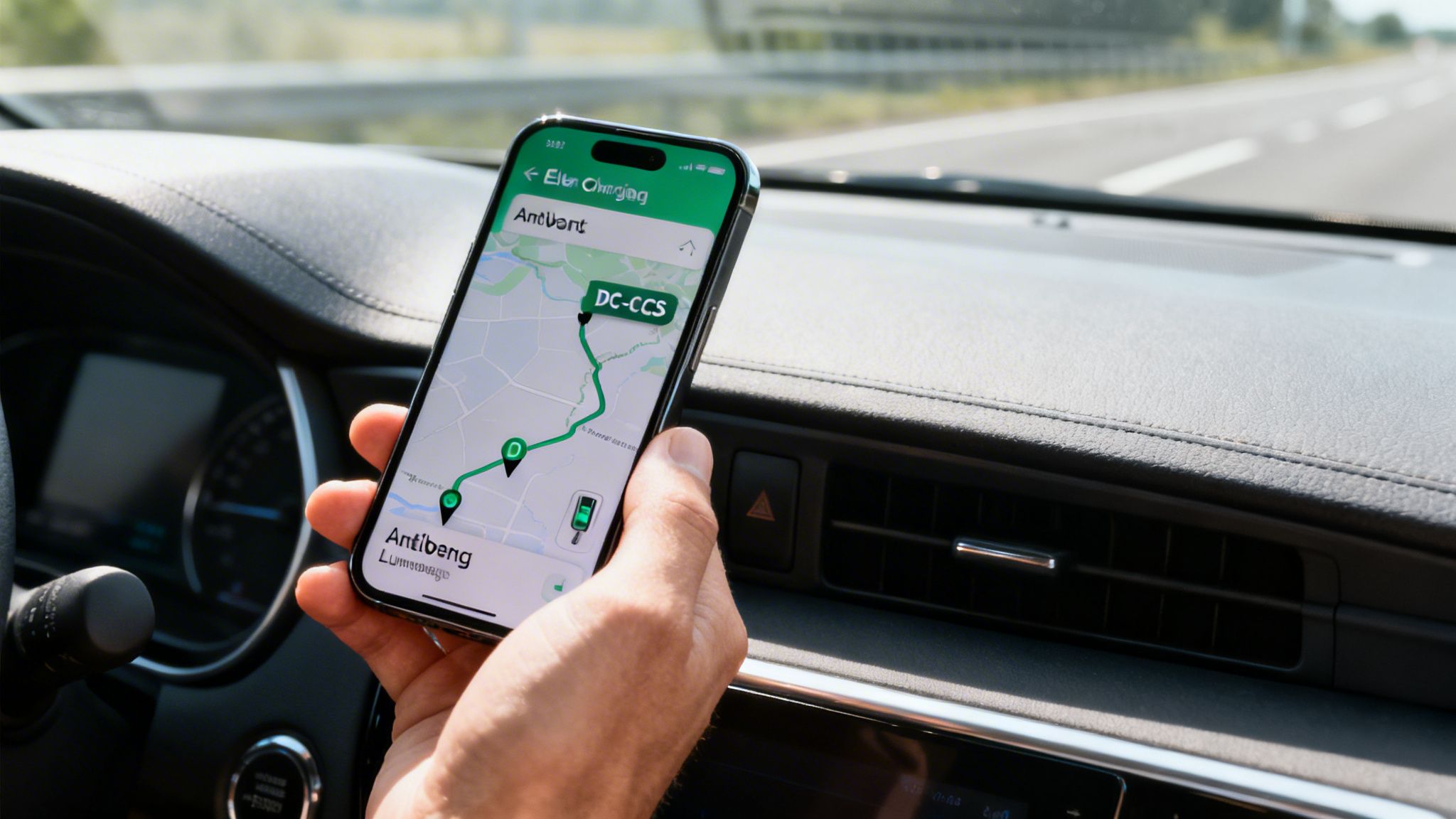
Finding the nearest charging station is one thing. The right one Finding a charging station is a whole different story. With a specialized app, you can filter results based on what really matters for your trip.
Imagine a sales representative driving from Antwerp to Luxembourg for an important meeting. Time is short, and a quick charge is necessary. With the Blulinc app, he can effortlessly find a compatible charging station using advanced filters.
- Filter by power: He can focus on DC fast chargers (50 kW or higher) to be back on track quickly.
- Filter by connector type: He can the CCS connector select that matches his car, to avoid compatibility problems.
- Check real-time availability: The app shows whether a charger is in use, which prevents a frustrating detour to an occupied point.
This level of detail transforms route planning from a reactive search into a proactive strategy. The driver can confidently choose a fast charger along their route, in less than 30 minutes carrying a substantial load and still arriving at his meeting on time. It is all about making smart, informed decisions along the way.
General map apps are useful for getting from A to B, but often lack the details that EV drivers really need. Specialized apps are built from the ground up with the electric driving experience in mind.
Comparison of features in charging apps
| Function | General map apps (e.g. Google Maps) | Specialized EV apps (e.g. Blulinc) |
|---|---|---|
| Find location | Yes, shows nearby charging stations. | Yes, extensive database. |
| Real-time availability | Limited or often inaccurate. | Yes, shows live status (available/busy). |
| Filter by connector type | Basic filters available. | Advanced filtering for all types (CCS, CHAdeMO, Type 2). |
| Filter by loading speed | Often absent or unreliable. | Yes, filter by kW (AC, DC fast, ultra-fast). |
| Price information | Sometimes available, but not always up-to-date. | Detailed, often real-time prices visible. |
| Paying via the app | Usually not supported. | Yes, start, stop, and pay for sessions directly in the app. |
| Route planning with charging stops | Yes, it is possible to add charging stops. | Yes, with smart suggestions based on range and charging speed. |
| Network integration | Shows various networks, but without integration. | Seamless integration with a single network for a consistent experience. |
As you can see, a specialized app for anyone serious about electric driving offers the essential tools that make the difference between a smooth and a stressful ride.
The power of an integrated network
An app connected to a large network offers more than just a card; it delivers a consistent, reliable experience. You can view prices, start and stop a session, and handle payments, all in one place. That is a world of difference compared to juggling a dozen different apps and RFID cards.
Of course, technology isn't everything. As soon as your app leads you to the location, it is the classic wayfinding signage which guides you the final meters. Clear signs in a large parking garage or on complex grounds are the perfect complement to the digital tool and ensure that you drive directly to the charger without hesitation.
Understanding the different types of charging stations
When you search for "charging stations for electric cars in my area," you will quickly notice that they are not all the same. Knowing the difference can save you a lot of time and prevent frustration on the road.The two main types you encounter are AC (alternating current) and DC (direct current) chargers, and they are designed for totally different situations.
Consider AC charging as your stable, overnight option. These charging stations supply power to your car's built-in charger, which then converts it to DC to charge the battery. It is the perfect solution for places where your car is parked for a few hours, such as at the office during the day or at home at night.
DC charging, on the other hand, is all about speed. These are the powerful units that bypass your car's internal inverter and pump direct current directly into the battery. This makes them ideal for a quick charge during a long drive or when you are short on time.
AC chargers: the workhorses for every day
AC chargers are by far the most common type, with a power of 3.7 kW to 22 kW.
- Charging at work: A 11 kW or 22 kW The charger is ideal for an office parking lot. Employees can plug in their cars upon arrival and leave for home with a full battery. It is an excellent, cost-effective way to have your fleet ready to go every morning.
- Charging at home: A 7.4 kW or 11 kW A charging station installed at home offers the ultimate in convenience. Your team can charge at night and benefit from cheaper residential electricity rates.
An SME in Ghent with 10 company cars is installing AC chargers in the company car park. By charging the cars at night, the company benefits from lower off-peak electricity rates. This not only guarantees that every car leaves in the morning with a full battery, but it also results in annual savings of thousands of euros on energy costs compared to public fast charging.
DC fast chargers: the pit stop for speed
DC fast chargers are the powerhouses of the public grid. Their capacity starts at 50 kW and can amount to 350 kW or even more. With this, you add in just 20-30 minutes adds hundreds of kilometers to the driving range.
In this area, the Belgian network is really starting to come into its own. The growth of fast chargers is transforming long-distance travel by EV. The number of ultra-fast charging points (more than 100 kW) rose to in 2024. 3,162 – an impressive increase of 119% in just one year. For fleet managers, this means that reliable, fast charging points "nearby" along highways and at shopping centers are finally a reality. With also 99,341 With AC points available, Belgium has a solid mix for every charging scenario. You can find more details about the evolution of the Belgian charging network at Gireve.com.
Let's return to the example of the SME in Ghent. If an employee suddenly finds himself with a low battery halfway through his route, he does not have to waste time driving back to the office. He can simply stop at a public DC fast charger for a quick boost and continue his appointments without significant delay. It is all about choosing the right charger for the right situation.
Guide to payments and charging etiquette
There is nothing more annoying than arriving at a charging station only to realize you don't know how to pay. In Belgium, the payment landscape is diverse: some charging stations accept credit cards, while others are tied to specific apps per network. This can quickly lead to confusion.
The simplest way to avoid this confusion is with a single charging card that works almost everywhere.This concept, roaming named, makes solutions like the Blulinc charge card so convenient. It frees you from juggling multiple apps and payment methods. You get a simple 'tap-and-charge' experience, wherever you are. Read more about how this works in our guide on Blulinc charge cards and their flexible payment options.
Your public charging bill deciphered
When you charge at a public charging station in Belgium, the final cost involves more than just the electricity consumed. To avoid surprises on your bill, it is useful to understand the various components of the total price.
- Price per kWh: This is the main cost for the energy your car consumes, comparable to paying for liters of fuel.
- Session or start rate: Some networks charge a small, one-time fee for starting a charging session.
- Time rate: Although less common, some chargers bill per minute, either on top of the kWh rate or not.
- Occupancy rate (Idle fee): This is important. If you leave your car parked after it is fully charged, a fine may be charged for every minute the charging spot is unnecessarily occupied.
For a company, these unpredictable public charging costs can throw budgets into disarray. A fleet of only 10 Vehicles relying on public DC fast chargers can easily see monthly costs fluctuate by hundreds of euros, depending on the networks used and the associated rates.
The unwritten rules of loading
In addition to the financial aspect, a little courtesy helps keep the public charging network running smoothly for everyone. The golden rule is: Move your car as soon as it is sufficiently charged. A charging bay is not a parking space. By leaving your car there, you block other drivers who may urgently need to charge.
Another sign of courtesy is to leave the charging station tidy. Roll up the cable after use and place the connector back in the holder. This prevents tripping and protects the equipment from damage, ensuring the charging station remains operational for the next user.
Charging at work: the ultimate convenience
Searching for "electric car charging stations in my area" is fine for on the go, but running a business that relies exclusively on public charging stations often leads to inefficiency and high costs.
The real breakthrough for any company is its own charging infrastructure on the work floor. For your employees, it is a fantastic benefit. For your fleet, it is the guarantee that every vehicle starts the day with a full battery, at a predictable and much lower cost.
Relying on public chargers means you always pay a premium. Public DC fast charging can easily cost more than double what you would pay at your own location with commercial electricity rates. For companies ready to make the switch, the installation of secure charging units the first crucial step.
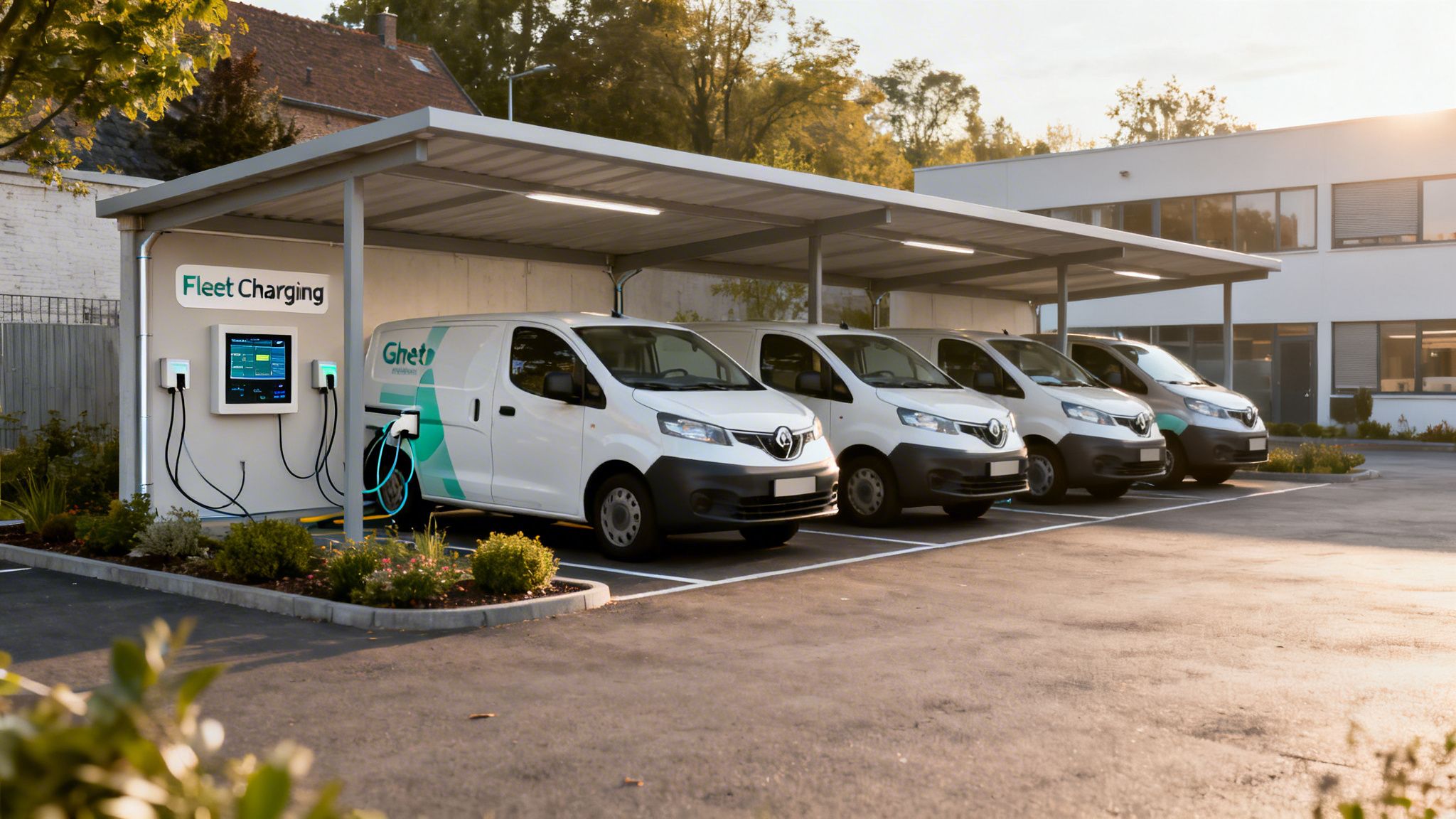
Control over your energy costs creates a powerful, self-sufficient ecosystem for your business.
A Belgian practical example
Let's put this in perspective. Imagine a medium-sized company in Ghent with a fleet of 15 company cars. Installing charging stations at the office immediately creates significant operational benefits.
- Significant cost savings: They can have all vehicles charged at night and thus take full advantage of cheaper off-peak electricity rates. This simple strategic shift can reduce their fleet's energy bill by 30-50% lower compared to using public fast chargers during the day.
- Guaranteed availability: No more wasted time. Every vehicle is ready at the start of the workday with a full battery. This eliminates productivity loss caused by drivers having to search for public charging points and wait.
- A valued benefit for employees: In a competitive labor market, offering charging facilities at work is a tangible benefit that helps attract and retain top talent.
This is not just about making life easier; it is a strategic move that directly improves your bottom line and makes your entire operation run more smoothly.
Smart solutions for your business
Modern charging infrastructure at work is much more than a wall socket. At Blulinc, we provide complete, turnkey solutions that encompass everything from the initial consultation and installation to daily operation. One of the most critical components of this is smart load management.
What is Smart Load Management? It is the technology that intelligently distributes the available electrical power across all connected chargers. It prevents overloading your building's power grid – even when many vehicles are charging simultaneously – and helps you avoid costly electrical upgrades, while everything continues to run smoothly.
This intelligent system means you can easily expand your charging infrastructure without having to worry about tripping a fuse. It automatically adjusts the charging speed for each vehicle based on the total available power.
With your own installation at work, you are no longer at the mercy of the public grid. You become the master of your own charging ecosystem: you manage the costs, guarantee vehicle availability, and prepare your company for a fully electric future.
A question about finding a charging station?
Switching to electric driving is exciting, but naturally raises questions. We often hear these questions from Belgian drivers and fleet managers, so let's clarify the most common ones.
What should I do if a charging station is not working?
It has happened to all of us: you arrive at a charging station, plug in your car, and… nothing happens. This is incredibly frustrating. First, look at the charger's screen. Often, an error code or a message is displayed that gives a hint about the problem.
If the screen is blank or the unit is unresponsive, look for a support phone number on the charging station itself. Most chargers in Belgium have one. By calling, you not only receive on-site assistance, but the problem is also recorded so that it can be resolved faster. Of course, the use of an app such as Blulinc which shows the real-time status of chargers, help you avoid this problem by leading you directly to a working unit.
How accurate are the maps from charging apps?
In general, specialized EV charging apps are your most reliable source. They receive their data directly from the charging networks, which means that information regarding location, availability, and operational status is usually correct.
A general app like Google Maps might show where a charger is, but often lacks live data. You could drive there only to discover that the charger is occupied or out of service. For your peace of mind and to avoid a wasted trip, always use an app developed specifically for EV drivers.
Can I reserve a public charging station in advance?
For the most part, public charging stations in Belgium operate on a first-come, first-served basis. Although being able to reserve a spot is a good idea, this is not yet a standard feature in the public network.
That being said, technology is constantly evolving. Some specialized solutions, particularly those aimed at commercial fleets and logistics hubs, are starting to roll out reservation systems. However, for the daily driver, the best approach is still to use a solid app to find an available charger in real time.
An important tip for fleet managers: although public reservations are rare, setting up your own reservable charging system at your depot gives you complete control and certainty. This is one of the biggest advantages of having your own charging infrastructure.
Why does my charging speed vary so much?
You have probably noticed that your car does not always charge at the maximum speed advertised by the charging station. This is completely normal and has several causes.
- The temperature of your battery: If your EV's battery is too cold or too hot, the system will deliberately slow down the charging speed to protect the battery.
- Your current charge level: Charging is fastest when your battery is between 20% and 80% is full. As the battery 100% as it approaches, the speed drops significantly to protect the battery cells.
- Shared assets at the location: Some charging points distribute their power across two parking spaces. If another EV connects next to you, your charging speed can be halved.
Knowledge of these factors helps you have more realistic expectations regarding the duration of a charging stop.
Ready to get a grip on your charging strategy? Whether it is for your company fleet or your employees, Blulinc offers the expert guidance and turnkey solutions you need to make electric charging simple, reliable, and cost-effective.