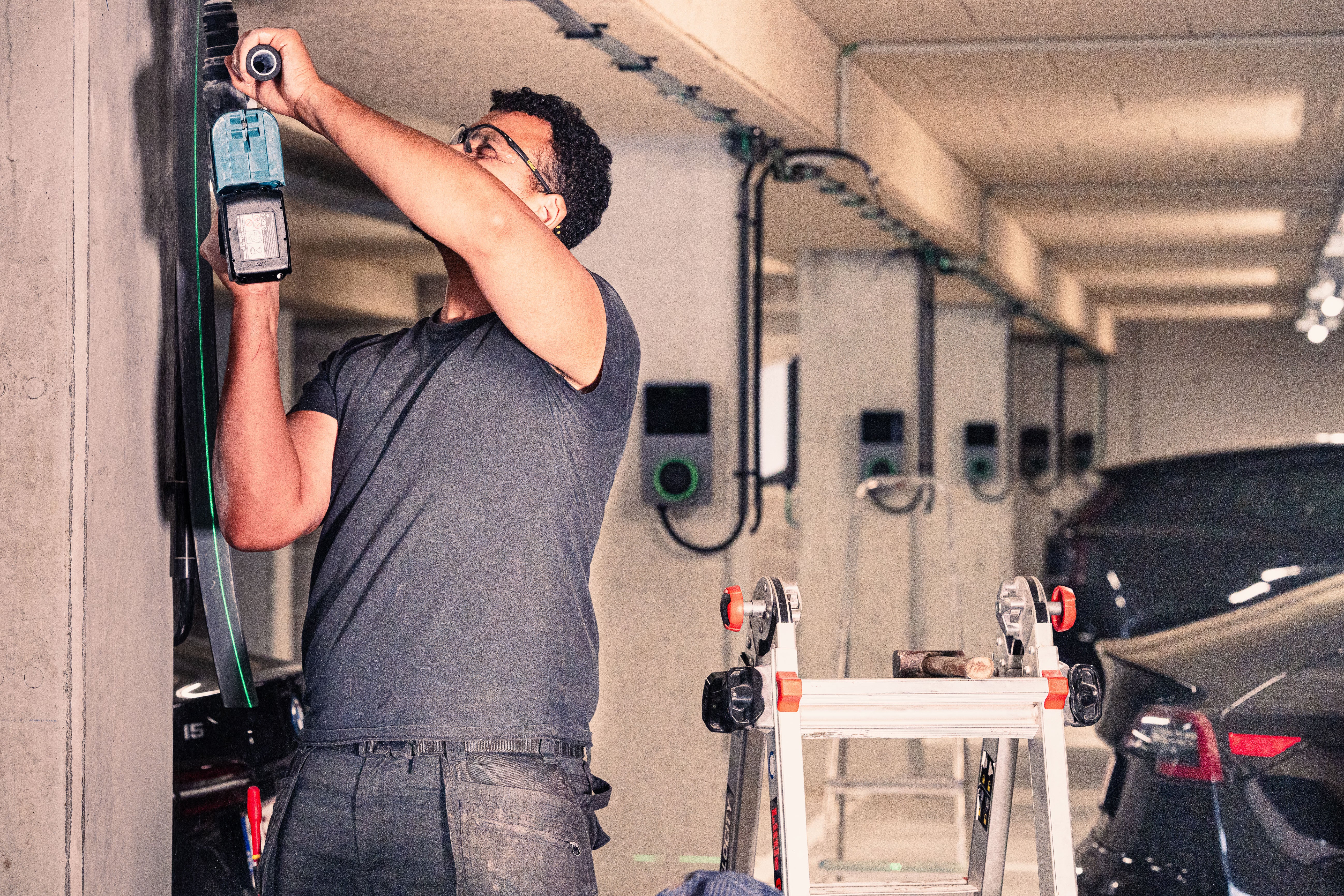

A smart charging station? What is it and how does it work?
We are all familiar with charging stations by now, but did you know that smart charging stations already exist? These are becoming increasingly intelligent when it comes to charging. For instance, they charge when electricity is affordable, allowing you to charge more cheaply, and in the future, it will likely even be possible to store and utilize solar energy.
A smart charging station thinks along.
A smart charging station from Blulinc knows when it is economical to charge at off-peak rates. This allows you to save on electricity costs and also relieves the strain on the electricity grid during peak times. But that is not the only thing a smart charging station from Blulinc takes into account. For instance, if you have solar panels, you can also indicate that solar panel energy is preferred when available. Often, an app allows you to specify when your car needs to be fully charged, so that the smart charging station from Blulinc can perfectly determine which energy to use: renewable or from the grid. Additionally, it can take into account other appliances that consume energy in the home. If other appliances consume a lot of energy, car charging can be scaled back to prevent overloading. In technical jargon, this is called 'load balancing'.

Is smart charging going to fully break through?
But it doesn't stop there; looking to the future, even more will be possible. For instance, a smart charging station from Blulinc will not only be able to charge your car but also use energy from the vehicle to absorb peaks or during a power outage. Moreover, you could even use your car's battery to store excess energy. Think, for example, of wind or solar energy that you cannot use immediately. This is called bidirectional charging, and the technology is also known as vehicle-to-grid. Currently, this is still used only sparingly. This is logical, because you need a special charging station that supports bidirectional charging. Furthermore, it is not just the charging station that needs to be capable of this; your car must support it as well. Today, there are only a handful of models that can do this.