

Ever typed "charging stations nearby" into your phone in mild panic? You are not alone. Good news: for electric drivers in Belgium, finding a charging point is becoming easier every day, thanks to a fast-growing network. The question is no longer or you find a charging station, but which best suits your needs.
The Public Charging Network in Belgium at a Glance

The search for a public charging station is becoming less of a hunt and more of a simple choice. Belgium has made a huge leap forward in expanding its charging infrastructure, which is crucial to supporting the national transition to electric driving. You can see this growth everywhere, from the busy city centers in Flanders to the winding roads in the Ardennes.
How fast is the network growing? The figures are impressive. The number of public charging points is expected to explode from approximately 50,000 in April 2024 to more than 100,000 by early 2026.
That is a doubling in less than two years, placing Belgium among the European leaders. It gives us a remarkable density of 7.6 charging points per 1,000 inhabitants. You can find more details about the expansion of the Belgian charging network with our colleagues at Electricity.
What Types of Chargers Will You Find?
Not all chargers are created equal. Knowing the difference is essential for planning your trips smoothly. On the road, you will mainly encounter two types:
-
AC chargers (Standard Charging): These are the most common charging points you see in supermarket car parks, at office buildings, and in residential areas. With a capacity of 11 kW to 22 kW They are perfect for charging your battery while you are working, running groceries, or parked for a few hours.
-
DC chargers (Fast charging): These are the powerhouses. You will find them mainly along highways and major traffic arteries. These powerful chargers deliver 50 kW up to 350 kW. They can charge your EV's battery to 80% in just 20 to 40 minutes, making them indispensable for long distances.
To make it even clearer, below you will find a handy overview of what you typically find in Belgium.
Overview of Public Charging Station Types in Belgium
This table provides an overview of the public chargers you will encounter, what they are most suitable for, and an indication of the costs.
| Charging station type | Power (kW) | Best for | Avg. cost per kWh |
|---|---|---|---|
| AC (Standard) | 11 - 22 kW | Recharge during work, shopping, or at night | €0,40 – €0,55 |
| DC (Fast) | 50 - 150 kW | Fast charging stops during longer journeys | €0,55 – €0,75 |
| DC (Ultra-fast) | 150 - 350+ kW | Back on the highway as soon as possible | €0,60 – €0,85+ |
These figures are a guideline, but they give you a solid basis of what to expect when you start charging.
How Much Does Public Loading Cost?
The price you pay at a public charging station can vary, but it is good to have an idea of the going rates. As a general rule, standard AC charging usually costs between €0,40 and €0,55 per kWh.
You pay a little more for the convenience of DC fast charging.The rates are usually between €0,55 and €0,75 per kWh, which reflects the higher speed and more expensive hardware.
This basic knowledge – the types of chargers and their costs – is the first step towards a stress-free EV experience. Armed with this information, you can make smarter choices that fit your schedule and budget.
Let's now look at how you can use the right tools to find the perfect charging location every time.
Finding the Perfect Charging Station with the Right App
Your smartphone is your best friend for avoiding charging stress and ensuring a smooth journey. Gone are the days of driving around hoping to spot an available charging station. With the right app in hand, you can find the perfect charging location from anywhere, turning the search for "car charging stations nearby" into a simple two-minute task.
Modern charging apps, and the Blulinc app in particular, are changing the way you use the public charging network. They act as your central hub for finding chargers, not just around the corner in Belgium, but throughout Europe. Forget gambling on station availability; you can see the real-time status before you even leave.
Filter Your Search for the Right Match
The secret to a quick and efficient charging stop is finding a station that suits your car, your schedule, and your budget. A good app lets you refine your search based on what really matters.
-
Connector type: Does your EV use a Type 2 connector for AC charging or a CCS connector for DC fast charging? By filtering by connector type, you will only see compatible stations. A simple click that saves you the frustration of arriving at a station with the wrong plug.
-
Loading speed: Are you in a hurry and do you need a quick boost of 30 minutes Do you need a DC fast charger, or do you have a few hours for a slower AC charge? You can filter by power (kW) to find a charger that fits your schedule.
-
Network operator: If you have a subscription or a preference for a specific provider, you can often filter the map to show only their stations.
This level of control is what distinguishes a planned, stress-free stop from a disorganized search. You are at the wheel, both literally and figuratively.
The Blulinc app, for example, gives you a clear map with all these filters at your fingertips.
This visual layout means you can immediately see the charging station density in an area and choose the best one for your specific needs on that trip.
Check Availability and Prices in Realtime
Perhaps the most crucial function of any charging app is showing real-time availability. There is nothing as frustrating as arriving at a charging station and discovering that every spot is occupied, or worse, that the charging point is out of service. A quick glance at the app confirms whether a station is available, in use, or offline, so you can choose a reliable option and even have a backup plan.
Price transparency is just as important. A reliable app must clearly display the charging rate. before you plug in. This helps you control costs and avoid unpleasant surprises, as prices can vary significantly between different operators. Usually, you see a breakdown of the price per kWh, any start-up fees, or time-based costs directly in the app.For those seeking the best value, especially when it comes to speed, you can find out more in our guide on finding fast charging stations nearby.
All this information—location, compatibility, availability, and costs—in one place gives you the confidence to plan your rides with absolute certainty. It is the difference between hoping for the best and knowing what to expect.
Ensuring a Smooth Charging Session, Every Time
Okay, you have found an available charging point. Perfect. But what happens once you are parked? Knowing exactly how to start and stop a charging session is the key to a worry-free experience, so you can get back on the road with confidence. Fortunately, the process is designed to be simple and intuitive.
Once at a public charging point, there are usually two ways to start charging. You can either scan the QR code on the station with the Blulinc app on your smartphone, or simply hold your physical charging card against the designated reader. Both methods authenticate your account immediately, after which the charging port unlocks and you can plug in the car.
Ending the session is just as easy. Use the app again or present your charging card. The station cuts off the power supply, unlocks the cable, and the costs are automatically settled via your Blulinc account. No hassle.
Reserve Charging Points for Optimal Planning
In busy city centers or for commercial fleets, such as trucks, finding a free charging point can sometimes be a challenge. That is why we see the option to reserve charging points becoming increasingly popular in Belgium. It offers that much-needed guarantee that is essential for tight planning.
With this feature, you can claim a specific charging point for a certain time slot via an app. This eliminates all uncertainty and guarantees that the charging station is available for you when you arrive. For fleet managers, this is a real game changer, as it vastly simplifies the logistics of charging multiple vehicles.
The process below shows how to find the right charging station, a process that becomes even more efficient with reservation options.

These visual steps – filtering by your needs, checking the live status, and viewing the price – form the basis for every successful search for a nearby charging point.
Etiquette at the Charging Station
A charging station is a shared facility. By following a few simple rules of courtesy, we make the experience much more pleasant for everyone. Our experience with thousands of Belgian EV drivers shows us that the following points make the biggest difference:
- Manage the cable: Always roll up the charging cable neatly after use and hang it back on the holder. A loose cable is a tripping hazard and can be damaged by the weather or if someone drives over it.
- Respect the time: Move your car as soon as it is sufficiently charged, especially at fast chargers. This frees up the spot for the next person. Some operators even charge occupancy costs on if you stand too long.
- Avoid 'ICEing': Blocking a charging spot with a non-electric vehicle (an 'Internal Combustion Engine' or ICEis a major source of frustration. Only park in a charging spot if you actually intend to charge.
Good charging etiquette is not just about politeness; it is essential for the efficiency and accessibility of the entire public charging network. A small effort by every driver has a large, positive impact on the entire community.
Smart Charging Solutions for Workplace and Fleet

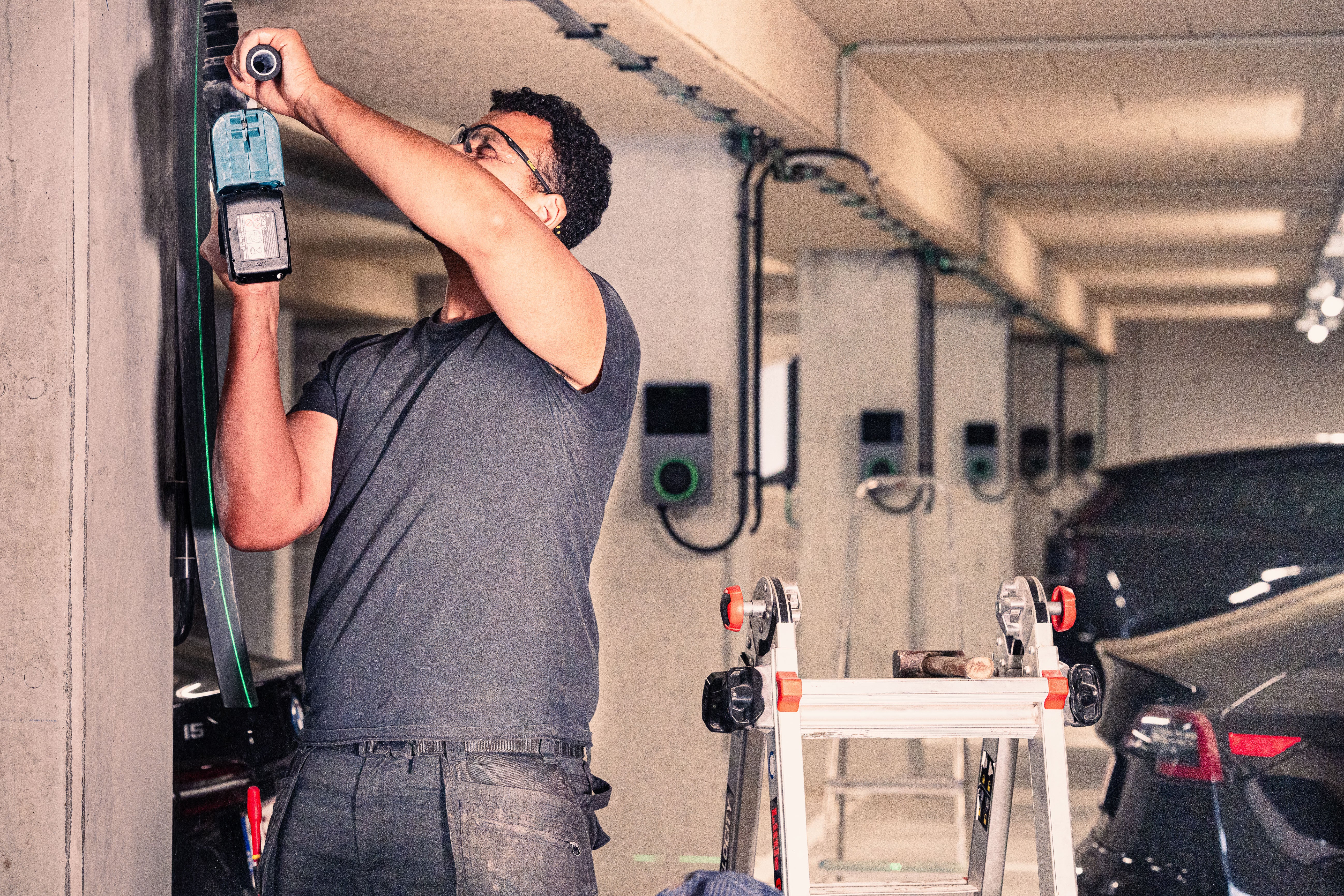
Is your team constantly searching for "nearby car charging stations"? This is not just a personal inconvenience for your drivers; it is a real logistical puzzle for your company. As a fleet manager or employer, you have the power to turn this challenge into a strategic asset. The real solution is not an endless search for public charging points, but creating your own reliable charging network, right on the work floor.
Installing charging stations in the company car park offers immediate, tangible benefits. It sends a powerful message about your commitment to sustainability and is a highly valued benefit that helps attract and retain top talent. For employees with an electric company car, charging stress disappears completely. They arrive at the office, plug in, and leave at the end of the day with a full battery.
The Benefit for Companies and Fleets
The benefits of charging at work go far beyond simply making your staff's lives easier. It is a direct path to higher operational efficiency and significant cost savings.
Imagine: an SME in Ghent with a fleet of 10 electric delivery vans. Without on-site charging points, their drivers are at the mercy of public networks. This means lost productive hours and unpredictable, often higher, charging costs.
By installing smart charging stations in its own parking lot, this company can charge its vehicles at night or during office hours at a much lower electricity rate. This not only centralizes operations but also leads to a significant reduction in Total Cost of Ownership (TCO) of the fleet. Suddenly, you regain full control over your charging costs.
Charging-as-a-Service: The Accessible Solution
We understand. The initial investment for the purchase and installation of charging infrastructure can seem like a major hurdle. That is precisely why we offer a flexible Charging-as-a-Service (CaaS) model on, designed to completely eliminate those high start-up costs.
With CaaS, you simply pay a fixed monthly amount. We take care of everything else:
- Installation: Our experts install all hardware, so you don't have to worry about technical details.
- Management: Through our platform, you monitor every charging session, manage costs, and gain access to clear, insightful reports.
- Maintenance: We ensure that the charging stations are always online, up-to-date, and working perfectly.
This model makes professional charging infrastructure accessible to every company, regardless of size. It transforms a major capital expenditure into a predictable, manageable operational cost.
Automatic Refund for Home Charging
One of the most powerful advantages, certainly within the Belgian tax landscape, is the ability to allow employees to charge their company cars at home and have the costs automatically reimbursed. It has quickly become a cornerstone of modern cafeteria plans and compensation packages.
Our platform can automate this entire process. An employee with a Blulinc home charging point charges their company vehicle. The system records the energy consumed and triggers an automatic reimbursement of electricity costs directly to the employee. This is then consolidated into one clear invoice for your company. This eliminates administrative hassle and offers a seamless, transparent solution for all involved.
Understanding and Managing Your Charging Costs
The final price on an invoice for public charging can sometimes come as a surprise. With various cost components, it is not always clear exactly what you are paying for. For every company, it is essential to keep these costs under control to protect the TCO benefit that makes your electric fleet so attractive.
When you charge at a public station, the price is more than just the electricity. Various components can influence the total, and knowing what they are helps you avoid unpleasant surprises.
Decipher Your Charging Invoice
Let's take a closer look at the most common components you might encounter on an invoice. Understanding what they mean for your total cost is the first step towards smarter charging.
Here is a breakdown of the typical components of your bill at a public charging station in Belgium.
| Cost component | What it is | Typical range in Belgium |
|---|---|---|
| Price per kWh | This is the core cost for the energy your vehicle actually consumes. It is almost always the largest part of your bill. | €0,40 – €0,85 |
| Starting rate | A one-time, fixed amount that is charged as soon as you start a charging session, regardless of how much energy you consume. | €0,50 – €1,00 per session |
| Time rate | A rate per minute for the time your vehicle is connected, sometimes on top of the kWh price. | €0,01 – €0,10 per minute |
| Occupancy cost | Consider this a fine. It is intended to prevent drivers from leaving their cars parked long after they are fully charged. | Can be high, e.g. €0,25+ per minute |
Once you know this, you can make better decisions on the road. A station without a starting fee can be cheaper for a quick 20-minute top-up, but for a full charge, a lower kWh price is usually more important, even with a small starting fee.
Total Transparency and Control for Your Fleet
For a fleet manager, tracking these varying costs across dozens of drivers, vehicles, and charging networks can quickly become an administrative nightmare. This is precisely where a unified management platform is not only convenient but essential. It brings together every charging cost – whether at the office, at an employee's home, or at a public station – into one clear, simple overview.
True cost management is not just about finding the cheapest charger; it is about complete visibility and control over every euro spent, wherever your team charges.
Our platform allows you, for example, to set specific rules for your drivers. Suppose you want to keep the charging costs of your field service employees under control. You can easily set a spending limit of €150 per month set this on every employee's charge card. As soon as that limit is reached, the card is automatically blocked until the next month. No more unexpected overruns.
This is the kind of detailed control that keeps your fleet's operational costs predictable and perfectly aligned with your financial forecasts. For more insights on this, you can consult our guide on the advanced management options for Blulinc charging cards explore. By mastering these tools, you can truly optimize your charging strategy and protect the financial benefits of your electric fleet.
Frequently Asked Questions About Electric Charging in Belgium
The switch to electric driving naturally raises quite a few practical questions, both for individual drivers and for companies greening their fleets. Here, we dive into the most frequently asked questions we receive daily at Blulinc, so you can hit the road with peace of mind.
What If A Charging Station Is Occupied Or Defective?
It is a scenario every EV driver dreads: you arrive at the planned charging point, only to find it is already in use or out of service. The best approach is to stay ahead of this problem. By checking the real-time status in advance using an app, such as the one from Blulinc, you know immediately whether a charging point is available. This way, you avoid an unnecessary detour.
Are you faced with a surprise after all? Don't panic. Via the app, you can immediately start a new route to the nearest available charging station. Sometimes a charging spot is occupied by a non-electric car (a phenomenon known as 'ICEing'). In that case, your options are more limited. You can report this to the owner of the premises, such as a supermarket car park, but it is always smarter to already have a plan B in mind.
How Do I Easily Manage Employee Charging Costs as a Company?
For companies that want to keep a grip on charging costs, a central management platform is the only way forward. With the Blulinc platform, you issue charging cards to your employees, complete with pre-set budgets or usage restrictions. This gives you full control over expenses.
All charging sessions – whether at home, at the office, or on the road – are automatically and centrally recorded. At the end of the month, you receive one clear, consolidated invoice. This not only makes reimbursement for home charging a breeze but also provides you with a clear overview for comprehensive budget control.
Are There Different Types of Plugs in Belgium?
Yes, but fortunately the situation is much simpler than it sounds. In Belgium, and actually throughout Europe, the Type 2 plug the standard for normal AC charging. Almost every public charging station and most modern electric cars are equipped with this.
For DC fast charging, which you mainly find along the highway, the 'CCS' plug has become the standard for most car brands. Your car is equipped with one of these two types in any case. Are you unsure? Your car's manual states exactly which type you need. Moreover, you can easily filter by plug type in charging apps, so that you are only directed to charging stations that are compatible with your car.
Ready to streamline your company's loading logistics and optimize costs? The team at Blulinc is ready to guide you through the world of e-mobility. Request a free consultation today and discover the charging solution that perfectly suits your fleet.