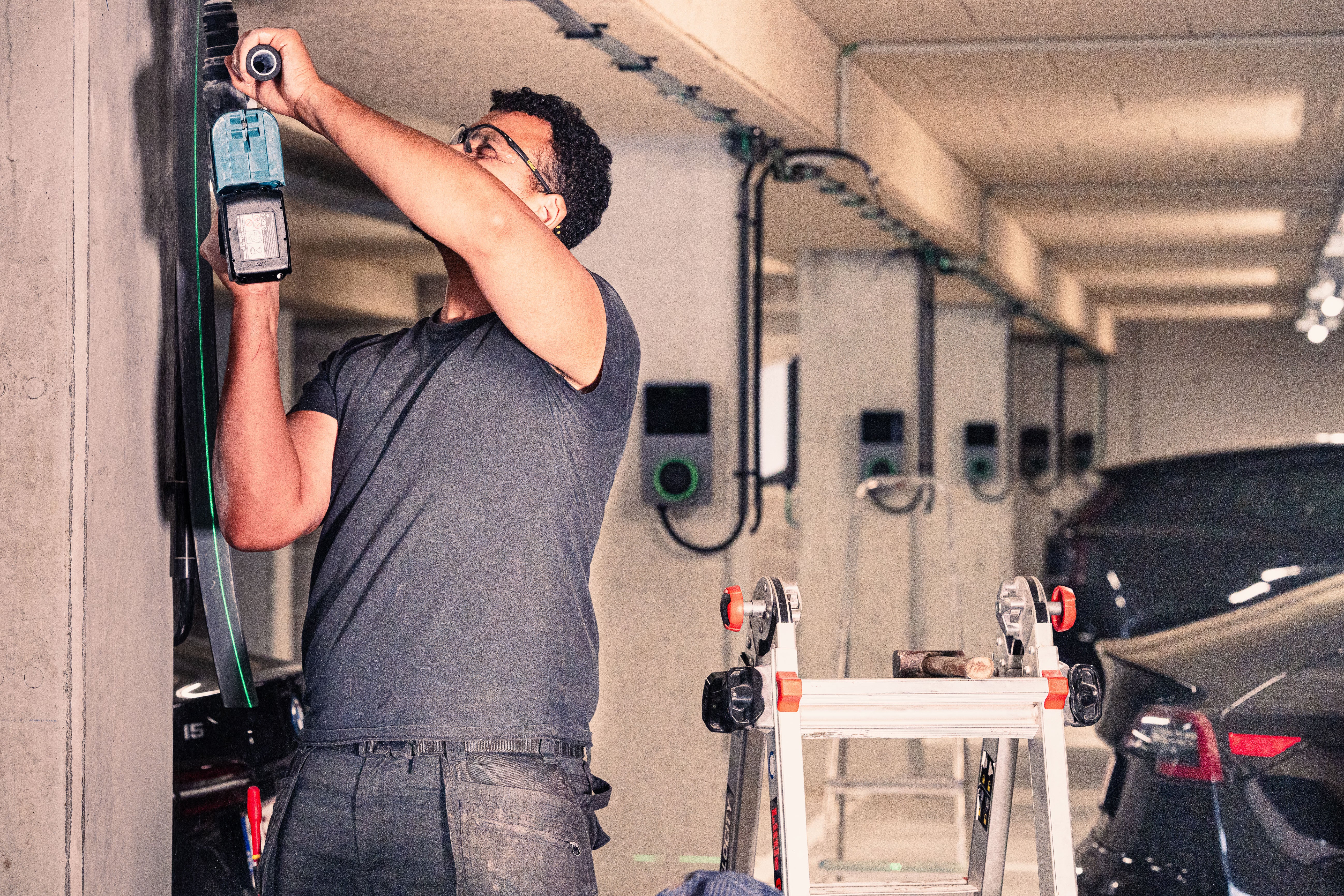


The quick search for “charging stations in your area” still causes a slight tension for many drivers. But that uncertainty is quickly a thing of the past. In Belgium, finding a charging point is easy these days. just as easy as finding a gas station. Thanks to explosive growth in infrastructure, you can hit the road with peace of mind.

From charging stress to charging convenience in Belgium
The worry about finding a charging station is a familiar feeling, but the reality on Belgian roads has changed drastically. The days when you had to carefully map out your route around a handful of scarce charging points are over. Belgium has become one of Europe's leaders in charging infrastructure, making the switch to electric driving more reliable and carefree than ever.
This is not an abstract idea; it is supported by impressive figures. The Belgian charging network has experienced spectacular growth in recent years. In 2024, Belgium already counted more than 100,000 public and semi-public charging points—a huge leap from the approximately 44,000 publicly accessible charging points in 2023. This means that capacity has more than doubled in just two years. You can view the details of this record growth on the European Alternative Fuels Observatory website.
A dense network across the entire country
This growth is not concentrated in a single region, but spread across the entire country. Flanders leads the way with roughly 60,000 charging points, followed by Wallonia with about 13,000 and Brussels with around 10,000. This wide distribution ensures that, wherever your journey takes you, you are rarely far from a charging point.
Belgium now ranks third in Europe in terms of charging density, with 7.6 charging points per 1,000 inhabitants. Only the Netherlands and Denmark are doing better.
This progress has direct benefits for both private drivers and businesses. For a fleet manager, it means fewer logistical headaches and greater operational efficiency. Employees can hit the road with peace of mind, knowing that there is always a "charging station nearby."
For private individuals, this translates into the freedom to take spontaneous trips without the constant fear of a dead battery. The question is no longer or you will find a charging point, but which fits your schedule best.
Choosing the right charging station for your trip
Finding a charging station is one thing; the right one Finding a charging station is what makes your EV experience smooth and efficient. Not all charging points are created equal, so let's go over the options to help you make the best choice for every trip.

You will generally encounter two main types of public charging stations: AC (alternating current) and DC (direct current).
Consider AC charging as the stable, reliable option. It is perfect for charging your battery while you are at the office, doing your weekly shopping, or parked overnight. It is the most common type and ideal for longer stops where time is not a major factor.
DC chargers In contrast, there are the sprinters. Often called fast chargers or ultra-fast chargers, they deliver a serious power boost in a short time, so you are back on the road quickly. These are your best friends when you are on a long drive and need a quick charge.
Matching the charger to your schedule
Let's take a typical workday as an example to see how this works in practice. Suppose you are a sales representative for a Ghent-based SME and you are driving from Antwerp to Liège for two client appointments.Your schedule is tight and every minute counts.
- Morning boost: After your first appointment in Antwerp, you notice that your battery is a bit low than desired. You have only 30 minutes before you need to leave for Liège. This is where an app like the one from Blulinc comes in handy: you filter for "DC fast chargers" along your route. While you have a cup of coffee, your car gets a substantial charge, giving you sufficient range for the next part of your journey.
- Afternoon refill: Your second appointment in Liège lasts a few hours. Instead of looking for another fast charger, you can find a standard AC charger near your client's office. This allows you to fully charge the battery at your leisure while you are in your meeting, so that you are ready for the return trip to Ghent without any extra stops.
This type of scheduling transforms charging from a potential problem into a seamless part of your workday.
The diversity of charging technology in Belgium is a major plus here. The network is designed to meet various needs, from quick stops along the motorway to longer parking sessions in the city. The Belgian infrastructure includes three key standards, and the growth in fast charging is explosive. As of 2024, there will be 3,162 fast chargers delivering 100 kW or more in Belgium—a stunning rise of 118.97% in just 12 months. You can learn more about this growth and the benefits for directors on the website of public charging station infrastructure in Belgium on go-electra.com.
Charging types and ideal use scenarios
To make it even clearer, here is a quick comparison of the charging types you will find in Belgium and when best to use them.
| Charger Type | Power (kW) | Avg. Charging time (Full) | Ideal for |
|---|---|---|---|
| AC (Normal) | 3.7 - 22 kW | 4-8 hours | Charging at home at night, at work during the day, or in long-term parking (e.g., shopping centers, cinemas). |
| DC (Fast) | 50 - 150 kW | 30-60 minutes | Quick stops during long drives, at motorway service stations, or when you quickly need a lot of range. |
| DC (Ultra-fast) | 150 - 350 kW | 15-30 minutes | The fastest option, perfect for getting back onto the highway with minimal delay. Ideal for high-performance EVs. |
This table provides a solid framework for deciding which charger best suits your immediate needs, so that you can charge more efficiently.
The main conclusion is simple: AC is for when you have time, and DC is for when you need speed. The right choice saves you both time and, often, money.
By learning to filter by the right connector, power, and even price in your charging app, you take back control. It allows you to plan your day around your schedule, not around your car's battery level. For those specifically interested in fast charging, we have put together a more detailed guide. You might be interested in our article about how to locate fast charging stations near you.
Your essential toolkit for hassle-free public loading
A successful public charging session is not a matter of luck—it is about having the right tools at hand. Consider this your essential kit for navigating the Belgian public charging network.With the right app and charging card, you turn every frantic search for "charging stations in your neighborhood" into a simple, confident action.
The heart of this kit is a powerful mobile app. A specialized charging app, such as the one we offer at Blulinc, acts as your command center for e-mobility. It is much more than just a map with dots; it gives you the crucial, real-time information that makes your journey completely seamless.
Finding more than just a charging station
The most basic task of a charging app is to show you where the charging stations are. But a first-class app goes much further by answering the questions that arise. Real to do when you are on the road:
- Is the charging station available? The app should show you live availability. There is nothing worse than driving to a charging station only to discover that it is occupied.
- How much will it cost? Transparent, live pricing information helps you avoid unpleasant surprises. You should be able to see the cost per kWh, any start-up fees, and potential occupancy costs before you plug in.
- How can I pay? Look for filters that allow you to choose by payment method, whether you prefer using a specific charge card, directly in the app, or a contactless credit card.
Here you can see how a clear, user-friendly interface can present all this information, so that you can make quick and well-considered decisions on the go.
This interface shows exactly how essential details—such as locations, availability, and connector types—can be clearly displayed, so that you can make a quick and informed decision.
The power of a single charging card
While an app is your digital key, a physical charging card is your universal passport. Juggling multiple subscriptions and cards for different charging networks is a headache of the past. A single charging card with extensive roaming capabilities is the new standard for worry-free travel.
The Blulinc charging card gives you, for example, access to an enormous network of more than 900,000 charging points across Europe. This means that whether you are in Brussels, Berlin, or Barcelona, one card is all you will ever need. It completely eliminates the hassle of signing up for multiple services, downloading dozens of different apps, or carrying a wallet full of RFID cards.
Pro tip: Always have a backup plan. Even with the best tools, a charging station can occasionally be out of service. Use your app to identify a second nearby charging option before heading to your first choice. It is a small step that can save you a lot of stress.
Understanding the various payment methods is also essential. While app-based payments and charging cards offer the most integrated experience, most chargers in Belgium now also support ad-hoc payments via QR code and credit card. This is convenient for one-time users but can sometimes be more expensive than using a specialized service.
To learn more about the different types of public charging stations and how to use them, you can consult our guide on electric car charging stations consult. Ultimately, having a reliable app and a universal charging card in your toolkit is the best strategy for effortless public charging.
How the perception and reality of electric charging differ
Is 'charging stress' still a real problem in 2024? It is a question we hear constantly, and frankly, it is often the biggest mental hurdle for drivers considering making the switch.Let's take a look at what people think that charging entails versus daily practice for an EV driver here in Belgium.
The data reveal a huge gap between what people imagine and what drivers actually experience. While many who do not yet drive electric worry about finding an available charging station, satisfaction among those who have already made the switch is sky-high. This is not a feeling; it is a fact. The fear of getting stranded is largely a myth in today's well-connected Belgium.
The trust gap: what the numbers show
Recent studies shed light on how perspectives have shifted. A 2024 study by BNP Paribas Fortis, for example, shows a spectacular transformation. In 2022, only 25% of Belgians felt there were enough charging points. By 2024, that number had doubled to 50%.
But the most telling insight comes from the comparison between general opinion and practical experience. Among current EV owners, satisfaction with the availability of charging points has risen to an incredible level. 95%. If you want to dive deeper into the data, you can read more about the insights on fleet electrification in Belgium from nextmobility.be.
This creates a gap of 45 percentage points between the perception of the general public (50% satisfied) and the reality for EV drivers (95% satisfied). The fear is more psychological than practical.
For any company looking to electrify its fleet, this is fantastic news. It is concrete proof that you can share with employees and stakeholders to reassure them that the charging infrastructure is more than ready. With more than 100,000 charging points For approximately 380,000 electric cars in Belgium, the capacity is clearly available.
All this means that concerns about infrastructure, once a major obstacle, have been largely removed. The way is clear for a smooth and confident transition to electric mobility, whether you are an individual driver or manage an entire fleet. The reality is simple: charging stations in your neighborhood Finding is much easier and more reliable than most people think.
Building your own charging infrastructure
Relying on the public charging network is one thing, but nothing surpasses the control, cost savings, and sheer convenience of having your own charging points at the workplace. For many Belgian companies, the switch from constantly searching for "charging stations in your area" to installing their own hardware is the logical next step. It is about taking control—literally—of your energy management, costs, and accessibility for your entire fleet and team.
The journey from initial doubts about EV charging to the reality of a smooth, integrated system is a common trajectory. We see it constantly.

As the infographic shows, those initial questions and concerns quickly disappear once a solid system is operational. For a company, expanding this infrastructure means that you are finally in the driver's seat of your e-mobility strategy.
Smart charging for business continuity
One of the very first things to consider when installing charging points at work is your building's electrical capacity. You cannot simply plug in a dozen chargers and hope for the best; that is a recipe for blown fuses and potentially huge grid upgrade costs. This is exactly where smart load management becomes essential
A smart charging system, managed via a platform such as that of Blulinc, It intelligently distributes power across all connected chargers. It ensures that every vehicle receives the necessary charge without ever overloading your building's electrical system. The system can even be configured to prioritize specific vehicles or schedule charging during off-peak hours to reduce your energy bill, all without interrupting your daily activities.
A concrete scenario: a Ghent consultancy firm
Let's take a look at how this works in practice. Imagine a consultancy firm in Ghent with 15 employees, most of whom drive an electric company car. They need a charging solution that works seamlessly, both at the office and for those working from home.
- At the office: They decide to install four dual-socket AC chargers in their parking lot. Using the Blulinc platform, their fleet manager easily sets up load balancing to prevent any risk of overloading their electrical connection. They also create a simple rule: charging takes priority around midday, when their on-site solar panels generate the most power. This simple adjustment drastically reduces their dependence on the grid and lowers their energy costs.
- At home: For team members who cannot always charge at the office, the company assists with the installation of a home charging station. These chargers are also connected to the central Blulinc platform. This is the key to effortless expense management, as it enables automatic reimbursement of home charging costs. The system tracks the exact amount of electricity used for the company car and reimburses the employee at a pre-agreed rate. No more spreadsheets and no more administrative hassle.
This integrated approach provides the fleet manager with a complete, real-time overview. He can view every charging session—at the office and at home—from a single dashboard, track total energy consumption, manage all costs, and request detailed reports for tax purposes.
By setting up this combined infrastructure, the Ghent-based consultancy not only offers a fantastic advantage; it also benefits optimally from Belgian tax incentives. The investment in their charging infrastructure is 150% deductible (a rate applicable until August 31, 2024), which significantly reduces the total cost of ownership (TCO) of their electric fleet.
With such a setup, charging is no longer a logistical puzzle. It becomes a strategic asset. It guarantees that every employee has a fully charged vehicle ready, whether at the office or at home, while the company maintains a firm grip on costs and energy consumption. It is the definitive solution for building a future-proof, fully integrated e-mobility strategy.
Your questions about electric charging, answered
To conclude, we address some of the most frequently asked questions we hear from Belgian drivers and companies. The world of electric charging can seem a bit complex at first, but with the right information, everything falls into place. Here are some simple, practical answers to help you charge with complete confidence.
What does the final price of a charging session consist of?
Understanding exactly what you are paying for is crucial. The final cost on your charging receipt is not just about electricity; it is a mix of various factors that can vary by charging station operator.
Your invoice will typically be a combination of:
- Price per kWh: This is the main component of your bill—the cost of the actual energy consumed by your car's battery.
- Session or start rate: Some operators charge a small, one-off fee solely for connecting and starting the charging session, regardless of how much you charge.
- Time-based rates: You can be billed per minute for the duration of your connection. This can be in addition to or instead of a kWh rate.
- Occupancy costs (idle fees): To keep charging stations free, operators sometimes add an "occupancy fee". This is to discourage drivers from leaving their cars parked after they are fully charged.
The best approach? Always check the pricing structure in your app before starting a session. A transparent platform, such as the Blulinc app, clearly displays all these potential costs upfront. No surprises.
What should I do if a public charging station is defective?
It is one of the biggest frustrations for an EV driver: arriving at a defective charging station. First of all, don't panic. The first step is to check whether the problem lies with the charger or simply with a poor connection. Disconnect the cable, reconnect it securely, and try restarting the session using your app or charging card.
If that doesn't work, look for a support number listed on the charging station itself. Most operators have a 24/7-hotline where you can report the problem and sometimes even get a remote reset. While you are on the call, it is a good idea to open your charging app and search for the nearest alternative station. A backup plan is always smart.
A well-maintained network is everything. At Blulinc, we monitor our stations in real-time to detect problems before they become an issue, but your reports help us—and the next driver—enormously.
Of course, charging costs are only one piece of the puzzle. New and potential EV owners often have bigger questions about the total financial picture, including the real Electric Vehicle maintenance costs in the long term.
How exactly do charging cards work on different networks?
Consider a modern charging card with roaming as your master key to the world of electric charging. Not so long ago, you needed a wallet full of different cards for different networks. That is changing. Today, a single card from a provider like Blulinc gives you access to hundreds of thousands of charging points throughout Belgium and the rest of Europe.
This works via roaming agreements between all the different providers. When you tap your Blulinc card at a partner charger, we handle the payment behind the scenes. Everything is then bundled into one simple, consolidated monthly invoice for you. This means you can drive from Ostend to Austria with one card and one account, making that "charging stations near you" search completely seamless, wherever you are.
Ready to make loading easy for your business and your team? Blulinc offers complete solutions, from smart charging stations at the workplace to a single charging card that more than 900,000 unlocks charging points throughout Europe. Request a free consultation and let's build a seamless e-mobility strategy for you together.