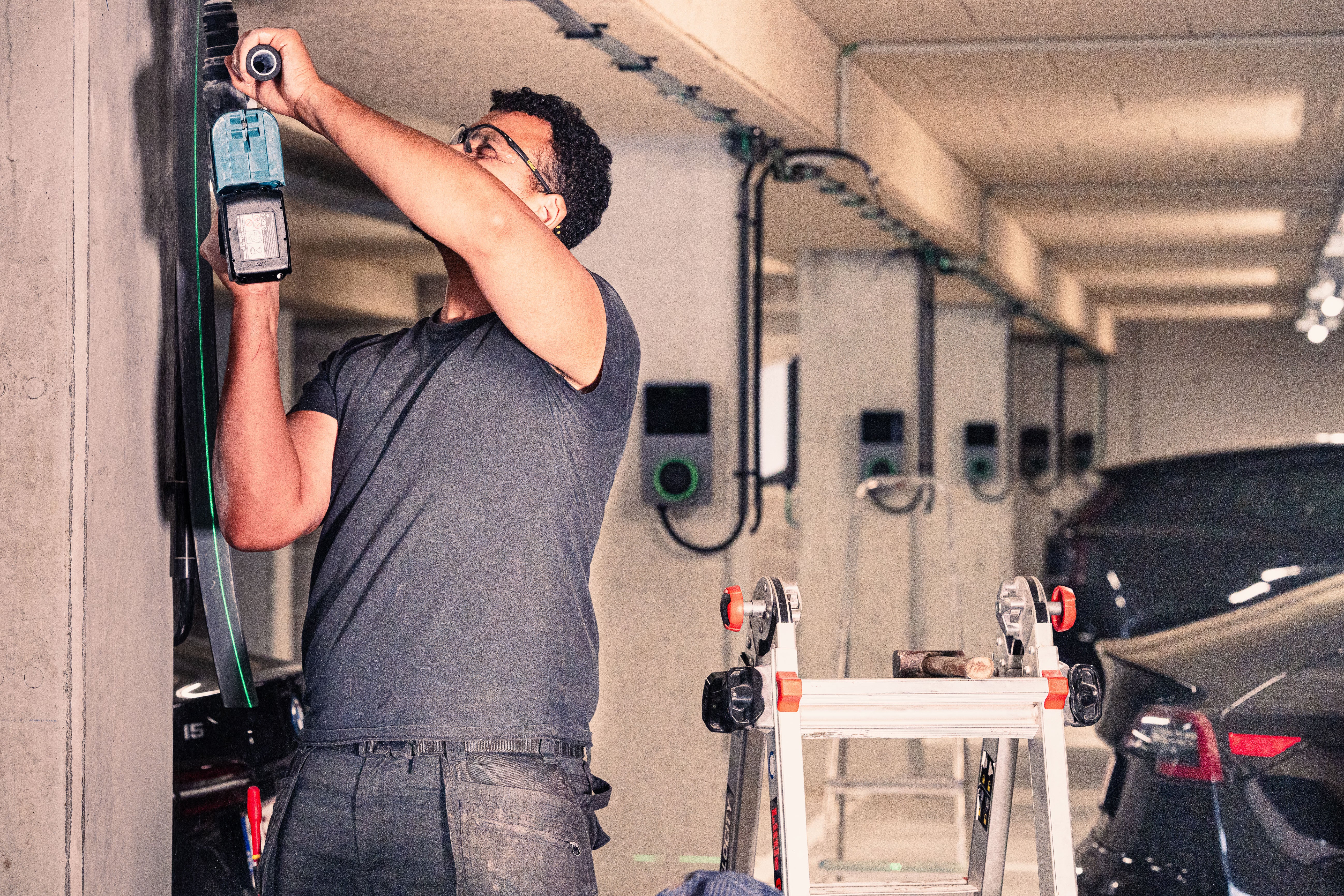


The switch to electric mobility is completely changing the way Belgian companies operate. Reliable bornes voitures électriques (Electric charging stations) are no longer a nice-to-have, but a strategic necessity. Now that your corporate fleets and your employees' cars are going electric, a well-thought-out charging infrastructure is essential to make the transition smooth and affordable.
Why Your Company Needs an Electric Charging Strategy
The electric revolution isn't coming — it is already here and is transforming Belgian roads and, by extension, company car parks. For business leaders, the question has quickly shifted from or you need to install charging stations to how and when. If you wait too long, you risk disrupting your operational activities, falling behind the competition, and missing out on very attractive financial benefits.
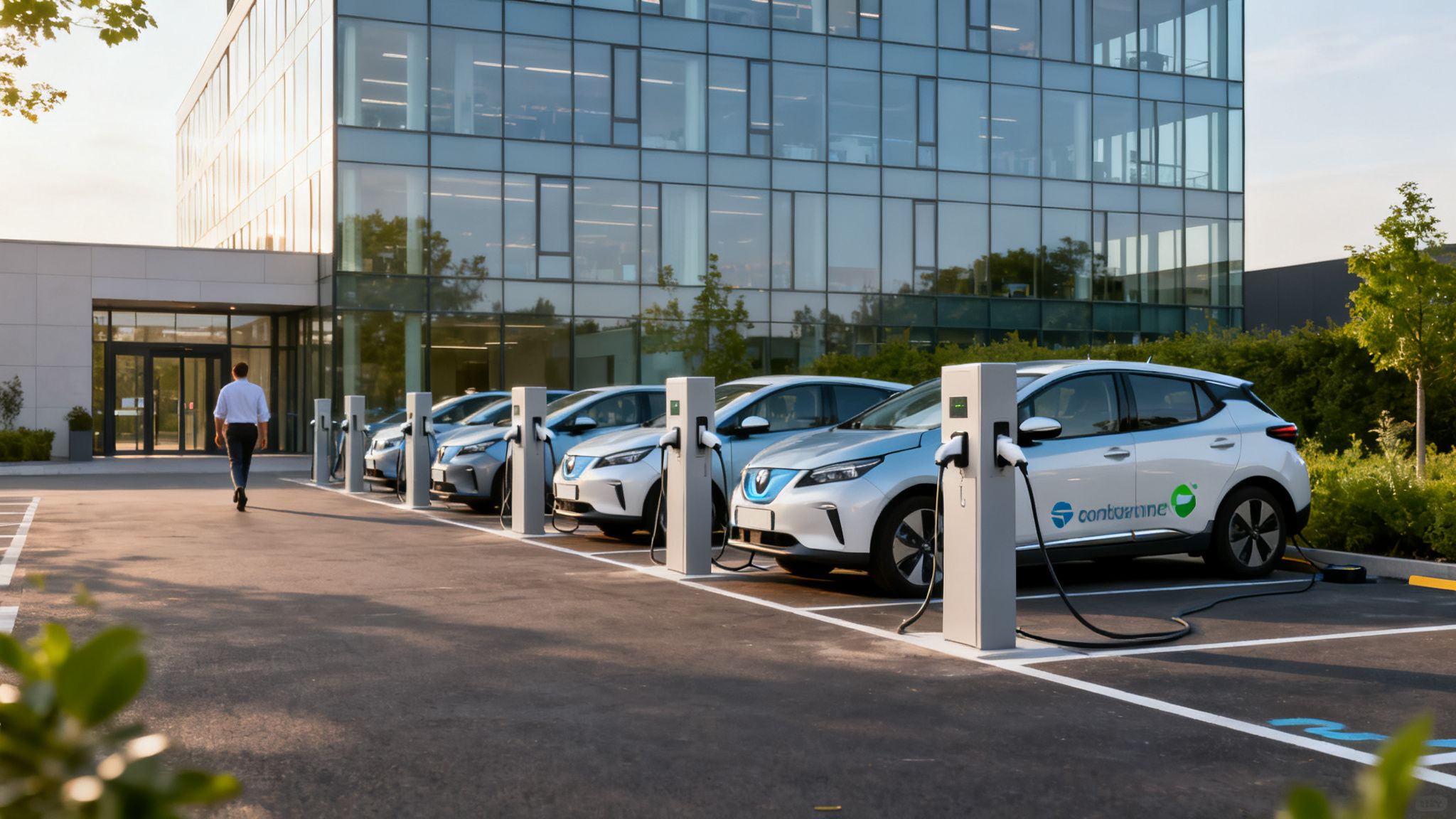
You see this rapid shift in vehicle adoption figures. The number of fully electric vehicles (BEVs) in Belgium rose to approximately 190,000 in 2023. That is a staggering increase of 111% compared to the 90,000 on the road in 2022. This explosive growth means that the demand for accessible charging points will only increase. For more insights, you can explore Mordor Intelligence's analysis of the Belgian EV charging market.
Your Complete Guide to Electric Charging
The world of commercial electric charging can seem a bit overwhelming at first. That is why we have compiled this guide — to offer you a clear and simple step-by-step plan. Consider us your expert partner, here to explain everything you need to know to prepare your business for the future.
In this guide, we build your knowledge of the basics and cover all the important topics:
- The Technical Basis: We unravel the core concepts, such as the crucial differences between AC and DC charging and what that means for you in practice.
- The Execution: From the initial site inspection to smart energy management, we guide you through the entire implementation process.
- The Financial Side: We examine various commercial models, such as directly purchasing your chargers versus a Charging-as-a-Service (CaaS) subscription, and help you calculate your potential return on investment.
- Regulations and Subsidies: You will gain a clear understanding of the specific Belgian regulations, tax deductions, and subsidies available to make your project more affordable.
By the time you have gone through this guide, you will have a clear and actionable plan to implement a successful charging solution that perfectly aligns with the unique needs of your business, your fleet, and your people.
Let's start at the beginning and explore the fundamental technologies that the world of bornes voitures électriques power
Understanding the Basics: AC and DC Charging
Not all charging stations are created equal, and knowing the difference is the first step towards a smart EV strategy for your business. The technology behind bornes voitures électriques It may sound complex, but it comes down to two types of electric current: alternating current (AC) and direct current (DC).
Each has its own application, and the right choice for you depends entirely on how your vehicles are used on a daily basis. Think of it like filling a water tank: AC is the steady, reliable tap, while DC is the high-pressure fire hose. One is not necessarily better than the other; they are designed for different purposes.
Making the right choice ensures that your charging setup is cost-effective, efficient, and perfectly aligned with your operational rhythm. Let's take a look at what this means specifically for your workplace, fleet, or commercial real estate.
The Workhorse for Everyday Use: AC Charging
AC charging is the most common and budget-friendly option, making it the standard choice for homes and many businesses. When you connect an electric car to an AC charger, the car's built-in inverter uses the alternating current from the grid and converts it into direct current to charge the battery.
This conversion process in the car is the main reason why AC charging is slower. But "slower" is relative. For a large number of operating scenarios, AC charging is not only sufficient, but even the ideal choice.
- Night Charging for Fleets: Imagine a logistics company with a fleet of 20 electric delivery vans. They return to the depot every evening and have 8-10 an hour. AC chargers get the job done effortlessly, making fast DC chargers an unnecessary expense.
- Loading for Employees at Work: For staff parking for a full workday, an AC charger offers more than enough time to charge the battery. This simple addition transforms your parking lot into a valuable business asset and a fantastic benefit for employees.
- Hotels and Hospitality: Guests staying overnight can plug in their car and wake up to a fully charged vehicle, ready for the next leg of their journey. A standard AC station is perfect for this type of long-term charging.
When Speed Is Everything: DC Fast Charging
DC charging, often referred to as "fast charging" or "rapid charging," is a completely different beast. It sends direct current directly to the vehicle's battery, completely bypassing the car's smaller, internal inverter. The heavy conversion from AC to DC takes place in the much larger and more powerful charging station itself.
This direct approach yields a huge speed gain. That speed comes with a higher price tag for both the hardware and the installation, but for some business models, it is indispensable.
Sector analyses show that, although AC charging more than 80% of daily charging needs covers, strategically placed DC fast chargers make long-distance travel and heavily used commercial fleets truly feasible. They are the key to eliminating charging anxiety for good.
This is where DC technology proves its worth. A taxi company or a last-mile delivery service cannot afford to leave vehicles standing idle for hours. 150kW DC fast charger can in less than 30 minutes adding hundreds of kilometers of range, keeping the fleet on the road and productive. Public charging hubs along major highways also rely on DC chargers to get drivers back on the road quickly.
Understanding Power Levels and Connectors
In addition to AC/DC separation, the power level — measured in kilowatts (kW) — determines the actual charging speed. The range is quite extensive.
| Charger Type | Typical Power Levels | Typical Use Case |
|---|---|---|
| AC | 11kW - 22kW | Workplace, fleet depot, home, hotels |
| DC | 50kW - 350kW+ | Public charging hubs, high-throughput fleet operations |
The good news? In Belgium and throughout Europe, connector standards have made it simple. The Type 2The -connector is the universal standard for AC charging. For DC fast charging, the standard is the Combined Charging System (CCS), that cleverly adds two large DC pins just below the Type 2 connector. This means that virtually every modern EV can use the infrastructure you decide to install.
Your Installation Plans: From Site Inspection to Commissioning
Installing charging stations is more than just attaching some hardware to the wall. A successful, cost-effective installation begins long before a single tool is picked up. Consider this section your practical guide to a smooth installation, starting with the all-important first step: a thorough site inspection.
Good planning for your bornes voitures électriques ensures that you get a solution that works today and can grow with you tomorrow. It is all about understanding the unique electrical landscape of your premises to avoid costly surprises and build a charging network that is both efficient and reliable. At Blulinc, this is exactly where every project begins.
The Basics: Your Site Inspection
Before we even consider which charger to choose, we conduct a detailed evaluation of your location. This serves as a health check for your building's electrical system, helping us understand the capacity, limits, and capabilities.
Our inspection focuses on a few core areas:
- Electrical Capacity: We carefully inspect your main connection and fuse box to determine how much power is actually available for charging stations without disrupting your daily business operations.
- Optimal Locations: We look for the most practical locations for the chargers. This means taking into account factors such as the proximity of power sources, the layout of your car park, accessibility, and whether excavation or civil works are required.
- User needs: We find out what you Real needs. Do you charge a small fleet of employees overnight? Or do you need fast chargers for customer vehicles that come and go quickly? The answer to that question determines the entire project.
This in-depth approach helps you avoid the common mistake of installing chargers that your building's infrastructure simply cannot handle. It saves you the shock of expensive and unexpected grid connection upgrades later on. To keep the physical installation phase on schedule, the use of tools such as Exayard construction takeoff software a great way to set budgets and manage resources effectively.
Smart Load Management: Your Electric Air Traffic Controller
One of the most powerful tools in our toolkit is smart load management. Imagine an air traffic controller for your building's electricity; it prevents overloading by intelligently distributing the available power to all connected cars.
This technology is the secret to installing multiple charging stations without having to pay for a huge, costly upgrade to your grid connection. It dynamically balances the electrical load so that every vehicle gets the charge it needs without ever blowing a fuse.
This type of smart distribution becomes essential as the Belgian charging network grows. In August 2024, the country passed the symbolic milestone of 100,000 Publicly accessible charging points — a clear sign of the national commitment to the electrification of the vehicle fleet. All that growth places more pressure on local networks, making smart management at the building level even more crucial.
Here is a simple flowchart showing how AC and DC charging work, which helps plan the right setup for your location.
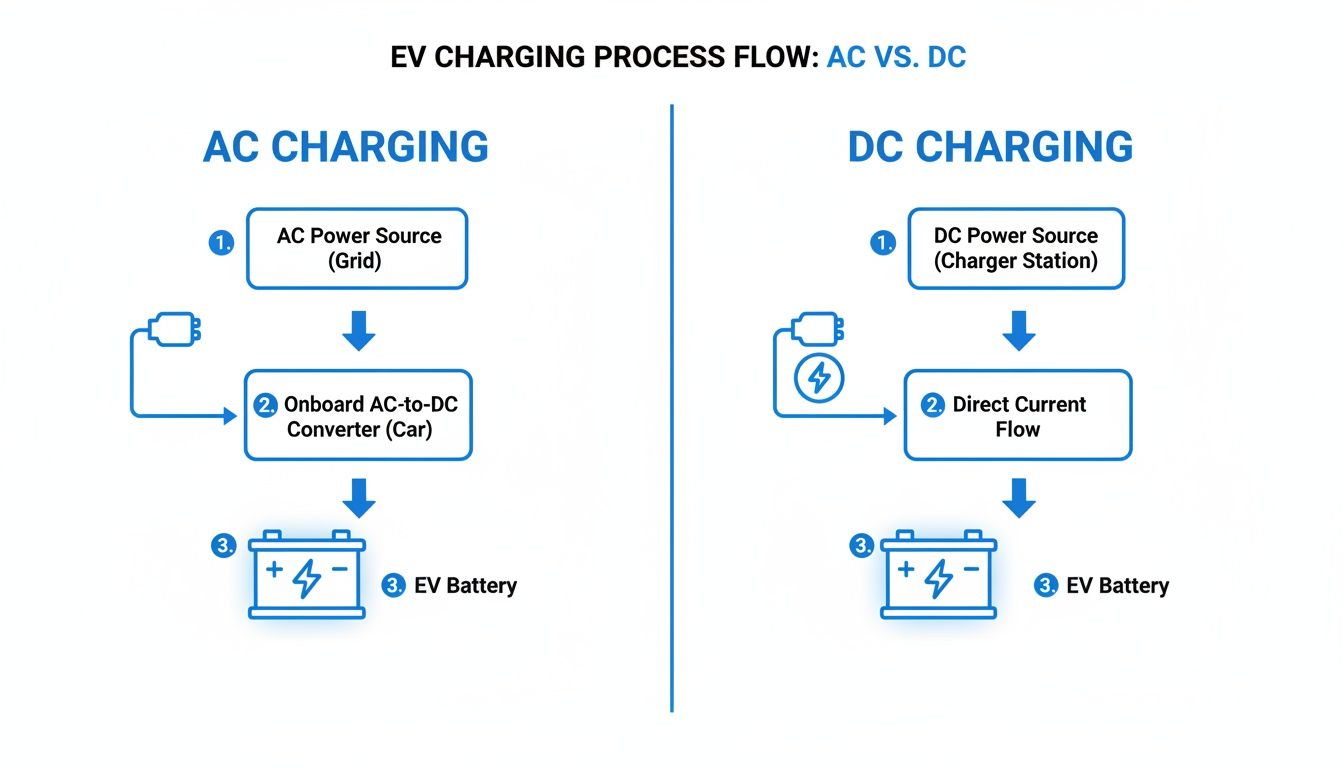
This visualization gets to the heart of the difference: AC charging relies on the car's built-in inverter, while DC charging bypasses it entirely to deliver power directly and much faster.
Let's look at load management in practice. Imagine a company with a fleet of 20 electric vehicles who all need to be ready early in the morning. Without smart management, simultaneously charging all these vehicles would almost certainly overload the building's electrical system. You would be facing a five-figure investment just to upgrade your grid connection.
But with our smart charging platform, we can schedule the cars to charge one after another, or at a lower power level overnight. The system automatically prioritizes the vehicles that need to leave first and even takes advantage of cheaper off-peak electricity rates. The result? All 20 vehicles are fully charged in the morning, your operating costs are significantly lower, and you have avoided a massive capital expenditure. That is the power of a well-planned installation.
Choosing Your Investment Model: CapEx vs. CaaS
Deciding how to finance your charging infrastructure is just as important as choosing the technology itself. As soon as you the physical installation of your bornes voitures électriques Once you have mapped out your strategy, you face an important decision: what is the right investment strategy? This choice will have a direct impact on your company's cash flow, operating costs, and long-term flexibility.
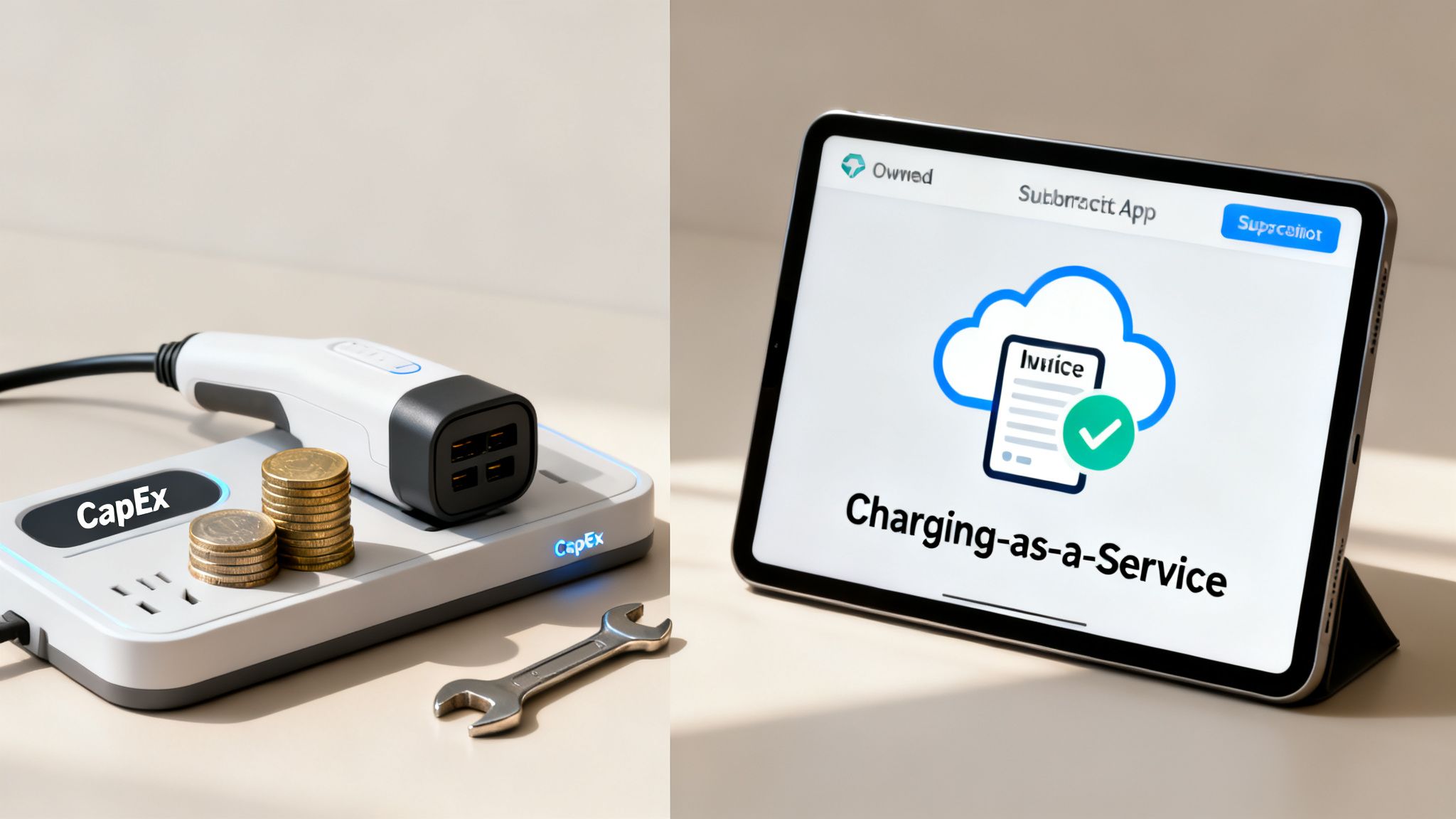
For companies here in Belgium, there are two main routes. You can take the traditional route and buy the hardware directly (CapEx), or you can opt for a more modern, service-based subscription ( )CaaSUnderstanding the differences is the key to a smart financial move that truly aligns with your business objectives.
The Traditional Way: CapEx
CapEx, An abbreviation for Capital Expenditure, is the classic ownership model. You purchase the charging stations, pay for the installation, and own the hardware from day one. This approach can be a good choice for companies that prefer to own their assets and have the capital available for a substantial initial investment.
But full ownership means full responsibility. As soon as the chargers are installed, everything that follows is your responsibility.
This includes:
- Current Maintenance: You are responsible for the maintenance of the loaders, handling repairs, and ensuring that they remain operational.
- Software updates: It is up to you to manage the necessary software updates to keep the stations secure and compatible with new EVs.
- Operational Management: All daily tasks — such as setting usage rates, processing payments, and supporting drivers — fall entirely under your responsibility.
The Flexible Alternative: CaaS
A much more modern approach is CaaS, in other words Charging-as-a-Service. Think of it as the Software-as-a-Service (SaaS) subscriptions you probably already use, but for your charging infrastructure. Instead of a large upfront purchase, you pay a simple, predictable monthly fee.
With a CaaS model from Blulinc, we take care of absolutely everything. The hardware, the installation, the software, ongoing operations, and all maintenance — it is all included. This model completely removes the financial barrier and relieves you of all the operational headaches associated with managing a charging network.
CaaS transforms what would be a capital-intensive project into a manageable operational expense. It frees up your capital for core activities, while still allowing you to offer a first-class charging experience.
Suppose a medium-sized company wants to install ten charging points for its team, but is hesitant due to the initial costs of €50.000+ and the hassle of management. With CaaS, they can have the entire solution installed and managed for a fixed monthly fee, making the project financially accessible and operationally simple from the start.
Comparison of Investment Models: CapEx vs. CaaS
So, which model is right for you? It really depends on your company's financial strategy and how much you want to manage internally. To help you clearly see the difference, this table provides a direct comparison of the two approaches.
| Feature | CapEx (Capital expenditure) | CaaS (Charging-as-a-Service) |
|---|---|---|
| Initial costs | High initial investment in hardware and installation. | Low or no initial costs. |
| Property | You are the full owner of the hardware and infrastructure. | We own and maintain the hardware. |
| Maintenance | Your responsibility, including costs for repairs. | Fully included in the monthly fee. |
| Flexibility | Less flexible; upgrading requires a new capital investment. | Very flexible; easy to scale up or upgrade. |
| Budgeting | Unpredictable maintenance costs can arise at any moment. | Predictable, fixed monthly operating expense (OpEx). |
| Management | Requires internal resources for management and support. | Fully managed by us, leaving your team free. |
Ultimately, the choice between CapEx and CaaS is a strategic decision. If you value asset ownership and have a dedicated facilities team, CapEx can be a good choice. However, if you are looking for financial flexibility, operational simplicity, and a future-proof solution that grows with you, CaaS offers a powerful and accessible way to electrify your business.
Request a free consultation
Navigating Belgian Regulations and Subsidies
A good understanding of the local regulatory landscape is the key to a cost-effective charging project. For every company in Belgium, navigating the rules, tax benefits, and subsidies for bornes voitures électriques significantly reduce total cost of ownership and accelerate your return on investment. This is not just about ticking off compliance requirements; it is a huge financial opportunity.
The Belgian government has taken a number of important measures to help companies with this transition. By utilizing these programs, you can make the installation of smart, connected charging stations a much more attractive proposition for your company, your team, and even your customers. Let’s break down the key available incentives.
Federal Tax Benefits for Businesses
At the federal level, the government has a strong incentive for companies willing to invest in publicly accessible charging infrastructure. If you install intelligent charging stations that are available to the public — at least during your company's opening hours — you may qualify for an increased investment deduction.
This deduction can reduce a significant portion of your taxable income. For charging stations installed before March 31, 2023, the deduction was a huge 200%. For installations completed between April 1, 2023, and August 31, 2024, the rate is 150%. The most important condition is that the stations must be "intelligent," which means that their charging time and capacity can be managed by an energy management system.
This incentive is not only intended to help individual companies. The bigger picture is to rapidly expand Belgium's public charging network, making electric driving more practical for everyone and ensuring that national electrification targets are met.
This federal support makes a real difference to your bottom line. Take, for example, an investment of €50.000 in qualifying public chargers. This can translate into a tax deduction of €75.000, which gives your project's ROI a powerful boost from day one.
Support Your Employees with Home Charging
The support does not stop at company parking. The government also acknowledged that as company fleets turn electric, employees need charging points at home. Owners and tenants who purchased home charging equipment between September 1, 2021, and August 31, 2024, could benefit from tax reductions on investments, which facilitated the installation of private bornes voitures électriques stimulated. For more details about this initiative, you can discover more insights into Belgian support for electric charging at electrive.com.
This is particularly important for companies with electric fleet vehicles. By helping your team install chargers at home, you ensure they start every day with a full battery, which is a major gain for operational efficiency. We can help you manage that entire process, right up to the reimbursement of home charging costs, making it a seamless benefit for your staff.
Regional Initiatives and How to Utilize Them
In addition to the federal programs, the three regions of Belgium have their own specific initiatives. These can vary widely, so it is essential to know what is available locally.
- Flanders: Often focuses on subsidies for public or semi-public charging points, to support companies that open up their infrastructure to the local community.
- Wallonia: Typically provides support targeted at SMEs and specific sectors to encourage the adoption of green technologies, including electric charging.
- Brussels-Capital Region: Has incentives aimed at improving air quality, often by providing subsidies to companies that switch their vehicle fleet to electric and install the necessary charging infrastructure.
Figuring out all these different schemes can be a headache, but we are here to help you identify and apply for every benefit you are entitled to. By combining federal tax deductions with regional subsidies, you can maximize your savings and build an irrefutable business case for electrification. For a deeper dive into the tax side of things, you might be interested in learn more about the tax deductibility of charging stations in our detailed article.
Ready to electrify your business and fully benefit from these financial advantages?
Request a free consultation
Your Step-by-Step Plan to a Smart Charging Solution
Where are you going next? We have covered a lot of ground, from the technical details and planning of a solid installation to the various financial models and the fine print of Belgian regulations. What might have seemed like a complex challenge should now feel like a clear and manageable process.
The journey from the initial idea to a fully operational, intelligent charging network is actually quite simple if you break it down. The real key is to move from broad ideas to specific actions that align with what your business actually needs — whether you are powering a commercial fleet, offering a benefit to your employees, or attracting new customers.
Your Concrete Step-by-Step Plan
To help you move forward with confidence, we have summarized the entire process into four essential next steps. Consider this your roadmap to tackle the project properly from the start.
-
Define Your Charging Needs: First and foremost, who are these chargers intended for? Do you primarily serve a fleet of delivery vans that charge at night? Employees who park all day? Or visitors who only need a quick charge? Your answer to this will guide every other decision you make.
-
Assess the Power Capacity of your Location: Next, you need a clear picture of your electrical capacity. A professional site inspection is not just a good idea; it is indispensable. It will tell you what your current grid connection can handle and indicate whether you need smart solutions such as dynamic load management. You might be interested in to learn how load balancing for your charging station can prevent costly grid upgrades in our special article.
-
Choose Your Investment Model: How would you like to handle the finances? You can purchase the hardware directly with a CapEx-investment. Or perhaps the flexibility and low initial cost of a CaaS (Charging-as-a-Service)-subscription better suits your budget and the way you want to operate.
-
Work Together with an Expert: Finally, you don't have to figure all this out on your own.Collaborating with an experienced e-mobility specialist like Blulinc means you receive expert guidance at every stage — from the initial site inspection and navigating subsidies to handling ongoing maintenance and operations.
A successful EV charging strategy is more than just hardware; it is a seamlessly integrated service that supports your business objectives, strengthens your brand, and delivers a reliable experience for every driver.
By following this step-by-step plan, you ensure that you are not simply installing a charging station, but building a future-proof asset. By taking the time to carefully consider each step, you end up with a solution that is efficient, cost-effective, and perfectly tailored to your needs.
Ready to take the first step and electrify your business?
Request a free, no-obligation consultation with our e-mobility experts today to start your project.
Frequently Asked Questions, Answered
Are you considering bornes voitures électriques to install at your company? You are not alone. We receive many good questions from Belgian companies taking the step towards e-mobility, so we have collected the most common ones here to provide you with some clarity.
How Long Does It Take to Install Our Commercial Charging Stations?
To be honest, it depends on the project. A simple installation where your location already has sufficient electrical capacity can go surprisingly fast — we can be finished within a few days.
However, larger projects require more time. If we need to upgrade your grid connection, dig trenches for new cabling, or carry out other earthworks, planning can take several weeks or even a few months. The good news is that our initial site inspection is designed to map all of this out in advance, so you receive a realistic schedule from the start. No surprises.
Can We Set Different Charging Rates for Different People?
Absolutely. This is one of the best aspects of a smart charging network. With a modern management platform, you have full control over pricing. We can help you set up specific user groups — think employees, visitors, and the general public — and assign each group its own unique rate.
This opens up many possibilities. For example, you can offer:
- Free loading for your employees as a fantastic benefit.
- A standard price per kWh for customers or visitors.
- Time-based rates (such as higher rates during peak hours) to encourage people to charge when electricity is cheaper.
What Happens if a Charging Station Becomes Defective?
Keeping your chargers operational is our top priority. We have built our entire service around maximizing uptime so that you don't have to worry about it. If you choose our Charging-as-a-Service (CaaS) model, all operations and maintenance are included in your plan. It is completely worry-free for you.
Our platform monitors your stations 24/7. As soon as it detects a problem, our technical team receives a notification. Many software issues can be resolved remotely within minutes. If a physical repair is required, we immediately send a qualified technician to your location to bring the station back online.
Do I Need a Permit to Install Chargers in Belgium?
That really depends on the scale and location of your project.For a simple setup at a workplace on private property, you may not need a specific permit, but the work must always comply with strict electrical safety standards.
You are more likely to require a permit for publicly accessible chargers, installations requiring extensive excavation, or any project that requires a major upgrade to your grid connection. This is another area where we take the lead. Our site evaluation covers all permitting requirements, ensuring your project is fully compliant with all local and national regulations from day one.
Ready to get clear answers for your specific project? The team at Blulinc is ready to help you plan your ideal charging solution. Request a free consultation today with our e-mobility experts.