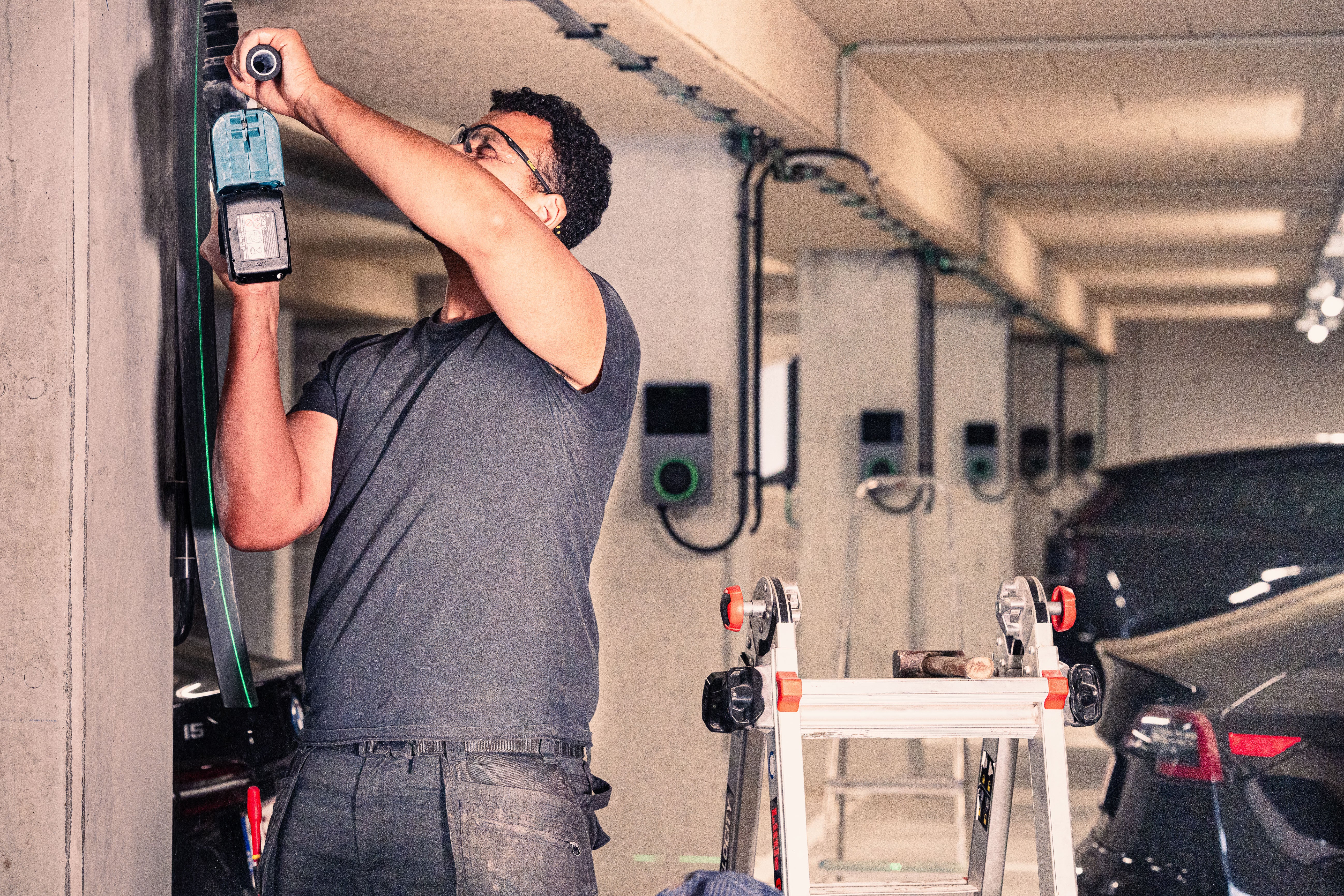


Charging your electric car at home is by far the most cost-effective and reliable A way to start every day with a full battery. The convenience is incomparable to public charging and gives you complete control over when you charge and what you pay.
Why charging your car at home is the norm in Belgium
The switch to electric driving is gaining momentum. Both private individuals and fleet managers are discovering the benefits, but the transition also raises a crucial question: where do you charge that car? Although the network of public charging points in Belgium continues to grow, nothing can match the simplicity and certainty of having your own charging point.

Your charging car at home is more than a luxury; it is the cornerstone of an efficient, stress-free EV experience. You are no longer dependent on available public charging stations, fluctuating rates, or the fear of a dead battery.
The undeniable benefits of having your own charging point
Why do most EV drivers opt for a home installation? The reasons are clear and practical:
- Unrivaled convenience: You get home, plug in the car, and the next morning you start with a fully charged battery. No detours to a charging station, no waiting times.
- Significant cost savings: Home charging is significantly cheaper. You pay the rate of your own energy supplier, which is typically much lower than commercial rates at public charging stations, to which start-up, time, and occupancy costs are often added.
- Complete reliability: Your own charging point is always available. You never have to worry about a defective or occupied public charging station – essential for those who rely on their car daily.
- Safety and efficiency: A professionally installed charging station is the safest way to charge your car. It is specifically designed for the high current load over extended periods, unlike a standard socket that can overheat and up to 30% more energy loss can lead.
Imagine this: a consultant in Flemish Brabant drives to clients daily. With a home charging point, he is guaranteed to start every day with a range of 400 km. Without this charging point, he would lose hours every week searching for and waiting at public chargers, which has a direct impact on his productivity and peace of mind.
In short, a home charging point transforms owning an electric car from a logistical challenge into a seamless part of your daily routine. It offers the certainty and comfort needed to fully enjoy electric driving. At Blulinc, we guide you through every step to realize this solution.
Choosing the right home charger for your EV and lifestyle
Choosing a charging point can seem overwhelming with all the technical specifications. At Blulinc, we are happy to help you see the wood for the trees and focus on what really matters for your car, your home, and your habits. The right choice depends on three factors: your car's charging speed, how much you drive daily, and the electrical connection at your home.
Electric driving is clearly on the rise. 'Charging your car at home' has become the most normal thing in the world for many. By now, has 23% of Belgian households an electrified vehicle, of which 9% are fully electric. That is a substantial increase of 7 percentage points since the beginning of this year. You can find more insights of this kind regarding the Belgian fleet at Next Mobility.
Finding the right load capacity
The charging capacity, expressed in kilowatts (kW), determines how fast your car charges.For home use, the most common power outputs are 7.4 kW, 11 kW, and 22 kW. But what does that mean in concrete terms?
- 7.4 kW (single-phase): A great starting point for most plug-in hybrids and many fully electric cars that charge on a single phase. Ideal if you mainly charge at night and do not cover hundreds of kilometers during the day.
- 11 kW (three-phase): This is the most popular choice in Belgium for fully electric drivers. An 11 kW charger requires a three-phase connection but fully charges an average EV in 6 to 8 hours. Perfect for plugging in overnight.
- 22 kW (three-phase): The fastest option, but far from all cars can handle this power. Moreover, it requires a heavier and more expensive grid connection. This is particularly interesting if you have a car with a very large battery or often need to be able to recharge quickly.
A practical example: a family in Antwerp with two electric cars. One is used daily for a 50 km commute, the other mainly for longer trips on weekends. Here, an 11 kW charger is perfect. With it, they can charge both cars one after the other overnight, without overloading the electrical system.
Smart charging stations versus standard chargers
A modern charging station is much more than a glorified power outlet. The big difference lies in the 'intelligence'. A standard charger does only one thing: supply power. A smart charger, on the other hand, opens up a world of possibilities that save you money and make life easier.
The most important function is Dynamic Load Balancing. This sounds technical, but it is brilliant in its simplicity. The system constantly measures how much power is being consumed in the house. Do you turn on the oven or the washing machine? Then the charging station automatically reduces the charging speed to prevent the fuses from blowing. As soon as power is available again, the charging speed increases. In a modern household, this is indispensable.
Additionally, with a smart charger you can:
- Schedule charging sessions to take advantage of cheaper night rates.
- Track your consumption down to the kilowatt-hour via an app.
- Connect your charging station to your solar panels to charge using free, self-generated electricity.
- Arrange automatic reimbursements for employees who charge their company car at home.
Choosing a smart charger is not a luxury, but a sensible investment that quickly pays for itself through a lower energy bill and safer use.
Below you will find a comparison of the most common load capacities, so that you get a better idea of what suits you.
Comparison of home charging capacities
| Load capacity | Connection | Estimated charging time (60 kWh) | Ideal for |
|---|---|---|---|
| 7.4 kW | 1-phase | 8-9 hours | Plug-in hybrids and EV drivers with a short daily commute who charge at night. |
| 11 kW | 3-phase | 5-6 hours | Most fully electric cars, ideal for overnight charging of the family car. |
| 22 kW | 3-phase | 2.5-3 hours | EVs with a large battery and drivers who need to be able to recharge quickly. |
As you can see, is 11 kW often the 'sweet spot' for most fully electric family cars, while 7.4 kW Perfectly sufficient for those who drive fewer kilometers or have a plug-in hybrid. The choice therefore really depends on your personal situation.
From choosing a charging station to installation: a smooth home experience
You have made the decision and chosen the perfect charger. Great! But the right charger is only half the story. Correct installation is at least as important to safely and efficiently charge your to charge car at home. With the right guidance, this process is surprisingly simple.
The key to a worry-free installation is thorough preparation and, crucially, collaboration with a certified installer. This guarantees not only that everything complies with strict Belgian legislation, but also that your charging point is perfectly matched to the capacity of your home and the needs of your car.
This infographic provides a clear overview of the key steps in choosing the right charging station.

As you can see, it always starts with a thorough analysis of your home situation. This is followed by the selection of the right capacity and the type of charger that seamlessly fits your lifestyle.
The essential electrical inspection and preparation
Before even a single cable is pulled, an analysis of your existing electrical installation is an absolute must. A certified installer, such as the partners Blulinc works with, therefore first performs a technical inspection out. Simply put: we take a thorough look at your fuse box.
During this inspection, we seek answers to several crucial questions:
- Can your grid connection handle it? The installer checks whether you have a single-phase or three-phase connection and what the maximum power is. This determines whether a powerful 11 kW or 22 kW charger is an option at all.
- Is a separate circuit needed? The answer is always yes. By law, a charging point must be connected to a separate, specifically protected circuit. This prevents overloading of your home network.
- Does the differential protection comply? For charging an EV, a specific residual current device (Type A with 6mA DC leakage protection or a Type B) is mandatory. This protects against direct current leakage, a risk unique to EV chargers.
- Where will the charging station be located? The installer assesses the best physical location and plans the most efficient route for the cabling from the meter cupboard to your driveway or garage.
Especially in older homes, there is a real chance that the fuse box requires modification or expansion. Although this might feel like an extra cost, it is a indispensable investment in safety of your home and family.
The role of a certified installer
In Belgium, the law is clear: the installation of a charging point may only be carried out by a certified electrician. This is not an unnecessary luxury, but a legal requirement that guarantees your safety. After all, the installation must comply with the General Regulations on Electrical Installations (AREI).
Once installed, an official inspection by a recognized body is mandatory. Without this inspection certificate, you may not use the charging point and, moreover, your fire insurance will not be in order. A professional partner like Blulinc coordinates this entire process for you, from A to Z.
A professional takes care of more than just the physical installation. They also handle the configuration of the charging station, including setting up smart features such as load balancing. This ensures that you can charge optimally and safely from day one, without worrying about spikes in your power consumption.
At Blulinc, we take these worries completely off your hands.We work with a network of certified installers who manage every step of the process: from the initial inspection to the final certification and commissioning. This ensures you have an installation that not only works perfectly today but is also fully ready for the future of electric driving.
Smart charging to optimize your energy costs
A modern home charging station is much more than a socket; it is a smart device that actively thinks along with you to significantly reduce your energy bill. The term 'smart charging' refers to technologies that ensure your charging car at home becomes not only safer, but also significantly cheaper. Here, your charging point becomes a strategic investment.

At its core, smart charging is about aligning your charging sessions with the lowest electricity rates and the available capacity of your grid connection. Instead of charging at full power immediately as soon as you plug in, a smart charger analyzes the situation and makes the best decision for your wallet and your home.
Protect your home with Dynamic Load Balancing
One of the most essential functions of every smart charger is Dynamic Load Balancing. This smart system prevents your home's electrical installation from becoming overloaded. It continuously measures the total power consumption in your home. If you start cooking while the washing machine is running, the charger detects this consumption peak and temporarily reduces the car's charging speed.
As soon as power is available again, the charger automatically increases the speed. This creates a perfect balance, prevents your fuses from blowing, and ensures that you can often avoid an expensive upgrade to your grid connection.
Scheduled charging at the lowest rates
Another major advantage is scheduling your charging sessions. Many energy suppliers in Belgium offer cheaper off-peak or night rates. With a smart charger, you can easily set charging to start only when these lower rates take effect, for example after 10:00 PM.
Suppose you drive 20,000 km per year with an EV that consumes approximately 18 kWh per 100 km. Your total annual charging requirement is 3,600 kWh. If the difference between your day and night rate is only € 0,10 amounts to per kWh, you save every year by consistently charging during off-peak hours € 360.
You can easily manage all of this via an app on your smartphone, giving you complete control over when and how your car charges. You can also set a goal, such as having the battery at 80% by 7:00 AM, so that you always leave with sufficient range.
Optimal use of your solar panels
Do you have solar panels? Then a smart charger will be a financial hit. By connecting the charger to your solar panel installation, you can charge your car with 100% free, self-generated energy. The smart charger knows when your panels produce more power than your home consumes and sends this surplus directly to your car instead of sending it back to the grid.
This is not only good for your bank account, but also maximizes the return on your investment in solar panels. Your digital meter and the P1 port play a key role in this. You can read more about activating and using them in our guide on the P1 port and your smart meter.
Seamless refund for company cars
For employees with a company car, smart charging offers an elegant solution to an administrative headache: the reimbursement of home charging costs.The Blulinc platform registers every kWh charged at home and arranges an automatic, tax-compliant reimbursement by the employer.
This process, often split-billing as mentioned, eliminates all the hassle. The employee does not have to submit expense reports, and the employer receives one clear, consolidated invoice. This type of efficiency is one of the main reasons why the focus in Belgium is shifting from simply installing charging points to creating smart, integrated solutions for both home and office.
Costs and financial benefits in Belgium
Investing in a home charging station for your electric car is a wise move, but what is the price tag? A clear picture of the total investment is the first step. When you decide your to charge car at home, The final invoice includes more than just the price of the charger. It is a combination of the hardware, the professional installation, and the mandatory inspection.
The good news is that both the federal government and the regions want to encourage the switch. They have introduced a series of financial incentives to significantly reduce your initial investment, making electric driving a more realistic option for families and businesses. Let's look at the specific costs and the available support.
The Belgian EV market is booming, with 29% of new cars which are now fully electric. This shift relies heavily on home charging. Although the public charging network is improving, nothing is as convenient as charging at home, which explains why 61% of drivers sees this as their preferred method. You can dig deeper into the Belgian EV market and infrastructure over on RetailSonar.
What is the realistic price of a home installation?
For a complete, certified home charging installation, you should expect a budget between € 1.500 and € 2.500. This amount includes various crucial components that guarantee your installation is safe, legal, and ready for use.
Here is a general overview of what that price range covers:
- The charging station: The price can vary depending on the brand, the power (such as 11 kW vs. 22 kW) and whether you choose a standard unit or a smart charger with more features.
- Professional installation: These are the costs for a certified electrician, including running the necessary cabling from your main panel to the desired location of the charger.
- Mandatory electrical inspection: Once everything is installed, an independent body must approve the installation in accordance with the AREI standards. This is non-negotiable.
- Essential materials: This includes all materials required for a safe installation, such as the correct cables, residual current devices, and other legally required safeguards.
Please note that factors such as the distance between your charger and your meter box or the need for a major modification to your electrical panel can affect the final cost.
Tax benefits for individuals and businesses
To the deal for charging car at home To make it even more attractive, the Belgian government has provided interesting tax benefits.
For private individuals, there is a federal tax reduction on the purchase and installation of a new, smart home charging station. Until August 31, 2024 can you get a tax reduction of 30% claim on your investment, with a maximum of € 1.750 per charging point.After that date, the reduction drops to 15%. The most important condition is that the charger must be 'smart' – which means it can manage charging times and power – and that it must run on green power.
For companies and self-employed individuals, the incentive is even greater. Investments in publicly accessible charging points are available until the end of August 2024 for 150% tax deductible. This makes installing chargers on your company premises not only a convenient service for staff and visitors, but also a fiscally smart move.
Regional premiums and support
In addition to federal tax benefits, some regions offer their own support, although these schemes may change. In Flanders, for example, there have been premiums for companies installing semi-public charging infrastructure. It is always a good idea to consult the latest information from regional agencies such as the Flemish Energy and Climate Agency (VEKA) or their counterparts in Wallonia and Brussels to see which subsidies are currently available.
A good understanding of these financial mechanisms is essential to determine your total cost of ownership (TCO). When you combine government support with the lower operating costs of an EV, you will often find that the initial investment pays for itself faster than you might think. For a more detailed look at how various pricing elements play a role, check out our guide on the understanding the CREG tariff for charging stations.
Your partner for effortless charging solutions
You now know the steps, costs, and benefits involved in charging your car at home. But how do you turn all of that into a smooth, worry-free experience? That is exactly where Blulinc makes the difference. We view a charging point not just as a product, but as the starting point of a lasting relationship, built on expertise, service, and pure ease of use.
From the initial consultation to the daily operation of your charging solution, we stand by your side. Our goal is simple: to completely simplify the entire process for you – from selecting the right hardware and arranging the installation to daily management. We remove the technical complexity so that you can focus on what really matters: worry-free electric driving.
Complete solutions for businesses and private individuals
For companies taking the leap to an electric fleet, the initial investment in charging infrastructure is often a significant hurdle. That is precisely why we have Charging-as-a-Service (CaaS) model developed. With this approach, we bear the entire investment for the hardware and installation. You pay only a fixed monthly amount and enjoy an all-in service, including maintenance and support.
Consider, for example, an SME in Ghent with 10 company cars. Instead of allocating a large capital sum for 10 home charging points, we handle all installations via our CaaS model without any upfront cost. The monthly fee covers everything, from installation to automatic refunds. This completely eliminates the financial and administrative burden.
One app and charging card for all of Europe
Convenience, of course, doesn't stop at your front door. Although you will usually charge at home, you also want to be able to count on a reliable network while on the road. With the Blulinc app and charging card you get seamless access to one of the largest public charging networks in all of Europe.
What does that mean for you?
- Complete freedom: Find and activate more than 900,000 charging points throughout Europe.
- Transparent management: Track your charging sessions, manage your costs, and view your history, all in one clear app.
- Easy payment: No more hassle with a wallet full of cards or different apps and payment methods. One card, one invoice.
Whether you are a private individual looking for a smart, future-proof charging station or a fleet manager needing a scalable solution, Blulinc offers the expertise and tools to make your transition to electric driving effortless.
Ready to put together your perfect charging solution? Request a no-obligation consultation today and discover what Blulinc can do for you.
Questions about charging at home? Here are the answers.
When you are considering installing a home charging point, questions will undoubtedly arise. That is perfectly normal. We often hear the same questions from people making the switch to electric driving, so we have listed the most important answers for you here.
Can I just charge my car using a standard wall socket?
Technically it is possible, but it is a very bad idea for daily use. Consider it a stopgap measure. Using a standard socket is agonizingly slow – count on more than 24 hours for a full battery in most cars.
However, the biggest problem is safety. Household sockets are not designed to withstand such an intense and continuous current load for hours on end. This creates a serious risk of overheating, which can lead to fire. A correctly installed, dedicated charging point is always the smarter, safer, and faster choice.
What are the realistic costs for installing a home charging point?
In Belgium, you can expect the total costs for a fully installed and certified home charging station to be between € 1.500 and € 2.500 lie.
This is not just for the charger itself. That price typically includes the device, full professional installation by a certified electrician, any necessary modifications to your electrical panel, and the crucial, mandatory safety inspection. The final price may vary somewhat depending on factors such as the charger's power output (for example, an 11 kW model) and the complexity of your home wiring.
Do I need to have my electricity connection upgraded?
Not necessarily, but this is something we check immediately. When our certified installer performs the initial on-site inspection, your existing connection is thoroughly examined.
For a popular 11 kW-charger you need a three-phase connection to utilize the full speed. If your home only has a single-phase connection, you can choose a charger with lower power or consider an upgrade. This is where smart features such as Dynamic Load Balancing become enormously useful. This technology intelligently manages your home's power consumption so that your car does not overload the system, which often saves you an expensive upgrade to your connection.
What if I move?
No problem at all. Your charging station is an asset you can take with you. A certified electrician can safely uninstall the unit in your current home and reinstall it at your new address.
Naturally, a new electrical inspection is required at the new location. This is to guarantee that everything is installed correctly and complies with the strict Belgian safety regulations (AREI). It is a crucial step to ensure that your charging station is safe, compliant, and ready for use, wherever you live.
Ready to make home charging simple and hassle-free? Blulinc offers expert advice and handles everything from start to finish.
Request a free consultation today and let's find the perfect charging solution for you together.